
You built the company as a C corporation because it made sense at the time. Investors liked the structure, your attorney set it up that way, or you wanted a familiar corporate framework. Then profits started showing up, and the tax result felt wrong. The corporation pays tax on earnings, and if you pull money out as a dividend, you can get taxed again personally.
That is the moment many owners start looking seriously at a c corp conversion to s corp.
A conversion can be smart. It can also be expensive if you rush it, miss an eligibility issue, ignore built-in gains exposure, or convert without thinking about what you are giving up. The biggest mistake I see is treating the S election like a form filing exercise. It is not. It is a tax strategy, a governance project, and for some companies, a long-term exit-planning decision.
The standard advice usually stops at pass-through taxation and built-in gains tax. That is not enough anymore. For founders, real estate investors, and businesses with appreciated assets, the better question is not just, “Can we convert?” It is, “Should we convert now, later, or not at all?”
Why Business Owners Convert from C Corp to S Corp
The most common reason is simple. Owners get tired of double taxation.
A profitable C corporation can pay tax at the corporate level. Then the owners may face tax again when profits come out as dividends. For a closely held company, that often feels like the business is being penalized for generating cash.
An S corporation changes that framework. In general, income passes through to the shareholders instead of being taxed first at the corporate level. For many small and mid-sized businesses, that is the core appeal.
This is not a fringe tactic. It reflects a long-running shift in how owners choose to operate. By 2015, there were approximately 4.5 million S corps compared to about 1.6 million C corps, a full reversal from the early period when C corps were far more common, according to Stout’s discussion of IRS Statistics of Income data.
What owners are usually reacting to
Most owners come to this decision after one of these moments:
- Profitability improved: The company finally has consistent earnings, and the tax drag becomes visible.
- Dividend planning looks inefficient: Cash distributions no longer feel tax-smart.
- The shareholder group is tight: A small ownership group often benefits more from pass-through treatment than a company built for multiple funding rounds.
- The business no longer needs the original C corp structure: What made sense at formation may not fit the current phase.
A lot of this comes down to choosing the right legal and tax structure for the business you have now, not the one you imagined at formation. If you are also comparing entity choices in a broader context, this piece on evaluating different business structures is a useful example of how structure decisions affect taxes, administration, and owner flexibility.
Conversion is often about fit, not just tax
Some businesses should stay C corporations. Others benefit from converting as soon as they are eligible. The right answer depends on your earnings pattern, asset profile, ownership mix, and long-term plans.
If you are still comparing options across entity types, this overview of https://alliedtax.com/c-corp-s-corp-or-llc/ can help frame where an S corp fits relative to an LLC or remaining a C corporation.
Practical takeaway: Owners usually do not convert because the form is easy. They convert because the C corp tax result stopped matching how the business operates.
Determining Your Eligibility for S Corp Status
Before filing anything, confirm that the corporation qualifies. Eligibility issues often lead to many failed or delayed elections.

The IRS rules are strict. A company cannot just want S status. It has to meet the requirements under IRC Section 1361.
The hard qualification rules
Start with the basics. The corporation must be a domestic corporation. If it is not domestic, the analysis stops there.
The shareholder count matters too. The corporation must have no more than 100 shareholders, and family members can be counted as one in certain cases. That rule helps some closely held businesses, but owners should not assume family grouping applies without checking how the stock is held.
The next issue is who owns the stock.
Eligible shareholders generally include
- Individuals who are U.S. persons
- Estates
- Certain trusts
Ineligible shareholders generally include
- Nonresident aliens
- Partnerships
- Corporations
One ineligible shareholder can wreck the election. I have seen this happen when a business transferred shares during estate planning, admitted an entity investor, or cleaned up cap table records too late.
One class of stock means more than owners think
A corporation seeking S status can have only one class of stock. That does not mean every shareholder must own the same number of shares. It means the shares must carry identical rights to distribution and liquidation proceeds.
Founders often get tripped up at this point.
A company may believe it has common stock only, but then the shareholder agreement gives one owner special distribution rights, a side letter creates economic preferences, or debt is drafted in a way that looks too much like equity. Those issues can create a second class of stock problem even when the certificate itself says “common.”
Use a real pre-election review
A proper eligibility review is not just a glance at your articles of incorporation. It should include the governing documents and the cap table that reflect real operations.
Check these records together:
| Item to review | What can go wrong |
|---|---|
| Articles and bylaws | Legacy terms conflict with S corp requirements |
| Stock ledger | Issuances or transfers were never properly recorded |
| Shareholder agreements | Side rights create stock-class issues |
| Trust documents | A trust shareholder may not qualify |
| Notes and redemption agreements | Debt may be treated like a second equity class |
Issues that should be fixed before filing
Some eligibility problems are fixable. Some are not, at least not quickly.
- Cap table cleanup: Missing stock records, unsigned transfers, and inherited shares should be resolved before election.
- Trust review: Do not assume a trust shareholder is eligible just because it has held stock for years.
- Investor structure: If a corporation or partnership owns shares, you may need a restructuring before S status is possible.
- Distribution rights: Any arrangement that changes economic rights among shareholders deserves legal review.
The owner test that matters most
Ask one blunt question. If the IRS reviewed your stock ownership and governing documents today, would the answer be clean and immediate?
If not, pause the conversion. The filing itself is easy compared with undoing a defective election.
Tip: Eligibility should be verified from both the tax file and the legal file. Problems often sit in the gap between those two sets of documents.
Owners often focus on tax savings first. The better sequence is eligibility, cleanup, filing, then post-election operations. If you reverse that order, you create unnecessary risk.
The Complete Conversion Process Step-by-Step
Once eligibility is clear, the work becomes procedural. That does not mean it is routine. Timing, signatures, and supporting cleanup matter.
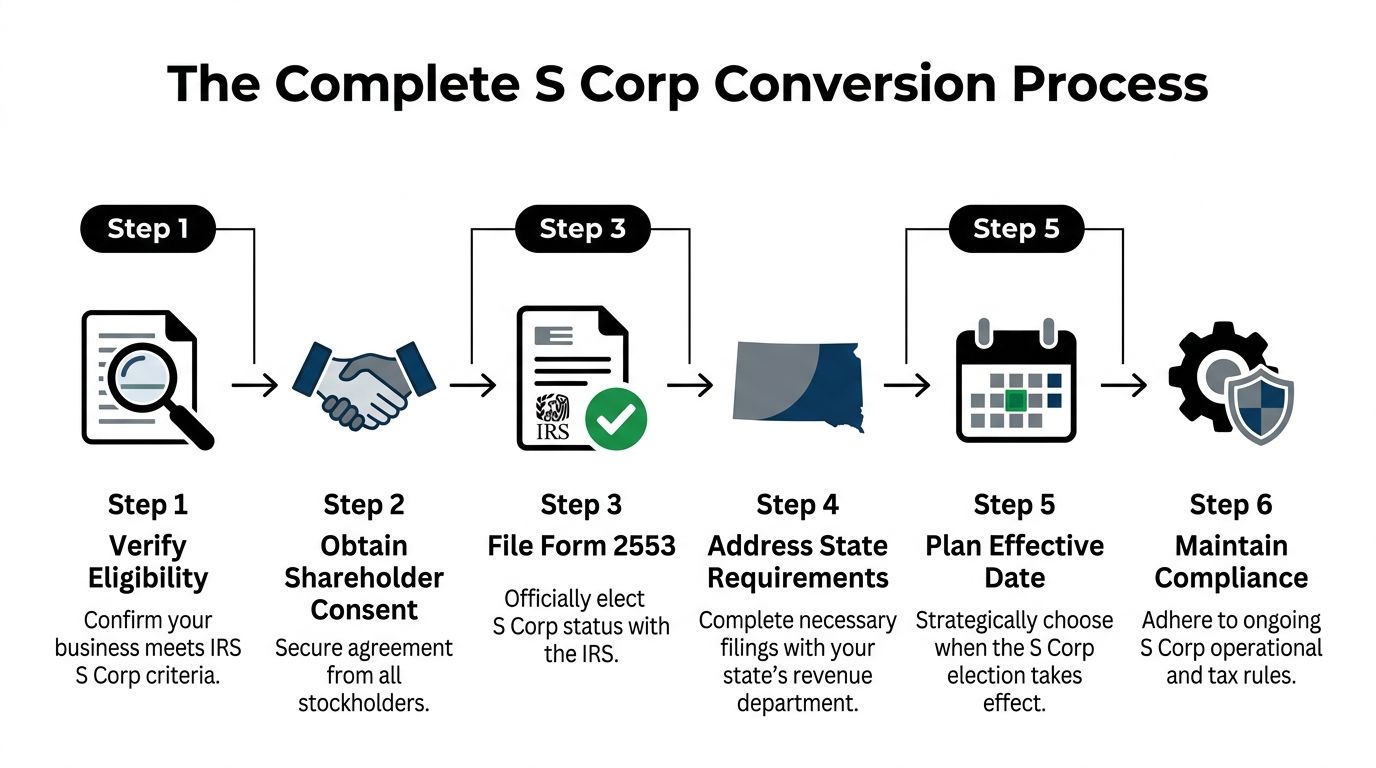
Start with shareholder approval and document review
Do not begin with the tax form. Begin with governance.
All shareholders must consent to the election. If one shareholder refuses, the corporation cannot make a valid S election. That sounds obvious, but I have seen businesses gather signatures late, discover a stale stock transfer, or realize an estate technically owns shares and the wrong person signed.
At this stage, review:
- The stock ledger: Make sure it matches actual ownership.
- Shareholder names and tax identification details: The Form 2553 information must be accurate.
- Board and shareholder records: Keep formal approval in the corporate file.
- Effective date planning: Decide when the S election should begin based on accounting and tax timing.
File Form 2553 correctly and on time
The IRS election is made on Form 2553. For a calendar-year corporation, the form must be filed by March 15 for the election to be effective in the current year. If you miss that date, late-election relief may still be possible, and approximately 70% of late filings seeking relief for reasonable cause succeed according to the ESOP Partners discussion of IRS data, but that route adds uncertainty and extra explanation that proper planning avoids (ESOP Partners).
If you want a practical overview of the election form itself, this guide to https://alliedtax.com/what-is-form-2553/ is a useful reference.
A few filing points matter more than owners expect:
- Every required shareholder signature must be there: Missing signatures are a common avoidable defect.
- The effective date must match your plan: Do not guess. Coordinate the date with the books and tax year.
- Use consistent ownership information: Names, addresses, and tax IDs should match the records.
- Keep proof of filing: Certified mail, fax confirmation, or another reliable submission record belongs in the file.
State treatment can differ from federal treatment
Federal approval does not automatically solve state compliance.
Some states recognize the federal S election automatically. Others require a separate election or additional filing. California is a common example where owners need to think about state treatment directly, including forms such as California Form 3560 where applicable.
That state-level step gets missed often, especially when an owner assumes the CPA filed everything or the incorporation attorney handled it. Neither assumption is safe.
Pre-election cleanup affects the tax outcome
A good c corp conversion to s corp process also includes a balance sheet review before filing. You want to know what tax exposure you are carrying into the new status.
That review usually looks at:
| Review area | Why it matters |
|---|---|
| Appreciated assets | Can create future built-in gains tax exposure |
| Inventory methods | LIFO recapture can create immediate income recognition |
| Earnings and profits history | Affects post-conversion distribution planning |
| Shareholder debt and basis records | Needed for accurate tax reporting after conversion |
The effective date should be strategic
Owners often ask whether they should file immediately. Sometimes yes. Sometimes no.
A rushed effective date can leave you with incomplete records, unresolved shareholder issues, or poor asset documentation. A delayed effective date can make sense if you need time to clean up ownership, finish an appraisal, or coordinate the election with payroll and accounting procedures.
Practical rule: A timely election with a complete file is better than a hurried election that creates cleanup work for years.
What a clean process looks like
A well-run conversion has a certain pattern:
First, the company verifies eligibility and fixes any ownership or stock issues.
Next, all shareholders consent and corporate records are updated.
Then Form 2553 is filed on time with a clear effective date.
After that, state filings are handled, tax attributes are reviewed, and accounting moves to S corporation reporting discipline.
That sequence works because each step supports the next one. What does not work is filing first and asking technical questions later.
Navigating Critical Tax Consequences of Conversion
The filing is the easy part. Planning for the tax consequences is a primary consideration.

Most owners have heard of built-in gains tax. Fewer understand how it works or how to manage around it.
Built-in gains tax is the conversion toll gate
Think of built-in gains tax as the IRS preserving tax on appreciation that happened while the corporation was still a C corporation.
If the company converts and later sells appreciated assets that had built-in gain on the conversion date, the corporation can still face tax on that pre-conversion appreciation during the recognition period. The baseline for that exposure depends on valuing assets at fair market value on the last C corp day, and the built-in gains framework described in the Stout analysis applies within five years post-conversion for those gains if recognized in that window.
That is why appraisals matter. Without a solid valuation baseline, owners have a weak record if the IRS later asks which gain was pre-conversion appreciation and which gain arose afterward.
LIFO recapture can surprise inventory-heavy businesses
If the corporation uses the LIFO inventory method, conversion can trigger LIFO recapture under Section 1363(d). In plain English, the business may have to bring LIFO reserve income into tax as part of the conversion process.
That issue gets overlooked because owners focus on pass-through benefits and miss what the inventory method is doing in the background. Manufacturers, distributors, and product-based companies should review this carefully before the election date is locked in.
AAA matters after the election
Once the company operates as an S corporation, distribution planning changes.
The Accumulated Adjustments Account, or AAA, becomes important because it helps track S corporation earnings that can generally be distributed without being taxed again as dividends, assuming basis and other rules are satisfied. Owners who ignore AAA often create confusion later when taking distributions or explaining tax treatment to shareholders.
A proper S corporation return has to reflect that history accurately. If you want a basic orientation to the return itself, see https://alliedtax.com/what-is-form-1120-s/.
A practical review before conversion
Before finalizing the election, a business owner should sit down with the balance sheet and ask:
- Which assets have appreciated while we were a C corporation
- Do we use LIFO for inventory
- What earnings and profits history are we carrying
- How will we track shareholder basis and post-conversion distributions
These are not academic questions. They determine whether the conversion produces savings or just shifts the timing of a later problem.
Key takeaway: If you cannot explain your asset values and tax attributes on the conversion date, you are not ready to elect S status.
The owners who get the best result usually treat conversion as a valuation and accounting project as much as a tax election.
Advanced Strategies and Optimal Timing for Your Election
The timing of a c corp conversion to s corp can change the economics of the decision.

Most guides stop after warning you about built-in gains tax. That is incomplete. Timing also affects what future benefits you may lose, especially if Qualified Small Business Stock, or QSBS, is part of the long-term plan.
Convert when the numbers are least painful
Earlier conversion can make sense when the corporation has less built-in appreciation, lower earnings and profits complexity, and cleaner records. That does not mean “convert immediately” in every case. It means compare the tax cost of carrying appreciated assets as a C corporation against the tax cost of converting now.
For asset-heavy businesses, lower fair market values on the conversion date can reduce future built-in gains exposure if assets are sold during the recognition period. That is one reason valuation timing matters.
For real estate owners, this analysis can become more nuanced because depreciation and gain characterization need careful tracking. For owners who are also trying to understand how capital gains get reported, the Schedule D Instructions can be a helpful general reference point.
QSBS changes the conversation
Many owners receive bad advice here. They hear “avoid double taxation” and convert without asking whether remaining a C corporation has strategic value.
According to the source provided for this topic, converting to an S corp can forfeit future QSBS eligibility, and the recent enhancements discussed there include a potential gain exclusion of up to $15 million. That makes the conversion decision much more than a current-year tax election. It becomes an exit-planning issue for founders and investors (SDC CPA).
When staying a C corporation may be smarter
An owner should slow down and model both paths if the company has these traits:
- High-growth potential: Future equity value may matter more than current pass-through treatment.
- Planned exit: A stock sale can produce a very different result than annual operating income.
- Outside investors or startup ambitions: The company may need the flexibility and profile of C corp ownership.
- Appreciating assets with uncertain timing: A rushed conversion can preserve less optionality than the owner realizes.
A better strategic question
Do not ask only, “Will S status lower my taxes now?”
Ask this instead. “Does converting now improve my total tax position over the life of the business, including how I expect to sell, recapitalize, or pass it on?”
That is the right framework. The best timing decision often comes from comparing two imperfect options rather than chasing one immediate benefit.
Post-Conversion Compliance and Avoiding Common Pitfalls
A successful election is only the start. Running the company correctly as an S corporation is what protects the benefit.
The most common post-conversion mistakes are not dramatic. They are routine administrative errors that accumulate until they become expensive.
Reasonable compensation is not optional
If you work in the business and take money out, salary has to be addressed seriously.
Owners sometimes convert, stop taking formal wages, and treat most cash as distributions. That is a bad pattern. The IRS expects owner-employees to receive reasonable compensation for services performed. If payroll is too low or nonexistent, the government may recharacterize distributions as wages.
Good practice means documenting how compensation was determined. Use actual job duties, time spent, industry role, and company economics. Do not choose a salary just because it produces the lowest payroll tax.
Tip: If the owner is the engine of the business, a token salary usually does not hold up well.
Basis tracking prevents ugly surprises
S corporation distributions are not automatically tax-free. Their treatment depends heavily on shareholder basis.
That means the corporation and the shareholder both need good records. If basis is not tracked, a distribution that the owner assumed was harmless may become taxable, losses may not be deductible as expected, and year-end reporting turns into reconstruction work.
Watch the operational habits that create technical problems
These issues are common after conversion:
- Commingling funds: Owners pay personal expenses from the business account and blur the record.
- Sloppy stock changes: Shares are transferred informally, often through estate or divorce events, without checking S eligibility.
- Uneven economic arrangements: Side deals with certain shareholders can create stock-class issues.
- Incomplete tax filings: The business treats the S return as a simple form instead of a corporate return that must tie to books, basis, payroll, and distributions.
Compliance is a process, not an annual event
The businesses that stay out of trouble tend to keep a routine:
| Compliance area | Good practice |
|---|---|
| Payroll | Run owner wages through payroll with support for amount |
| Books | Separate distributions, wages, loans, and reimbursements clearly |
| Ownership records | Update stock ledger and review transfers before they happen |
| Tax reporting | Reconcile return figures to internal records and shareholder reporting |
A c corp conversion to s corp works best when the books, payroll, and governance all reflect the new structure. If one of those lags behind, the tax benefit becomes harder to defend.
What does not work
What does not work is operating exactly as before and assuming the election alone changed everything.
It did not. The tax status changed. Your procedures need to change with it.
Frequently Asked Questions About S Corp Conversions
What if I miss the March 15 deadline
You may still be able to request late-election relief if you can show reasonable cause. As noted earlier, late filings seeking relief succeed fairly often, but the process is less clean than filing on time. The better approach is still to plan ahead and submit a complete Form 2553 before the deadline.
Can I switch back to a C corporation later
Yes, a corporation can terminate or revoke S status and become a C corporation again. But that should not be done casually. Changing status can affect tax attributes, future planning, and the ability to make another S election later. This is one of those decisions that should be modeled before action is taken.
What happens to C corporation net operating losses after conversion
C corporation tax attributes do not all transition neatly into the S corporation world. Net operating losses from C corp years need careful review because their treatment after conversion is not the same as carrying them forward as though nothing changed. Owners should get specific advice based on their return history.
Do I need a valuation before converting
If the corporation owns appreciated assets, a valuation is often one of the best defensive steps you can take. It helps establish fair market value on the conversion date and supports later built-in gains analysis.
Is an S election always the best move for a profitable small business
No. It is often attractive, but not automatic. If QSBS planning, investor goals, stock-sale exit potential, or ownership complexity matter, staying a C corporation may still be the better strategic choice.
If you are considering a Allied Tax Advisors review for a c corp conversion to s corp, the smartest next step is a pre-election analysis. That means checking eligibility, reviewing shareholder structure, modeling built-in gains exposure, and weighing whether QSBS or future exit planning should keep you in C corp status. A well-timed conversion can be valuable. A poorly timed one can lock in avoidable tax cost.