
The fundamental difference really boils down to this: An LLC offers simplicity and tax flexibility, which is why it's a go-to for most small businesses. On the flip side, a C Corp provides an investor-ready framework specifically built for raising capital and scaling aggressively. Your choice hinges entirely on whether you value operational ease or are gearing up for future funding rounds.
Making the Right Choice: C Corp or LLC
Deciding on your business structure is one of those foundational moments for any entrepreneur. This single choice impacts everything from your daily operations and how you're taxed to whether you can easily bring on investors down the road. The "C Corp or LLC" debate isn't about which one is universally "better"—it's about finding the perfect fit for your specific vision and business goals.
An LLC, or Limited Liability Company, is a fantastic hybrid structure. It gives you the liability protection you'd get with a corporation but combines it with the simpler pass-through taxation of a sole proprietorship. This means the company's profits are only taxed once on your personal return, neatly sidestepping the "double taxation" headache that C Corps can face. They're known for being flexible and having a lower administrative burden, making them a crowd favorite for consultants, service businesses, and most small enterprises.
A C Corporation, on the other hand, is a much more formal and rigid entity, treated as completely separate from its owners in the eyes of the law. While this structure comes with corporate-level taxes and stricter compliance rules (think mandatory board meetings and detailed bylaws), it's the gold standard for any business with ambitions of raising venture capital or eventually going public. Why? Because C Corps can issue different classes of stock, offer compelling stock options to attract top talent, and accommodate an unlimited number of shareholders.
Key Takeaway: If your primary goal is building a profitable business with minimal red tape and straightforward taxes, an LLC is almost always the smarter path. But if your roadmap includes raising serious outside capital from venture capitalists, a C Corp isn't just an option—it's practically a requirement.
To put the core differences into perspective, let's start with a quick side-by-side look at the two structures. This table gives you a high-level overview before we get into the nitty-gritty details of taxation, ownership, and compliance.
C Corp vs LLC At a Glance
| Feature | LLC (Limited Liability Company) | C Corp (C Corporation) |
|---|---|---|
| Taxation | Pass-through taxation (profits taxed on personal returns). | Subject to "double taxation" (corporate and shareholder levels). |
| Ownership | Owned by "members." Flexible profit distribution. | Owned by "shareholders." Can issue multiple stock classes. |
| Investor Appeal | Generally less attractive to venture capitalists and angel investors. | Highly attractive to investors due to stock structure. |
| Governance | Flexible; fewer formal requirements. Governed by an operating agreement. | Strict formalities; requires a board of directors, officers, and meetings. |
| Best For | Small businesses, freelancers, and companies not seeking venture capital. | Startups planning to raise venture capital, go public, or have many owners. |
This gives you the lay of the land. Now, let's dig deeper into what these differences actually mean for your business in the real world.
Defining the Core Business Structures
Before we get into the weeds of choosing between a C Corp and an LLC, let's get clear on what these structures actually are. They aren't just different names on a form; they represent fundamentally different legal and financial paths for your company. Getting this choice right from the start begins with understanding the distinct identity of each.
The Limited Liability Company (LLC) is a uniquely American creation, and it’s a brilliant one. Think of it as a hybrid, blending some of the best features of corporations and partnerships into one flexible entity.
At its heart, an LLC gives its owners (called "members") limited liability protection. This is a big deal. It means a legal wall separates your personal assets—your house, your car, your savings—from your business debts and any lawsuits it might face. This corporate-style shield is often the primary reason people move on from being a sole proprietor.
The Flexible Framework of an LLC
But liability protection is only half the story. The real magic of an LLC is its operational flexibility, which feels much more like a partnership. Instead of the strict, top-down rules of a corporation, an LLC's governance is guided by a document called an operating agreement. This is your internal playbook, spelling out how the business is run, how profits and losses are split, and how ownership changes hands.
This flexibility is a massive advantage. For instance, members can agree to distribute profits in a way that doesn't directly mirror their ownership stake, which is a great way to reward partners for "sweat equity" or other contributions.
It's no surprise the LLC has become the go-to for so many new ventures. U.S. Census Bureau data reveals that of the more than 5 million new business applications filed in 2024, the vast majority chose the LLC for its straightforward management and tax benefits.
The LLC is the modern default for most small to medium-sized businesses because it delivers critical liability protection without the burdensome administrative formalities required of a C Corporation. It’s built for operational ease.
The Formal Structure of a C Corporation
The C Corporation (C Corp), on the other hand, is the most traditional and formal business structure you can choose. It's a completely separate legal entity from its owners, who are called "shareholders." This legal separation is absolute, offering the strongest possible liability shield between your personal finances and the business.
A C Corp is defined by its rigid, three-tiered governance structure:
- Shareholders: The actual owners who elect the board of directors.
- Board of Directors: They handle the big-picture strategy and oversee the company’s overall health.
- Officers: Hired by the board—think CEO, CFO—to manage the day-to-day operations.
This formal hierarchy demands that you follow strict corporate rules, like holding regular board meetings, keeping meticulous minutes, and maintaining corporate bylaws. A C Corp also has what’s known as perpetual existence, meaning the company lives on even if shareholders sell their stock or pass away. This stability, plus its ability to issue different classes of stock, makes it the gold standard for companies that plan to raise money from venture capitalists.
If you're curious about other options, you can explore a broader range of options in our guide to different business structure types. Now that we have this foundational understanding, we can jump into a head-to-head comparison.
How Taxation Shapes Your Financial Future
When you're trying to decide between a C Corp and an LLC, taxation isn't just one box to check—it’s the single biggest factor that will shape your company's financial life. The tax structure you choose directly impacts everything from your personal take-home pay to how much cash you have left to reinvest and grow the business. Getting this right from the start is absolutely crucial.
The fundamental difference comes down to two completely different tax philosophies: the C Corp's "double taxation" model versus the LLC's "pass-through" approach. Each one carries serious consequences for your bottom line.
The C Corp and Double Taxation Explained
A C Corporation is treated as a completely separate taxpayer in the eyes of the IRS. This means the corporation itself files its own tax return and pays corporate income tax on its net profits. That's the first layer of taxation.
The second layer comes into play when the company distributes those after-tax profits to its owners (the shareholders) as dividends. At that point, the shareholders have to report that dividend income on their personal tax returns and pay taxes on it again at their individual rate. This two-hit process is what's famously known as double taxation.

It's a structure that has been debated for decades. In 2025, the federal corporate tax rate is a flat 21%. While that rate might seem appealing, the double taxation effect can really sting.
Think about it this way: if your C Corp earns $100,000 in profit, it first pays $21,000 in corporate tax, leaving $79,000. If the company then pays that $79,000 out as a dividend to a shareholder in a 20% personal tax bracket, that shareholder owes another $15,800 in taxes. The original $100,000 has shrunk to just $63,200 by the time it hits their personal bank account.
The LLC and Pass-Through Simplicity
An LLC works very differently. By default, it’s a "pass-through" entity, which means the business itself pays no federal income tax. Instead, the profits and losses simply "pass through" the company directly to its owners, who are called members.
Members report their share of the income on their personal tax returns and pay tax at their individual rates. The key here is that the profit is only taxed once. This complete avoidance of a corporate-level tax is a massive advantage for most small and medium-sized businesses.
Key Insight: If your goal is to pull profits out of the business regularly for personal use, the LLC's pass-through tax treatment is almost always going to be more efficient than the C Corp's double taxation model.
The specific default tax treatment for an LLC depends on how many members it has. A single-member LLC is taxed as a sole proprietorship, while a multi-member LLC is taxed as a partnership. To really dig into these differences, it's worth understanding the default rules and elective options for an LLC's tax classification.
The S Corp Election: A Strategic Hybrid
There's a fantastic strategic play that sits between these two worlds: the S Corporation (S Corp) election. An S Corp isn't a separate type of business entity; it's a special tax status that an LLC or a C Corp can elect, as long as it meets certain IRS criteria (like having no more than 100 shareholders, all of whom must be U.S. citizens or residents).
Choosing the S Corp election gives you the best of both worlds in many cases. Your business gets the same pass-through taxation as a standard LLC, meaning profits and losses flow directly to the shareholders' personal returns, dodging the C Corp double taxation bullet entirely.
But the S Corp has a unique trick up its sleeve that a standard LLC doesn't, especially for owners who also work in the business. It lets you pay yourself a "reasonable salary" and take the rest of the company’s profits as distributions. Your salary is subject to self-employment taxes (Social Security and Medicare), but—and this is the big part—the distributions are not. This can result in huge tax savings compared to a multi-member LLC, where all profits passed through to active members are typically hit with self-employment tax.
Let's put some real numbers to this. Here’s a quick breakdown of how $100,000 in profit might be taxed under each structure.
Tax Treatment Comparison: LLC vs C Corp
| Tax Scenario | LLC (Pass-Through) | C Corp (Double Taxation) | Entity with S Corp Election |
|---|---|---|---|
| Corporate Level Tax | $0 | $21,000 (at 21% rate) | $0 |
| Remaining for Distribution | $100,000 | $79,000 | $100,000 |
| Tax on Distribution | Taxed at personal rates | Taxed at personal dividend rates | Taxed at personal rates |
| Self-Employment Tax | Applied to all profits | Not applicable | Applied only to salary portion |
As you can see, the financial outcomes are worlds apart. The decision between an LLC or C Corp, and whether an S Corp election makes sense for you, directly impacts how much of your hard-earned revenue you actually get to keep.
Attracting Investors and Structuring Ownership
When you're deciding between a C corp and an LLC, one of the biggest questions to ask is: "What are my long-term plans for funding?" The entity you choose sends a clear signal to the outside world, especially to potential investors. One path is designed for flexibility and internal control, while the other is practically purpose-built for raising capital and scaling up.
If your roadmap includes pitching to angel investors or venture capitalists (VCs), the choice is pretty much made for you. In the startup world, the C corporation is king. This isn't just a casual preference; it's a fundamental requirement for most institutional investors. They need a structure they understand—one that easily accommodates preferred stock, gives them protective provisions, and paves a clear path toward an exit, like an IPO or acquisition.

This isn't just anecdotal. The data shows that venture-backed startups overwhelmingly go the C corp route. In fact, over 80% of companies that received venture capital funding in 2024 were C corporations. The trend is undeniable.
Why Investors Demand the C Corp Structure
So, why the strong preference? It all boils down to a few key structural advantages that an LLC just can't offer in the same clean, standardized way. For most VCs, these features are non-negotiable.
- Issuing Different Stock Classes: C corps can create different classes of stock, most importantly common stock for founders and employees, and preferred stock for investors. Preferred stock isn't just a fancy name; it comes with crucial rights, like liquidation preferences, that ensure investors get their money back first if the company is sold.
- Employee Stock Option Plans (ESOPs): To compete for top talent, high-growth startups need more than just a good salary; they need to offer equity. Stock options are the currency of Silicon Valley, and the C corp provides a simple, legally vetted framework for creating and managing these essential plans.
- Unlimited Shareholders: A C corp can have an unlimited number of shareholders. This is critical for a company that plans to go through multiple funding rounds and maybe, one day, go public. An LLC that elects S corp tax status, by contrast, is capped at just 100 shareholders.
- Standardized Governance: VCs invest in portfolios of hundreds of companies and crave predictability. The C corp’s formal structure—shareholders, a board of directors, and corporate officers—is a familiar and reliable governance model they can trust.
Key Takeaway: If raising money from VCs is even a remote possibility on your horizon, starting as a C corp from day one (or converting before you fundraise) will save you a mountain of time, legal fees, and friction with potential investors.
The LLC Advantage in Ownership Flexibility
While the C corp is the undisputed champion of the venture capital arena, the LLC really shines when it comes to ownership flexibility. It's the ideal choice for businesses that are self-funded or backed by a small, tight-knit group of private investors.
The LLC's secret weapon is its operating agreement. Think of this as a highly customizable constitution for your business. This single document allows the members (owners) to structure ownership and profit distributions in all sorts of creative ways that a C corp's rigid shareholder structure just can't handle.
For instance, LLC members can decide to allocate profits and losses in a way that doesn't match their ownership percentages. This is perfect for partnerships where one person puts in the cash and another contributes "sweat equity" and industry expertise. You can learn more about the key advantages of a corporation if this kind of custom arrangement isn't your top priority.
This level of customizability is a huge plus for:
- Real estate investment groups
- Family-owned businesses
- Partnerships with unequal contributions
- Companies where lifestyle and profit-sharing are more important than explosive growth
But here's the catch: that same flexibility is often a red flag for VCs, who see it as messy and non-standard. Bringing a new member into an LLC means formally amending the operating agreement, a process that’s far more involved than a C corp simply issuing a new block of shares.
No matter which path you take, understanding your financials is crucial for attracting capital. Mastering investor-ready financial modeling for startups will prepare you to have those serious conversations. Ultimately, your decision between a C corp and an LLC has to be a direct reflection of your goals for capital and ownership.
Administrative Burdens and Costs: The Day-to-Day Reality
Choosing between a C Corp and an LLC goes far beyond taxes and investor appeal. It’s a decision that dictates the day-to-day operational reality of your business. You’re not just picking a legal structure; you're choosing a level of administrative complexity that will stick with you for the long haul, impacting your time, your focus, and your budget.
A C Corporation comes with a very specific, strict set of rules called corporate formalities. These aren't just suggestions. They are legal necessities required to maintain the corporation's integrity as a separate entity from its owners. Think of it as the required, meticulous maintenance for a high-performance engine.
The LLC, on the other hand, was built for flexibility and simplicity. Its administrative workload is dramatically lighter, freeing up owners to actually run the business instead of getting bogged down in procedural paperwork. For entrepreneurs who value operational agility, this is a huge plus.
The Rigid World of C Corp Compliance
The administrative weight of a C Corp is significant, and you can't just ignore it. If you fail to keep up with these formalities, you risk severe legal blowback. The worst-case scenario? A court could decide to "pierce the corporate veil," which means your personal liability protection vanishes, and your personal assets are suddenly on the line.
Here’s what you’re signing up for with a C Corp:
- Mandatory Board Meetings: You must hold regular meetings for both the board of directors and the shareholders, and you have to document them.
- Detailed Minute-Keeping: Every significant decision needs to be officially recorded in the corporate minutes. No exceptions.
- Corporate Bylaws: This is the formal rulebook for your company. Every action you take must align with what's written in this document.
- Stock Issuance and Tracking: Ownership is handled through formal stock certificates, which demands precise record-keeping.
This rigor almost always translates into higher ongoing costs. You'll need to keep a lawyer and an accountant on retainer just to make sure you're ticking all the right boxes, and that becomes a fixed operating expense you have to plan for.
Real-World Impact: For a small C Corp, the time and money spent on board meetings, preparing minutes, and filing compliance documents can easily consume dozens of hours and several thousand dollars every single year.
The Leaner Approach of an LLC
The LLC was specifically created to give business owners liability protection without the suffocating bureaucracy that comes with a traditional corporation. Its compliance requirements are minimal, giving you more direct control and far less paperwork. While good record-keeping is always a smart move, the state-mandated hoops to jump through are much less demanding.
The key document for an LLC is its operating agreement. While not every state legally requires one, operating without it is a huge mistake. This internal document lays out the rules for ownership, how profits are split, and who manages what. It provides all the structure you need with the flexibility to change it, avoiding the rigid procedures of corporate bylaws.
A State-by-State Look at Formation and Ongoing Costs
The initial setup costs are also different. Filing to form an LLC is often cheaper than for a C Corp. But you have to look at the whole picture. In California, for example, the initial filing fee is pretty similar for both. However, LLCs get hit with an annual $800 franchise tax, no matter how much (or how little) they make. That's a significant ongoing cost you have to bake into your budget.
Here’s a quick breakdown of typical costs:
| Cost Type | LLC | C Corp |
|---|---|---|
| Initial State Filing Fee | Varies ($50 – $500+) | Varies ($100 – $500+) |
| Annual Report/Fee | Varies by state | Varies by state |
| Ongoing Legal/Acct. Fees | Lower; less complex | Higher; strict compliance |
Beyond the structural costs, smart expense management is key to profitability. For some great ideas on this, check out these 10 smart ways to reduce operating costs.
At the end of the day, the administrative simplicity of an LLC usually means lower long-term costs and less time buried in compliance. For businesses that don't need the investor-friendly structure of a C Corp, it's often the more efficient path forward.
Matching Your Business Goals to the Right Structure
Choosing between a C Corp and an LLC isn't some abstract exercise. This is where theory hits reality. The "best" structure is simply the one that actually fits what you're trying to build. Forget the legal definitions for a moment; let's walk through some real-world scenarios to see how this plays out.
Ultimately, this decision comes down to your vision. Are you building a solid lifestyle business, or are you shooting for the moon to become the next industry-defining company? Your answer changes everything.
The Solo Consultant or Freelancer
Picture a freelance graphic designer here in San Diego. She's great at what she does, working with clients on a project-by-project basis. Her goals are pretty clear: protect her personal savings, keep the paperwork to a minimum, and take home as much of her earnings as possible.
For her, the LLC is the clear winner. It gives her that critical liability shield, separating her personal bank account from any business disputes. From a tax perspective, a single-member LLC couldn't be simpler. All the business profit "passes through" directly to her personal tax return, letting her sidestep the complicated, two-layer tax system of a C Corp. Plus, the administrative load is light—no board of directors, no formal meeting minutes. That’s a huge win for someone running the whole show themselves.
The Family-Owned Restaurant
Now, let’s think about a family starting a restaurant. They plan to pour most of the profits right back into the business for the first few years to grow. They need liability protection, of course, but they also need a flexible way to distribute profits. Maybe one partner put in most of the cash, while the others are providing the sweat equity to get it off the ground.
Once again, the LLC is the superior choice. The key is the operating agreement, which lets them customize how profits are split. They aren't locked into distributing money based on ownership percentage, which is something a C Corp just can't do easily. This kind of flexibility is a lifesaver for family businesses where contributions aren't always just financial. While they could elect S Corp status down the line to manage self-employment taxes, the standard LLC gets them what they need with the least amount of fuss.
The following infographic drives home the difference in the day-to-day administrative reality of these two entities.
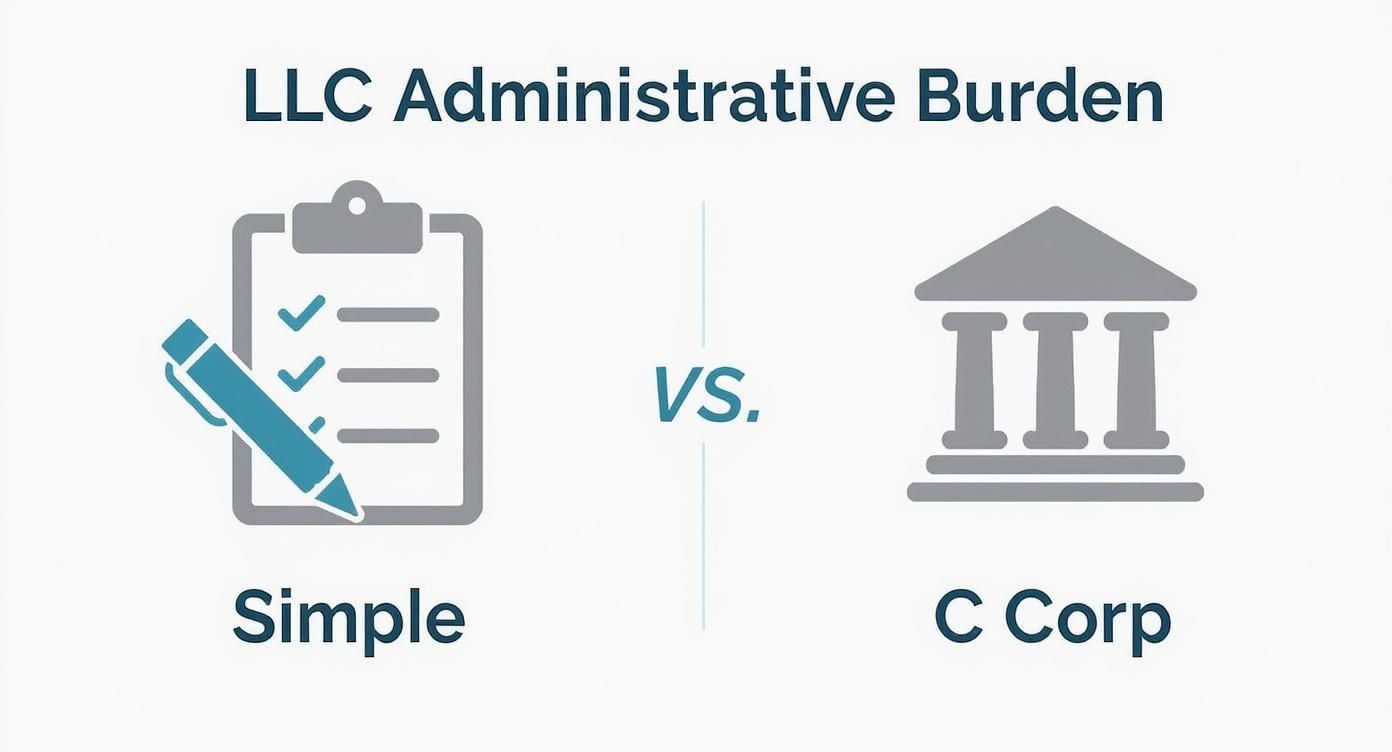
You can see why service businesses and small, closely-held operations almost always lean toward the LLC for its simplicity.
The High-Growth Tech Startup
Let's shift gears completely. Think about a tech startup with massive ambitions. The founders have a game-changing product, and they know they'll need serious outside funding from angel investors and venture capitalists (VCs) to scale quickly. Their absolute top priority is being "investor-ready."
In this case, the C Corporation isn't just the best choice—it's pretty much the only one. VCs will almost always insist on a C Corp before they write a check.
Investors need the ability to receive preferred stock, which gives them specific rights like liquidation preferences if the company is sold. The C Corp framework is specifically designed to handle these complex equity structures, making it the undisputed gold standard for any business on the venture capital track.
A C Corp makes it easy to issue different classes of stock, set up employee stock option plans (ESOPs) to attract top-tier talent, and bring on an unlimited number of shareholders. Starting as an LLC would create immediate friction with investors and likely force a costly, time-consuming conversion to a C Corp later on. It’s better to start with the end in mind.
The Real Estate Investment Group
Finally, imagine a group of people pooling their capital to buy and manage rental properties. They need two things above all else: ironclad liability protection for each property and a flexible way to allocate profits and losses among the partners.
For real estate investors, the LLC is incredibly advantageous. In fact, many savvy investors go a step further and create a separate LLC for each individual property (or use a Series LLC where available). This strategy firewalls each asset, meaning a lawsuit tied to one property can't take down the entire portfolio. The ability to specially allocate depreciation and profits in the operating agreement is another huge perk that a C Corp just can't offer.
Choosing the right entity starts with being honest about where you want to go. Define your endgame first, and the right path becomes much clearer.
Frequently Asked Questions
When you're weighing the C Corp vs. LLC decision, a lot of practical questions pop up. Here are some straight answers to the ones we hear most often from entrepreneurs.
Can I Switch from an LLC to a C Corp Later On?
Absolutely. Converting an LLC to a C Corp is a well-trodden path, especially for startups that hit a growth spurt and decide to chase venture capital. It involves a formal state filing process to change your entity type.
Just be aware that this conversion isn't a simple paperwork swap; it carries real legal and tax consequences. It's crucial to have experienced legal and tax pros guide you through it. Frankly, if you're confident from the get-go that VC funding is in your future, starting as a C Corp is often the cleaner, more cost-effective route.
Which One Gives Me Better Liability Protection?
This is a common point of confusion. The truth is, both LLCs and C Corps offer a robust "corporate veil" that shields your personal assets from business liabilities. One isn't automatically better than the other at this.
The real factor determining how strong that shield is comes down to your own business practices. Keeping your business and personal finances completely separate and following the required corporate formalities is what truly protects you, regardless of the entity you choose.
It's a myth that C Corps offer inherently superior liability protection. The strength of your legal shield depends entirely on how meticulously you maintain the separation between yourself and your business.
Can an LLC Have Shareholders Like a C Corp?
Nope, the terminology and structure are different here. An LLC has "members," not shareholders, and their ownership stakes and rights are defined in a private operating agreement.
C Corps, on the other hand, are owned by shareholders who hold shares of stock. This distinction is a huge deal for investors. They understand and prefer the standardized, easily transferable nature of stock. If your business plan involves issuing equity to a wide range of investors, the C Corp is built for that world.
Choosing between a C Corp or LLC really boils down to your specific business vision. For expert guidance on entity selection, tax strategy, and compliance here in San Diego, the team at Allied Tax Advisors is ready to help. Schedule a consultation with Allied Tax Advisors to discuss your options.