
To figure out your adjusted gross income, you start with your total gross income and then subtract a specific list of "above-the-line" deductions. This number, what we call your AGI, is arguably the single most important figure on your entire tax return. Why? Because it's the gateway to qualifying for a whole host of valuable credits and deductions.
Why Your Adjusted Gross Income Matters

Think of your Adjusted Gross Income as the bedrock of your tax return. It isn't your final taxable income, but it's the crucial starting point for nearly everything that follows. You'll find it on line 11 of Form 1040, and this one number has a surprisingly massive impact on your financial life.
A lower AGI is a powerful thing. It doesn't just reduce your taxable income, which usually means a smaller tax bill. More importantly, it can open the door to significant tax savings you might otherwise be completely shut out from.
The Gatekeeper for Tax Benefits
So many of the most valuable tax credits and deductions are tied directly to your AGI. It’s the number that determines things like:
- Whether you can contribute to a Roth IRA.
- If you're allowed to deduct contributions made to a traditional IRA.
- Your eligibility for education credits, such as the American Opportunity Tax Credit.
- The total amount of the Child Tax Credit you're able to claim.
The heart of smart tax planning often comes down to one thing: legally lowering your AGI. When you maximize those above-the-line deductions, you're not just cutting your immediate tax bill—you're also boosting your odds of qualifying for other powerful tax breaks down the line.
Global Income and Your AGI
Remember, your AGI needs to reflect all your income, and that includes any money you earned outside the U.S. In the 2021 tax year alone, American taxpayers reported a whopping $365.5 billion in foreign-source gross income. That’s a huge jump from previous years and a clear sign of how important it is to track every single income stream when you calculate your adjusted gross income. You can dig into more of these stats directly from the IRS.
Getting this number right is non-negotiable. For a more detailed breakdown of the basics, you might find our guide on https://alliedtax.com/what-is-adjusted-gross-income/ helpful. Nailing this calculation is the first real step toward taking a smarter, more strategic approach to your taxes.
Identifying All Your Sources of Gross Income

Before we can even think about deductions, we need a solid starting point. That means tracking down every dollar you received during the year to figure out your gross income. This number is the bedrock of your entire tax return, so getting it right is the most critical first step in calculating your adjusted gross income.
To get an accurate number, you first need a clear picture of all your income sources, which means understanding the difference between gross and net income. Your gross income is the grand total of every payment, benefit, and profit you received before a single cent in taxes or deductions is taken out.
Beyond Your W-2 Salary
For most people, the first document that comes to mind is the Form W-2 from their employer. But for many, total gross income is a lot more than just that one number. A complete picture includes all the other ways money flows into your life.
Think of it like putting together a financial puzzle. Every piece—no matter how small—is essential to see the full picture of your annual earnings. Missing even one can throw off your AGI calculation and potentially lead to headaches with the IRS later on.
Common sources of income to round up include:
- W-2 Wages: This is the big one for most—your salary, wages, tips, and other compensation from an employer.
- Freelance or Self-Employment Income: Money you made from your own business or a side gig, usually reported on a Form 1099-NEC or 1099-K.
- Investment Earnings: This covers interest from bank accounts (Form 1099-INT), dividends from stocks (Form 1099-DIV), and capital gains from selling assets.
- Rental Property Income: The gross rent you collected from tenants before you subtract any of your expenses.
Uncovering Often-Overlooked Income
It's easy to focus on the obvious stuff, but plenty of other income sources are taxable and must be included in your gross income. Forgetting these is a common and often costly mistake.
For instance, unemployment compensation is fully taxable at the federal level and must be reported. The same goes for distributions from retirement accounts like a 401(k) or a traditional IRA—that money generally counts as income in the year you take it out. If you want to dig deeper, our guide explores the nuances of https://alliedtax.com/what-is-unearned-income/.
Your gross income is a comprehensive tally of all money you received, not just what you earned from your primary job. This includes everything from a small freelance project to the interest earned on a savings account.
Gathering Your Financial Documents
The secret to getting your gross income right is simply good organization. As tax season gets closer, start gathering all the forms you'll need. Keeping them in a dedicated folder—whether it’s a physical one on your desk or a digital one on your computer—will save you a ton of stress.
Here’s a quick reference table to help you match common income types with the tax forms you should be looking for.
Common Sources of Gross Income and Corresponding Tax Forms
| Income Type | Common Tax Form | Key Consideration |
|---|---|---|
| Wages & Salary | Form W-2 | You'll get one from each employer you worked for during the year. |
| Freelance Income | Form 1099-NEC | Issued for non-employee compensation of $600 or more from a client. |
| Interest Income | Form 1099-INT | From banks and financial institutions for interest earned on your accounts. |
| Dividend Income | Form 1099-DIV | From brokerage firms or companies for stock dividends you received. |
| Brokerage Sales | Form 1099-B | Details sales of stocks, bonds, or other securities. Crucial for capital gains. |
| Unemployment | Form 1099-G | Reports unemployment compensation and state/local tax refunds. |
| Business/Trust Income | Schedule K-1 | Issued to partners or beneficiaries of an estate or trust. |
Make sure you have all these documents lined up. By carefully collecting and adding up the income from every relevant source, you build a solid, defensible gross income figure. This precision is the essential first step to getting your AGI right and building an effective tax strategy.
Using Above-the-Line Deductions to Lower Your AGI
After you've added up all your income sources, the real work—and the real opportunity—begins. This is where you can legally and effectively lower the amount of income the IRS gets to tax. The key? A special set of deductions called above-the-line deductions.
Think of these as your first line of defense in tax strategy. Found on Schedule 1 of Form 1040, they're so powerful because they reduce your income before you even get to the standard vs. itemized deduction crossroads. This direct hit to your AGI can open the door to other credits and tax breaks, making each dollar deducted here work twice as hard for you.
Supercharge Your Savings with Retirement Contributions
One of the smartest ways to shrink your AGI is by paying your future self. When you contribute to certain retirement accounts, you get an immediate tax deduction while building a nest egg for down the road. It’s a classic win-win.
- Traditional IRA Contributions: Money you stash in a traditional Individual Retirement Account (IRA) is often directly deductible. For 2024, you can contribute up to $7,000 ($8,000 if you're 50 or older). In many situations, that entire amount comes right off the top of your gross income.
- Health Savings Account (HSA) Contributions: If you’re covered by a high-deductible health plan, an HSA is a financial powerhouse. Contributions are tax-deductible, the funds grow tax-free, and withdrawals for medical expenses are also tax-free. Frankly, it’s one of the best AGI-reducing tools out there.
Let's put it into practice. Say you're single and your gross income is $80,000. If you max out your traditional IRA at $7,000, your AGI instantly drops to $73,000. That one move could be the very thing that qualifies you for other valuable tax benefits.
Deductions for Education and Health
The tax code acknowledges that some of life's biggest expenses deserve a break. Two of the most common relate to paying for your education and your health.
The student loan interest deduction lets you write off up to $2,500 of the interest you paid on student loans during the year. For anyone chipping away at education debt, this is a huge help that lowers your AGI without needing to itemize.
In the same vein, the educator expense deduction allows eligible teachers to deduct up to $300 for unreimbursed classroom costs like books and supplies. It might not sound like a fortune, but every single dollar you can deduct from your income counts.
Critical Deductions for the Self-Employed
If you’re a freelancer, contractor, or small business owner, these above-the-line deductions aren't just a nice perk—they're absolutely fundamental. They account for the real costs of being your own boss.
The most crucial one is the deduction for one-half of your self-employment tax. A regular employee's boss pays half of their Social Security and Medicare taxes. When you're self-employed, you foot the entire bill. The IRS lets you deduct the "employer" half, a fair adjustment that makes a significant dent in your AGI.
You can also make much larger, tax-deductible contributions to retirement plans designed for the self-employed:
- SEP IRA: A Simplified Employee Pension plan lets you contribute up to 25% of your net adjusted self-employment income, capped at a whopping $69,000 for 2024.
- SIMPLE IRA: This plan involves both employee and employer contributions, providing another potent way to save for the future while cutting your current tax bill.
On top of that, self-employed folks can usually deduct the premiums they pay for health insurance for themselves and their families. This is a massive deduction that makes healthcare more affordable and provides a substantial AGI reduction.
Adjustments for Investments and Other Scenarios
Your AGI calculation doesn't stop with your day job. What happens in your investment portfolio can also offer an opportunity to lower your taxable income.
If your capital losses from selling investments like stocks or crypto are greater than your capital gains, you can use that net loss to your advantage. You’re allowed to deduct up to $3,000 of net capital losses against your other income (like your salary) each year.
Pro Tip: Have a net loss bigger than $3,000? Don't worry, it's not wasted. You can carry the excess loss forward to future tax years to offset gains or deduct against income then.
This can be a silver lining in a down market, turning a portfolio loss into real, immediate tax savings.
Another situation to be aware of involves alimony. If your divorce agreement was finalized before 2019, the alimony payments you make are typically deductible. This is another direct reduction to your AGI, though it's important to note the person receiving the payments must report it as income.
By thoughtfully applying these above-the-line deductions, you can take control of the most important number on your tax return. For more ideas on lowering your tax burden, you might be interested in our guide on top deductions and credits you might be missing. Every deduction whittles down your gross income, setting you up for a smaller tax bill and potentially unlocking even more tax benefits.
Putting AGI Calculation into Practice: Real-World Examples
The best way to get a handle on AGI is to see it in action. The formula itself—Gross Income minus "Above-the-Line" Deductions—is straightforward, but watching the numbers fall into place makes it all click.
Let’s walk through two common scenarios. First, we'll look at a salaried employee with a few typical deductions. Then, we’ll dive into a more complex situation for a self-employed professional.
This flowchart shows the basic journey from your total income down to your AGI.
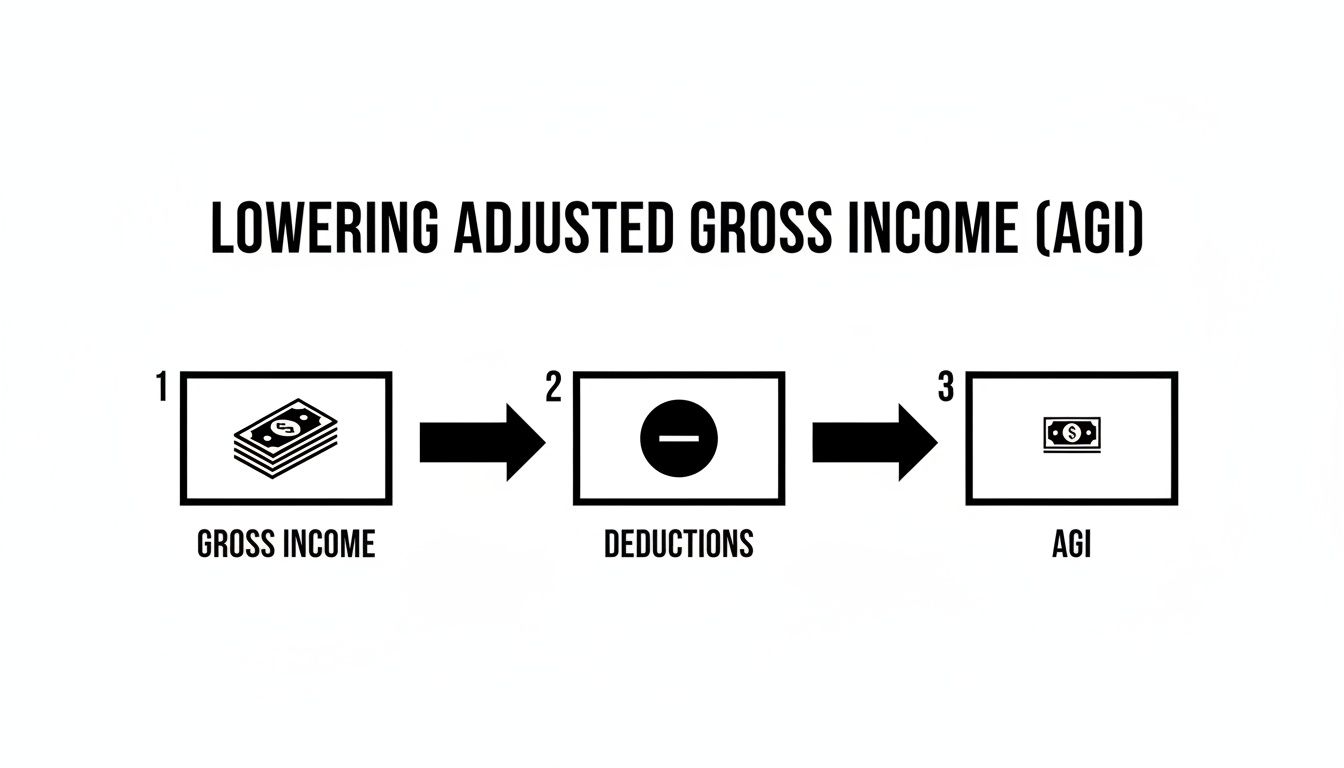
As you can see, every valid deduction you take directly chips away at your gross income. The result is a lower AGI, which usually means a smaller tax bill.
Example 1: The W-2 Employee
Meet Sarah, a graphic designer at a marketing agency. She files as a single individual and has a fairly standard financial picture, but she’s smart about taking advantage of key deductions to lower her tax burden.
First, we need to add up all her income sources to find her gross income for the year.
- W-2 Salary: Sarah earned $85,000 from her full-time job.
- Interest Income: Her high-yield savings account also generated $200 in interest, which is reported to her on a Form 1099-INT.
This brings her total gross income to $85,200.
Now, let's look at the "above-the-line" deductions she can take. Sarah is proactive about her finances. She contributed $7,000 to her traditional IRA (the max for her age) and also paid down $1,800 in student loan interest. Both are excellent deductions for trimming your AGI.
By making that IRA contribution and claiming her student loan interest, Sarah is doing more than just saving for retirement or paying off debt. She's strategically reducing the income figure the IRS uses to determine her eligibility for other credits. It's a textbook example of how a few smart moves can create a ripple effect across your entire tax return.
With all the numbers in hand, we can calculate her AGI.
Sarah's AGI Calculation
- Gross Income: $85,200
- Less: Traditional IRA Contribution ($7,000)
- Less: Student Loan Interest Deduction ($1,800)
- Adjusted Gross Income: $76,400
Just by using two common adjustments, Sarah shaved $8,800 off her income. This doesn't just lower her tax bill; it also improves her chances of qualifying for other valuable tax breaks.
Example 2: The Self-Employed Consultant
Now let’s look at Mark, a self-employed IT consultant. His finances are a bit more involved, with business income, several deductions, and some investment activity. This is a great example of why entrepreneurs need to be meticulous record-keepers.
First, let's figure out Mark's gross income.
- Business Income: He brought in $150,000 from his clients, all reported on various 1099-NEC forms.
- Capital Loss: Mark also sold some stocks, which resulted in a net capital loss of $5,000 for the year.
Next, we need to identify his above-the-line deductions. As a business owner, he has quite a few more available to him.
- Self-Employment Tax Deduction: Mark’s total self-employment tax bill comes to $21,189. The good news is he gets to deduct one-half of that amount, which is $10,595.
- SEP IRA Contribution: He made a hefty $25,000 contribution to his SEP IRA, a powerful retirement tool for the self-employed.
- Self-Employed Health Insurance: Mark paid $8,000 in health insurance premiums for himself, which is fully deductible.
- Capital Loss Deduction: Although his actual investment loss was $5,000, the IRS limits how much you can deduct against other income in one year to $3,000. The remaining $2,000 gets carried forward to future tax years.
Now we can put all the pieces together and calculate Mark's AGI.
Mark's AGI Calculation
- Gross Income: $150,000
- Less: One-Half of Self-Employment Tax ($10,595)
- Less: SEP IRA Contribution ($25,000)
- Less: Self-Employed Health Insurance Premiums ($8,000)
- Less: Net Capital Loss Deduction ($3,000)
- Adjusted Gross Income: $103,405
All told, Mark managed to reduce his gross income by a whopping $46,595. This really highlights the power of self-employment deductions when you calculate adjusted gross income.
For people navigating multiple income streams and deductions, tax software like TurboTax can be a huge help in making sure nothing gets missed. As these examples show, it doesn't matter if you're a salaried employee or a business owner—understanding and applying the right deductions is the key to an accurate and often more favorable AGI.
How Your AGI Unlocks (or Locks) Major Tax Breaks

Your Adjusted Gross Income isn't just a number you calculate on the way to your final tax bill. It’s the gatekeeper. Think of your AGI as the key figure that determines your access to some of the most powerful tax-saving tools the IRS offers.
The lower you can get that AGI number, the more doors of opportunity will swing open. Why? Because many valuable tax credits and deductions have AGI-based income limits. If your AGI is even a dollar too high, you could see a benefit reduced or lose it entirely. This is exactly why every "above-the-line" deduction matters so much.
AGI's Grip on Tax Credits
Tax credits are the gold standard of tax breaks since they slash your tax bill dollar-for-dollar. But nearly all of the big ones are tied directly to your AGI. A few hundred dollars in income can be the difference between getting a credit and getting nothing.
Here are a few common credits that are extremely sensitive to your AGI:
- The Child Tax Credit: This credit starts to shrink once your AGI climbs above $200,000 for single filers or $400,000 for married couples filing jointly.
- American Opportunity Tax Credit (AOTC): A crucial credit for college students, the AOTC begins phasing out for single filers with an AGI over $80,000.
- Lifetime Learning Credit (LLC): This education credit also has strict income limits, making your AGI the deciding factor in whether you can claim it for tuition.
- Premium Tax Credit: This credit is a lifeline for many who buy health insurance through the Marketplace, and your eligibility is directly tied to where your AGI falls in relation to the federal poverty level.
The bottom line is simple: a lower AGI boosts your odds of qualifying for these valuable credits. A single above-the-line deduction, like a traditional IRA contribution, could easily lower your AGI just enough to put you back in the running for a credit worth thousands.
How AGI Influences Deductions and Retirement Savings
Beyond credits, your AGI also controls your ability to claim certain deductions and even how you can save for retirement. These rules are designed to prevent high-income earners from getting benefits intended for middle- and lower-income families.
A prime example is the Roth IRA. Your ability to contribute directly is limited by your AGI. For 2024, if you're a single filer with a modified AGI over $161,000, you can't contribute at all.
The same goes for deducting traditional IRA contributions. If you or your spouse have a retirement plan at work, your AGI determines whether you can deduct your full contribution, just a part of it, or nothing.
Another critical one is the medical expense deduction. You can only deduct qualified medical expenses that exceed 7.5% of your AGI. A lower AGI means a lower hurdle. For instance, if your AGI is $100,000, you need more than $7,500 in medical bills before you can deduct a dime. But if you manage to lower your AGI to $80,000, that threshold drops to $6,000, making the deduction much easier to claim.
The relationship between your AGI and your eligibility for various tax benefits is a critical part of strategic tax planning. The table below shows just how significantly your AGI can influence what you get to keep.
Key Tax Credits and Deductions Affected by AGI Thresholds
| Tax Credit / Deduction | General AGI Impact | Example Scenario |
|---|---|---|
| American Opportunity Tax Credit | Phase-outs begin for single filers over $80,000 and joint filers over $160,000. | A student's parent with an AGI of $162,000 gets a reduced credit, while one with an AGI of $158,000 (after an IRA deduction) qualifies for the full amount. |
| Child Tax Credit | The credit is reduced for joint filers with an AGI above $400,000. | A family with an AGI of $405,000 sees their credit shrink, potentially losing hundreds of dollars they could have kept by lowering their AGI. |
| Medical Expense Deduction | You can only deduct expenses that exceed 7.5% of your AGI. | A taxpayer with $7,000 in medical bills and a $100,000 AGI can't deduct anything. If they lower their AGI to $80,000, they can now deduct $1,000 ($7,000 – $6,000). |
| Roth IRA Contributions | Direct contributions are phased out and then disallowed as your AGI rises. For 2024, the single filer limit starts at $146,000. | An individual with an AGI of $148,000 can only make a partial Roth contribution. A small above-the-line deduction could restore their ability to contribute the full amount. |
As you can see, actively managing your AGI isn't just an accounting exercise—it has a direct and significant impact on your financial well-being. Each deduction you take helps lower that key number, unlocking more savings down the line.
Common Questions About Calculating AGI
Once you start working with the AGI formula, you'll find that a few specific questions tend to come up time and time again. Getting these sorted out is crucial for filing your taxes correctly and with confidence. Let's walk through a few of the most common issues people run into.
AGI vs. MAGI: What's the Real Difference?
This is probably the biggest point of confusion I see. People hear Adjusted Gross Income (AGI) and Modified Adjusted Gross Income (MAGI) and assume they're interchangeable, but they serve very different roles.
Your AGI is the number you arrive at after subtracting your "above-the-line" deductions from your gross income. You'll find it right there on line 11 of your Form 1040.
MAGI, on the other hand, is a specific calculation the IRS uses to see if you qualify for certain tax breaks. To figure out your MAGI, you start with your AGI and then add back certain deductions you might have taken. The exact formula changes depending on the tax benefit in question. For example, if you're trying to determine if you can contribute to a Roth IRA, the MAGI calculation requires you to add back the student loan interest deduction, among others.
A key takeaway: For a lot of people, their AGI and MAGI are the exact same number. They only diverge if you've taken one of the specific deductions that needs to be added back for an eligibility test.
Do Charitable Donations Lower My AGI?
Great question, and it gets right to the core of how deductions are categorized. While giving to charity is a fantastic thing to do, your donations will not lower your AGI.
The reason is simple: charitable giving is a "below-the-line" deduction. This means it's part of your itemized deductions, which you report on Schedule A. You only get the benefit if you choose to itemize instead of taking the standard deduction. Since it’s not an "above-the-line" adjustment found on Schedule 1, it doesn't factor into the AGI calculation at all.
Do I Still Need to Calculate AGI if I Only Have W-2 Income?
Yes, you absolutely do. This is a non-negotiable step in the process, even for taxpayers with the simplest situations. Your employer withholds taxes based on the information you provide, but that's just a pre-payment, an estimate of what you'll owe. Your final, actual tax liability is determined by your AGI.
Besides, even with just a W-2, you could still be eligible for valuable above-the-line deductions that lower your AGI. Think about it:
- Did you put money into a traditional IRA? That's a direct reduction to your AGI.
- Are you a teacher who spent your own money on classroom supplies? You can deduct up to $300.
- Did you make payments on student loans? You may be able to deduct up to $2,500 in interest.
Skipping the AGI calculation just because your income seems straightforward could mean you’re overpaying your taxes. It’s always worth the time to make sure you’re not leaving any money on the table.
Trying to untangle the rules around AGI, MAGI, and the countless deductions can feel overwhelming. For personalized guidance to ensure you're filing accurately and taking advantage of every opportunity, trust the experts at Allied Tax Advisors. Discover how our strategic tax planning can benefit you at https://alliedtax.com.