
Calculating your rental income tax starts with a simple formula, but the details are where things get tricky. At its core, you're just taking your Gross Rental Income, subtracting all your Deductible Expenses, and what's left is your Taxable Income. That final number is what the IRS looks at to figure out what you owe.
Sounds simple enough, right? Let's break down that first—and most important—part.
What Counts as Rental Income

Before you can even think about deductions, you have to get a rock-solid handle on your total income. And trust me, the IRS sees "income" as a lot more than just the rent checks that hit your bank account each month.
It's a common rookie mistake for landlords to only report the base rent. The reality is, pretty much any money you receive from your tenant needs to be accounted for. Forgetting a source of income is one of the quickest ways to trigger an audit or get hit with penalties later on.
Beyond the Monthly Rent Check
So, what else do you need to report? The rule of thumb is to include any payment you get from a tenant that isn't a true security deposit you intend to give back.
Here are a few of the most common income sources landlords miss:
- Advance Rent: Let's say your new tenant pays first and last month's rent upfront. That "last month's rent" is considered income in the year you receive it, not the year it actually applies to.
- Lease Cancellation Fees: If a tenant pays a penalty to break their lease early, that fee is absolutely rental income and has to be on your tax return.
- Retained Security Deposits: Did you keep part of a security deposit to cover damages or unpaid rent? The amount you didn't return becomes taxable income for that year.
- Tenant-Paid Expenses: If your lease makes you responsible for the water bill but your tenant pays it directly for you, that payment counts as rental income. The good news? You can then deduct that same amount as a utility expense.
Getting these classifications right is crucial. For a deeper dive, our guide explains in detail how the IRS views rental income.
Sources of Gross Rental Income
To make it even clearer, let's summarize the common types of income you need to track. It's not just about the monthly rent—it's about every dollar your property generates.
| Income Source | When It's Considered Income | Example |
|---|---|---|
| Normal Rent Payments | In the year received | The standard $1,500 monthly rent check you collect. |
| Advance Rent | In the year received, not when applied | A tenant pays the last month's rent in December 2024 for November 2025. |
| Lease Termination Fees | In the year received | A tenant pays a $1,000 fee to end their lease six months early. |
| Retained Security Deposit | In the year you keep it | You withhold $500 from a deposit to repair a damaged wall. |
| Tenant-Paid Expenses | In the year the tenant pays your bill | Your tenant pays the $75 trash collection bill that is your responsibility. |
| Non-Monetary Payments | When services are rendered | A tenant who is a painter paints the house in exchange for one month's rent. |
This table is a great starting point. The main takeaway is to document every single payment meticulously, no matter its purpose, to keep your records clean and defensible.
The key takeaway is this: any financial benefit you receive in exchange for the use of your property is likely taxable. Always document every payment, regardless of its purpose, to maintain a clean and defensible record.
It's also worth noting how taxes on rental income differ around the world. In 2025, some countries have rates as low as 10%, while others go over 50%. Here in the United States, your net rental income is taxed at your personal marginal rate, which can be anywhere from 10% to 37%, depending on your total income bracket.
Uncovering Every Landlord Tax Deduction

Once you have a firm handle on your total rental income, it's time for the fun part: cutting down that taxable figure with deductions. This is where all that meticulous record-keeping you've been doing all year really starts to pay dividends.
Most landlords know the big ones—mortgage interest, property taxes—but if that’s where your list ends, you're almost certainly leaving money on the table.
The secret is to think like the IRS. You can deduct any expense that is both ordinary (common in the rental business) and necessary (helpful for your business). When you adopt that mindset, you start to see potential write-offs everywhere. The real goal here is to account for every single dollar you spent managing, maintaining, and protecting your property.
Going Beyond the Obvious Deductions
It's easy to focus on mortgage interest, as it's often the biggest single deduction. But savvy landlords know that the small expenses add up to create huge savings.
Let's look at a few areas that are frequently underutilized:
- Professional and Legal Fees: Did you pay a lawyer to review your lease? Or an accountant to help with your Schedule E? Those professional fees are 100% deductible.
- Insurance Premiums: This isn’t just about your basic landlord policy. Think broader: flood insurance, fire, theft, and even specific liability policies are all deductible business expenses.
- Advertising Costs: Any money spent to find a new tenant is fair game. This includes everything from online listings on Zillow to the "For Rent" sign you stuck in the front yard.
A $150 legal consult here and $50 in online ads there might not seem like much on their own. But when you add them up across an entire year, especially with multiple properties, these deductions can make a significant dent in your tax bill.
The Power of Travel and Home Office Deductions
One of the most overlooked goldmines for deductions is travel. Every time you drive to your property—whether it’s to show it to a potential tenant, collect rent, or meet a contractor—those miles are a deductible expense.
You have two ways to claim this:
- Standard Mileage Rate: This is the simplest method. You just track your business-related miles and multiply the total by the IRS's official rate. For 2024, that's 67 cents per mile.
- Actual Expenses: For this, you’ll track all your car-related costs—gas, oil changes, repairs, insurance—and then deduct the percentage of those costs that apply to your rental business use.
And what about your workspace? If you have a dedicated area in your home used exclusively for managing your rental properties, you can likely claim a home office deduction. This lets you write off a portion of your home's expenses, like utilities, homeowners insurance, and even mortgage interest, based on the square footage of your office.
A quick pro tip: The key to making these deductions stick is to keep records as you go. A simple mileage log in your car and a clear, dedicated home office space are your best defense in an audit.
It's also interesting to see how different countries handle this. In Portugal, for example, new long-term residential leases in 2025 could see the standard 25% flat tax rate drop as low as 5% for contracts lasting over 20 years—a major incentive to create stable housing.
Spotting Every Possible Write-Off
To really get your head around all the possibilities, it helps to see the common deductions right next to the ones people often forget. Seeing them laid out like this can jog your memory about expenses you paid for months ago.
Here is a quick reference table I put together to help landlords identify every possible write-off.
Common vs. Overlooked Rental Deductions
| Deduction Category | Common Examples | Often-Missed Examples |
|---|---|---|
| Financing Costs | Mortgage Interest | Points paid to get a loan, mortgage broker commissions |
| Property Operations | Property Taxes, Insurance | Pest control services, bank fees for a rental account |
| Professional Fees | Property Management Fees | Legal fees for evictions, tax preparation fees |
| Travel & Office | Mileage to the property | Home office deduction, supplies like paper and ink |
| Repairs & Maintenance | Fixing a leaky pipe, replacing a broken window | Lawn care services, HOA dues, cleaning between tenants |
This table is a great starting point, but every landlord's situation has its own unique quirks.
To dig even deeper and ensure you’re not missing a thing, it's worth checking out more comprehensive guides on essential landlord tax write-offs. At the end of the day, the more you know about the tax code, the less of your hard-earned money you'll have to hand over.
Using Depreciation to Reduce Your Tax Bill
Of all the deductions landlords have at their disposal, depreciation is easily the most powerful. It's also, unfortunately, the most misunderstood.
I think of it as a "phantom" expense. You get to deduct a significant amount from your taxable income every year, but you don't actually spend a dime of cash in that year to get the write-off. It’s a game-changer for your bottom line.
Essentially, the IRS acknowledges that your building and its components wear out over time. Even if the market value of your property is climbing, the government lets you write off a portion of its original cost basis each year. This non-cash deduction is often the single biggest tax break a real estate investor has. Getting this right isn't just good practice—it’s crucial for protecting your cash flow.
How Rental Property Depreciation Works
You can't just deduct the entire purchase price of your property in the year you buy it. That would be too easy! Instead, the tax code requires you to spread that cost over the property's "useful life." For any residential rental in the U.S., the IRS has set this useful life at a very specific 27.5 years.
To get started, you need to figure out your property's cost basis. This isn't just what you paid for it. It also includes certain closing costs and settlement fees, like title insurance, legal fees, or recording fees.
Here's the critical part: you can only depreciate the building, not the land it sits on. Land doesn't wear out. So, your first real task is to separate the value of the building from the value of the land.
Once you have the building's basis, the math is pretty straightforward: you simply divide that number by 27.5. The result is your annual depreciation deduction.
Heads Up: You don't have a choice about claiming depreciation. If you don't take the deduction, the IRS will act as if you did when you eventually sell the property. This is called "depreciation recapture," and it means you'll pay taxes on the benefit you never even took. It’s a classic use-it-or-lose-it situation.
A Real-World Depreciation Example
Let's walk through how this plays out with actual numbers.
Say you buy a duplex for $400,000. You look at the county's property tax assessment, which states the land is worth $80,000 and the structure (the building) is valued at $320,000.
- Building's Cost Basis: $320,000
- Useful Life: 27.5 years
- Annual Depreciation Deduction: $320,000 / 27.5 years = $11,636
That $11,636 is a deduction you can take against your rental income every single year. It doesn't matter if your property's rent brought in a healthy profit or if you had zero repair costs—you still get to claim it.
This is where the magic happens. Your property might be cash-flow positive, but depreciation can turn it into a loss on paper. For instance, if your net income before depreciation was $8,000, claiming that $11,636 deduction creates a taxable loss of -$3,636. In many situations, that loss can offset other income you have, lowering your overall tax bill even further.
To really dig into the nuances, you can learn more about the specifics of the depreciation of rental property and see how it fits into your broader tax strategy.
What About Improvements and Appliances?
The 27.5-year clock is for the residential structure itself. But what about all the other things you buy or upgrade over the years? They have their own, often faster, depreciation schedules.
- Capital Improvements: A major project like a new roof or a full kitchen remodel gets depreciated over 27.5 years, just like the original building.
- Appliances & Furnishings: Things like a new refrigerator, stove, or even carpeting are considered personal property. These get depreciated over a much quicker 5-year period.
- Land Improvements: Adding a fence, driveway, or major landscaping is depreciated over 15 years.
Keeping track of these different asset classes and their schedules is key. It might seem like a bit of a headache, but it allows you to accelerate your deductions on shorter-lived items, giving you more significant tax savings upfront.
Let's See How This Works in the Real World
Okay, we’ve covered the theory. But let’s be honest, nothing clicks until you see it all laid out with real numbers. Let's walk through a full-year scenario for a landlord I'll call Sarah. This is how you take that pile of receipts and turn it into a final number for the IRS.
Sarah owns a single-family rental home. She's what the IRS calls an "active participant," which just means she’s involved in management decisions like approving tenants and repairs. This detail is more important than it sounds because it impacts how you can use any potential losses.
Tallying Up the Annual Income
First things first, we need to account for every dollar the property generated. For Sarah, this is more than just the rent checks.
Her tenant pays $2,200 a month. That’s our baseline.
- Gross Scheduled Rent: $2,200/month x 12 months = $26,400
But real life is messy. Back in July, the dishwasher gave up the ghost. Sarah and her tenant agreed the tenant would pay for the $250 emergency repair and just take it out of the next month's rent. Even though Sarah never physically touched that $250, it’s still considered income to her—a bill was paid on her behalf.
She also charges a $50 monthly pet fee, which adds up.
- Pet Rent: $50/month x 12 months = $600
So, when we add it all together, her true gross income for the year looks like this:
Total Gross Income: $26,400 (Rent) + $250 (Tenant-Paid Repair) + $600 (Pet Rent) = $27,250
Subtracting the Operating Expenses
Next up, we subtract all the "ordinary and necessary" expenses Sarah paid to keep the rental running. Thankfully, she’s a meticulous record-keeper, which makes this part a breeze.
Here’s a look at her annual cash-out-of-pocket expenses:
- Mortgage Interest: $7,500 (Crucially, this is only the interest, not the principal payment).
- Property Taxes: $4,200
- Landlord Insurance: $1,100
- Repairs & Maintenance: This includes the $250 dishwasher repair (which neatly cancels out the income we added earlier), plus another $400 for a plumber and $150 for a spring landscaping cleanup. Total = $800.
- Professional Fees: She paid a one-time $1,000 fee to a property manager to find and screen her newest tenant.
- Utilities: Sarah covers the trash and sewer bills, which came to $600 for the year.
Add those up, and you get her total cash expenses.
Total Operating Expenses: $7,500 + $4,200 + $1,100 + $800 + $1,000 + $600 = $15,200
With that, we can figure out her net operating income before we bring in the biggest deduction of all: depreciation.
Net Operating Income (Pre-Depreciation): $27,250 (Income) – $15,200 (Expenses) = $12,050
Factoring in the Depreciation Deduction
This is where the magic happens. Depreciation is the IRS’s way of letting you deduct for the slow, steady wear and tear on your property over time. It’s a game-changer.
Sarah originally bought the property for $450,000. Her property tax assessment helpfully broke down the value: $100,000 for the land (which you can't depreciate) and $350,000 for the building itself. That $350,000 is her starting point, or "basis."
This infographic gives you a clear picture of how this works.
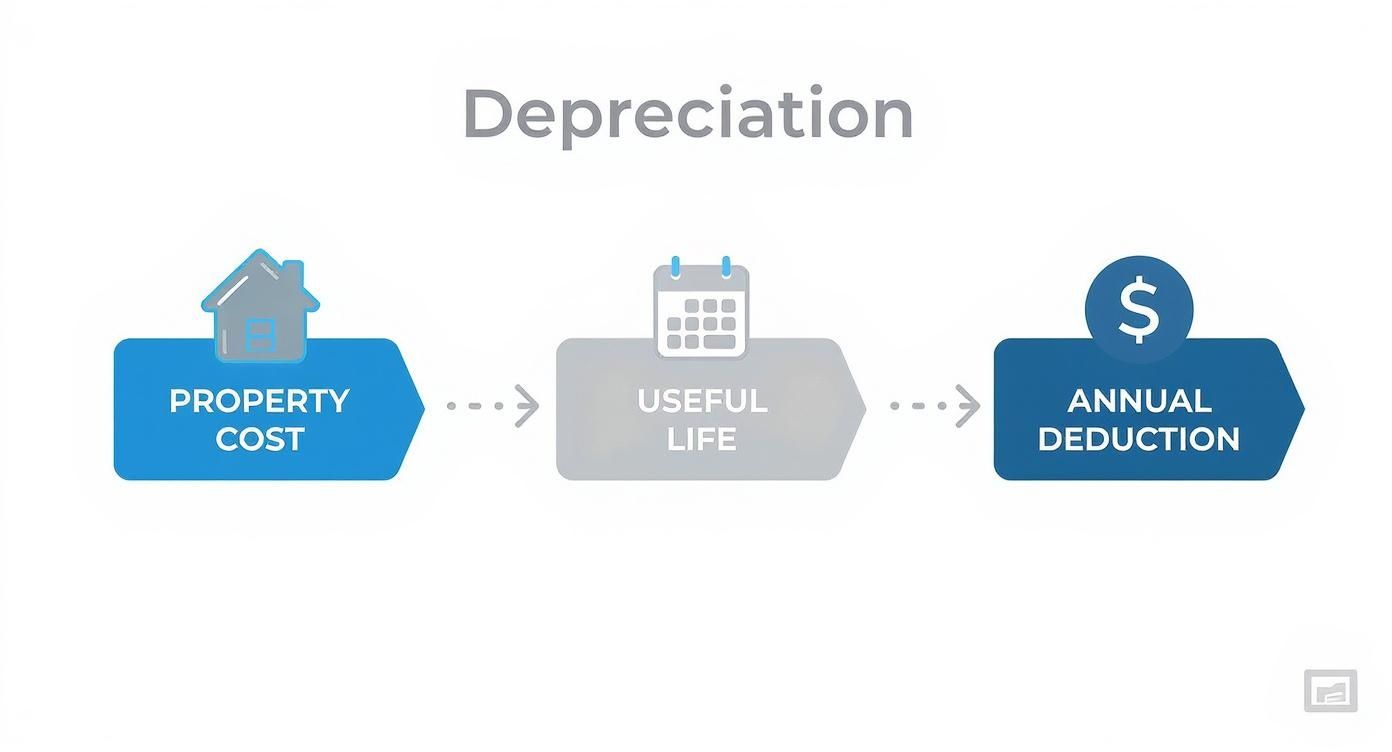
As you can see, you simply take the cost of the structure and divide it by its official "useful life" to get an annual deduction that can seriously slash your taxable income.
For Sarah, the math is straightforward:
- Building Basis: $350,000
- IRS Useful Life: 27.5 years (the standard for residential real estate)
- Annual Depreciation Deduction: $350,000 / 27.5 = $12,727
Calculating the Final Taxable Income
We have all the pieces now. We just take her net operating income and subtract that powerful depreciation deduction.
Final Calculation: $12,050 (Net Operating Income) – $12,727 (Depreciation) = -$677
And there it is. Sarah's rental property, which actually put cash in her pocket every month, now shows a taxable loss of $677. This is the final number she'll report on her Schedule E.
Because she’s an active participant and her total income is within certain IRS limits, she can likely take this $677 "passive loss" and use it to reduce other income, like from her day job. This is the perfect illustration of how a profitable investment can legally result in a tax loss—a core strategy for savvy real estate investors.
Alright, you've done the heavy lifting—you've tracked your income, tallied up your expenses, and figured out your depreciation. Now it's time to put it all together on the right tax form: IRS Schedule E, Supplemental Income and Loss.
Don't let the government-form look of it intimidate you. Schedule E is basically the official scorecard for your rental property business, and it's more straightforward than it appears. It's designed to guide you through the exact calculations we've been talking about, taking you from your gross rental income down to your final taxable profit or loss. Nailing this part is key to staying compliant and keeping the IRS happy.
Getting Familiar With Schedule E
When you pull up the form, you'll see it’s broken down into logical sections. The top part is simple—just identifying the property by its address. After that, it’s really just a matter of plugging in the numbers you’ve already figured out.
Here’s a look at the main section of the form, straight from the IRS.

As you can see, the layout makes it pretty easy to transfer your expense totals into the right boxes.
You'll be working primarily with these lines:
- Line 3 "Rents received": This is where your total gross rental income goes. Simple enough.
- Lines 5-17 "Expenses": This is the heart of your deductions. There are specific lines for all the common stuff—advertising, insurance, mortgage interest, property taxes, and repairs.
- Line 18 "Depreciation": That all-important depreciation deduction gets its own dedicated spot.
- Line 21 "Total expenses": The form does the math for you here, summing up all your deductions.
- Line 22 "Income or (loss)": Here's the bottom line. You'll subtract total expenses from your income to see your net result.
That number on Line 22 is what this is all about. This final figure—whether it's a profit or a loss—is what flows from Schedule E over to your main Form 1040 and directly affects your overall tax situation for the year.
How Schedule E Fits into Your Main Tax Return
Once you've got that final number on Schedule E, its journey isn't over. That net income or loss gets carried over to Schedule 1 (Form 1040), Additional Income and Adjustments to Income.
From there, the total from all your rental properties gets combined with your other income sources, like your day job or a side business. This is how your final Adjusted Gross Income (AGI) is calculated. This flow-through effect is why it’s so critical to accurately calculate rental income tax. A simple mistake on Schedule E can ripple through your entire return.
If you want to dive even deeper into the form's nuances, our comprehensive guide on filing Schedule E for rental income is a great resource.
It's also fascinating to see how differently other countries handle this. Take Poland, for example. They've introduced a simplified lump-sum tax for private rentals. Landlords there pay a flat 8.5% on income up to PLN 100,000 and 12.5% above that. The catch? They can't deduct any expenses like repairs or depreciation. As you can see on PWC's website, it's a much simpler system, but it really underscores the huge advantage U.S. landlords have with Schedule E, especially when operating costs are high.
Answering Your Top Questions About Rental Income Tax
When you’re a landlord, navigating the world of rental income taxes can feel like a maze. A lot of questions come up, especially when you're trying to figure out what you can and can't deduct or what to do when things don't go as planned.
Getting these details right is the key to accurate reporting and, frankly, to sleeping well at night. Let's walk through some of the most common questions I hear from property owners.
Is It a Repair or an Improvement?
This is easily one of the most confusing areas for landlords. The line between a repair and an improvement can feel blurry, but the IRS sees them very differently.
A repair is something you do just to keep the property in good working order. Think of it as maintenance.
- Fixing a leaky pipe under the sink
- Replacing a single broken window
- Patching a small hole in the drywall
These are everyday costs of doing business, so you can deduct them in the same year you pay for them.
An improvement, on the other hand, adds significant value to your property or extends its useful life. You're not just fixing something; you're making it better. Examples include putting on a brand new roof or doing a full kitchen remodel. You can't write off the entire cost of an improvement in one go. Instead, you have to depreciate it over several years.
Can I Deduct My Full Mortgage Payment?
I get this question all the time from new investors. The short answer is no, you can't deduct the entire monthly payment you send to the bank.
Here’s the breakdown: You can only deduct the mortgage interest portion of your payment. For most landlords, this is one of their single largest tax deductions. The rest of your payment—the principal—is paying down your loan and building equity in the property, so the IRS doesn't consider it a deductible expense.
What Happens If I Have a Rental Loss?
It’s not uncommon for your total expenses to be higher than your rental income, especially in the first few years. When this happens, you have a rental loss, which can actually be a good thing for your tax situation.
Often, this "passive loss" can be used to offset other income you have, like the salary from your day job. This can directly lower your overall tax bill for the year.
It's crucial to be aware of the passive activity loss rules, though. The IRS has limits on how much of a loss you can deduct, and these limits are often tied to your income level. It's worth taking the time to understand how these rules apply to you.
For a hands-on way to see how these numbers play out and to get a better feel for the core calculations, it can be helpful to try Using a Rental Income Tax Calculator.
Navigating rental property taxes can be complex, but you don't have to do it alone. The experts at Allied Tax Advisors specialize in real estate tax compliance, helping landlords optimize deductions and ensure accurate filings. Contact us today for personalized tax guidance.