
You worked extra hours, saw a bigger gross paycheck, and expected a nice reward for the effort. Then you opened the pay stub and felt that sinking feeling. The taxes looked huge, the net pay looked smaller than expected, and now you're wondering whether overtime is even worth it.
That reaction is common, especially in California. The confusion usually comes from three separate issues getting mashed together. First, paycheck withholding often looks harsher on overtime than your final tax bill. Second, California and federal overtime rules don't match. Third, the new federal overtime deduction has created a lot of bad assumptions, especially for employees who earn overtime under California's daily rules instead of the federal weekly standard.
If you're a San Diego employee trying to make sense of your pay stub, or a small business owner trying to keep payroll accurate, the key is to separate labor law from tax law. They overlap, but they are not the same thing.
Table of Contents
- That First Overtime Paycheck Shock
- Why Overtime Withholding Feels So High
- Federal vs California Overtime Tax Rules
- The New Federal Overtime Tax Deduction Explained
- The Critical California Limitation You Must Understand
- Payroll Processing and W-2 Reporting for Employers
- Actionable Planning Tips for 2026
- Frequently Asked Questions About Overtime Tax
That First Overtime Paycheck Shock
Maria in San Diego picks up extra shifts, works a string of long days, and waits for that first larger paycheck to hit. She already knows she earned more. Then she checks the deposit amount, opens the pay stub, and thinks something must be wrong because the taxes look much higher than usual.

Usually, nothing is wrong. What happened is that payroll withheld tax in a way that feels aggressive in the moment, even if your final tax bill won't be that high. That's why people often say overtime is “taxed more,” when what they really mean is “more was withheld on this check.”
That misunderstanding gets worse in California because the state's overtime rules are stricter than federal law. Employees can earn overtime under California's daily rules even when they haven't crossed the federal weekly threshold that matters for the new federal deduction. If you also deal with long shifts and premium rates, understanding resources on calculating double time payroll can help you separate wage calculations from tax treatment.
You're not confused because the rules are simple. You're confused because California labor law and federal tax law measure overtime in different ways.
For employees, that affects take-home pay and tax planning. For employers, it affects payroll setup, W-2 reporting, and the risk of giving workers the wrong expectation about what counts for a deduction.
Why Overtime Withholding Feels So High
Most overtime paycheck shock starts with one simple problem. Withholding is not the same thing as final tax.
Payroll systems have to estimate what tax to hold back before your full-year tax return exists. When one paycheck suddenly jumps because of overtime, the system may withhold more aggressively than you expected.
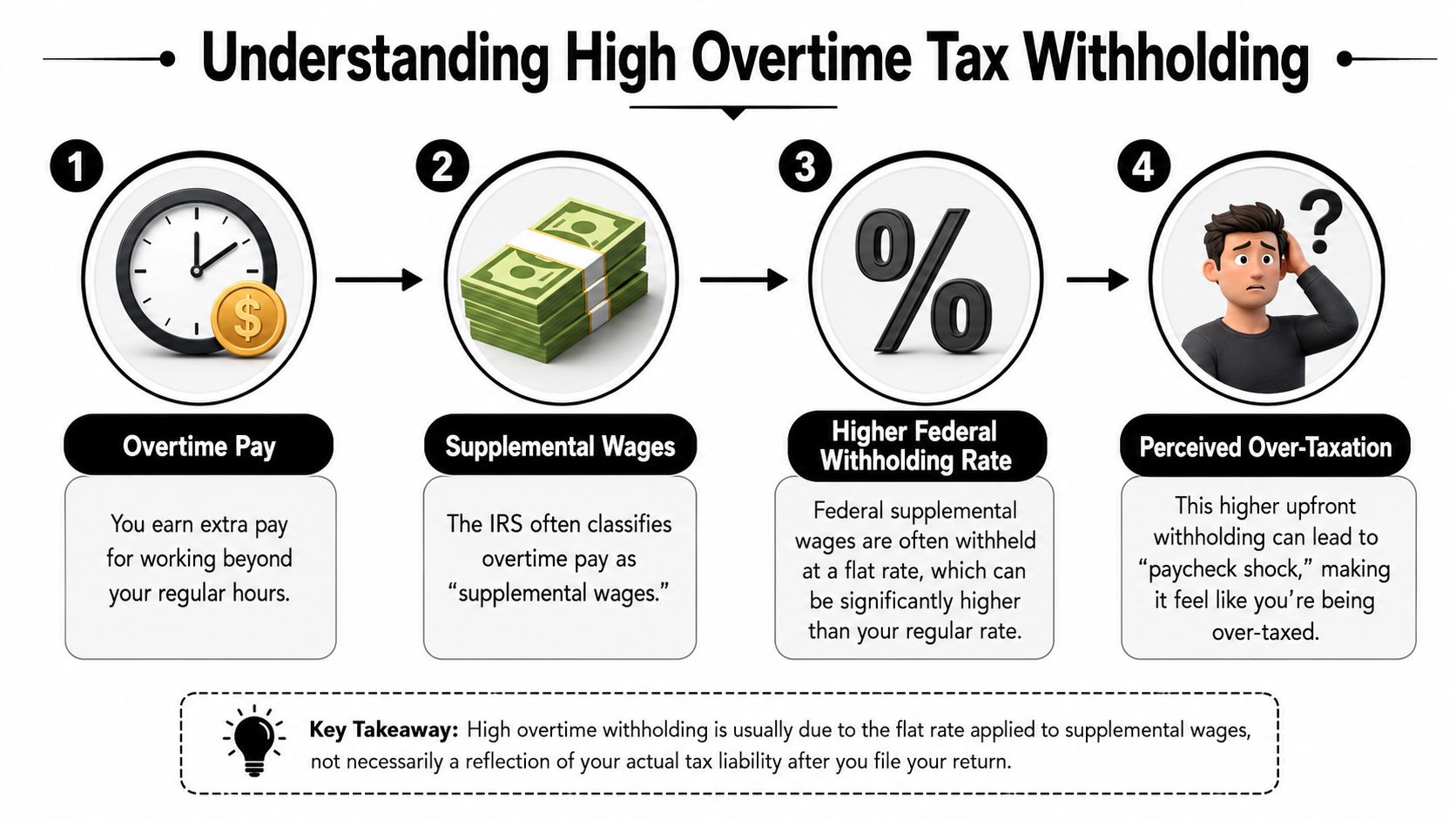
The GPS analogy
Think of payroll like a GPS app. You drive at a normal speed most of the trip, then for a short stretch you go much faster. If the GPS assumes that burst of speed will continue for the entire trip, it recalculates everything based on that temporary spike.
Payroll can do something similar. One overtime-heavy check can make the withholding formula behave as if that higher pay level is normal. The result is a bigger tax bite on that specific payday.
Why the check feels worse than the annual result
Employees often focus on the net pay from one check, which makes sense. Bills are due now, not next April. But tax liability gets settled on the annual return, not on a single payroll date.
That means two things can both be true:
- Your overtime check can have high withholding
- Your actual year-end tax may be lower than that withholding suggested
If too much was withheld over the year, the difference may come back as part of your refund. If too little was withheld, you may owe when filing. The pay stub is a running estimate, not the final score.
What to look at on the stub
A good first step is learning which lines reflect withholding and which reflect wages. If you've ever wondered about the abbreviations on your check, this guide to what FIT means on a paystub helps decode one of the most common federal withholding labels.
Practical rule: Don't judge your tax situation from one overtime check alone. Judge it from your full-year income, your withholding pattern, and your tax return.
The phrase California overtime tax often gets used as if it describes one single rule. It doesn't. You're dealing with payroll withholding rules, federal income tax rules, and California state tax rules at the same time. Each one can treat the same overtime dollar differently.
Federal vs California Overtime Tax Rules
The cleanest way to understand California overtime tax is to separate the taxes by type. Some taxes apply to all wages, including overtime. Others depend on whether the rule is federal or state.
Federal payroll taxes
Federal payroll taxes still apply to overtime wages. If you earn more, payroll taxes generally apply to those wages just like they do to regular wages.
However, many workers expect an exemption that doesn't exist. The new federal overtime deduction doesn't erase payroll taxes. It's a federal income tax concept, not a blanket removal of every tax line on your check.
Federal income tax
Federal income tax is where the new overtime deduction matters. But only some overtime qualifies, and only under the federal rule discussed later in this article.
That distinction matters because many employees hear “no tax on overtime” and assume every premium dollar gets special treatment. That's not how the rule works in practice.
California state income tax
California does not offer a state-level tax exemption or deduction for overtime pay. Overtime earnings remain taxable at full California state income tax rates ranging from 1% to 13.3%, depending on the worker's total income bracket, and California does not conform to the federal overtime deduction. If a worker claims the federal deduction, California requires that amount to be added back on the state return, as explained in this California overtime tax guide.
Here's the practical result. A worker may receive a federal tax benefit on qualifying overtime, yet still pay California tax on that same overtime income.
Reading the pay stub without guessing
If you're trying to connect wage rights with tax treatment, it also helps to understand employee classification first. For a plain-English overview, this article on understanding your rights to overtime pay is useful because overtime rules begin with whether a worker is exempt or nonexempt.
The chart below separates the main treatments.
| Tax Type | Federal Treatment | California Treatment |
|---|---|---|
| Federal payroll taxes | Apply to overtime wages | Not applicable as a California rule |
| Federal income tax | Some federally qualified overtime may be deductible on the federal return | Not applicable as a California rule |
| State income tax | Not a federal tax | California taxes overtime and does not conform to the federal deduction |
| State disability related withholding | Not a federal tax | May still appear on California payroll records depending on wage treatment |
For most workers, the key lesson is simple. California labor law may require overtime pay, but California tax law still taxes that pay.
The New Federal Overtime Tax Deduction Explained
The federal deduction has attracted attention because the name sounds broad. In reality, it's narrower and more technical than most headlines suggest.
What counts as qualified overtime
The new federal “No Tax on Overtime” deduction applies only to overtime hours worked beyond 40 in a week under the federal FLSA standard, and it excludes California's daily overtime. The deduction is capped at $12,500 for single filers and begins to phase out for individuals with Modified Adjusted Gross Income over $150,000, according to the State Controller's Office explanation of the federal overtime deduction.
The most important phrase in that rule is qualified overtime compensation. Not all overtime is qualified. The federal rule looks to overtime required by federal law, not every premium wage category created by state law.
If you want a broader explanation of how workers can claim the federal overtime and tip deductions for the applicable years, this overview of new tax deductions for service and hourly workers is a helpful companion.
Who gets the full benefit
Even when a worker has qualifying overtime, the deduction isn't automatic in the sense people often assume. A person still needs enough eligible overtime under the federal definition, and income level can reduce the benefit.
That's why two California workers with similar-looking overtime checks can have very different federal outcomes. One may have federally qualified weekly overtime. The other may mostly have daily overtime under California rules, which doesn't count for this federal deduction.
The federal deduction is real, but it isn't universal. Eligibility depends on the kind of overtime, not just the fact that overtime was paid.
Many tax planning mistakes often stem from these circumstances. Employees hear “overtime deduction” and treat all premium pay as if it qualifies. Employers may also communicate too broadly, which can create frustration at tax time.
The Critical California Limitation You Must Understand
This is a detail often overlooked. California and federal law use the word “overtime,” but they do not always mean the same thing for tax purposes.
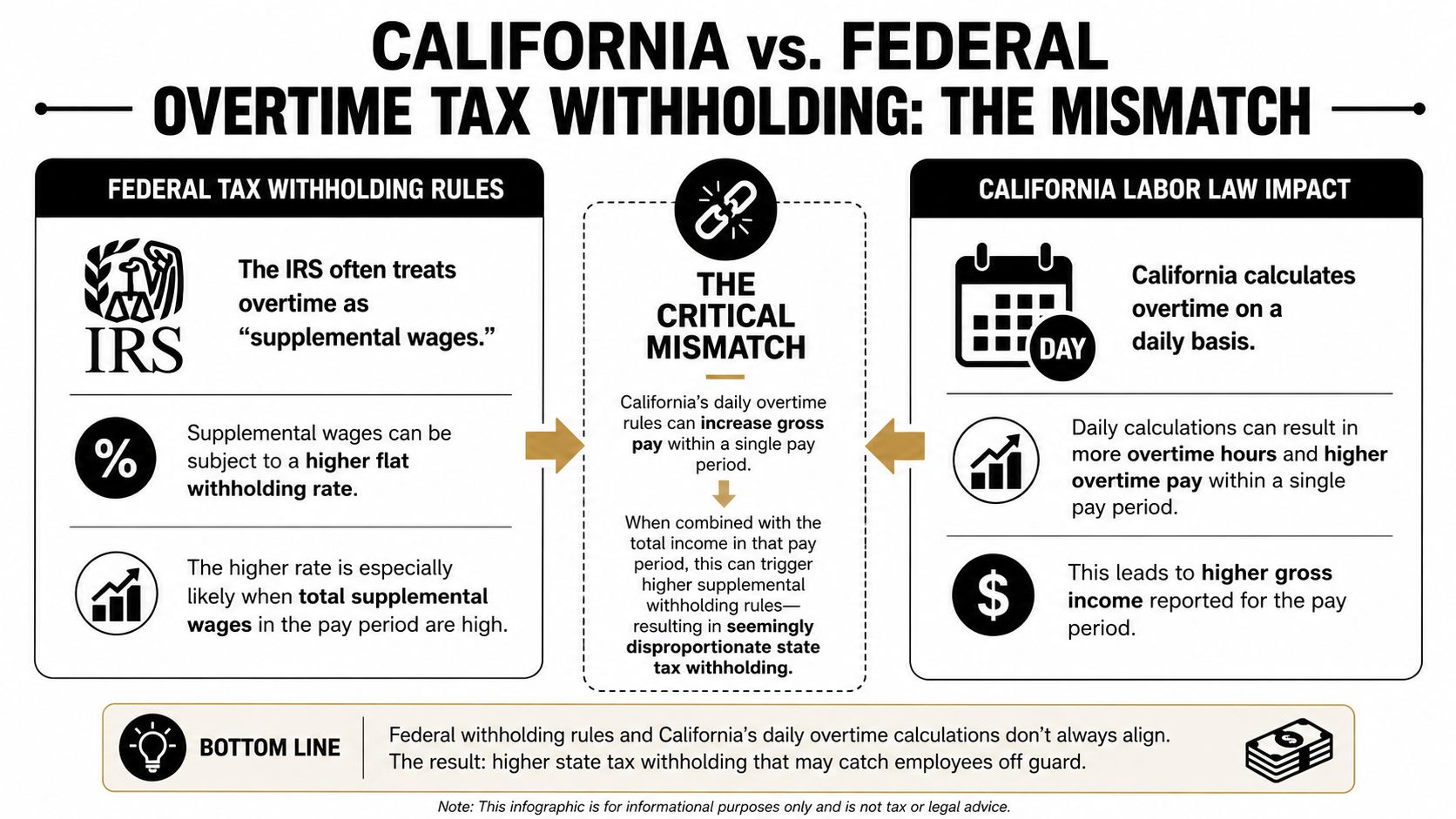
California measures overtime differently
Under California Labor Code 510, overtime is required for work exceeding 8 hours in a day, while the federal deduction applies only to overtime required by the federal Fair Labor Standards Act, which is typically hours over 40 in a week. That means California daily overtime hours are ineligible for the federal deduction, as summarized in this California overtime law explanation.
That sounds technical until you apply it to a real schedule. Then it becomes obvious why so many California workers overestimate the federal benefit.
A simple example that trips people up
Suppose an employee works four 10-hour days in a week.
Under California labor law, those days can produce daily overtime because each day goes beyond the regular daily threshold. The employee may feel they worked “a lot of overtime,” and from a wage law standpoint, that's true.
But under the federal weekly standard, that worker may still not have crossed the weekly threshold required for qualified federal overtime. So the employee can receive California overtime wages and still get little or no federal overtime deduction from those hours.
Here's another version of the same problem:
- California question: Did the employee go over the daily threshold?
- Federal deduction question: Did the employee work overtime that federal law requires, usually over the weekly threshold?
Those are different tests.
Many California workers don't have a tax problem. They have a definition problem. Their pay stub says overtime, but the federal deduction asks a narrower question.
This mismatch is the heart of California overtime tax planning. If your schedule regularly includes long shifts but not much weekly excess over the federal threshold, the new federal deduction may be much smaller than you expected. For some workers, it may not apply to most of the overtime they think they earned.
For small business owners, this same mismatch creates a payroll classification challenge. You cannot tag all overtime wages as federally deductible. You have to separate California-created overtime from federally qualified overtime.
Payroll Processing and W-2 Reporting for Employers
For employers, this issue moves from theory to paperwork very quickly. The tax treatment only works if payroll records can identify the right kind of overtime.
What employers need to track now
A new federal requirement starting in tax year 2026 mandates separate reporting of qualified overtime compensation on the W-2 form. That means employers must segregate federal-qualifying overtime, generally hours over the federal weekly threshold, from California-specific daily overtime. The reporting change and its compliance burden are outlined in this employer alert on overtime tracking and W-2 reporting.
This is a major process issue for businesses using QuickBooks, IRIS, or other payroll systems that were originally set up to calculate wages correctly but not necessarily to label overtime by federal versus California source.
If your business runs payroll for instructors or learning businesses, looking at a specialized tool such as tutor payroll software can be useful because it shows how industry-specific payroll tracking features can reduce manual cleanup later.
Where payroll systems can go wrong
The biggest risk is treating all overtime as one bucket. That may be enough for wage payment, but it isn't enough for federal tax reporting once separate qualified overtime reporting becomes mandatory.
Business owners should review:
- Earnings code setup: Can the system distinguish California daily overtime from federal weekly overtime?
- Timekeeping flow: Are hours coded in a way that preserves the legal basis for the overtime premium?
- W-2 readiness: Can your software output qualified overtime compensation separately when required?
A practical starting point is reviewing your payroll workflow from calculation through filing. This guide on how to calculate payroll taxes can help business owners map the tax side of payroll before the reporting deadline arrives.
For employers in San Diego, the primary issue isn't just compliance. It's employee trust. If the W-2 overtime figure is wrong, the employee may claim the wrong deduction, miss a deduction, or question the entire payroll process.
Actionable Planning Tips for 2026
Good planning starts with accepting one uncomfortable truth. A larger overtime check does not automatically mean a larger tax break, especially in California.
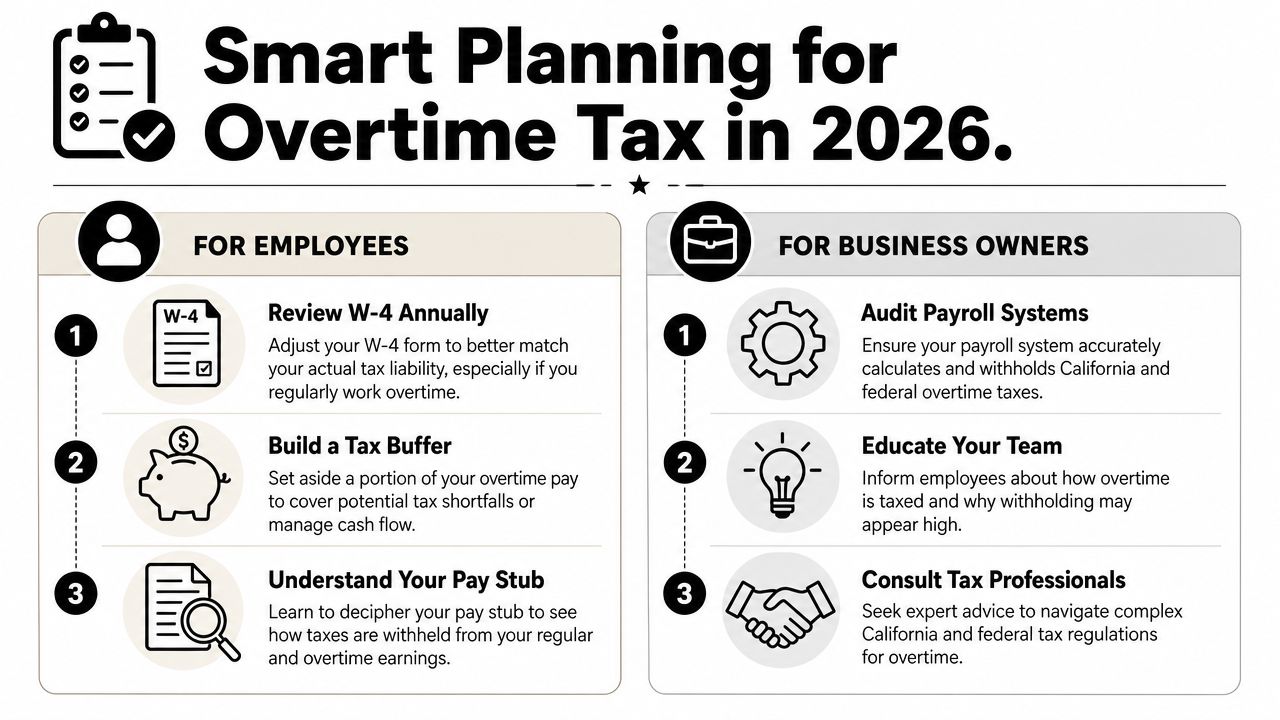
For employees
If you regularly work overtime, don't wait until filing season to look at the issue.
- Review your withholding setup: If your refunds or balances due keep surprising you, revisit your Form W-4 with current income in mind.
- Keep pay records: Save pay stubs that show how overtime was paid. If your employer later breaks out qualified overtime separately, compare it to your own records.
- Budget from net pay, not gross pay: Overtime can help cash flow, but only if you plan around the amount deposited into your account.
- Ask better questions: Instead of asking, “Is my overtime tax-free?” ask, “Which of my overtime is federally qualified, and what remains taxable in California?”
For business owners
Payroll review should happen before year-end pressure arrives.
Consider this short checklist:
- Audit earnings codes in QuickBooks or IRIS. If your system only has one overtime category, that's a red flag.
- Coordinate payroll and tax teams. The person running hours and the person preparing tax forms need the same definitions.
- Train managers and employees. Staff should understand why a California overtime line on a pay stub doesn't automatically equal a federal deduction.
- Test W-2 output early. Don't assume your software setup will produce the correct overtime reporting without review.
Watch for this: If your payroll reports can't tell you why an overtime premium was paid, they may not support accurate federal reporting later.
The best planning move for both groups is the same. Treat California overtime tax as a classification issue first and a tax return issue second. Once the wage type is identified correctly, the tax treatment becomes much easier to manage.
Frequently Asked Questions About Overtime Tax
Are bonuses and commissions taxed like overtime
They can create a similar paycheck experience because withholding on non-regular pay often feels higher than workers expect. But that doesn't mean the final annual tax is automatically higher in the same way the check suggests. The details depend on how payroll processes the payment and how it fits into your total yearly income.
Does California double time qualify for the federal deduction
Generally, no if the pay is required only because of California's state overtime rules. The federal deduction focuses on federally qualified overtime, not every premium category recognized under California labor law. If the extra pay exists because California requires it rather than federal law, you should assume it needs careful review before treating it as deductible.
What if I'm salaried and exempt
Usually, this issue doesn't apply in the same way because exempt employees generally aren't entitled to overtime wages under the standard overtime rules. The first question is classification, not tax. If a worker is misclassified, wage and tax issues can both follow.
Why does my refund not match my overtime withholding
Because withholding is only a prepayment estimate. Your refund or balance due depends on your entire tax return, including total income, filing status, deductions, credits, and how much was withheld across the full year. One large overtime check can distort your expectations if you focus only on that single pay period.
For many readers, the biggest takeaway is this: California overtime pay and federally deductible overtime are not the same category. Once you understand that distinction, your pay stub, tax return, and payroll process all make much more sense.
If you want help sorting out overtime withholding, California add-backs, payroll setup, or W-2 reporting, Allied Tax Advisors can help San Diego employees and business owners make sense of the rules and avoid costly mistakes.