
Yes, you absolutely can claim exempt on your W-4, but it’s a path reserved for a very specific group of people who meet two strict IRS conditions.
Think of it this way: your regular W-4 tells your employer to set aside a small piece of each paycheck to pre-pay your annual tax bill. When you claim 'exempt,' you're essentially telling them, "Don't set anything aside for federal income tax. I won't have a bill to pay." This is only allowed if you had zero tax liability last year and expect the same this year.
What It Really Means to Claim Exempt on Your W-4
Claiming exempt on your W-4 is a direct order to your employer to stop withholding federal income tax from your paychecks. It’s not a tax-saving trick or a way to get a bigger paycheck temporarily; it’s a formal declaration that you don't expect to owe any federal income tax for the year.
This is where a lot of people get tripped up. Getting a big tax refund doesn't mean you had zero tax liability. A refund simply means you overpaid your taxes during the year through withholding, and the IRS is giving you your own money back.
Having zero tax liability is completely different. It means your total tax bill for the entire year was literally $0.
The Big Picture: What to Know Before You Claim Exempt
Before you even think about checking that box, you need to understand the ground rules. Getting this wrong can lead to a surprise tax bill and penalties from the IRS, so it's worth paying close attention.
Here's a quick summary of the essentials.
| Concept | What It Means for You |
|---|---|
| Two-Part IRS Test | You must have had zero tax liability last year AND expect zero tax liability this year. No exceptions. |
| Federal Income Tax Only | This only stops federal income tax withholding. You will still pay Social Security and Medicare (FICA) taxes. |
| Annual Expiration | Your exempt status is only good for one year. You must file a new W-4 by February 15 of the next year to continue it. |
| Tax Bill Risk | If you claim exempt but end up owing taxes, you'll have to pay the full amount at tax time, plus potential penalties. |
Basically, this isn't a decision to be taken lightly. It’s for those who are certain their income will stay below the threshold that triggers federal income tax.
Key Considerations Before Claiming Exemption
Let's break down those core principles a bit more, because this is where the details really matter.
-
It’s an All-or-Nothing Switch: Claiming exempt shuts off all federal income tax withholding completely. You can't use it to just reduce your withholding a little bit.
-
It Expires Every Year: This is a big one. A standard W-4 stays in effect until you change it. An exempt W-4, however, expires. You have to submit a new one every year by February 15 to keep your exempt status going.
-
FICA Taxes Are Unaffected: Remember, this only applies to federal income tax. Your employer is still required by law to withhold 7.65% of your pay for Social Security and Medicare.
Think of claiming exempt as a declaration of certainty, not a financial gamble. The IRS takes withholding seriously, so you need to be 100% sure you qualify before making the claim. An unexpected tax bill next spring is a painful way to learn you were wrong.
Getting this right from the start is crucial. This guide will walk you through exactly how to determine if you qualify, how to fill out the form, and what happens if you make a mistake. Understanding the rules is the first step to making a smart, responsible choice for your financial situation.
Meeting the Two Strict IRS Rules for Exemption
Want to claim exempt on your W-4? First, you have to get past the IRS's two-part test. There are no exceptions and no wiggle room here. Think of these rules as the only two keys that unlock the "exempt" box—if you don't have both, you can't get in.
These rules are surprisingly simple, but they're also a huge source of confusion. Let's clear things up. One rule looks back at last year, and the other looks forward to this year. You have to satisfy both at the same time.
This flowchart breaks down the basic questions you need to answer.
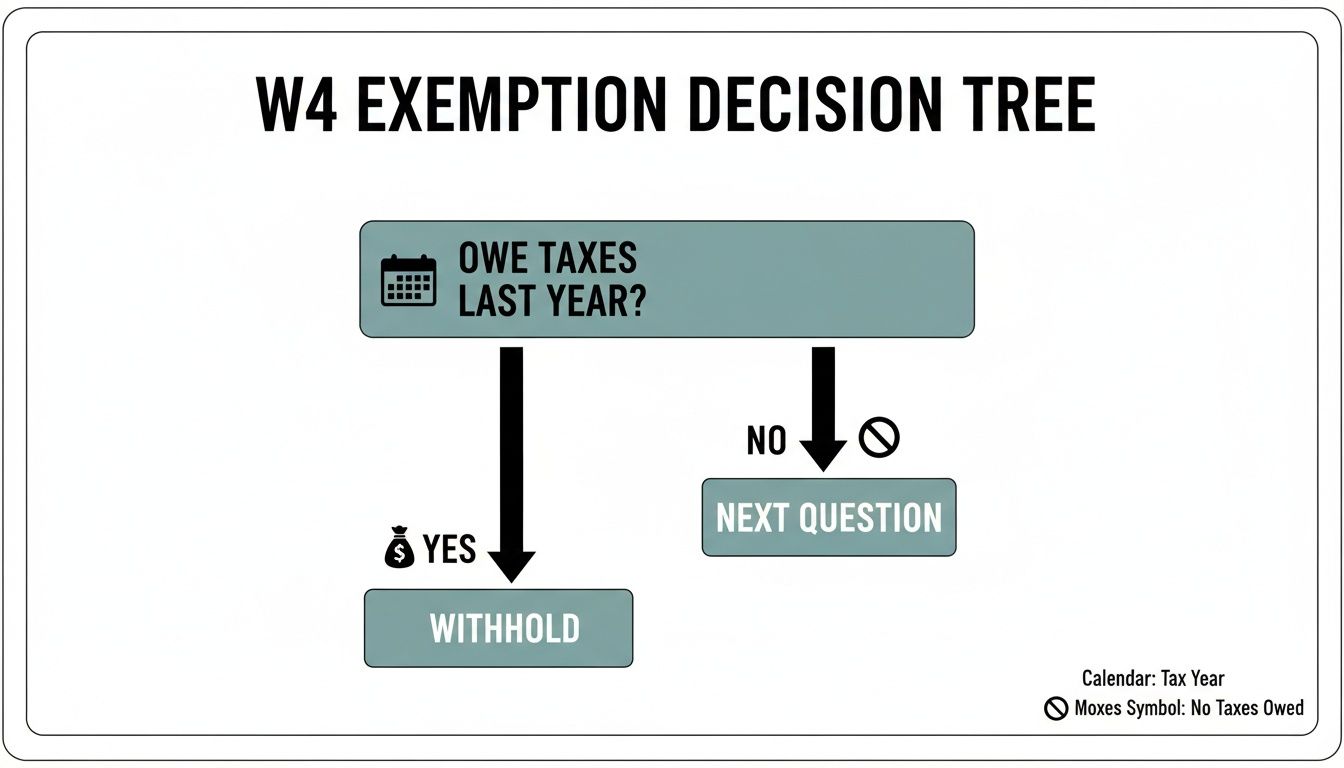
As you can see, if you owed even one dollar in federal tax last year, you're immediately disqualified.
The First Rule: A Look Back at Last Year
The first gate you have to pass is all about last year's taxes. You must have had zero tax liability for the previous tax year. This is where most people get tripped up. They think getting a big refund means they had no tax liability. That’s a myth.
A tax refund just means you gave the government an interest-free loan. Your employer withheld too much from your paychecks. For instance, if your total tax bill was $2,000 but your paychecks had $2,500 withheld, you'd get a $500 refund. You still had a $2,000 tax liability.
To pass this first test, your total federal income tax on last year's Form 1040 had to be exactly $0. This means you were entitled to get back every single penny of federal income tax that was withheld.
The Second Rule: A Look Forward to This Year
The second rule is about the here and now. You must reasonably expect to have zero tax liability for the current tax year, too. This isn't just a guess; you need to look at your expected income for the whole year and be confident you won't owe any federal income tax.
So, who does this usually apply to?
- Students: A college student with a summer job whose total pay for the year won't exceed the standard deduction.
- Retirees: Someone working a few hours a week to supplement their Social Security, keeping their total income below the tax-filing threshold.
- Low-Income Earners: Anyone whose total income for the year is less than the standard deduction for their filing status.
The core idea here is consistency. The IRS is looking for a pattern. Your financial picture from last year (which resulted in zero tax) needs to look a lot like your financial picture for the current year. Claiming exempt isn't a one-off trick for a single low-income year.
This two-part test isn't new. It’s been the standard for a long time, ensuring only people with genuinely minimal tax obligations can stop withholding. As tax experts at H&R Block explain, you must have owed no federal tax in the prior year and expect to owe none in the current year.
What Does "Reasonably Expect" Really Mean?
So how do you "reasonably expect" to have no tax liability? It's time for some quick back-of-the-napkin math. First, add up all the income you expect to earn this year from every source—your job, a side gig, investments, you name it.
Next, compare that number to the standard deduction for your filing status. For 2024, the standard deduction for a single person is $14,600. If your total expected income is less than that, you'll probably have zero tax liability and pass the second test.
But be careful if your situation is more complex. If you have unearned income (like dividends or capital gains) or if someone else can claim you as a dependent, the math changes. In those cases, you really need to double-check the rules before making a move.
How to Fill Out Your W4 to Claim Exempt Status
So, you've crunched the numbers and confirmed you meet both of the IRS's strict requirements for claiming exempt. Great! The next part—actually filling out the Form W-4—is surprisingly simple, but you have to get it exactly right.
The modern W-4, which got a facelift back in 2020, makes this a straightforward process. You get to skip most of the form's complexity. Think of it like using the express lane at the grocery store; you’re bypassing all the regular aisles because you only need to handle a couple of specific items.
A Step-by-Step Guide to the Form
The path to claiming exempt is short and sweet. You only need to touch three parts of the form and leave everything else completely blank.
Here’s exactly what you need to do:
- Complete Step 1 (Personal Information): This is where every W-4 starts. Fill in your full name, Social Security number, address, and filing status (like Single or Married filing jointly). Make sure this information is a perfect match with your Social Security records to prevent any holdups.
- Skip Steps 2 and 3: These sections are for people with multiple jobs, dependents, or other adjustments. Since you're claiming exempt, they don't apply to you. Just leave them completely empty.
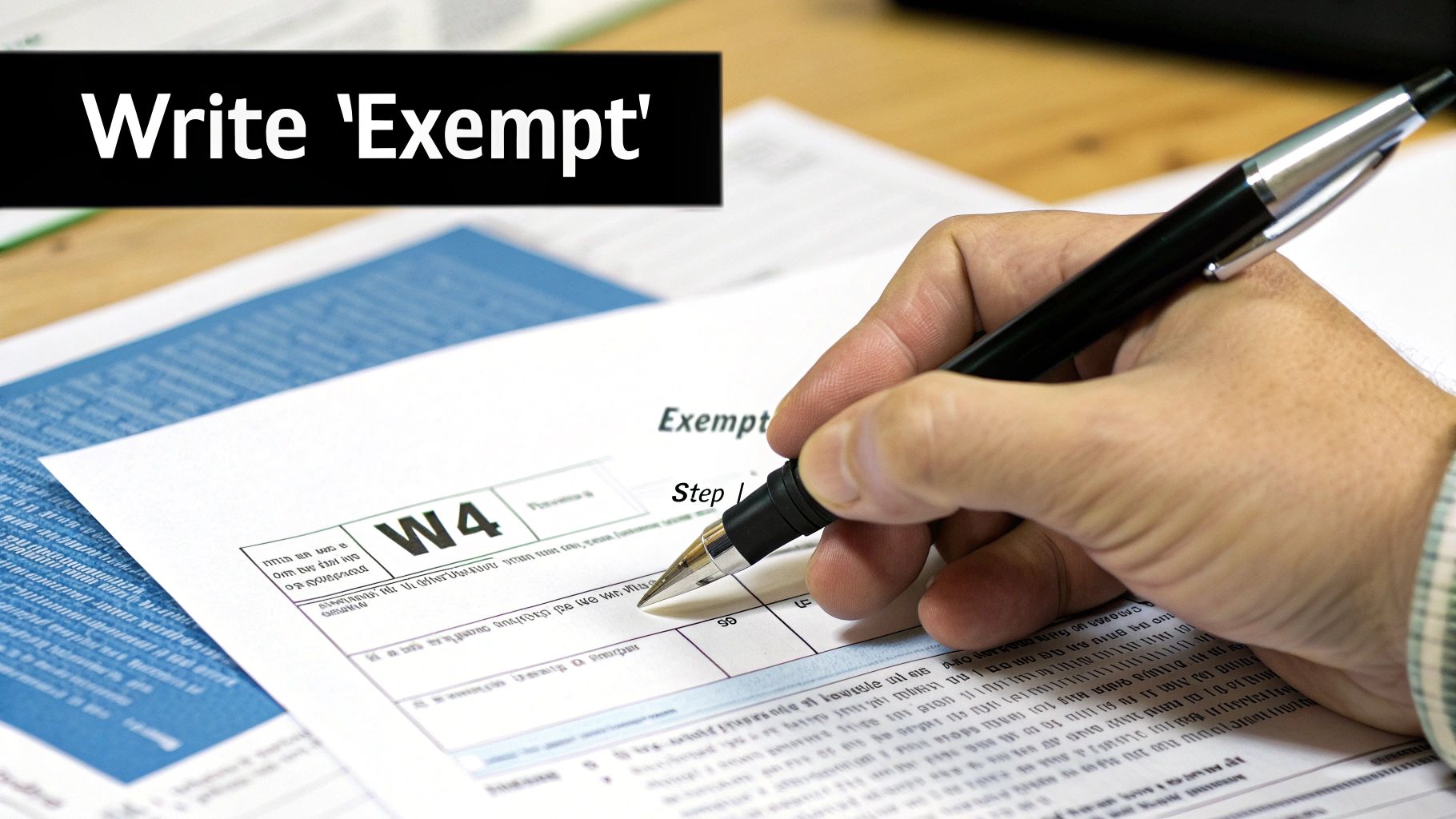
- Write "Exempt" in Step 4: This is the magic step. In Step 4(c), you’ll see a line for "Extra withholding." Don't put a dollar amount here. Instead, write the word Exempt clearly on this line. This is your official declaration to your employer and the IRS.
- Sign and Date in Step 5: Finally, head down to Step 5 to sign and date the form. Your signature is your legal confirmation, under penalty of perjury, that you meet both conditions for exemption. An unsigned form is an invalid form.
The Critical Annual Deadline You Cannot Miss
Claiming exempt status isn't a "set it and forget it" deal. This is a big one that trips a lot of people up. Your exemption is only good for one calendar year. To keep it going, you have to submit a brand-new Form W-4 to your employer every single year.
Key Takeaway: Your exempt status expires on February 15 of the following year. You must hand in a new W-4 claiming exemption on or before this date to stop your employer from automatically starting to withhold federal income taxes.
If you miss that February 15 deadline, your employer has no choice—they are legally required to start withholding taxes. They'll treat you as Single with no other adjustments, which is usually the setting that withholds the most tax possible.
This can lead to a sudden, unwelcome drop in your take-home pay. It’s not your employer penalizing you; they're just following IRS rules to make sure taxes are collected.
How to Revoke Your Exemption Mid-Year
Life happens. Maybe you got a big raise, picked up a side gig, or received some other income that means you no longer have zero tax liability. What do you do now?
If your situation changes and you no longer qualify to be exempt, you're required to revoke your status within 10 days. Don't worry, it's easy. All you have to do is submit a new, updated Form W-4 to your employer.
This time, you will not write "Exempt" anywhere. You'll fill out the form based on your current financial picture, completing Steps 2-4 as needed to calculate the right amount of withholding. For a more detailed walkthrough on this, check out our guide on how to change your tax withholding. Updating your W-4 promptly is crucial for staying on the right side of the IRS and avoiding a nasty tax bill and potential penalties come tax time.
The Real Financial Risks of Claiming Exemption Incorrectly
Thinking of claiming exempt on your W-4 to get a bigger paycheck? It's a tempting thought, but it’s not a harmless shortcut. This isn't one of those "ask for forgiveness, not permission" situations. The IRS has some serious financial penalties in place to make sure people don't misuse this option.
The most immediate shock comes at tax time. If you claim exempt when you shouldn't have, you haven't been paying your federal income taxes all year. Come April, you'll be staring at a bill for your entire year's tax liability, due all at once. That can be a huge, and often devastating, financial blow.

The Sting of the Underpayment Penalty
On top of owing the full tax bill, the IRS will likely hit you with an underpayment penalty. You can think of this as an interest charge on the taxes you should have been paying from each paycheck. Our tax system is designed to be "pay-as-you-go," so if you don't, the IRS essentially charges you for holding onto their money for too long.
This penalty isn't a flat fee; it's calculated based on how much you underpaid, for how long, and the current interest rate. It can easily tack on hundreds or even thousands of dollars to what you already owe.
A false exemption claim can also attract more direct IRS attention. If they decide your claim was intentionally misleading, they can slap you with a separate $500 penalty just for the false statement—and that's before adding in all the other taxes and penalties you'll owe.
Long-Term Compliance Consequences
Making a bad call on your W-4 can put you on the IRS's radar for a long time. The agency might send what's called a "lock-in letter" directly to your employer. This is an official notice that overrides your W-4 and tells your employer exactly how to withhold taxes from your pay.
Usually, a lock-in letter forces your withholding to the highest possible rate—Single with no adjustments. This means your take-home pay will shrink dramatically, and you lose control over your own withholding until the IRS is convinced you're back in compliance. Getting that control back is a slow, frustrating process.
Navigating IRS Notices and Professional Help
An incorrect claim often triggers a stream of confusing letters from the IRS. You might get a notice proposing changes to your return, which can be incredibly stressful. It's crucial to understand what these documents mean. For example, knowing what a CP2000 notice is can prepare you for what happens when the IRS finds a mismatch between their records and your tax return.
Given the potential for such severe financial fallout, guessing is your worst enemy. It's always a smart move to consult with professional tax preparers before making a decision. An expert can look at your unique financial picture, confirm if you're actually eligible for exemption, and help you avoid a mistake that could lead to a massive financial headache down the road.
Real-World Examples of Who Qualifies for Exemption
The IRS rules can feel a bit abstract, so let's put them into practice. Seeing how these rules play out for real people makes it much easier to understand if claiming exempt is the right move for you.
We'll walk through a few common scenarios. Think of these as a gut check—by comparing them to your own situation, you can get a much clearer picture of whether claiming exempt on your W-4 makes sense.
The Student Summer Job Scenario
Let's start with a classic: Alex, a full-time college student who lands a paid summer internship.
Last year, Alex had a similar part-time gig and earned $5,200. That's well under the standard deduction, so his federal tax bill was $0. He got back every dollar that was withheld from his paychecks. So far, so good—he passes the first IRS test.
This year, his internship will pay him $6,000, and he doesn't have any other income. Since the 2024 standard deduction for a single filer is $14,600, he’s again on track to owe nothing in federal income tax.
- Last Year's Tax Liability: $0
- This Year's Expected Tax Liability: $0
- Verdict: Alex checks both boxes. He can confidently claim exempt on his W-4 for the summer, which means more cash in his pocket each payday.
The Retiree with a Part-Time Gig
Now, let's look at Brenda. She’s retired and collects Social Security, but she also works about 10 hours a week at the local library to stay busy and earn a little extra money.
Last year, her library job paid her $9,000. Because her combined income was low, her Social Security benefits weren't taxable, and she owed zero federal income tax. That’s the first rule cleared.
She expects to work the same hours and earn about the same amount this year. Since nothing significant has changed in her finances, it's safe to assume she won't owe any federal tax this year either.
By claiming exempt, Brenda stops the government from taking an unnecessary loan out of her small paychecks. It keeps her cash flow simple and steady, and she won't have to wait until next spring to get her money back as a refund.
Common Mistakes and Who Doesn't Qualify
It's just as important to understand when you can't claim exempt. A lot of people get tripped up here, thinking that a big refund last year or a single low-paying job is enough to qualify. It's not.
Let's bust a few myths.
Scenario 1: The Freelancer with a Day Job
Carlos works part-time at a coffee shop, earning a W-2 paycheck. He expects to make $12,000 there, which is below the standard deduction. Seems simple enough, right?
But here's the catch: Carlos also runs a successful freelance graphic design business that will bring in another $30,000. His total income is actually $42,000, which puts him squarely in tax-paying territory. Even though his W-2 job alone wouldn't create a tax bill, his total income picture makes him ineligible to claim exempt.
Scenario 2: The Employee Who Gets a Surprise Bonus
Maria had a low-income year last year and owed no tax. This year, she expects her regular salary to fall just short of the standard deduction, so she claims exempt on her W-4.
Then, in July, her company announces a surprise $5,000 bonus for everyone. This extra cash pushes her total income for the year over the standard deduction threshold. Suddenly, she's going to have a tax liability.
- What Maria Has to Do: The law is clear. Maria must submit a new W-4 to her employer within 10 days. On the new form, she'll revoke her exempt status and fill out the withholding steps to make sure enough tax is paid for the rest of the year.
The takeaway here is simple: your entire financial life for the year matters. When you're thinking, "Can I claim exempt on my W-4?" you have to look at every dollar from every source, not just the paycheck from one job.
Understanding the Modern W-4 and How It Works
If you’ve been in the workforce for a while, you probably remember filling out a W-4 by trying to figure out the right number of "allowances." Well, it's time for an update. The IRS completely redesigned the form in 2020, and the old, often confusing system of personal allowances is gone for good.
This wasn't just a minor tweak; it was a fundamental shift in how your employer calculates the tax withheld from your paycheck. The new Form W-4 now uses a five-step process that feels more like a mini tax return, creating a much clearer line between your life situation and your withholding. You can get more insights on this major change and Federal Income Tax Withholding Methods over at SmartAsset.
From Allowances to Accuracy
The old W-4 ran on a simple but often inaccurate system of allowances. You'd claim a number based on dependents and other factors, but it was really just a rough estimate. This approach frequently caused people to withhold way too much or far too little, leading to either a huge refund (basically an interest-free loan to the government) or a nasty surprise tax bill in April.
The modern W-4 gets rid of that guesswork. Instead of abstract allowances, it asks for concrete financial details to dial in a much more precise withholding amount.
The new structure now considers things like:
- Your filing status (Single, Married Filing Jointly, etc.)
- Whether you or your spouse hold multiple jobs
- The actual number of dependents you'll claim
- Other income you might have, like from investments or a side hustle
- Any itemized deductions you plan on taking
This method directly connects your withholding to your real tax liability, which just makes more sense. Understanding this is key because it shows why claiming 'exempt' is such a specific and serious declaration. Under this new system, you can’t just tweak allowances to adjust your take-home pay; you're making a precise calculation based on your actual financial life.
The new W-4 is designed for precision, not approximation. It aims to get your withholding as close to your actual tax bill as possible, minimizing surprises when you file your annual return.
Why This Matters for Claiming Exemption
Grasping this modern, five-step system is crucial to understanding the weight of claiming exempt status. The form is built to calculate what you owe based on real numbers you provide. When you claim 'exempt,' you're essentially bypassing this entire calculation and telling the system that your final tax bill for the year will be zero. That’s a powerful statement, not just another box to check.
The move away from allowances reinforces that claiming exempt isn't a clever trick to temporarily boost your paycheck. It is a factual statement about your tax liability for the entire year. By understanding how the W-4 calculates Federal Income Tax (FIT), you can see why the IRS has such clear rules in place. For a deeper dive, learn more about what FIT means on your paystub in our related article.
Answering Your Top W-4 Exemption Questions
Once you get the basics down, the "what if" questions usually start popping up. Real life is rarely as neat and tidy as a tax form, so let's tackle some of the most common questions people ask about claiming exempt.
Think of this as the practical FAQ section—the stuff you need to know when your financial situation doesn't fit into a perfect little box.
What If My Financial Situation Changes Mid-Year?
Life happens. Maybe you got a significant raise, picked up a side gig, or received some other unexpected income. If your financial picture suddenly changes and you now expect to owe federal income tax for the year, you need to act fast.
The IRS gives you a very specific deadline: you have just 10 days to give your employer a new Form W-4. On the new form, you'll simply leave the "Exempt" line blank and fill out the other steps as needed to get your withholding back on track. If you don't, you could be in for a nasty surprise with a big tax bill and underpayment penalties come tax time.
Does a Federal Exemption Cover My State Taxes?
This is a huge point of confusion, so let's be crystal clear: claiming exempt on your federal W-4 does not automatically make you exempt from state or local income taxes.
Your federal W-4 only speaks to the IRS. State tax agencies have their own set of rules and their own forms. To see if you can claim an exemption from state withholding, you’ll have to check your state’s specific guidelines and fill out their required paperwork.
Will Claiming Exempt Stop Social Security and Medicare Taxes?
Nope, not a chance. Claiming exempt only stops the withholding for federal income tax.
Your employer is still legally required to take out FICA taxes—Social Security and Medicare—from every single paycheck. These are entirely separate from your income tax liability.
- Social Security Tax: This is withheld at 6.2%.
- Medicare Tax: This is withheld at 1.45%.
No matter what your W-4 says, these deductions are non-negotiable.
Can My Employer Get in Trouble If I Claim Exempt Incorrectly?
The responsibility for what you put on your W-4 is all on you. Your employer's job is simply to follow the instructions you provide on the form you sign.
As long as they've correctly implemented the W-4 you gave them, they are generally off the hook for any mistakes you made. However, the IRS can step in. If they determine your claim is wrong, they can send your employer a "lock-in letter," which essentially forces a specific withholding amount and overrides whatever you put on your form.
Feeling uncertain about your unique tax situation? The expert team at Allied Tax Advisors provides personalized guidance to ensure you make the right choices for your financial health. Let our experienced professionals help you navigate your tax obligations with confidence.