
Changing your tax withholding is pretty straightforward—it just involves filling out and submitting a new Form W-4 to your company's HR or payroll department. This simple form tells your employer how much federal income tax to take out of each paycheck, which is key to avoiding a nasty surprise tax bill or a giant refund come April.
Why Your Tax Withholding Matters More Than You Think

Let's be real, tax withholding isn't exactly a thrilling topic. But getting it right can mean the difference between owing the IRS and having hundreds, or even thousands, more in your pocket throughout the year. It's easy to see a big tax refund as a windfall, but think about what it really is: an interest-free loan you've given the government with your own money.
When you dial in your withholding, that money goes back into your monthly budget where it can do more for you. The W-4 is a much more dynamic tool than most people realize; it’s not a "set it and forget it" form you fill out on your first day and never touch again. The best approach is to let your W-4 evolve right along with your life.
Key Life Events That Should Trigger a W-4 Review
Certain milestones can completely change your tax picture, making your current withholding settings outdated almost overnight. Knowing what these triggers are is the first step to staying in control of your finances.
This table gives you a quick snapshot of common situations that mean it's probably time to adjust your tax withholding.
| Life Event | Why You Should Adjust Withholding | Potential Impact if You Don't |
|---|---|---|
| Getting married or divorced | Your filing status changes, which directly impacts your tax bracket and standard deduction amount. | You could withhold far too much or too little, leading to a huge refund or a surprise tax bill. |
| Having or adopting a child | You may now qualify for valuable tax credits, like the Child Tax Credit, which significantly lowers your total tax liability. | You'll likely overpay your taxes all year, giving the government an unnecessary loan. |
| Starting a side hustle | Extra income from a second job or freelance work usually doesn't have taxes withheld automatically. | You'll almost certainly owe the IRS at tax time, potentially with underpayment penalties. |
| A significant salary increase | A big pay bump for you or your spouse could push you into a higher tax bracket, meaning you need to withhold more. | You may not withhold enough to cover the new, higher tax rate, resulting in a tax bill. |
Missing these updates is a common oversight. IRS data suggests that around 30% of taxpayers either overpay or underpay their taxes each year, often because their withholding is based on old information. For more on this, you can even explore data about global withholding tax rates to see how this works on a broader scale. A quick W-4 update ensures your paycheck actually reflects your current financial life.
A common mistake is to only think about taxes during tax season. Proactive W-4 management throughout the year is the key to avoiding surprises and optimizing your cash flow.
When you start treating your W-4 as an active part of your financial plan, you empower yourself. It gives you the precision to pay what you owe without locking up your hard-earned money for months on end.
Don't Touch That W-4 Just Yet—Here’s What You Need First
It's tempting to just jump right in and start filling out your W-4, but that’s a classic mistake. I always tell people to think of it like gathering ingredients before you start cooking; a little prep work up front makes the whole process smoother and ensures the final result is exactly what you wanted.
Taking a few minutes to get organized now will save you from the stop-and-start frustration of hunting down documents midway through. Let's get everything you need in one place.
Your Pre-W-4 Checklist
To get an accurate picture of your tax situation, you'll want to have a few key documents and figures at your fingertips.
- Your Latest Pay Stub: This one is a must-have. It shows your year-to-date earnings and, crucially, how much federal income tax has already been taken out. If you're looking at your stub and wondering what all the acronyms mean, our guide explains what FIT means on your paystub.
- Your Spouse's Pay Info (if filing jointly): If you're married and file taxes together, the IRS looks at your combined household income to figure out your tax bracket. Make sure you have your spouse's most recent pay stub on hand.
- Details on Other Income: Got a side hustle? Earning money from investments? You'll need a solid estimate of any income you're earning that doesn't have taxes automatically withheld.
- Planned Tax Credits & Deductions: This is where you can really fine-tune things. Jot down any credits (like the Child Tax Credit) or deductions (like for student loan interest or IRA contributions) you plan to claim.
Getting these numbers together is what separates a wild guess from a calculated financial move. It’s the difference between crossing your fingers and hoping you got it right, and actually knowing you did.
Once you have this information compiled, you’re ready to tackle the W-4 or use a tool like the IRS's Withholding Estimator with confidence. This prep work is your best defense against a surprise tax bill next spring or unnecessarily shrinking your paychecks all year long.
Using the IRS Tax Withholding Estimator Like a Pro
The IRS online estimator is your secret weapon for nailing your withholdings, but I'll admit, it can look a little intimidating at first. Let's break it down together. Don't think of it as a test—it's more like a smart calculator built to help you answer the question, "How do I change my tax withholding accurately?"
It takes the dense language of the tax code and translates it into a series of straightforward questions. You feed it your financial details, and in return, it runs the numbers and gives you a clear, actionable recommendation for your W-4.
Getting Started with the Estimator
When you first land on the estimator's page, you'll be greeted with questions about your basic info, like your filing status and whether you can be claimed as a dependent. This first step lays the groundwork for the entire calculation.
Here’s a peek at what you'll see. This is where you'll want to have those documents we talked about handy—your latest pay stubs, income projections, and notes on any deductions or credits.

The interface is really designed to guide you through the process, making sure you don't miss any critical details that could throw off your tax outcome. The tool is especially powerful because it accounts for nuances that the paper W-4 worksheets can't always capture easily, especially if your financial life isn't super simple.
A Real-World Example in Action
Let’s walk through a common scenario to see this tool in action. Imagine a married couple, Alex and Jordan, who file their taxes jointly.
- Alex has a full-time job earning $85,000 annually.
- Jordan recently started a freelance graphic design business and expects to earn about $20,000 this year.
- They have one child, who is 5 years old.
- They also plan to contribute $4,000 to a traditional IRA.
This situation has a few moving parts: two different income streams (one W-2, one 1099), a major tax credit, and a key deduction. This is exactly where the estimator shines.
Pro Tip: Don't just guess on your income. Use your most recent pay stub to find your year-to-date earnings and the exact federal tax already withheld. For freelance income, look at your invoices or bank deposits to make a realistic projection for the rest of the year.
The tool will prompt them to enter Alex's salary, pay frequency, and the federal tax withheld so far. Then, it will ask about Jordan's self-employment income. Finally, it will have sections for them to add information about their child and other financial details.
Understanding Your Adjustments and Credits
This is where you really get to fine-tune your withholding. The estimator will ask about things that reduce your taxable income—a crucial part of getting the math right.
For Alex and Jordan, they would input:
- Dependents: They'll claim their 5-year-old child, which makes them eligible for the Child Tax Credit. The estimator automatically calculates the value of this credit for them.
- Adjustments: They'll enter their planned $4,000 IRA contribution. This directly reduces their overall taxable income.
Understanding your adjusted gross income is a huge part of this process. If you want to dive deeper, you can learn more about what adjusted gross income is and see how it impacts your bottom line.
Once all the information is in, the estimator calculates their total expected tax liability for the year. It then compares that number to the amount Alex is on track to have withheld from their paychecks.
The final results page will show them if they're on track to overpay, underpay, or get it just right. More importantly, it gives them a precise dollar amount to enter on their new Form W-4. For instance, it might recommend they have an extra $150 withheld from each of Alex's paychecks to cover the taxes on Jordan's freelance income. This is the kind of specific, actionable advice that makes the tool so valuable.
Translating Your Estimator Results to the W-4 Form
You've made it through the IRS Tax Withholding Estimator, and now you have the most important piece of the puzzle: a clear, data-driven recommendation for your withholding. So, what's next? It's time to put those numbers into action on the actual Form W-4. This is where your hard work pays off, directly impacting the size of your paychecks.
A lot of people find this final step intimidating, but it's much more straightforward than it looks. The IRS redesigned the W-4 to be more intuitive, and the estimator's results page is built to align almost perfectly with the form's sections.
Let's walk through exactly how to map the estimator’s output onto the W-4 you'll hand over to your employer.
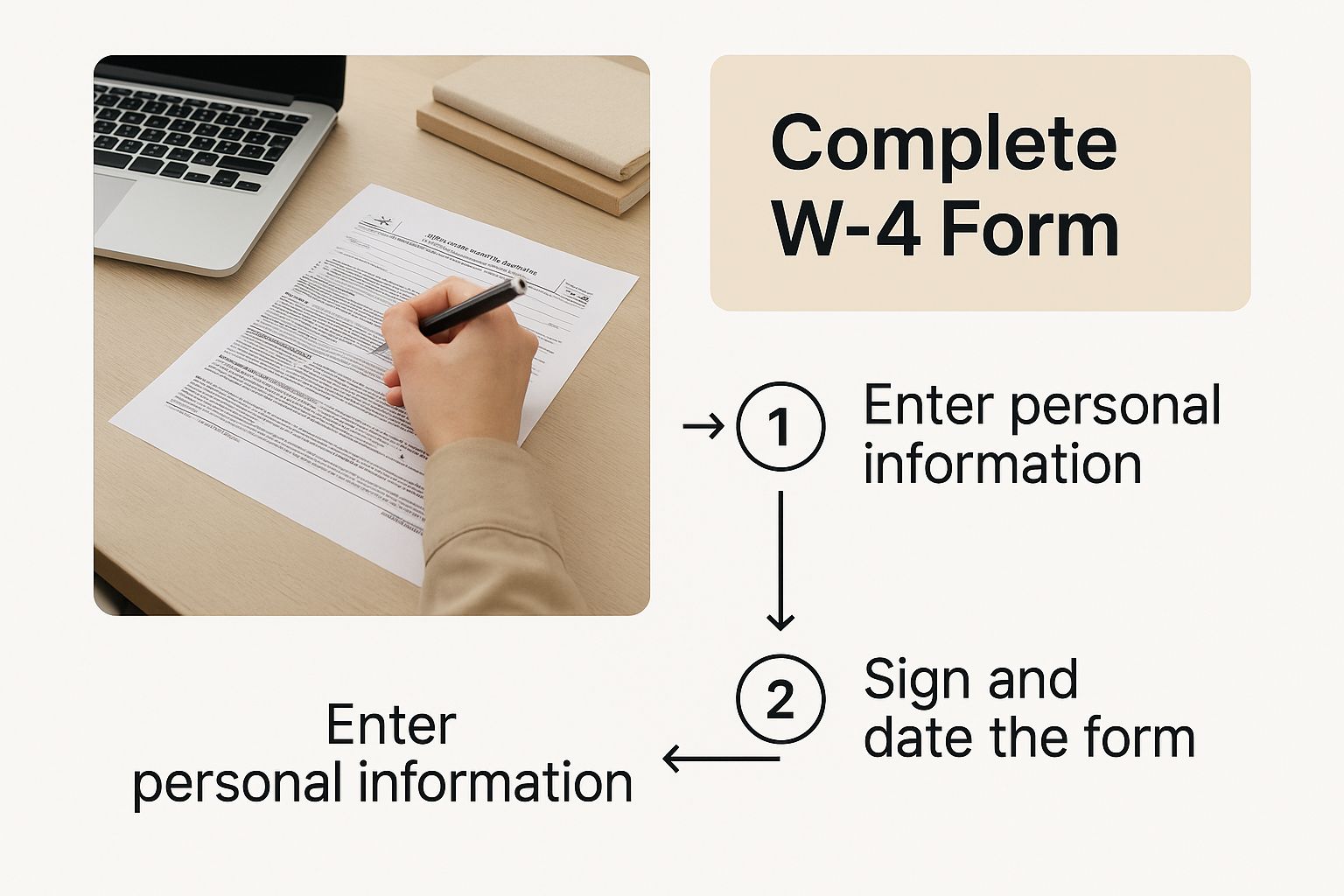
This simple flow—gather your info, run the numbers, and fill out the form—is the key to getting your withholding right and avoiding any last-minute surprises.
Decoding the Modern W-4 Form
The current Form W-4 is broken into five steps. For most people, only Step 1 (your personal info) and Step 5 (your signature) are mandatory. Steps 2, 3, and 4 are where you’ll plug in the specific recommendations from the IRS estimator.
Think of the estimator as your cheat sheet. It did all the heavy lifting, so now all you have to do is copy the answers over.
The estimator’s results page will give you specific figures for these lines:
- Step 3 Claim Dependents: The estimator will tell you the exact dollar amount to put on line 3. It calculates this by multiplying your qualifying children by $2,000 and any other dependents by $500.
- Step 4 Other Adjustments: This section has three parts, and the estimator will provide a single number for each line that applies to your situation.
- (a) Other Income: If you have income from a side gig, investments, or other non-job sources, the tool calculates the amount to note here.
- (b) Deductions: For those who itemize deductions beyond the standard deduction (like for significant mortgage interest or charitable giving), the estimator provides the figure for this line.
- (c) Extra Withholding: This is probably the most common adjustment. If the estimator finds you need a bit more tax withheld from each paycheck to cover your total tax liability, it will give you a specific dollar amount to enter here.
The most important thing to remember is this: you don't need to do any new math. Simply copy the numbers from the estimator's results page into the corresponding lines on the Form W-4.
The Real-World Impact of Getting It Right
Tweaking these numbers directly affects your financial health. According to the IRS, nearly $300 billion was refunded to taxpayers in recent years—a clear sign that millions of people are over-withholding. When you overpay, you're essentially giving the government an interest-free loan with your own money.
On the flip side, under-withholding can get expensive. Nearly 30% of filers end up owing the IRS, and if you owe more than $1,000, you can get hit with an underpayment penalty. A precise W-4 helps you find that sweet spot, keeping your money in your pocket throughout the year while making sure you’ve covered your tax obligations.
For a broader perspective, you can find more insights on withholding tax rates from around the globe.
A Practical Example
Let’s circle back to our couple, Alex and Jordan. The estimator told them to have an extra $150 withheld from Alex’s paycheck to cover the taxes on Jordan’s freelance income.
Here's exactly how they would fill out Alex’s W-4:
- Step 1: They fill in their personal information and check the box for "Married filing jointly."
- Step 2: They leave this entire section blank. The estimator already did the work of combining their incomes into the final calculation.
- Step 3: They enter $2,000 for their one child.
- Step 4(c): Here's the key part. They write $150 on the line for "Extra withholding."
- Step 5: Alex signs and dates the form, and it's ready to go.
That's it. By translating the estimator's results this way, they've clearly instructed Alex's employer to adjust the withholding to cover all their household income. No more guessing, and no nasty tax bill next April. This is how you change your tax withholding with confidence.
Getting Your New W-4 to Your Employer and Making Sure It Sticks
You’ve wrestled with the IRS calculator and filled out your new Form W-4. Great! But you're not quite at the finish line. The final, crucial step is getting that form to your employer and confirming the changes actually hit your paycheck.
How to Submit Your Updated W-4
How you hand this off really just depends on your company's setup. Many companies, especially larger ones, have an online HR or payroll portal. You'll likely find a section for "Tax Forms" or "Withholding" where you can enter the new information directly from your worksheet. It's usually pretty straightforward.
For other employers, it might be a more old-school approach: print the physical form, sign it, and hand it over to your HR manager or the person who handles payroll.
My advice? Don't just leave it on someone's desk. It’s always a good idea to send a quick follow-up email. Something simple like, "Hi, just confirming I submitted my updated W-4 today. Could you let me know when I can expect to see the change in my pay?" This creates a simple paper trail and keeps everyone on the same page.
The Final Check: Your Pay Stub
The real proof is in the pudding—or in this case, your pay stub. You'll need to keep an eye on your next paycheck or two to make sure everything went through correctly.
Don't panic if you don't see the change on the very next check. Most payroll departments have processing deadlines, so if you submit your form after their cutoff, the update might not kick in until the following pay period.
When that new pay stub arrives, scan for the federal tax withholding line. It’s usually labeled something like "Federal Income Tax," "FIT," or "Fed Tax."
Now, pull out an old pay stub and compare the numbers. You should see a noticeable difference that reflects your changes.
- Increased withholding? The tax amount deducted should be higher.
- Claimed more dependents or deductions? The tax amount should be lower.
This quick comparison is your confirmation that the payroll department got your request and you’ve successfully dialed in your withholding.
If the amount hasn't changed after two paychecks, or if it just looks completely wrong, get in touch with your HR or payroll contact. A simple clerical error is often the culprit, and a friendly chat is usually all it takes to get it sorted out. This last bit of diligence ensures your hard work pays off for the rest of the year.
Common Questions About Changing Your Withholding
When you get into the weeds of adjusting your tax withholding, a few questions always seem to surface. Knowing the answers to these common sticking points will help you handle your unique situation and sidestep mistakes that could leave you with a surprise tax bill.
How Often Can I Actually Change My W-4?
Honestly, as often as you need to. There's no official limit on how many times you can submit a new Form W-4 to your employer.
The best practice I always recommend is to give it a quick review at least once a year. It's also smart to revisit it anytime you have a major life or financial event—think getting married, having a baby, getting a big raise, or even starting a side business. This flexibility is what makes the pay-as-you-go system work, letting you make adjustments on the fly.
What if I Have a Side Hustle With Unpredictable Income?
This is a classic scenario. For income that bounces around, the IRS Tax Withholding Estimator is incredibly helpful. It can help you figure out how much extra withholding to add to your regular paycheck to cover the taxes on that side income.
The other route, and one many freelancers prefer, is to manage it yourself by making quarterly estimated tax payments directly to the IRS. If that sounds like a better fit, it's worth taking a moment to understand what estimated tax payments are and see if it's the right strategy for you.
A word of caution: Don't just ignore income that doesn't have taxes withheld. The IRS expects you to be paying tax on all your earnings throughout the year. If you don't, you can get hit with underpayment penalties, even if you settle the full bill by the April tax deadline.
Will Changing My Federal W-4 Automatically Update My State Taxes?
No, and this is a critical detail that trips a lot of people up. Your federal Form W-4 only impacts your federal income tax withholding.
Most states with an income tax have their own, completely separate withholding forms and rules. Whenever you update your federal W-4, make it a habit to immediately check if your state form needs an update, too. Keeping them in sync is key to avoiding an unexpected state tax bill.
I Submitted a New W-4, but My Paycheck Still Looks Wrong. Now What?
First, don't panic. Give it a pay cycle or two for the changes to kick in. Payroll departments run on tight deadlines, and it's very possible your new form simply missed the cutoff for the very next paycheck.
If, after a couple of paychecks, things still seem off, just have a friendly conversation with someone in your HR or payroll department. A simple, polite "Hey, can you just double-check that my latest W-4 has been processed?" is all it takes. Simple data entry errors happen to the best of us and are usually a quick fix.
Figuring out the nuances of tax withholding can feel overwhelming, but you don't have to go it alone. The team at Allied Tax Advisors is here to offer expert guidance and create a personalized tax strategy that ensures your finances are set up for your unique situation. https://alliedtax.com