
Tax season hits, and a lot of separated or divorced parents end up staring at the same question on their laptop screen: can you claim child support payments on taxes?
Usually the panic starts after a practical moment. You paid support all year and want to know if there's a deduction. Or you received support and you're worried you'll owe tax on money you needed for groceries, school costs, and rent. Then someone mentions the Child Tax Credit, someone else mentions head of household, and suddenly you're trying to decode family law and IRS rules at the same time.
Here's the straight answer. You can't deduct child support if you pay it, and you don't report it as taxable income if you receive it. But that's only the first layer. The bigger tax issue, and often the more valuable one, is who gets to claim the child.
That distinction is where people make expensive mistakes. They focus on the payments and miss the dependency rules, filing status, and credits tied to the child. If you're dealing with a new custody order, mixed support language in a divorce judgment, or old arrears, that confusion gets worse fast.
Navigating Taxes After a Divorce or Separation
Maria had just finished sorting her court papers at the kitchen table. Her divorce was final, support payments had started, and now she had two urgent questions. Would the child support she received count as income, and could her ex claim the kids because he was sending money every month?
Those are normal questions. They also get answered badly all the time.

The tax rule for child support itself is simple. The strategy around it isn't. Many parents assume paying support should create a deduction, or that receiving support should raise their tax bill. Neither assumption is right under federal law.
The primary stress point is that two separate tax questions get mashed together:
- Question one: Are child support payments deductible or taxable?
- Question two: Which parent gets the tax benefits connected to the child?
Those are different issues, with different rules, and they shouldn't be mixed.
Practical rule: If you're asking whether child support changes your taxable income, the answer is no. If you're asking who gets the child-related tax benefits, you need to look at custody and dependency rules.
That second question often matters more than people realize. A parent may get no deduction for paying support, yet still be able to claim the child if the paperwork is properly structured. Another parent may receive support and still lose the dependency claim if they signed the wrong release form without understanding the tax consequences.
A seasoned CPA is essential. Family court language often sounds clear to the parties but isn't precise enough for a tax return. The IRS cares about classification, documentation, and who is legally entitled to claim what.
Why Child Support is Tax-Neutral
The IRS treats child support as tax-neutral. In plain English, that means it doesn't create a tax deduction for the payer and it doesn't create taxable income for the recipient.
The simplest way to think about it
Think of child support as money already taxed once, moving from one parent to help cover a child's living costs. It isn't a business expense. It isn't wages. It isn't investment income. It's a personal legal obligation tied to raising a child.
That is why federal tax law doesn't reward the payer with a deduction and doesn't punish the receiving parent with a tax bill. The government is basically saying: this money is for the child's support, so tax rules shouldn't distort it.
The IRS framework is direct. Under IRS Publication 504 guidance summarized by H&R Block, child support is "not deductible by the payer and not taxable to the payee." That classification separates it from ordinary deductible expenses and keeps it outside gross income calculations for the recipient.
What this means on your return
If you pay child support:
- Don't deduct it on Form 1040. It isn't an above-the-line deduction.
- Don't try to bury it as another personal expense. That creates problems, not savings.
- Don't assume wage garnishment changes the rule. The payment method doesn't create a deduction.
If you receive child support:
- Don't report it as taxable income.
- Don't include it in gross income just because it showed up regularly.
- Don't let software prompts push you into misclassifying it. Tax software is only as good as the answers entered.
If you're also trying to understand how support gets calculated before it ever reaches the tax side, this explanation of how Texas child support is determined is a useful legal primer because it shows how family law calculations and tax treatment are separate issues.
For a focused summary of the federal tax rule itself, see Allied Tax Advisors' guide on whether child support is taxable.
Child support is legally important, financially important, and tax-neutral. Those three things can all be true at once.
Why the rule exists
The policy behind the rule is sensible. Child support is meant to help pay for food, housing, clothing, education, and day-to-day care. Taxing the receiving parent on that money would reduce what reaches the child. Giving the payer a deduction would turn child support into a tax planning tool rather than a support obligation.
That's why this area is simpler than people expect on paper, and trickier than people expect in real life. The rule itself is clean. The disputes usually come from labeling problems, mixed support language, or confusion with dependency claims.
Child Support vs Alimony A Critical Tax Distinction
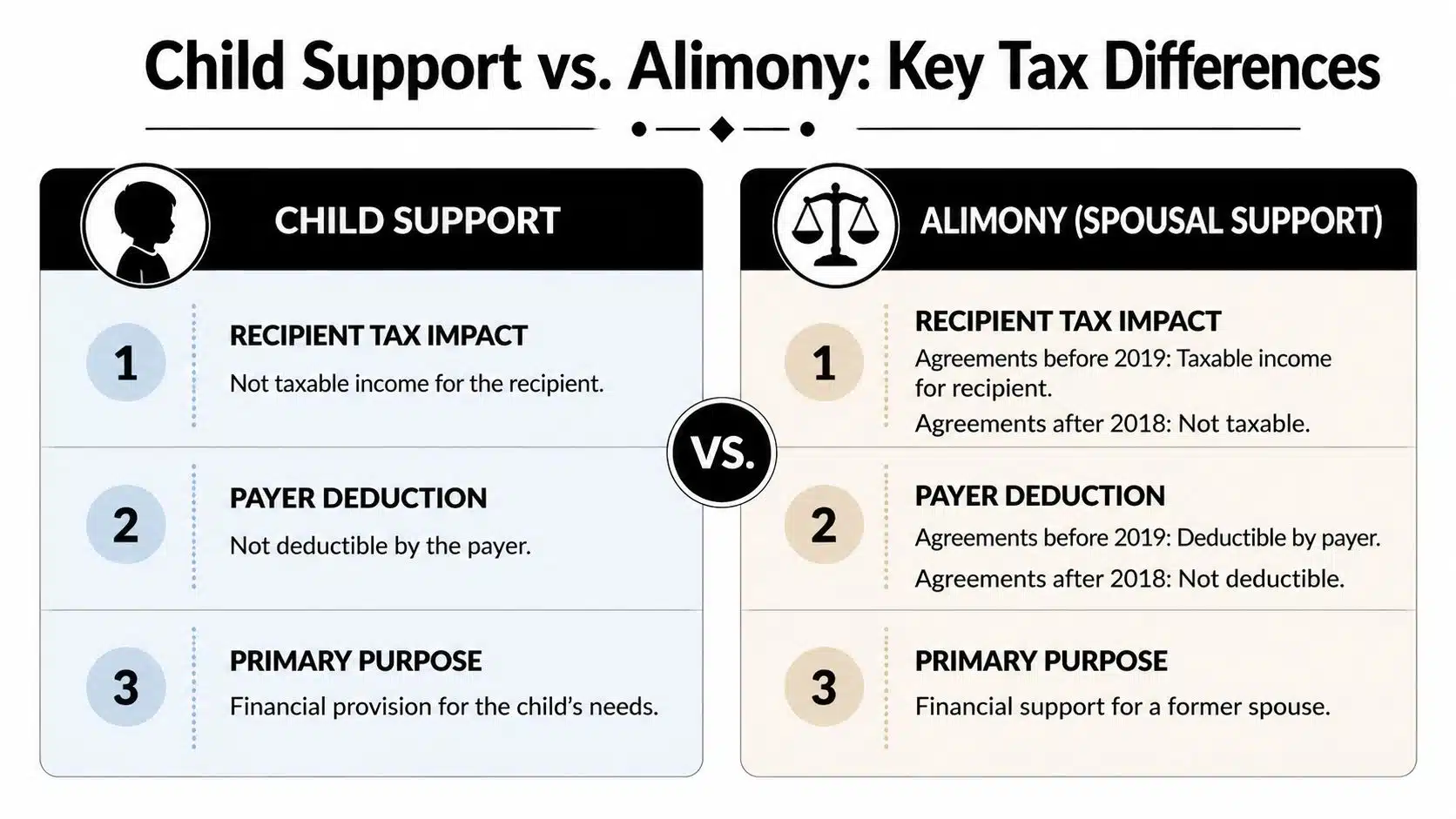
A lot of tax mistakes happen because people use child support and alimony as if they mean the same thing. They don't. They serve different purposes, and the tax treatment depends on what the payment is.
Why this distinction matters
Child support is for the child.
Alimony, also called spousal support or maintenance, is for a former spouse.
That sounds obvious, but divorce orders often bundle obligations together in ways that confuse people later. If your decree uses loose wording, you can end up assuming a payment is deductible when it isn't, or reporting income you didn't need to report.
The other complication is timing. Alimony rules changed for divorces finalized after the federal law change tied to the Tax Cuts and Jobs Act. According to the verified data provided, alimony was deductible for divorces before January 1, 2019, and became tax-neutral after that change. Child support, by contrast, has long been non-deductible and non-taxable.
Tax Treatment at a Glance Child Support vs Alimony
| Payment Type | Payer's Treatment (Deductible?) | Recipient's Treatment (Taxable Income?) |
|---|---|---|
| Child Support | No | No |
| Alimony for pre-2019 divorce agreements | Yes | Yes |
| Alimony for post-2018 divorce agreements | No | No |
Where people go wrong
The common mistakes look like this:
- Reading the decree casually: If the order says "support" without separating child support from spousal support, trouble starts.
- Assuming all recurring payments work the same way: They don't. The label and legal structure matter.
- Ignoring modification dates: A later modification can affect how an obligation should be treated.
If your decree mixes terms like support, maintenance, reimbursement, and family expenses, stop guessing. The wording may control the tax result.
A practical way to classify a payment
Ask three questions:
Who is the payment meant to support?
If it's clearly for the child, treat it as child support.When was the divorce agreement executed?
That matters for alimony treatment.Does the order separately state the amounts?
If the order cleanly splits child support and alimony, compliance is easier. If it doesn't, a tax review is worth the cost.
Parents often think the issue is whether the payment was made monthly, by check, or through payroll withholding. That's not the deciding factor. The deciding factor is legal classification.
My recommendation
If you pay or receive any court-ordered amount that isn't clearly labeled, don't file until someone experienced has reviewed the decree or settlement agreement. A sloppy assumption in this area can create an amended return, IRS correspondence, and a fight with your former spouse.
Who Can Claim the Child as a Dependent
The larger tax benefit usually resides in this detail. You may not get a deduction for child support, but claiming the child can provide credits and filing benefits that matter far more than people expect.

Custody usually controls the tax claim
Under IRS rules, the custodial parent generally has the right to claim the child. The non-custodial parent can claim the child only if the custodial parent signs Form 8332. As noted in TurboTax's discussion of child support and taxes, Form 8332 was introduced in 2009, and the Child Tax Credit was $2,000 per qualifying child in 2023, impacting over 40 million families annually.
That single rule clears up a lot of bad assumptions. Paying support does not automatically let you claim the child. Covering a lot of the child's expenses does not automatically let you claim the child either. The IRS wants the correct custodial status or a signed release.
Why Form 8332 matters so much
Form 8332 is the cleanest way to prevent a tax dispute. If the custodial parent agrees that the non-custodial parent can claim the child for a tax year, that release should be documented properly. A side email, text message, or informal promise isn't the standard you want to rely on when filing.
Here is the blunt advice:
- If you're the custodial parent, don't sign Form 8332 casually. Know exactly which year or years you're releasing.
- If you're the non-custodial parent, don't file based on verbal permission. Get the signed form.
- If your court order says one parent can claim the child, don't assume that's enough by itself. Make sure the tax paperwork lines up with the legal agreement.
The tax benefits tied to the child
Claiming the child can affect more than one line on a return. It can shape eligibility for the Child Tax Credit and can affect filing status in some cases. If you're trying to sort out whether you qualify for a more favorable filing status, this guide on filing single or head of household is worth reviewing before you submit a return.
For parents dealing with shared parenting schedules, legal custody language can add another layer of confusion. This overview where Bryan Fagan discusses 50/50 custody child support helps illustrate why equal parenting time and tax entitlement are not always the same thing.
The parent who pays support is not automatically the parent who claims the child. Those are separate rules, and mixing them up causes rejected returns.
My recommendation
Negotiate tax benefits deliberately. Put the arrangement in writing. Use Form 8332 when required. If an agreement alternates years, keep a calendar note and a signed copy of the release. This is one of the easiest tax disputes to avoid, and one of the most annoying to clean up after the fact.
Navigating Special Child Support Tax Situations
Basic child support is straightforward. The edge cases are where people get tripped up.
Mixed payments and unallocated support
Some divorce agreements use broad language such as "family support" or combine child support and spousal support into one payment. That creates a classification problem. If the order doesn't clearly separate the amounts, the parties often make inconsistent assumptions later.
My advice is simple. Don't self-interpret mixed language. Have the order reviewed before filing. If a payment contains more than one support category, the tax treatment depends on the legal structure, not what either parent intended after the fact.
Arrears don't become deductible or taxable
Paying old child support arrears doesn't suddenly create a tax deduction. Receiving past-due child support doesn't suddenly make the money taxable. Arrears are still child support.
What changes in arrears cases is usually enforcement, not taxability. Tax refund offsets, garnishments, and collection notices may enter the picture, but that doesn't convert child support into deductible or taxable income.
Direct payments to third parties
Parents often ask about paying a school, doctor, landlord, therapist, or activity provider directly instead of sending cash to the other parent. Direct payment may satisfy a family law obligation if the order allows it, but it usually doesn't change the tax character of the payment.
The key issue is documentation. If the support order allows direct payments, keep proof that the payment was required and made. If the order doesn't allow it, you may create a family court dispute even if your tax treatment stays the same.
Property transfers instead of cash
Sometimes support disputes get tangled with property settlements. One spouse transfers an asset, takes over a bill, or gives up a claim to offset support issues. That is not a do-it-yourself tax call.
Property transfers raise different tax questions than recurring support payments. If your agreement uses assets to satisfy family obligations, have both the legal and tax treatment reviewed together.
For readers comparing how family courts approach support inputs in different states, this overview of Hawaii child support calculations shows why support formulas and tax reporting should be analyzed separately.
Situations that deserve extra caution
- Bundled support language: One payment described with more than one purpose
- Catch-up payments: Large arrears paid in a single period
- Third-party expenses: Tuition, medical bills, or housing costs paid directly
- Asset-based settlements: Property transfers used to resolve support disputes
When money moves under a divorce order, the label on the payment matters. When assets move, the tax questions multiply.
State Tax Rules and Essential Documentation
Most states generally follow the federal approach on child support, but don't rely on assumptions. State conformity isn't something to guess at, especially if your divorce order, residence, and enforcement state don't all match.
The federal treatment is clear and substantial. According to TaxAct's discussion of child support tax law, in 2021, 6.9 million custodial parents received $15.8 billion in formal child support payments, and none of that triggered federal income tax liability, preserving an average of $2,300 per recipient annually from taxation.
What documents you need to keep

A clean paper trail solves a lot of future problems. Keep these records in one folder, digital or physical:
- Divorce decree or separation judgment: This is the starting point for classifying payments.
- All later court modifications: Support terms change. Your records need to show the current rule.
- Proof of payment: Bank statements, canceled checks, wage withholding records, or payment portal confirmations.
- Support ledger or payment history: Track what was due, what was paid, and when.
- Form 8332 if applicable: If the non-custodial parent claims the child, keep the signed release.
- Tax returns for the relevant years: These help if the IRS or your preparer needs to compare filing positions over time.
Why this paperwork matters
Documentation protects you in three ways.
First, it helps classify payments correctly. Second, it helps resolve disputes with a former spouse about whether support was paid or who had the right to claim the child. Third, it gives you something solid to show a tax professional or tax authority if questions come up later.
My recordkeeping advice
Create a folder for each tax year. Put in the decree, any modifications, proof of every payment, and any dependency release forms. If your support is processed through payroll or a county agency, download annual records before links expire or account access changes.
When to Call a CPA for Your Tax Situation
Some child support tax issues are simple enough to handle with good records and clear paperwork. Others are not. If your situation has any gray areas, guessing is the expensive option.
Call a CPA if any of these apply
- Your order combines support types: If child support and spousal support aren't clearly separated, you need classification help.
- You and your ex disagree about who claims the child: This can delay refunds and trigger IRS scrutiny.
- Form 8332 is missing, incomplete, or disputed: Don't file first and hope later.
- You paid arrears or had a refund offset: The tax treatment may be simple, but the reporting and documentation still need care.
- You used property or direct bill payments to satisfy obligations: Those arrangements deserve a review.
- You own a business or have variable income: Family court numbers and tax numbers often diverge.
- You received an IRS notice: At that point, speed matters.
A CPA can review the decree, classify the payments, confirm the dependency claim, and make sure the return matches the facts. That's far better than filing a return built on assumptions from a message board or a tense conversation with your ex.
If you're trying to choose professional help, this article on how to find a good CPA gives a practical checklist for evaluating experience and fit.
One option in San Diego is Allied Tax Advisors, which handles individual tax preparation, amended returns, IRS notices, and resolution work that can overlap with divorce-related tax issues.
The right time to get tax advice is before you file the return you may need to fix later.
Child Support Tax FAQs
Does child support count as income for EITC purposes?
No. Child support isn't taxable income for the recipient, and the verified data states recipients do not report child support on Form 1040 or include it in gross income calculations for determining filing requirements or eligibility for credits like the Earned Income Tax Credit.
Can parents create their own tax rule in a divorce agreement?
They can agree to many things between themselves, but they can't override IRS requirements. If the non-custodial parent is going to claim the child, the tax paperwork has to support that position, including Form 8332 when required.
What if the non-custodial parent provides more than half the child's support but doesn't have Form 8332?
That parent should not assume they can claim the child. Under the verified IRS rule set described earlier, the non-custodial parent gains that right solely through a signed Form 8332 from the custodial parent.
If you're dealing with child support, dependency claims, or a divorce decree that doesn't read cleanly, get a second set of eyes before filing. Allied Tax Advisors can help you review the tax treatment, organize the right documents, and file a return that matches the actual rules instead of costly assumptions.