
When you sell a rental property, the IRS wants its piece of the pie—and that includes clawing back some of the tax benefits you've enjoyed along the way. This process is known as depreciation recapture, and it's a tax bill that often catches investors by surprise.
Think of it this way: the depreciation deductions you took each year were essentially a tax deferral, not a tax-free gift. The IRS let you reduce your taxable income while you owned the property. But when you sell, it’s time to settle up on those deferred taxes. This isn't the same as capital gains; it's a separate tax with its own rules.
The Foundation of Depreciation Recapture
Depreciation is one of the best perks of real estate investing. It's a "phantom expense" that lets you write off a piece of your property's value each year, lowering your annual tax bill without you actually spending any cash.
But the IRS keeps a running tab. When you sell, the government essentially says, "Okay, we let you defer taxes on all those deductions. Now it's time to pay them back." The total depreciation you claimed over your holding period is added back and taxed. To really get a handle on this, you first need a solid grasp of how the initial deductions work, which is covered well in this guide on What Is Rental Property Depreciation Explained.
Why Recapture Exists
So, why does the IRS do this? It’s all about preventing a tax loophole.
Without recapture, an investor could get a double benefit: first, by deducting depreciation against their regular income (which is often taxed at higher rates), and second, by selling the property and having the entire profit taxed at the typically lower long-term capital gains rates. Recapture closes this loophole, ensuring the portion of your gain that came from depreciation deductions is taxed fairly.
This isn't just some minor detail in the tax code; it fundamentally changes the math on your investment's total return. Your real profit isn't just the sale price minus what you paid.
Here's the most critical part: Depreciation recapture on rental property is not optional. The IRS taxes you on the depreciation you were allowed or allowable to take. This means even if you never claimed a single depreciation deduction, you'll still be taxed as if you had.
Getting this concept down is the first step toward becoming a savvy real estate investor. It shapes how you think about long-term profitability and helps you plan your financial strategy from day one.
How Taking Depreciation Lowers Your Property's Basis (And Creates a Future Tax Bill)
To get your head around depreciation recapture on rental property, we first have to talk about your property's adjusted cost basis. Just think of the basis as its official value for tax purposes. When you first buy a property, its basis is pretty simple—it’s what you paid, plus some of your closing costs.
But here's where things get interesting. Each year, as you take that handy depreciation deduction, you're also systematically lowering this basis. The IRS mandates that residential rental properties are depreciated over 27.5 years. While this annual write-off is a fantastic way to lower your taxable income each year, it's also chipping away at your property's value on paper.
This slow-and-steady reduction is what sets the stage for a future tax bill. The lower your basis gets, the wider the potential gap between that basis and your final sale price. That gap is your taxable gain, and a big chunk of it is going to be subject to recapture.
The "Allowed or Allowable" Rule You Absolutely Cannot Ignore
This is a big one, and it trips up a lot of new investors. In the eyes of the IRS, taking depreciation isn't optional. The tax code is built on an "allowed or allowable" principle, which means when you eventually sell, the IRS calculates your gain as if you claimed every penny of depreciation you were entitled to.
You can't skip depreciation for a few years and expect a pass. The IRS will still tax you on the recapture for the amount you should have taken, even if you never actually got the benefit of that deduction on your annual returns.
This is why meticulous record-keeping is non-negotiable for real estate investors. It’s crucial to track this correctly from day one. You can dive deeper into the nuts and bolts of these deductions in our detailed guide on the depreciation of rental property. Getting this right helps you avoid a nasty tax surprise that stems from a simple oversight.
A Real-World Example of Basis Reduction
Let's walk through a real-world scenario to see how this all connects. This is especially important when you start factoring in things like capital improvements, and it's helpful for understanding tenant improvement costs, which also get added to your property's basis and then depreciated.
Let’s say you bought a rental property for $550,000. We’ll assume $500,000 of that is for the building itself (the part you can depreciate).
Over 10 years, you claim about $18,182 in depreciation each year ($500,000 / 27.5 years). That comes out to a total of $181,820 in deductions that have lowered your taxable rental income. Great!
But here’s the catch. Your property's basis is no longer $550,000. It’s now just $368,180 ($550,000 – $181,820).
Now, imagine you sell the property for $800,000. Your total taxable gain is a whopping $431,820 ($800,000 – $368,180). The first $181,820 of that gain—the part equal to your depreciation deductions—is subject to recapture tax at a special rate of up to 25%. That alone creates a tax bill of $45,455 on the recaptured portion.
This direct line between the annual tax breaks and the final tax bill is why depreciation is often called a double-edged sword. It’s a powerful tool, but one every investor needs to master.
Let's Do the Math: A Step-by-Step Guide to Calculating Depreciation Recapture
Theory is one thing, but seeing the numbers in action is where it all clicks. Let's walk through a realistic example to see exactly how depreciation recapture on rental property plays out when you sell.
This isn't just an academic exercise. Getting this calculation right is crucial, as it directly impacts how much of your profit gets taxed and at what rate. We'll start from the beginning—the day you bought the property—and work our way to the final tax breakdown.
Step 1: Establish Your Original Cost Basis
First things first, you need a starting point. This is your original cost basis. It’s more than just what you paid for the property. Think of it as your total investment to acquire the asset, which includes the purchase price plus any closing costs you paid, like title insurance, legal fees, or transfer taxes.
Let's say you bought a rental for $400,000 and had $10,000 in settlement fees. Your original cost basis would be $410,000. Simple enough.
Step 2: Tally Up Your Total Depreciation
Next, add up all the depreciation deductions you've claimed while you owned the property. The IRS says a residential building has a useful life of 27.5 years, and you get to deduct a portion of its value each year. Remember, you can only depreciate the building, not the land it sits on.
Imagine the land value was $85,000 of your $410,000 basis. That leaves a depreciable basis of $325,000 for the structure itself.
- Annual Depreciation: $325,000 / 27.5 years = $11,818
- If you owned the property for 10 years, your total depreciation adds up to $118,180.
This is the number the IRS will be looking at very closely.
Step 3: Find Your Adjusted Cost Basis
Your adjusted cost basis is your property's value for tax purposes when you sell. It’s a running tally that starts with your original basis and goes down with every dollar of depreciation you take. The formula couldn't be simpler:
Adjusted Cost Basis = Original Cost Basis – Total Depreciation Claimed
Plugging in our numbers:
$410,000 (Original Basis) – $118,180 (Total Depreciation) = $291,820 (Adjusted Cost Basis)
This is a critical figure. It’s what the IRS considers your "break-even" point.
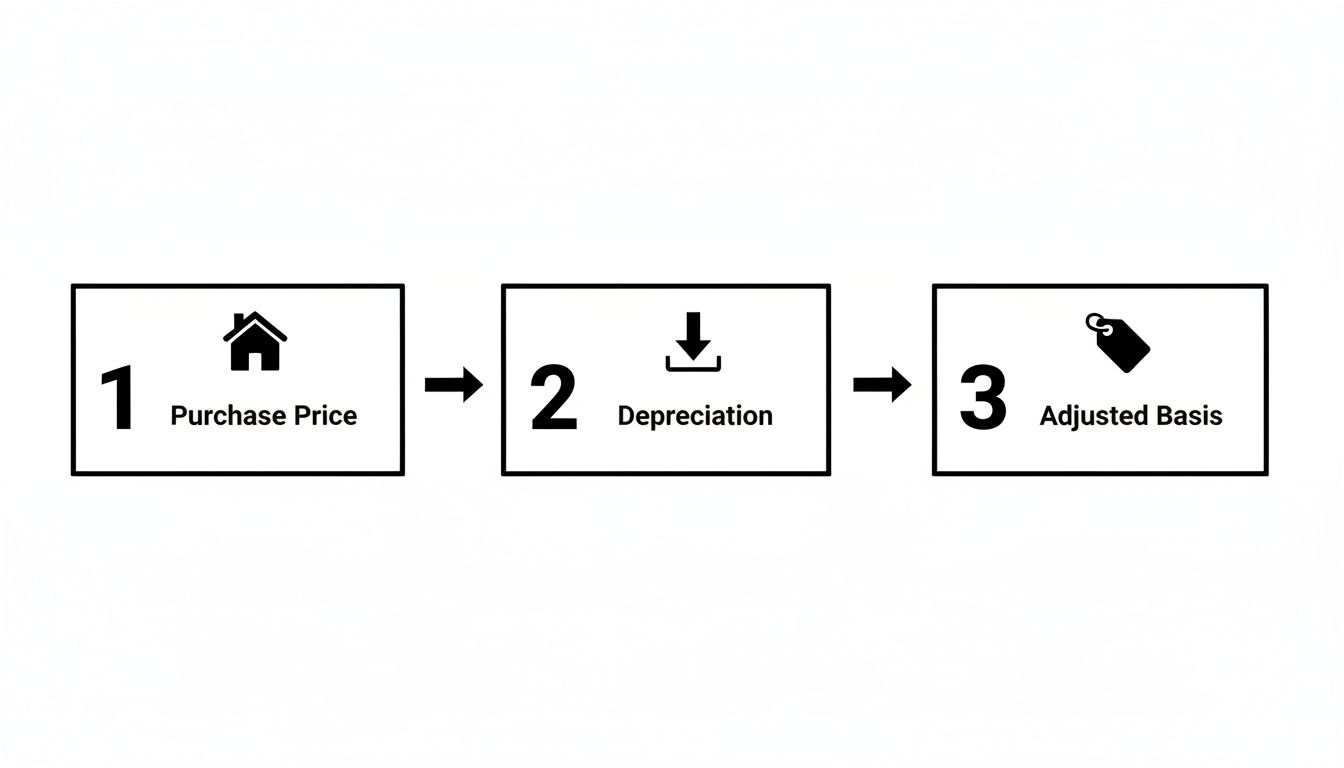
As you can see, every year you claim depreciation, you're lowering your basis. This is a great benefit year-to-year, but it sets the stage for a bigger taxable gain at the time of sale.
Step 4: Calculate Your Total Gain on the Sale
Now for the exciting part—the sale. Your total taxable gain is the difference between what you sell the property for and your adjusted cost basis. Let's assume you sell it for $550,000.
- Total Gain = Sale Price – Adjusted Cost Basis
- $550,000 – $291,820 = $258,180
That $258,180 represents your total profit. But the IRS doesn't treat it all the same. The final step is to slice this pie into two different pieces, each with its own tax rate.
Step 5: Split the Gain into Recapture and Capital Gain
This is the moment of truth. Here’s where you separate the part of your gain that came from depreciation from the part that came from pure market appreciation.
-
Unrecaptured Section 1250 Gain: This is the portion subject to the recapture tax. The rule is that it's the lesser of your total depreciation claimed ($118,180) or your total gain ($258,180). In our case, it's $118,180. This slice of the profit gets taxed at a special rate of up to 25%.
-
Long-Term Capital Gain: This is the rest of your profit—the real appreciation in value. To find it, just subtract the recapture amount from your total gain.
- $258,180 (Total Gain) – $118,180 (Recapture) = $140,000
- This $140,000 is what most people think of as profit. It's taxed at the much friendlier long-term capital gains rates of 0%, 15%, or 20%, depending on your income bracket.
To make it even clearer, here is the entire calculation laid out in a table.
Depreciation Recapture Calculation Example
This table summarizes how a total gain of $258,180 is broken down for tax purposes based on our example.
| Calculation Step | Description | Example Value |
|---|---|---|
| Purchase Price | The initial amount paid for the property. | $400,000 |
| Closing Costs | Eligible costs to acquire the property. | $10,000 |
| Original Cost Basis | Total initial investment (Purchase Price + Closing Costs). | $410,000 |
| Total Depreciation | Cumulative depreciation claimed over 10 years. | ($118,180) |
| Adjusted Cost Basis | Original Basis – Total Depreciation. | $291,820 |
| Sale Price | The final selling price of the property. | $550,000 |
| Total Gain | Sale Price – Adjusted Cost Basis. | $258,180 |
| Unrecaptured §1250 Gain | The lesser of Total Gain or Total Depreciation. | $118,180 |
| Long-Term Capital Gain | Total Gain – Unrecaptured §1250 Gain. | $140,000 |
By following these steps, you’ve successfully separated the two types of taxable gains from your rental property sale. This clarity is key to accurate tax reporting and avoiding any unwelcome surprises from the IRS.
Understanding the Rules: Section 1250 vs. Section 1245 Property
When you look at your rental property, you see a single investment—a house, a duplex, an apartment building. But the IRS sees things a bit differently. For tax purposes, your property is actually a bundle of different assets, and each component plays by its own set of depreciation rules.
Getting this right is a huge deal because it directly impacts your tax bill when you eventually sell. The two big categories you absolutely need to know are Section 1250 property and Section 1245 property. Let’s break down what they are and why they matter so much.
Section 1250 Property: The Building Itself
This is the main event for most real estate investors. Section 1250 property is the building and its structural guts—the foundation, walls, roof, plumbing, and electrical systems. It's the core asset.
The depreciation here is pretty straightforward. Under the current tax system (known as MACRS), real estate gets depreciated using the straight-line method. You simply deduct an equal amount of value each year over the property's IRS-defined useful life.
- Residential Rentals: You’ll depreciate these over 27.5 years.
- Commercial Properties: These have a longer depreciation schedule of 39 years.
When you sell, the depreciation you’ve claimed on this part of the property gets its own special tax treatment. This is the "unrecaptured Section 1250 gain" we've been talking about, and it’s taxed at a maximum rate of 25%.
Section 1245 Property: The "Stuff" Inside
Now, let's talk about the other stuff. Section 1245 property covers all the tangible personal property in your rental that isn't a permanent part of the building. Think about items like refrigerators, stoves, dishwashers, carpets, and even certain light fixtures.
These assets have much shorter useful lives—typically 5 or 7 years—which means you can write them off much faster. This accelerated depreciation gives you a bigger tax break in the early years of owning the property.
But here’s the trade-off. That speedy write-off comes back to bite you at tax time. When you sell, the depreciation recapture on rental property for these Section 1245 assets is taxed as ordinary income. Depending on your tax bracket, that could be as high as 37%—a huge jump from the 25% cap on the building itself.
The Bottom Line: Depreciating Section 1245 assets quickly feels great upfront, but the recapture is taxed at much higher ordinary income rates. This isn't just about bookkeeping; it’s a strategic choice that directly affects your net profit down the road.
A Side-by-Side Comparison
Putting the two categories next to each other really highlights the differences. Classifying your assets correctly from day one is critical for accurate and strategic tax planning.
| Feature | Section 1250 Property | Section 1245 Property |
|---|---|---|
| What It Is | Real property (the building and its core structure) | Personal property (appliances, carpet, fixtures) |
| Depreciation Timeline | 27.5 years (residential) or 39 years (commercial) | Typically 5 or 7 years |
| Depreciation Method | Straight-line | Accelerated |
| Recapture Tax Rate | Capped at 25% (as unrecaptured §1250 gain) | Taxed as ordinary income (up to 37%) |
This distinction can have a massive impact on your final return. For investors in higher tax brackets, the combined hit from recapture tax, capital gains, and the Net Investment Income Tax can easily wipe out 30-40% of the profits from a sale. While most of your building falls under Section 1250 (reported on Form 4797), getting the classifications wrong can leave you with a surprisingly large—and entirely avoidable—tax bill. You can learn more about how recapture impacts rental property sales on dstproperties1031.com and see how these rules play out with real numbers.
How to Legally Defer or Minimize Your Recapture Tax

Knowing how depreciation recapture works is one thing; knowing how to deal with it is another. The good news is that the tax code offers several powerful, completely legal ways for smart investors to postpone or reduce this tax hit.
Instead of just accepting a big tax bill, you can make proactive choices that protect your profits and support your long-term financial goals. These aren't sneaky loopholes. They are well-established provisions for sound financial planning. It really just comes down to smart timing and picking the right tool for your situation.
Defer Indefinitely with a Section 1031 Exchange
For most real estate investors, the Section 1031 exchange is the go-to strategy for a reason. It's incredibly effective. This part of the tax code lets you sell an investment property and roll all the proceeds into a new "like-kind" property, kicking both the capital gains and the depreciation recapture on rental property down the road.
Think of it as trading up. Instead of cashing out, paying taxes on your profit, and then shopping for a new property with what's left, a 1031 lets you swap your equity from one asset directly into another. The entire tax bill—including all that accumulated recapture—gets deferred and carried over to the new property.
A 1031 exchange is a strategy of deferral, not elimination. You can continue to roll your gains and recapture from one property to the next, potentially for your entire investing career. The tax only becomes due when you finally sell a property for cash without executing another exchange.
Successfully pulling this off requires following some strict IRS deadlines. You must identify a potential replacement property within 45 days of the sale and close on it within 180 days. To get into the nitty-gritty, you can learn more about what is a 1031 exchange in this detailed guide.
Eliminate Recapture Through Estate Planning
A 1031 exchange just postpones the tax bill. But what if you could wipe it out completely? There's one strategy that does just that: holding the property until you pass away. This isn't a gloomy thought; it's actually a foundational strategy for long-term wealth transfer among savvy real estate investors.
When you leave a rental property to your heirs, they get it with a "step-up in basis." This is a huge deal. It means the property's cost basis is reset to its fair market value on the date of your death. In one fell swoop, this adjustment eliminates all the capital gains and—crucially—all the depreciation recapture that built up over your lifetime. Your heirs could turn around and sell the property the next day for that market value and likely owe little to no tax.
Other Strategic Approaches to Consider
Beyond the 1031 exchange and estate planning, you still have other moves you can make to soften the blow from recapture tax. These tactics offer more flexibility and can be adapted to your unique financial picture.
- Installment Sales: Instead of taking one big check, you can structure the sale so the buyer pays you over several years. This spreads your taxable gain and the recapture tax across multiple tax periods, which can be a great way to keep yourself in a lower tax bracket.
- Strategic Timing: If an exchange isn't in the cards, think carefully about when you sell. Selling in a year when your other income is lower—maybe you retired or had a business loss—can significantly reduce the tax rate you pay. On the flip side, try to avoid selling in a peak income year.
- Charitable Donations: If you're philanthropically minded, donating a highly appreciated property to a qualified charity can be a fantastic option. You often get to claim a charitable deduction for the property's full market value while completely sidestepping both capital gains and recapture taxes.
By understanding and using these strategies, you can change your relationship with depreciation recapture. It stops being an unavoidable penalty and becomes just another manageable part of your overall investment plan.
Reporting Depreciation Recapture on Your Tax Return
Once you’ve nailed down the numbers, it's time to report everything to the IRS. This isn't just a matter of plugging figures into a form; it’s about telling the complete financial story of your rental property sale. Getting this right is crucial for staying compliant and avoiding those dreaded IRS notices.
The main stage for all this action is IRS Form 4797, Sales of Business Property. Think of this as the dedicated paperwork for any asset you used in your business, and yes, that absolutely includes your rental property. This is where you'll lay out all the mechanics of the sale for the IRS.
Starting with Form 4797
Your focus will be Part III, Gain From Disposition of Property Under Sections 1245, 1250, 1252, 1254, and 1255. It sounds complicated, but this section is designed to walk you step-by-step through the calculation to pinpoint your total gain and, more importantly, isolate the portion that's considered depreciation recapture.
Here's what the form will ask you to lay out:
- The gross sales price you received.
- Your original cost basis, including all capital improvements.
- The total depreciation you claimed (or could have claimed).
- Your final adjusted basis.
The form does the heavy lifting, subtracting your adjusted basis from the sales price to find your total gain. It then guides you to figure out how much of that gain is pure depreciation recapture. The result is a clear separation between any ordinary income gain (from Section 1245 property) and the unrecaptured Section 1250 gain from the sale of the building.
The Final Stop: Schedule D
The numbers don't stop at Form 4797. From there, your calculated gains travel to other parts of your tax return to be taxed at the proper rates. Specifically, that unrecaptured Section 1250 gain flows from Form 4797 straight over to Schedule D (Capital Gains and Losses).
On Schedule D, this figure gets its own special line—one designated for gains taxed at the 25% rate. This is critical. It ensures the recapture amount is taxed at its unique maximum rate, keeping it separate from your standard long-term capital gains that get the more favorable 0%, 15%, or 20% rates.
Meticulous record-keeping is the backbone of accurate tax reporting. Without clear documentation for your original purchase price, closing costs, capital improvements, and every depreciation deduction claimed, completing Form 4797 correctly is nearly impossible.
Navigating these forms requires real precision. For a wider view of the financial impact of a sale, our guide on the tax implications of selling rental property offers more context. When in doubt, working with a tax professional ensures every number lands in the right box, giving you peace of mind and protecting you from potential headaches down the road.
Frequently Asked Questions About Depreciation Recapture
Let's dive into some of the questions that almost always come up when real estate investors start grappling with depreciation recapture. Getting these details right can make a huge difference to your bottom line.
What Happens If I Never Claimed Depreciation?
This is a big one, and it trips up a lot of new landlords. The IRS has a simple, and rather unforgiving, rule here: they tax you on the depreciation you were allowed to take, not just what you actually claimed.
It's based on an "allowed or allowable" standard. So, when you sell your rental, the IRS calculates your gain as if you took the depreciation deduction every single year. You'll still owe recapture tax on the amount you should have taken, even if you never did. It’s a classic case of a missed opportunity—you skip the yearly tax benefit but still have to settle the bill at the end.
Is Recapture the Same as Capital Gains Tax?
Not quite. They're two different taxes that apply to two different parts of your profit. It’s helpful to think of your total gain as one big pie. The IRS cuts that pie into two slices, and each slice gets taxed differently.
- Depreciation Recapture: The slice of the pie that represents the depreciation you claimed over the years is called "unrecaptured Section 1250 gain." This part gets taxed at a special, higher rate, which can be up to 25%.
- Capital Gains: The other slice—the part that comes from the property's actual increase in market value—is a standard long-term capital gain. This is taxed at the more favorable capital gains rates of 0%, 15%, or 20%, depending on your overall income.
Can a 1031 Exchange Eliminate Recapture Forever?
A 1031 exchange is an incredible tool, but it’s for deferral, not permanent elimination. When you do an exchange, the recapture tax you would have owed gets rolled forward into the new property. It doesn't just vanish into thin air.
If you eventually sell that replacement property without rolling it into another exchange, you'll have to pay the recapture from the original property plus any new recapture from the second one. The tax liability can be deferred over and over again through a series of exchanges, and it's only truly wiped clean if you hold the property until you pass away. At that point, your heirs inherit it at a "stepped-up basis," and the deferred tax liability is forgiven.
A 1031 exchange effectively kicks the tax can down the road, allowing your equity to continue growing without an immediate tax hit. However, the underlying liability remains until a final sale or until it's wiped out by a step-up in basis.
Does Recapture Apply If I Sell at a Loss?
This one seems counterintuitive, but yes, it's entirely possible. You can have a taxable gain—and therefore owe recapture tax—even if you sell the property for less than you originally paid for it.
Here’s how that works. Depreciation deductions lower your property's adjusted basis over time. Let's say you bought a place for $300,000 and took $50,000 in depreciation over the years. Your new adjusted basis is $250,000. If you then sell it for $280,000, you actually have a $30,000 taxable gain, even though you sold for $20,000 less than your purchase price. That entire $30,000 gain is considered depreciation recapture.
Navigating these complex rules is essential for protecting your investment returns. At Allied Tax Advisors, we specialize in rental property taxation and strategic planning to help you make informed decisions. Learn how we can support your financial journey at https://alliedtax.com.