
You're staring at the bank feed, the payouts have landed, and the account balance looks fine. Then you open the P&L and the margin doesn't match what you expected. That's the point where a lot of online sellers realize they don't have a bookkeeping problem, they have an e-commerce accounting problem.
A generalist bookkeeper can record deposits and pay bills. That's not enough when your sales come through Shopify, Amazon, WooCommerce, PayPal, and marketplace payouts that bundle sales, refunds, commissions, fees, chargebacks, and timing differences into one net deposit. The job is to turn messy transaction flow into clean financial truth, so you can see whether the business is making money or just moving cash around.
Table of Contents
- Why Your Online Store Needs a Specialist
- What An E Commerce Accountant Does
- When to Hire An E Commerce Accountant
- How to Interview And Onboard Your Accountant
- Understanding Pricing Models And What You Get
- The San Diego Advantage With Allied Tax Advisors
- Your Next Steps To Better E Commerce Financials
Why Your Online Store Needs a Specialist
A seller calls me in a panic after a strong quarter. The bank balance is up, ad spend is under control, and yet the books show a thin margin and a tax bill that feels too high. The problem usually isn't one bad month. It's that the business has outgrown generic bookkeeping.
An e-commerce accountant earns their keep when managing the financial operations of online businesses. Thomson Reuters reported that e-commerce already accounted for an average of 19% of total sales among retailers and restaurants, and accounting firms serving retail businesses were handling an average of 1,592 clients, 14,323 e-commerce transactions, and 700 to 800 journal entries each month. That volume tells you everything you need to know, this work is not just data entry, it's operational control over a high-volume sales engine. Thomson Reuters
Practical rule: if your month-end close depends on cleaning up payouts after the fact, you're already behind.
A traditional bookkeeper often books the bank deposit and moves on. That works for a simple service business. It fails fast in online retail, because the net deposit hides the actual economics of the sale. The fees, refunds, and chargebacks never show up as clearly as they should unless someone ties the payout back to the order ledger line by line.
The business cost is obvious. Reported revenue can be overstated, cash-based sales can be understated, and margin analysis gets fuzzy right when you need it most. If you're trying to understand tax obligations for a digital business, it's also worth reviewing this practical guide on paying taxes for an online business, because bad bookkeeping and bad tax planning usually show up together.
The bigger issue is speed. Online sellers can grow without adding much overhead, but the accounting load rises anyway. More channels mean more payouts, more fees, more inventory movement, and more cleanup before the numbers can be trusted. That's why specialists matter, they don't just “keep the books,” they keep the business from making decisions on distorted numbers.
What An E Commerce Accountant Does

A seller gets a clean bank deposit and assumes the books are fine. They are not. An e-commerce accountant takes gross marketplace activity and rebuilds it into records you can trust, which means mapping each payout back to sales, refunds, commissions, processing fees, and timing gaps instead of posting the net deposit and hoping the numbers sort themselves out.
Payouts Are Not Revenue
Marketplace deposits look clean in the bank. The books tell a different story. As Forti explains, platform payouts usually include sales, refunds, marketplace commissions, payment-processing fees, chargebacks, and timing differences, so the accountant has to reconcile the payout to the underlying order ledger to avoid understating revenue and overstating cash-based sales. what an e-commerce accountant does and why it differs from general bookkeeping
That is the line between general bookkeeping and specialist work. A bookkeeper can post money in and money out. A specialist asks what that deposit is made of, then splits it correctly, because net deposits can hide fee leakage and refund volume.
You don't manage an online store from the bank feed alone.
You manage it from the order ledger, the payout report, and the inventory trail.
The technical work does not stop at revenue. In marketplace-heavy businesses, accountants reconcile SKU-level COGS, landed costs, freight, duties, shrinkage, and returns across systems like Shopify, Amazon, payment gateways, and ERP or accounting software. That work feeds monthly P&Ls, margin-by-channel reporting, and rolling cash-flow forecasts. Sellers who need a broader operating reference can use ai model outfit e-commerce from WearView, because it shows how multi-channel commerce depends on clean operational inputs, not polished storefronts.
The hidden problem is simple. Small gaps in fees or uncleared refunds do not always break the balance sheet, but they distort decisions. You buy inventory too early, scale ads on the wrong channels, or assume a product line is profitable when the cash trail says otherwise.
Core Services Every Online Seller Should Expect
A solid e-commerce accounting setup usually has four moving parts, and each one catches a different kind of error.
Platform integrations connect Shopify, Amazon, WooCommerce, and payment gateways to the accounting system. Without that connection, someone is importing files by hand, and manual imports are where errors multiply.
Sales tax compliance tracks where you owe tax, not just where you sell. Crossing state thresholds or using fulfillment centers can create obligations that a generalist bookkeeper will miss until the problem shows up.
Inventory and COGS tracking tie stock costs to channel-level profitability. If your landed cost is wrong, your margin is fiction. For a clear baseline on the accounting mechanics, review this guide to cost of goods sold.
Financial reporting turns all of that into usable numbers, especially P&L by channel and cash-flow visibility. Sellers who want the margin side of the story can also read the guide to sustainable eCommerce scaling, because margin clarity matters before you chase growth.
Accounting gets harder as the business expands. Analysts at Sage describe how online commerce keeps growing while the accounting workload grows with it, because more channels mean more payouts, more fees, more inventory movement, and more cleanup before the numbers can be trusted. Sage
A practical sign is reporting discipline. If your numbers cannot explain which channel earns money, which SKU drags margin, and which payout still needs reconciliation, the books are not helping the business. A specialist fixes that by tying the order flow, the payout flow, and the inventory flow together before management decisions are made.
When to Hire An E Commerce Accountant
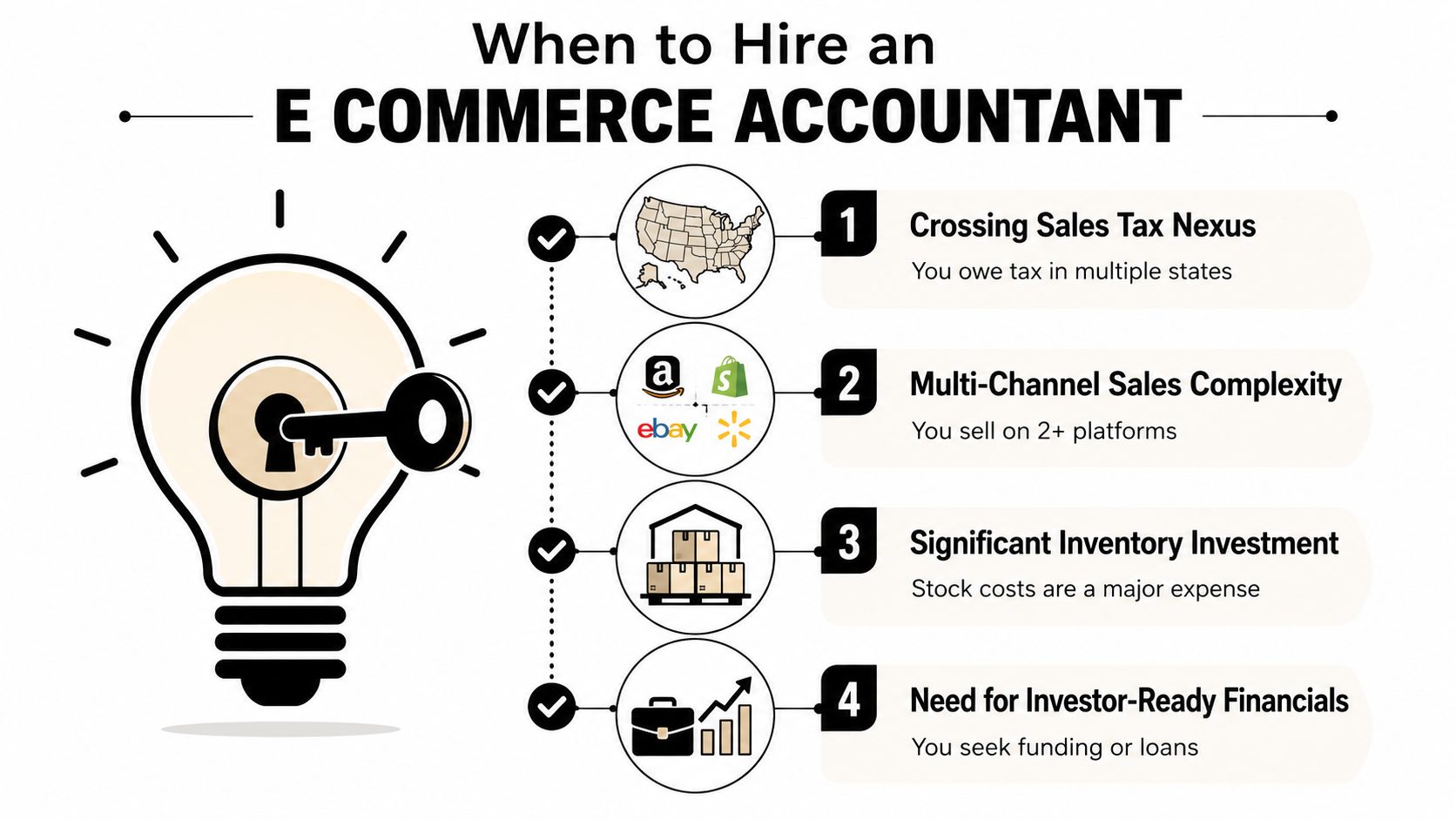
The wrong time to hire is after tax season panic starts. The right time is when the books stop explaining the business. If your bank balance and reported revenue keep drifting apart, your current setup is already too slow to catch the problem.
A simple comparison helps.
| Trigger | Generalist Bookkeeper | E Commerce Accountant |
|---|---|---|
| Bank deposits don't match reported sales | Books the deposit and moves on | Reconciles payouts to orders, fees, and refunds |
| You sell on multiple channels | Tracks transactions separately | Consolidates channel-level profitability |
| Inventory is material | Records purchases | Tracks landed cost, shrinkage, and returns |
| You cross tax or operational thresholds | Reacts when problems show up | Monitors obligations and keeps the structure current |
That is the line that matters. If you sell on one platform, carry light inventory, and your deposits are easy to trace, a basic bookkeeper may be enough for now. If you sell across three or more channels, carry meaningful inventory, or rely on marketplace and fulfillment systems that create timing gaps, you need someone who understands the mechanics behind the numbers.
Sales tax complexity is another clear trigger. Once a business starts crossing state nexus thresholds or selling through fulfillment centers, tax collection becomes an ongoing control issue, not a year-end filing task. The same is true for products with frequent returns or mixed fees. By the time you discover the problem in March, the cleanup is already expensive and distracting.
Hire mid-year, not at the deadline. Mid-year onboarding gives the accountant time to clean up old data before the next filing cycle starts.
There is also a profitability trigger. If inventory valuation, write-offs, and tax collection are not being handled correctly, reported margins can look healthy while cash generation stays weak. That kind of distortion pushes sellers into bad ad decisions, overbuying, or avoidable financing stress. If you are preparing for funding, debt, or an exit, you need clean records long before anyone asks for them. When a San Diego seller comes to Allied Tax Advisors after payouts, orders, and inventory have been left to drift apart, the fix usually starts with a hard reset, not a light review. For sellers who want a cleaner chart of accounts before the handoff, review the guide to setting up QuickBooks for e-commerce.
How to Interview And Onboard Your Accountant
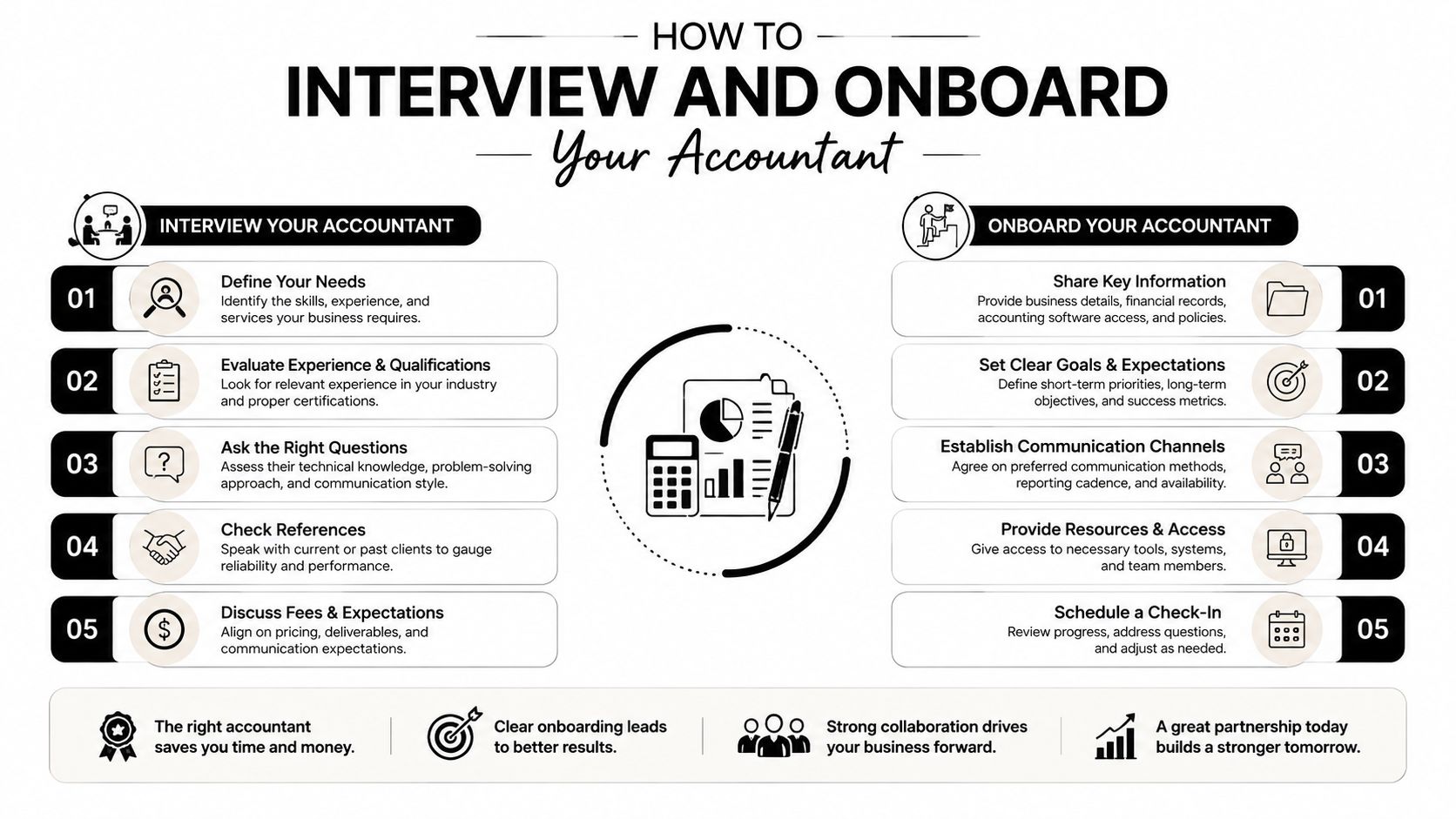
A weak interview sounds polite and vague. A strong one gets specific fast. Ask how they handle marketplace payout reconciliation, which platforms they support, how they treat inventory and COGS across channels, and how they manage multi-state sales tax nexus. If they can't talk through those topics clearly, they're not your accountant.
Questions That Separate Specialists From Generalists
Start with the workflow, not the branding.
- Payout handling: Ask how they reconcile deposits from Shopify, Amazon, or PayPal back to orders, refunds, and fees.
- Sales tax knowledge: Ask how they track nexus and what they do when you add a new state or fulfillment node.
- Inventory method: Ask how they treat landed cost, returns, shrinkage, and obsolete stock.
- Tool stack: Ask which software they use for integrations and reporting.
A real specialist answers with process, not slogans. They can explain what comes in, what gets mapped, and what shows up in the monthly close. They should also be comfortable telling you when a system issue is the problem, not just the books.
For QuickBooks-heavy sellers, it helps to understand your own setup before the meeting. The guide on how to set up QuickBooks is a useful prep step because your accountant can move faster when your chart of accounts and integrations are already organized.
What To Prepare Before The First Call
Come with your current platform list, login access for reporting, bank and credit card statements, prior tax returns, sales tax filings, and inventory reports. If you have one, bring a sample payout report and a recent P&L, because those two documents expose problems quickly.
Don't wait to ask about reporting cadence either. You should know when you'll receive monthly numbers, what format they'll come in, and who is responsible for follow-up questions. If the answer is vague, expect the relationship to stay vague.
The best onboarding happens when roles are clear on day one. You provide clean access and complete data. They map the systems, identify the gaps, and tell you where the historical cleanup starts. That's the difference between an engagement that stabilizes the business and one that just files returns.
Understanding Pricing Models And What You Get
Price matters, but scope matters more. Cheap bookkeeping can be expensive if it misses payout reconciliation or inventory distortion. E-commerce accounting usually costs more than standard small-business bookkeeping because there are more transactions, more systems, and more compliance touchpoints.
| Pricing Model | Typical Range | What It Usually Covers | Best For |
|---|---|---|---|
| Monthly retainer | Ongoing fixed fee | Reconciliation, reporting, routine tax support, advisory calls | Sellers who want predictable support |
| Hourly rate | Time-based billing | Cleanup, questions, project work, special analysis | Businesses with irregular needs |
| Project-based cleanup | One-time engagement | Historical cleanup, catch-up books, system resets | Sellers with messy prior records |
A retainer works well when the accounting load is steady and the systems are already integrated. It gives you predictable access to a specialist who can watch the numbers each month instead of only showing up at tax time. Hourly billing can be useful for one-off questions or a small amount of cleanup, but it gets expensive when the business is messy and no one owns the workflow.
Project fees are common for historical cleanup, and that's fair. If the books need a reset, the work is real. What you want to avoid is an under-scoped monthly engagement where the fee covers only basic bank reconciliation and not the payout-to-order work your business needs.
If your monthly fee is low because the scope is thin, the savings are fake.
Ask what's included before you sign. Annual tax filing, new-state sales tax registration, and historical cleanup are often separate from month-to-month bookkeeping. That's not a problem if the scope is clear. It becomes a problem when you assume the accountant is handling it and they assume you knew it was extra.
The budget you need depends on complexity, not optimism. More channels, more fees, more inventory movement, and more tax exposure all increase the workload. Build your budget around the actual reconciliation process, not the cheapest number on a proposal.
The San Diego Advantage With Allied Tax Advisors
San Diego sellers benefit from having a firm that understands both online commerce and local tax realities. Allied Tax Advisors is a Clairemont, San Diego firm with decades of experience in tax and accounting, and that matters when your business has to deal with California rules, multi-state sales tax, and rapid operational changes at the same time.
Their value is breadth. The team includes CPAs, enrolled agents, and client-relationship specialists, and they support business clients with S Corporation and LLC filings, sales-tax management, payroll processing via IRIS software, QuickBooks bookkeeping, and ongoing advisory. That combination is useful for e-commerce sellers who want one firm that can handle bookkeeping, filings, and tax-resolution issues without bouncing between providers.
The other advantage is visibility. An online client portal gives business owners a more immediate view of their financials, which is exactly what an e-commerce seller needs when inventory, payouts, and tax obligations are moving in different directions. If you're trying to keep a growing store organized without losing control of the numbers, local expertise plus responsive access beats a generic remote setup.
There's also a practical trust factor. A firm rooted in San Diego can better understand the cadence of California compliance and the operational reality of local founders who still sell nationally. That's not a slogan, it's a workflow advantage when you need clean records, fast answers, and support that fits the pace of the business.
Your Next Steps To Better E Commerce Financials
Start with the truth. If your bank deposits, platform payouts, and reported revenue don't line up cleanly, you need a specialist, not another month of guesswork. The same goes for inventory-heavy operations, tax complexity, and businesses that have outgrown basic bookkeeping.
Your next move should be simple.
- List the gaps. Note where your current books break down, especially payouts, refunds, inventory, and sales tax.
- Gather records. Pull platform access, bank statements, inventory reports, and prior filings.
- Prepare questions. Ask candidates how they handle reconciliation, tax nexus, and reporting.
- Talk to specialists. Compare at least two firms before you choose.
The right accountant won't just close the books. They'll give you cleaner decisions on inventory, ad spend, and growth, because the numbers will finally reflect what's happening in the business.
If your online store has outgrown basic bookkeeping, Allied Tax Advisors can help you clean up the reconciliation, tighten the reporting, and build a tax process that fits real e-commerce operations. Visit Allied Tax Advisors to connect with a San Diego team that understands sales tax, inventory, and the reporting discipline online sellers need.