
So, you're thinking about forming an S corporation. Smart move. But how does it actually work?
It’s a two-part play. First, you have to form a regular business entity—usually an LLC or a C corporation—with your state. Once that's official, you then file a special election with the IRS to be taxed as an S corp. It's not a business structure itself, but a tax status.
Your Path to Smarter Business Taxation
Let's be clear: choosing the S corp route is a tax strategy, plain and simple. You're not creating a new type of company from scratch. Instead, you're telling the federal government you want your existing LLC or corporation to be taxed under a different set of rules. This little distinction is the key that unlocks some serious financial perks for small business owners.
Why go through the trouble? The biggest driver is the potential for much smarter business taxation. A solid grasp of Tax Law is essential here, but the two main benefits that really get entrepreneurs interested are pretty straightforward:
You get to sidestep "double taxation." A traditional C corp gets hit with taxes on its profits, and then you, the owner, get taxed again when those profits are paid out as dividends. S corps, on the other hand, are "pass-through" entities. The profits and losses flow directly to your personal tax return, completely avoiding that first layer of corporate income tax.
You can significantly cut down on self-employment taxes. This is often the real game-changer. As the owner, you pay yourself a "reasonable salary," which is subject to standard payroll taxes (Social Security and Medicare). But here’s the kicker: any remaining profits can be taken as distributions, and those distributions are not subject to self-employment tax. For many, this can add up to thousands of dollars in savings each year.
Why S Corps Are Still a Go-To Choice
The S corp isn't some new fad; it's been a powerhouse in the U.S. business world for decades. In fact, over the last 30 years, S corporations have shown a remarkable average annual growth rate of 6.8%. That's a huge contrast to the decline we've seen in standard corporations.
By 2012, an astounding 4.2 million S corp tax returns were filed, making them the clear favorite among pass-through entities.
The S corp strikes a unique balance. It gives you the liability protection of a traditional corporation but combines it with the favorable pass-through tax treatment of a partnership. This hybrid model makes it a perfect fit for consultants, small service businesses, and startups poised for growth.
Ultimately, deciding on an S corp comes down to a simple calculation: do the tax savings outweigh the extra administrative work, like running payroll and keeping up with corporate formalities? For millions of entrepreneurs, the answer is a firm yes.
Is an S Corp Even an Option for You? Let's Check
Before you get caught up in filing paperwork, let's pump the brakes. The very first thing—the absolute non-negotiable step—is figuring out if your business can even be an S corp. The IRS has a strict guest list, and if you’re not on it, your application gets denied. It's a waste of time and can create a real mess with your taxes down the road.
Think of it less as a simple checklist and more as a set of foundational rules. Getting these right from the start is crucial.
Who Can Be an Owner? (The Shareholder Rules)
This is where most business owners get tripped up. The IRS is incredibly specific about who can own a piece of your S corporation.
First off, your company has to be a domestic one—formed and operating right here in the United States. You also can’t have more than 100 shareholders. There’s a nice little carve-out for families, though, where several family members can often count as a single shareholder, giving you some breathing room.
Most importantly, every single one of your shareholders has to be a "U.S. person." This generally means:
- U.S. citizens
- Resident aliens
- Certain specific types of trusts and estates
This single requirement is a dealbreaker for many. It means partnerships, other corporations, and non-resident aliens cannot be shareholders. Imagine a startup with two American founders and an angel investor from Canada—that business, unfortunately, can't be an S corp. This is a critical point to consider if you're planning on seeking international funding.
The "One Class of Stock" Rule, Demystified
Another major hurdle is the requirement that your company can only have one class of stock. This sounds more intimidating than it is.
At its core, it just means that every share must have the same economic rights. When it's time to distribute profits or liquidate assets, every share gets the same proportional treatment.
What you can do is create differences in voting rights. For example, you could have voting stock for the founders who are running the show and non-voting stock for passive investors or family members. As long as a share of each type gets the exact same dividend payout, you're in the clear.
The key takeaway here is economic equality. If you start creating different classes of shares with special payout preferences—like one group getting paid before another—you've just violated the rule and made your S corp election invalid.
This flowchart can help you visualize where the S corp decision fits into the bigger picture of choosing a business structure.
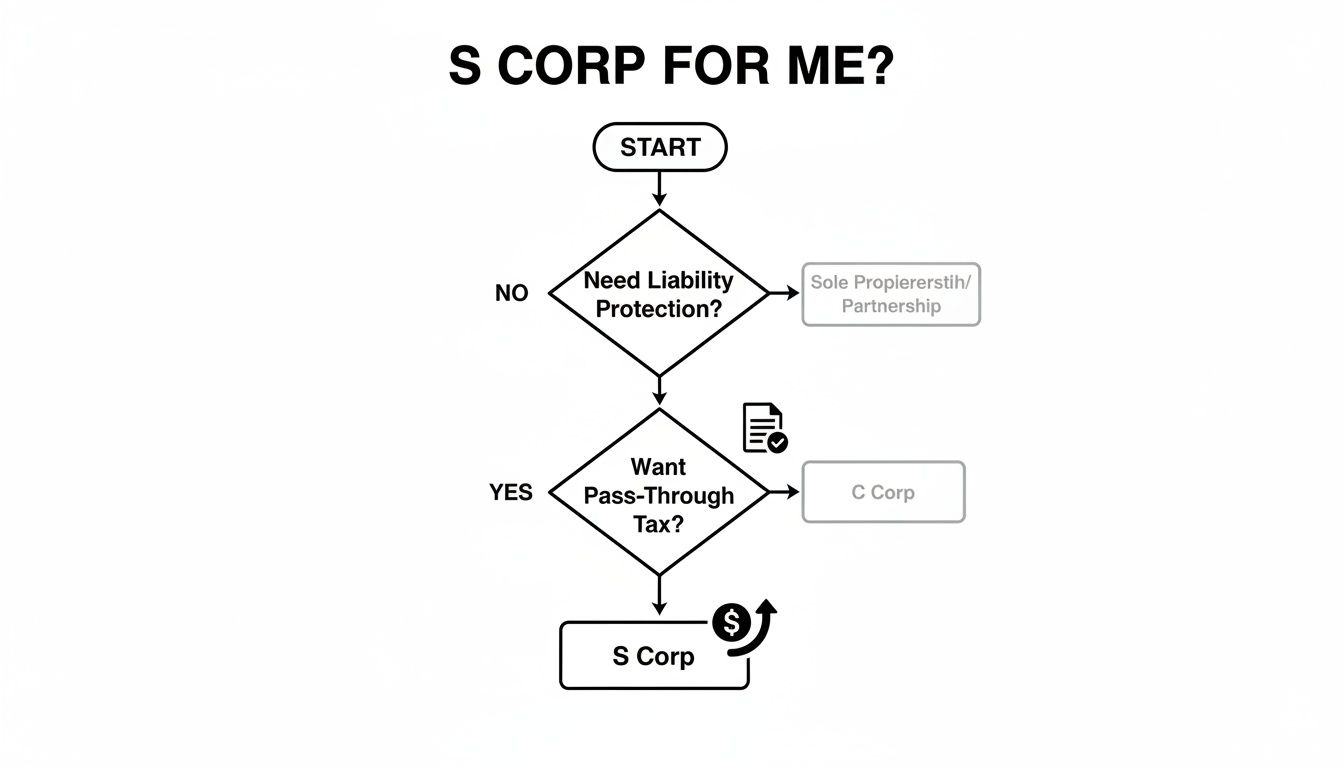
As you can see, the journey often starts with the need for both personal liability protection and the tax efficiency of a pass-through entity.
Business Types That Simply Can't Be S Corps
Finally, a few types of businesses are just flat-out barred from becoming S corps, no matter who owns them. This list includes certain financial institutions like banks and insurance companies, as well as some specialized international sales corporations.
For those who do qualify, the appeal is clear. A Bureau of Economic Analysis report showed that between 2000 and 2015, the S corp’s share of all U.S. corporations jumped from 56.7% to 73.3%. That’s a massive shift, driven by the tax advantages small businesses can gain.
Following these rules is simply the price of admission. If you're on the fence, digging into a detailed comparison of the S corp vs LLC for small business can give you the final piece of the puzzle.
Incorporating Your Business at the State Level

Okay, you've confirmed you're eligible. Now for the first real, tangible step: creating the legal business entity that will serve as the foundation for your S corp.
This is a point that trips up a lot of new entrepreneurs. You don't actually "form an S corp" directly with the state. Instead, you'll first form a standard LLC or a C corporation. Then, you'll ask the IRS to treat that new entity as an S corp for tax purposes. This initial state filing is what gives your business its own legal identity and the crucial liability protection that separates your personal assets from your business debts.
Choosing and Securing Your Business Name
Before you file a single piece of paper, your business needs a name—and this is as much a legal requirement as it is a branding choice. Every state has its own set of rules you have to follow, or they'll just reject your application.
Here’s what they typically look for:
- Is it unique? Your name can't be identical or "deceptively similar" to another business already on the books in your state. Every Secretary of State website has a free search tool you should use first.
- Does it have the right ending? You have to signal your business structure by adding a legal suffix like "LLC," "L.L.C.," "Limited Liability Company," "Inc.," "Incorporated," or "Corporation."
- Are you using restricted words? If you want to use words like "Bank," "Insurance," "Trust," or "University," be prepared for a much more involved process, as these usually require special licensing and state approval.
Found the perfect name? Most states will let you reserve it for a small fee. This can lock it down for anywhere from 30 to 120 days, giving you plenty of time to get your paperwork in order without someone else snatching it up.
Appointing a Registered Agent
This is a non-negotiable requirement. Every LLC and corporation must designate a registered agent, sometimes called a statutory agent. This is simply the official person or company tasked with receiving important legal and government mail for your business.
Your registered agent needs a physical street address in your state of incorporation and has to be available during regular business hours. Think of them as your business's official point of contact for the serious stuff: lawsuits, state tax notices, and annual report reminders.
You can be your own registered agent, but I usually advise against it. Doing so means your home address becomes a public record, and you’re chained to your desk during business hours in case a process server shows up. For a small annual fee, a professional service offers privacy and the freedom to actually run your business.
Dropping the ball here is a big deal. Failing to maintain a registered agent can lead to fines, penalties, and in a worst-case scenario, the state could administratively dissolve your company.
Deciding Where to Incorporate
I get this question all the time from people asking how do you form an s corporation: "Shouldn't I incorporate in Delaware or Nevada to save on taxes?" While those states are known for their corporate-friendly laws, the answer for almost every small business is a firm no.
Incorporate in the state where you actually do business.
Let's say you run a marketing agency from your office in Austin, Texas. If you form an LLC in Nevada, you're just creating a headache for yourself. You'd have to register in Nevada and then turn around and register in Texas as a "foreign entity" to legally operate there.
You’ll end up paying fees and filing annual reports in two states. For states like California, which has a 1.5% net income franchise tax on S corps, you won't dodge that tax just by incorporating elsewhere if your income is earned there. The perceived perks of an out-of-state incorporation rarely justify the extra cost and paperwork for a small business.
Filing Your Formation Documents
With the prep work done, it's time to make it official. You'll file your formation documents with your state's business agency, which is usually the Secretary of State. What you file depends on the entity you chose:
- If you formed an LLC: You'll file the Articles of Organization.
- If you formed a Corporation: You'll file the Articles of Incorporation.
These forms are usually pretty simple, asking for basic info like your business name, address, registered agent details, and the name of the organizer. Once the state gives its stamp of approval, your company legally exists. You're officially on the board, and now you can move on to the federal side of things.
Making the S Corp Election with IRS Form 2553

Alright, you’ve navigated the state-level paperwork and your LLC or C corporation is officially formed. Now comes the moment that actually makes this all worthwhile: telling the IRS you want to be taxed as an S corp.
This is done by filing IRS Form 2553, Election by a Small Business Corporation. Don't just see this as another form to check off the list. This document is the key that unlocks the pass-through tax structure you're after. Without it, the IRS sees you as a default C corp or LLC, and you'll miss out on all the potential tax savings.
Getting the Timing Right: Form 2553 Filing Deadlines
The IRS is not known for its flexibility on deadlines, and Form 2553 is a prime example. When you file this form directly impacts when your S corp tax status begins. Get it wrong, and you could be waiting another year.
Generally, you have a very specific window to file:
For a Brand-New Business: You must file Form 2553 no later than two months and 15 days after your company’s date of formation. This is the date your state officially approved your Articles of Incorporation or Organization.
For an Existing Business: If you're converting an existing LLC or C corp, you can file at any time during the tax year before you want the S corp status to take effect. To make the election for the current tax year, you must file within that same two-month, 15-day window from the start of your tax year (which is January 1 for most businesses).
To help clarify this, the table below breaks down the most common scenarios.
Key Deadlines for Filing Form 2553
| Scenario | Filing Deadline for Current Tax Year | Example |
|---|---|---|
| New Business Formation | Within 2 months and 15 days of the formation date. | Your LLC is formed on June 1. You must file Form 2553 by August 15 for the S election to be effective starting June 1. |
| Existing LLC (Calendar Year) | Between January 1 and March 15. | Your LLC has been operating for years. To be taxed as an S corp for 2024, you must file Form 2553 by March 15, 2024. |
| Existing C Corp (Calendar Year) | Between January 1 and March 15. | Your C corp wants to become an S corp for 2024. The deadline to file Form 2553 is March 15, 2024. |
These dates are unforgiving. Understanding your specific deadline is absolutely essential to getting the tax treatment you want, when you want it.
A Word of Caution from Experience: Missing this 75-day window is easily one of the most common and damaging mistakes new founders make. If you file late without a valid reason, the IRS will simply make your S corp election effective for the next tax year, which can throw your entire financial plan off course.
The Most Important Parts of Form 2553
The form itself is relatively short, but a few boxes require your undivided attention. A simple mistake here can get your application rejected. For a deep dive, this guide on what Form 2553 entails is a great resource, but here’s what to triple-check:
- Effective Date (Part I, Line E): Be precise. This is where you state the exact date your S corp tax status should begin, and it has to align with the IRS deadlines.
- Shareholder Consent (Part I, Column K): This is a non-negotiable. Every single shareholder must sign and date the consent statement. A single missing signature is an automatic denial.
- Tax Year (Part II): Most businesses will simply use a calendar year ending December 31. If you need a different fiscal year for a specific business reason, you’ll have to justify it here.
And when I say every shareholder must consent, I mean it. Someone owning just 1% of the company has the same signature requirement as someone owning 99%. It’s a group decision, and the IRS needs proof.
What to Do if You File Late
It happens. You get busy running the business, and the deadline flies by. Is it a total loss? Not necessarily.
The IRS has a process for late election relief, outlined in Revenue Procedure 2013-30. If you have a "reasonable cause" for filing late, you might get approved. To qualify, you generally must:
- Have failed to become an S corp only because Form 2553 wasn't filed on time.
- Provide a good reason—a "reasonable cause"—for the delay.
- File the late form within 3 years and 75 days of your intended start date.
When you file late, you have to attach a statement explaining why. Simply forgetting isn't going to cut it. A much better reason would be relying on bad advice from a professional or having a legitimate, documented personal emergency that prevented you from filing.
The S corp is incredibly popular for a reason—the IRS reports over 5 million of them are active today. But getting it right means sweating the details, and Form 2553 is the biggest detail of them all. For more on the official rules, you can always check the S corp requirements on the IRS website.
Getting Your S Corp Up and Running
So you’ve filed the state paperwork and sent Form 2553 off to the IRS. Congratulations, but don't pop the champagne just yet. The real work starts now: shifting from just having the legal structure to actually operating like a proper S corp every single day.
One of the first practical steps is getting an Employer Identification Number (EIN) from the IRS. If you formed a brand new corporation, or if you're an LLC that plans to hire anyone (including yourself), you absolutely need one. Think of it as a Social Security number for your business. It's the key to opening a business bank account, filing taxes, and, most critically, getting payroll set up.
Nail Down Your Internal Rules
With the legal and tax basics handled, it's time to create the internal rulebook for your company. These documents are not just formalities; they are essential for protecting your liability shield and making sure everyone is on the same page.
Bylaws or an Operating Agreement: If you formed a C corp, you'll draft bylaws. If you went the LLC route, you need an operating agreement. This is your company's playbook, spelling out everything from management duties and shareholder rights to how you'll make major decisions.
Hold That First Official Meeting: Get your board of directors (for a corporation) or members (for an LLC) together for an initial meeting. This is where you’ll formally adopt the bylaws, appoint officers like a CEO or Treasurer, and authorize the issuance of stock to the owners.
Issue Stock Certificates: It might sound a bit old-school, but issuing physical stock certificates is a crucial step. It provides a clear, tangible record of ownership, which can save you massive headaches with legal and tax issues down the road. As you bring on stakeholders, remember that managing those relationships is key. Finding the best CRM for small business early on can help you stay organized and focused on growth.
The Critical Role of Payroll
Alright, let's talk about the single most important operational shift for an S corp owner: payroll. You can no longer just transfer money from the business account to your personal account whenever you feel like it. You are now officially an employee of your own company.
This is the entire linchpin of the S corp strategy. The IRS mandates that you pay yourself "reasonable compensation" for the services you provide. That salary is subject to payroll taxes (Social Security and Medicare). The profits left over after paying that salary can be taken as distributions, which are not subject to those same payroll taxes.
Running a formal payroll is non-negotiable. The IRS is actively on the hunt for S corps where owner-employees are only taking distributions and not a salary. This is a massive red flag that can easily trigger an audit, resulting in back taxes, interest, and steep penalties.
Messing this up completely defeats the purpose of choosing the S corp structure in the first place. You have to get this right.
What Does "Reasonable Compensation" Actually Mean?
So, what's the magic number for a "reasonable" salary? The IRS is intentionally vague, but the general guideline is what a similar business would pay someone else to do your job in your industry and location.
Think about these factors when setting your salary:
- What are your actual duties and responsibilities?
- What's your background, experience, and training?
- How much time and effort are you pouring into the business?
- What do comparable positions in your industry pay?
It’s a smart move to document exactly how you landed on your salary figure. Pull some salary data from industry reports, keep good records of your duties, and be ready to defend your compensation if the IRS ever comes knocking. This is where the legal theory of an S corp crashes into the practical reality of running your business, and learning how to do payroll for small business correctly is the key to staying compliant.
Common Questions About Forming an S Corp
When you're wading through the details of setting up an S corporation, a few questions always seem to pop up. Let's tackle the most common ones I hear from business owners so you can move forward with a clear head.
Can I Switch My LLC to an S Corp?
Absolutely. In fact, this is one of the most popular strategies for successful small businesses. If your existing Limited Liability Company meets all the S corp requirements, making the switch is surprisingly simple.
You just need to file Form 2553 with the IRS. That's it. You are simply electing a different tax status for your LLC.
There's no need to dissolve your company or form a new one with the state. Your business remains an LLC for legal purposes, keeping all its operational flexibility, but it gets taxed like an S corp at the federal level. It's the best of both worlds.
What if you're a sole proprietor? You'll need to form an LLC or a C corporation with your state first. Once that's official, you can then file for the S corp election.
What’s the Deal With "Reasonable Compensation"?
Think of reasonable compensation as the fair market salary you must pay yourself for the actual work you do in your business. This isn't optional—it's a core rule of being an S corp owner who is also an employee.
This salary has to be paid before you take any tax-advantaged profit distributions. Why does the IRS care so much? Because your salary is subject to payroll taxes (Social Security and Medicare), while distributions are not. This rule prevents owners from paying themselves a $1 salary and taking all the profits as distributions to dodge those taxes.
So, what’s a "reasonable" amount? It needs to be a defensible number based on real-world factors, such as:
- The specific duties you perform.
- Your experience and qualifications.
- The going rate for similar positions in your geographic area.
- The company's overall financial health.
Getting this wrong is a huge red flag for the IRS. It's one of the first things they look for in an S corp audit. Underpaying yourself on payroll is a fast track to back taxes, penalties, and a major headache.
What if I Forget to File Form 2553 on Time?
Missing the strict deadline for Form 2553 feels like a disaster, but don't panic just yet. The IRS provides a way out through a process called late election relief, which is outlined in Revenue Procedure 2013-30.
You can typically get an extension of up to 3 years and 75 days from your intended S corp start date, but you need to show "reasonable cause" for the delay. This means you have to attach a formal statement to your late Form 2553 explaining why you couldn't file on time.
A good reason might be that you relied on incorrect advice from a professional or a major life event prevented you from filing. Just saying "I forgot" won't cut it. Crafting a convincing reasonable cause statement is key, and I highly recommend working with a tax pro to get it right.
Do I Need to File for S Corp Status With My State, Too?
This is a fantastic question, and the answer is a classic "it depends on your state." The good news is that most states automatically recognize your federal S corp election. If the IRS says you're an S corp, so do they. No extra paperwork needed.
However, a few states march to the beat of their own drum. States like New York and New Jersey, for instance, require you to file a separate state-level S corp election form. They have their own deadlines and rules that you have to follow in addition to the federal ones.
If you miss a required state filing, you could end up in a real mess—treated as an S corp for federal taxes but as a C corp for state taxes. That can get complicated and expensive fast. Always, always check the rules with your state's Department of Revenue before you assume you're done.
Navigating the complexities of S corp formation and compliance can be challenging. The team at Allied Tax Advisors leverages decades of experience to guide business owners through every step, from initial filing to ongoing payroll and tax planning. Ensure your business is structured for success by partnering with our expert CPAs and enrolled agents. Learn more about our business services and schedule a consultation today.