
When people talk about "writing off a car" on their taxes, it’s not about getting a vehicle for free. What it really means is deducting the costs of using your car for business, which in turn, lowers your taxable income.
The IRS gives you two ways to do this: you can either take a flat-rate deduction for every business mile you drive (Standard Mileage Rate) or you can track and deduct the actual costs of running your vehicle (Actual Expense Method).
What It Means to Write Off a Car

A car write-off is simply a business expense. If you're self-employed, a freelancer, or a business owner, it’s one of the most powerful tools you have to lower your tax bill. Think about it—if you have to drive your car to earn a living, the government allows you to recoup some of those costs.
The underlying idea is straightforward: any money you spend on your vehicle for work-related activities can be deducted from your business income. This doesn't make your car payment vanish, but it does mean a good chunk of your vehicle expenses can significantly reduce what you owe come tax time.
Two Paths to Your Deduction
The IRS lays out two distinct methods for calculating this deduction. The one you choose really boils down to your driving habits, how much your car costs to operate, and frankly, how much paperwork you're willing to handle.
-
The Standard Mileage Rate: This is the no-fuss option. You just need to keep a log of all the miles you drive for business. At the end of the year, you multiply that number by a standard rate set by the IRS. For 2024, that rate is 67 cents per mile. The beauty of this method is its simplicity—that single rate is meant to cover gas, insurance, maintenance, and even the gradual wear and tear on your car (depreciation).
-
The Actual Expense Method: This route involves more detailed record-keeping but can often lead to a much bigger deduction, especially if you have a newer car, a more expensive vehicle, or one with high operating costs. With this method, you'll tally up everything you spent on the car for the year—gas, oil changes, insurance premiums, registration fees, new tires, repairs, and depreciation. You then deduct the portion of those costs that directly relates to your business use.
The decision between these two methods isn't just about one tax year. It can have lasting consequences.
A critical point to remember: If you start with the Actual Expense Method in the first year a car is used for business, you are generally locked into that choice. You can't switch back to the Standard Mileage Rate for that same vehicle in later years.
Making the Right Choice for Your Business
So, how do you decide? Let's look at a couple of real-world scenarios.
A freelance consultant who drives thousands of miles a year visiting clients in a reliable, fuel-efficient sedan might find the Standard Mileage Rate is the perfect fit. It’s easy to track and provides a solid deduction with minimal hassle.
On the other hand, a general contractor with a brand-new work truck that guzzles gas and requires expensive maintenance will likely get a much larger tax break by tracking every single receipt and using the Actual Expense Method.
To help you visualize the trade-offs, here's a quick comparison of the two approaches.
Quick Comparison: Standard Mileage vs. Actual Expenses
This side-by-side look at the two methods for deducting car expenses can help you see the key differences in simplicity and potential savings.
| Feature | Standard Mileage Rate | Actual Expense Method |
|---|---|---|
| Record-Keeping | Simple: Track business miles, date, and purpose. | Detailed: Keep all receipts for gas, repairs, insurance, etc. |
| Calculation | Business Miles x IRS Rate (e.g., 67 cents in 2024) | (Total Car Expenses) x (Business Use Percentage) |
| Best For | High-mileage drivers, older cars, those who prefer simplicity. | Low-mileage drivers, new/expensive cars, high-cost vehicles. |
| Depreciation | Included in the standard rate; no separate calculation needed. | Calculated and deducted separately as a direct expense. |
| Flexibility | Can switch to the Actual Expense method in a later year. | Generally cannot switch to the Standard Mileage rate later. |
Ultimately, choosing the right method is the foundation of maximizing your vehicle deduction. Taking a few minutes to weigh these options before the tax year gets underway will pay off significantly in the long run.
Is Your Vehicle Use Deductible?
Before you even start thinking about calculations, the first hurdle is making sure your driving actually counts as a legitimate business activity. The IRS is notoriously strict about this, drawing a firm line between business travel, personal errands, and your daily commute. Getting this right is the absolute foundation for a solid, audit-proof deduction.
One of the most common misunderstandings revolves around the daily commute. Let me be clear: driving from your house to your main office or workplace is never deductible. It’s a personal expense in the eyes of the IRS, no matter if you’re taking work calls or mentally prepping for a big meeting.
The game changes once you’re at your primary place of work. Any driving from that point forward—say, to meet a client, scout a new location, or drop off a delivery—falls squarely into the business category.
Distinguishing Business From Personal Trips
Let’s walk through a few real-world examples to make this distinction perfectly clear.
- Deductible: A freelance photographer leaves her studio and drives to a local park for a client photoshoot. The mileage for this trip is 100% business-related.
- Deductible: A caterer loads up his van at his commercial kitchen and drives to an office park to deliver a corporate lunch order. This is a clear-cut business trip.
- Not Deductible: After dropping off the lunch, the caterer stops at the grocery store to pick up items for his family dinner. The drive from the client's office to the grocery store is business, but the miles from the grocery store back to his home are personal.
It's common to mix business and personal errands in one trip, but you have to be meticulous about tracking just the business portion. Only those specific miles are eligible for a deduction.
This infographic breaks down the basic thought process for qualifying and logging your drives.
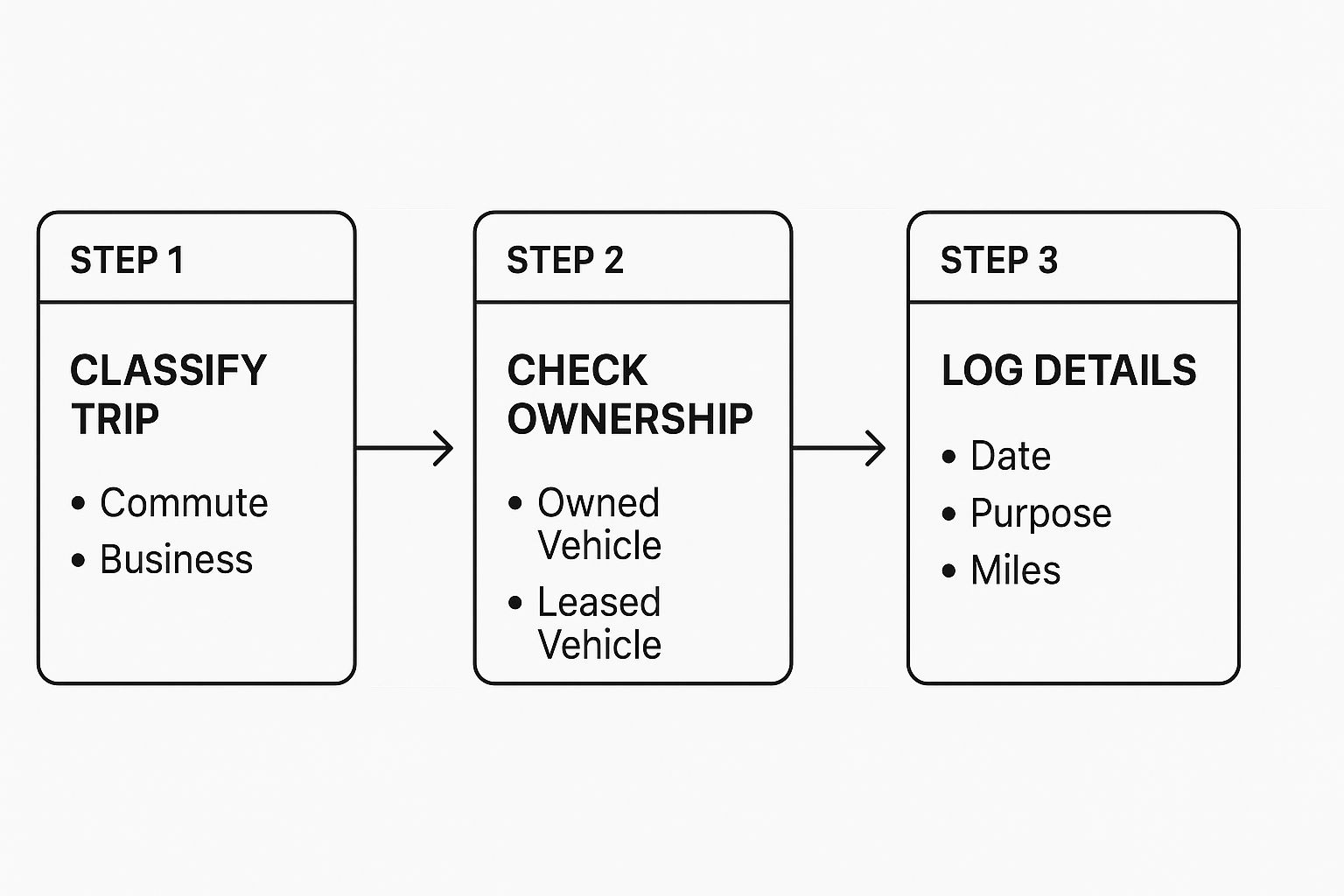
The key is to get into the habit of mentally classifying every trip before you put the car in drive. A little foresight goes a long way.
How Ownership and Business Structure Affect You
The way you can claim deductions also shifts depending on whether you own or lease the vehicle and how your business is legally set up. This is especially important for anyone running a sole trader business who needs to understand how these rules apply to their specific situation. Don’t worry, both leased and owned vehicles have clear paths for deductions; the calculations are just different.
It’s also interesting to see how depreciation—a vehicle’s loss in value—fits into the picture. It’s estimated that in 2025, vehicles will depreciate by an average of 12.5% annually, with some work vans losing close to 20%. This is the same logic insurance companies use for an insurance "write-off." If a car's repair costs exceed roughly 70% of its market value, it's often declared a total loss. While this isn’t a tax write-off, it underscores just how central a vehicle's financial value is.
The Golden Rule: The IRS only lets you deduct the business-use portion of your vehicle expenses. If your logbook shows you use your car 60% for business and 40% for personal trips, you can only deduct 60% of the total eligible costs.
Using the Standard Mileage Rate

If the thought of keeping a shoebox full of gas receipts and oil change invoices makes you break out in a cold sweat, you're going to love the standard mileage rate. This is by far the simpler of the two methods, and it's a lifesaver for consultants, freelancers, and small business owners who are constantly on the move.
The whole idea here is to swap detailed expense tracking for one simple metric: the number of miles you drive for business. That's it. At tax time, you just multiply your total business miles by a set rate the IRS provides each year. For 2024, that rate is a healthy 67 cents per mile.
What Is Included in the Rate?
So, what does that 67-cent figure actually represent? The IRS didn't just pull it out of thin air. They designed it to be an average, all-inclusive number that covers the typical costs of owning and running a vehicle.
Think of it as a bundled deduction that accounts for:
- Gas and Oil: All the fuel you pump into your car.
- Maintenance: Routine things like oil changes, tire rotations, and new wiper blades.
- Vehicle Insurance: The premiums you pay to keep your car insured.
- Depreciation: The gradual loss of value your car experiences from wear and tear.
Since these costs are already baked into the per-mile rate, you can't deduct them as separate expenses. That’s the trade-off for the simplicity—no need to itemize every single car-related bill.
Expert Tip: To keep your options open down the road, you absolutely must choose the standard mileage rate in the first year you use your car for business. If you start by deducting actual expenses, you're pretty much stuck with that method for as long as you own that car.
Expenses You Can Still Deduct
While the mileage rate is designed to be comprehensive, it doesn't cover absolutely everything. The IRS recognizes that some costs are incurred during business travel, not just from owning the car.
Good news: you can still deduct these expenses on top of your mileage:
- Parking fees for client meetings
- Tolls you pay on business-related trips
- The interest portion of your auto loan
- State and local personal property taxes on your vehicle
So, if you pay $15 for a parking garage to meet a client downtown, that $15 is a separate deduction in addition to the mileage you claim for the drive itself.
Putting It Into Practice
Let's walk through a quick, real-world scenario. Imagine you're a freelance photographer who drove all over town last year for photoshoots, client meetings, and scouting locations. You were smart and kept a detailed mileage log.
At the end of the year, your log shows a total of 12,000 business miles. Using the 2024 standard mileage rate, your calculation is a breeze:
12,000 business miles x $0.67/mile = $8,040
Just like that, you have an $8,040 deduction to lower your taxable income. It’s a powerful and straightforward way to handle your vehicle write-off without the administrative nightmare of tracking every last penny.
Calculating Your Actual Vehicle Expenses
While the standard mileage rate is popular for its simplicity, the actual expense method can often lead to a much larger tax deduction. This is especially true if you have an older car with high repair costs, a more expensive vehicle, or you just don't rack up a ton of miles each year.
Going this route definitely requires more discipline with your record-keeping, but the payoff can be huge. Instead of a simple per-mile rate, you get to add up every single dollar you spent keeping your vehicle on the road for work and deduct the business portion.
What Expenses Can You Include?
The list of deductible costs here is pretty long. The key is to get into the habit of saving every receipt, invoice, and bank statement related to your vehicle throughout the year. Every little bit adds up.
Here’s a look at the main expenses you'll be tracking:
- Fuel and Oil: Every trip to the gas station and every oil change counts.
- Repairs and Maintenance: This is a big one. Think new tires, brake jobs, engine work, and even routine tune-ups.
- Insurance Premiums: The money you pay to keep your vehicle insured is a significant and eligible expense.
- Registration Fees and Taxes: Those annual state registration fees and any personal property taxes on your vehicle are fair game.
- Lease Payments: If you lease the vehicle you use for business, those payments can be deducted.
- Depreciation: This is often the single largest component of the actual expense method. It’s how you write off a portion of your car's value over its useful life.
Don't forget the small stuff, either. Things like car washes or parking fees can be included if you can show they are ordinary and necessary for your business—like keeping your car presentable for client meetings. For a complete breakdown, check out our guide on deducting vehicle expenses.
The Power of Depreciation
This is where the actual expense method really flexes its muscles, particularly if you have a newer or more expensive vehicle. Depreciation is simply the accounting acknowledgment that your car loses value over time from wear and tear. The IRS lets you treat this loss in value as a business expense.
It's the same concept insurers use. A car’s value drops fast in the first few years. In the U.S., the average car depreciates about 32.36% in just three years, and it’s even steeper in the UK at around 38.72%. This rapid decline is why an insurer might "total" a car when the repair bill gets close to its diminished market value, as detailed in this report on motoring depreciation.
For your taxes, you'll calculate depreciation using specific IRS formulas. It’s definitely more involved than just adding up gas receipts, but it can easily lead to a deduction worth thousands of dollars.
A Critical Choice: Be aware that if you choose the actual expense method in the first year you use a car for business, you generally can't switch over to the standard mileage rate for that same vehicle in the future. This makes your initial decision really important for your long-term tax strategy.
A Real-World Calculation Example
Let's see how this works in practice. Say you're a general contractor with a heavy-duty truck. You look at your logbook and see you drove a total of 20,000 miles for the year. Out of that, 15,000 miles were for business—visiting job sites, hauling materials, and meeting with clients.
That makes your business-use percentage 75% (15,000 / 20,000).
Now, let's tally up your annual expenses from your records:
- Gas and Oil: $5,500
- Insurance: $1,800
- Repairs & Tires: $1,200
- Registration: $300
- Depreciation: $6,000
- Total Annual Expenses: $14,800
To get your final deduction, just apply your business-use percentage to your total expenses:
$14,800 (Total Expenses) x 75% (Business Use) = $11,100
In this case, your actual expense deduction is a whopping $11,100. All that detailed tracking paid off, giving you a powerful write-off that will significantly lower your tax bill.
Keeping Records the IRS Will Accept

When it comes to vehicle deductions, the strength of your claim rests entirely on the quality of your records. It’s a simple truth: without clear, consistent documentation, even a legitimate write-off can get tossed out in an audit. This isn't about getting bogged down in complex spreadsheets. It's about building simple habits that will stand up to IRS scrutiny.
The IRS operates on a "prove it" basis. Whether you choose the standard mileage rate or the actual expense method, they won't just take your word for it. Let's walk through how to build a record-keeping system that gives you total confidence at tax time.
Logging Your Business Mileage
If you’re taking the standard mileage deduction, your logbook is everything. I can’t stress this enough. A sloppy or incomplete log is one of the first things an auditor will spot, and it can put your entire deduction at risk.
To make your records bulletproof, every single business trip entry needs these four key details:
- The date of your trip.
- Your starting point and destination. Specific addresses are always best.
- The business purpose of the drive (e.g., "Meet with Smith & Co. about Q3 project," not just "client meeting").
- The total miles you drove for that specific trip.
Keeping up with this manually can be a pain, which is why technology is your best friend here. A GPS car tracker with route history features can automate the process, and tons of great smartphone apps use GPS to log every drive. All you have to do is go in later and swipe left for personal and right for business.
Key Takeaway: The IRS puts a huge emphasis on "contemporaneous" records. This means you recorded the trip at or near the time it happened. Trying to recreate a full year's worth of drives from memory in December just won't cut it.
Tracking Your Actual Expenses
Decided to go with the actual expense method? Your focus now expands from just tracking miles to capturing every single dollar you spend on your vehicle. This requires a bit more organization, but it absolutely doesn't have to be a nightmare. The goal is simple: document every eligible cost.
You can go old-school and use a dedicated folder or even a shoebox for receipts—just make sure you organize them by month or category (Fuel, Repairs, Insurance, etc.).
A better way for most people is to go digital. Countless apps let you just snap a photo of a receipt, and the software will categorize the expense and save the image for you. It's a game-changer.
Whichever system you land on, you have to save proof for all your vehicle-related costs. This means gas receipts, repair invoices, insurance statements, and even your registration renewal forms. For a deeper dive, our guide on how to track business expenses has some great, practical tips. Ultimately, a clean system not only makes tax time a breeze but also gives you the solid evidence you need if the IRS ever comes knocking.
Common Mistakes and Special Rules
Navigating the tax rules for vehicle deductions can feel like trying to find your way through a maze blindfolded. The potential savings are huge, but a few common missteps can easily lead you down the wrong path, resulting in a disallowed deduction or, worse, an audit.
Let's look at the mistakes I see most often. Trying to deduct commuting miles is a classic. That drive from your house to your main office or shop? It's considered a personal expense and is never deductible. Period. Another big one is claiming 100% business use. This is a massive red flag for the IRS unless you can prove, without a doubt, that the vehicle was never used for anything but work. For most business owners, that's a very tough bar to clear.
Switching Between Deduction Methods
Your first choice of deduction method can have long-lasting consequences, so you need to understand the rules of the road before you start.
If you go with the standard mileage rate the first year you put a car into business service, you've given yourself some flexibility. Down the line, if your repair bills start piling up, you can switch over to the actual expense method to capture those higher costs.
But be careful—it doesn't work the other way around. If you start with the actual expense method, you're generally stuck with it for as long as you own that car. You can't flip-flop back to the standard mileage rate. This makes that initial decision incredibly important.
Special Rules for Leased Vehicles
Leasing a vehicle for your business has its own quirks. You can absolutely deduct the business-use portion of your lease payments, but you'll have to use the actual expense method to do it.
If you decide to use the standard mileage rate on a leased vehicle instead, just know that you're committed. You have to stick with that method for the entire lease term, and that includes any renewals. No switching allowed.
It's also crucial to understand the difference between a tax write-off and an insurance write-off. An insurance "write-off" means the car is a total loss. This typically happens when the cost to fix it is more than 70-75% of its market value right before an accident. You can learn more about how vehicle valuations play into this on blackbook.com. This has nothing to do with the annual tax deductions we're talking about here.
Don't forget that heavier vehicles like trucks, SUVs, and cargo vans often qualify for much better depreciation rules. Provisions like Section 179 can let you take a massive deduction in the very first year. To see if your workhorse qualifies for these accelerated write-offs, check out our guide on vehicles eligible for Section 179.
By keeping these common traps and special rules in mind, you can make sure your vehicle deduction is not only maximized but also solid enough to withstand scrutiny.
Got Questions About Writing Off Your Car? We've Got Answers.
Here are some of the most common questions I hear from business owners trying to figure out car write-offs. Getting these details right can make a huge difference in how much you save on your tax bill.
Can I Write Off the Full Price of My Car the Year I Buy It?
Usually, the answer is no. Think of it this way: a vehicle is a major asset that you'll use for years. So, the IRS wants you to spread that cost out over its useful life through a process called depreciation. You deduct a piece of the car's value each year.
But there are some powerful exceptions to this rule. Tax provisions like Section 179 and bonus depreciation can be game-changers, allowing you to deduct a massive chunk—sometimes even 100%—of the cost in the very first year. These accelerated write-offs are typically for heavier vehicles (think trucks, SUVs over 6,000 lbs, or cargo vans) that are used more than 50% for business.
What if I Just Use My Personal Car for Business Sometimes?
You can still absolutely claim a deduction! The key is that you can only write off the portion of your expenses that directly relates to your business driving. This is where meticulous record-keeping isn't just a good idea—it's a must. The IRS is a stickler for separating business trips from personal errands.
You have to track your business mileage to figure out your business-use percentage. Let's say you drove a total of 10,000 miles all year. Your log shows that 3,000 of those miles were for client meetings and supply runs. That means your business-use percentage is 30%. You'd then take that 30% and apply it to your total vehicle expenses (gas, insurance, repairs, etc.) to find your deductible amount.
The Bottom Line: Don't dismiss those occasional business trips. They add up to a real deduction, but only if you have the detailed, contemporaneous records to back up your claim.
Is the Standard Mileage or Actual Expense Method Better?
This is the classic "it depends" scenario, and it really does come down to your specific circumstances.
-
The standard mileage rate is beautifully simple. It's often the winner for people who drive a ton of miles for business in a car that's good on gas and doesn't need a lot of repairs.
-
The actual expense method requires more effort but can deliver a much bigger write-off. This is often the case if you have a high car payment, expensive insurance, hefty repair bills, or if your vehicle depreciates quickly (like a new luxury car).
My advice? Run the numbers both ways for the first year you use the car for business. It’s the only way to know for sure which method will put more money back in your pocket.
Navigating vehicle deductions and other tricky tax situations can be a headache. The team at Allied Tax Advisors has spent decades helping business owners and individuals build smart tax strategies. Schedule a consultation with us today to make sure you're not leaving any money on the table.