
When it comes to Section 179 and vehicles, two things matter more than anything else: how much the vehicle weighs and how you use it for your business. The magic number is 6,000 pounds, which is the Gross Vehicle Weight Rating (GVWR) that separates smaller passenger vehicles from their heavy-duty counterparts.
Why does this matter so much? Because vehicles over that 6,000-pound threshold unlock significantly larger tax deductions. It’s a game-changer. Of course, the other non-negotiable rule is that the vehicle must be used more than 50% of the time for business.
Understanding Section 179 Vehicle Eligibility
The idea behind Section 179 is pretty straightforward. Instead of slowly depreciating an asset over several years, the tax code lets you write off the entire cost of qualifying equipment in the first year you use it. It’s an immediate reward designed to encourage small businesses to invest in themselves.
When we're talking about vehicles, the rules aren't about the specific make or model. It's all about how the IRS classifies it based on weight and its role in your business. The GVWR—the maximum safe operating weight of a vehicle, including cargo and passengers—is the first thing you need to check. You can almost always find this printed on a sticker inside the driver’s side door jamb.
This visual gives you a great overview of how the Section 179 deduction works, with the weight requirement being a central piece of the puzzle.
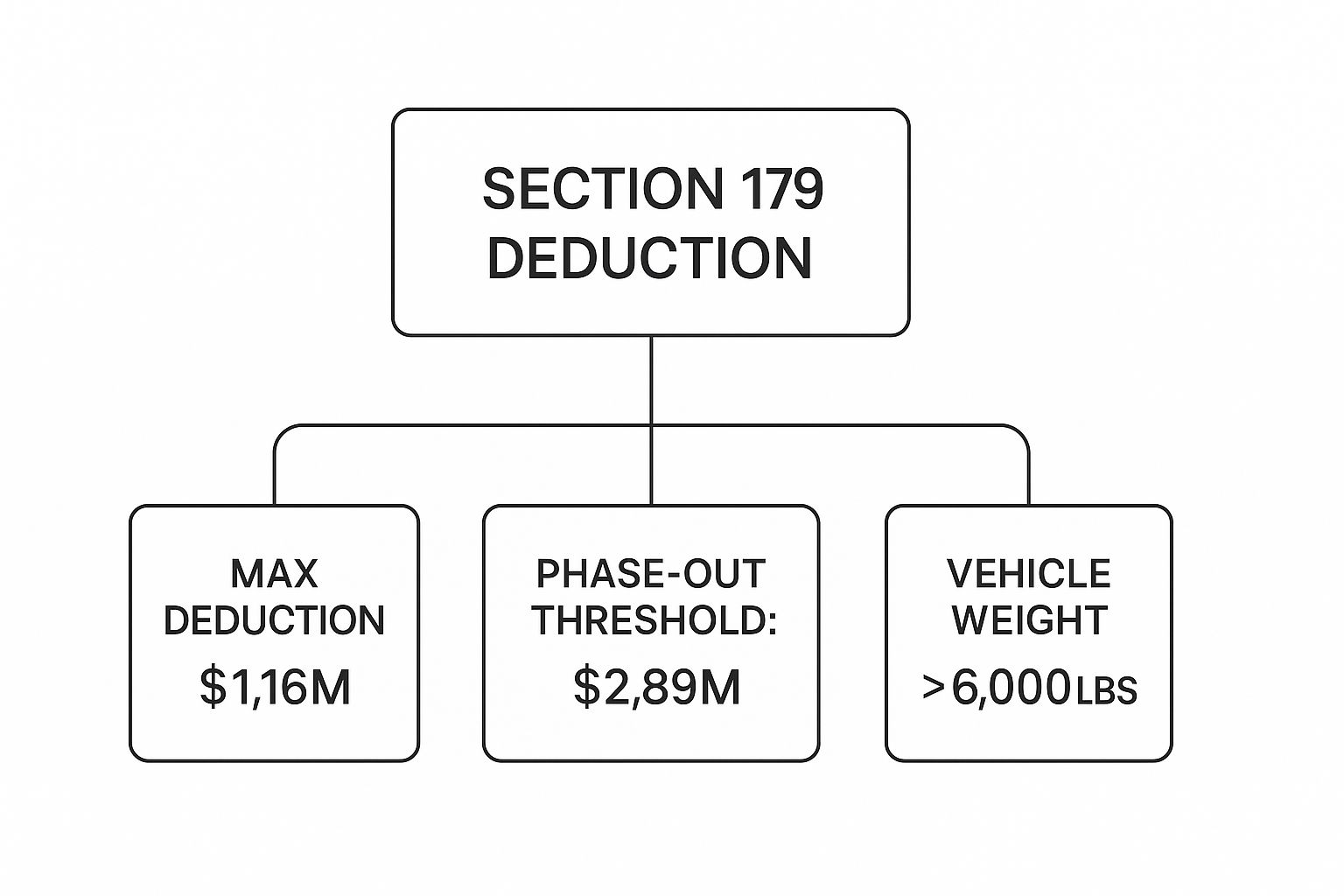
As you can see, hitting that 6,000-pound mark is critical, but it all works within the larger framework of the overall deduction and spending caps for the year.
Key Eligibility Requirements
To make sure this tax break is used for genuine business purposes and not just as a loophole for a fancy personal car, the IRS has a few key rules. They’re simple, but you have to follow them to the letter.
- Business Use: This is the big one. The vehicle has to be used for business more than 50% of the time. If you use it for business 80% of the time, your deduction is based on 80% of the vehicle's cost.
- Placed in Service: You can't just buy the vehicle and let it sit. You must start using it for your business during the same tax year you plan to claim the deduction.
- Weight Classification: As we've covered, the GVWR is what separates the good deductions from the great ones. Heavy vehicles (those over 6,000 lbs) qualify for a much more generous write-off.
Recent legislative updates for 2025 have made these rules even more valuable. With higher deduction limits and the return of 100% bonus depreciation, businesses can now get massive first-year write-offs. For heavy SUVs, trucks, and vans with a GVWR over 6,000 pounds, you can take a Section 179 deduction of up to $31,300. Even better, bonus depreciation can often cover the rest of the vehicle's cost, creating a potent tax-saving combo. To dig deeper into the specifics, you can find a wealth of information on the official 2025 guidelines at Section179.org.
To help simplify these rules, here’s a quick breakdown of how different vehicle types are treated under Section 179.
Section 179 Vehicle Deduction Quick Reference
| Vehicle Category (by GVWR) | Section 179 Deduction Limit | Eligible for 100% Bonus Depreciation? | Primary Use Case |
|---|---|---|---|
| Light Vehicles (< 6,000 lbs) | $20,200 (if bonus depreciation is taken) | Yes | Passenger cars, small SUVs, and crossovers used for business travel. |
| Heavy Vehicles (6,001 – 14,000 lbs) | $31,300 | Yes | Large SUVs, heavy-duty trucks, and passenger vans. |
| "Workhorse" Vehicles (> 6,000 lbs) | Up to $1,260,000 | Yes | Cargo vans, box trucks, and specialty vehicles with no passenger seating behind the driver. |
This table shows just how much the deduction can vary. The difference between a light passenger car and a heavy-duty work truck is night and day when it comes to your tax bill. Always confirm a vehicle's GVWR and your business-use percentage before making a purchase.
How the Section 179 Deduction Actually Works
It’s best to think of Section 179 less like a tax rule and more like a powerful financial tool. Forget the old, slow method of depreciating a business vehicle over several years. Section 179 is like getting a massive, upfront rebate from the IRS.
This tax code provision lets you deduct the entire qualifying purchase price of an asset in the same year you buy it and start using it. This front-loads your tax savings, giving you a huge cash flow boost right away. You can then pour that capital back into your business—maybe for a new marketing campaign, another hire, or just more inventory. It's designed specifically to help small and medium-sized businesses invest in the tools they need to grow.
Core Concepts You Need to Know
To get this right, you need to be familiar with a couple of key terms the IRS uses. They might sound a bit formal, but the concepts are straightforward.
- Qualifying Property: This is just about any tangible asset you buy for your business, including vehicles. The great thing is that both new and used vehicles can qualify, which is a big deal for businesses working with a tighter budget.
- Placed in Service: This is a simple but critical one. It means you must actually start using the vehicle for business purposes during the same tax year you claim the deduction. You can't just buy a truck in December, let it sit on the lot, and expect to write it off.
These two rules ensure the tax break goes toward assets that are actively helping you run your business.
Understanding the Annual Limits
Section 179 isn't a free-for-all; the IRS caps it each year to keep the benefits focused on small to mid-sized companies. There are two main numbers you have to keep an eye on.
First is the maximum deduction limit. For 2025, you can deduct up to $1,260,000 on qualifying equipment. This is the grand total you can write off across all your eligible purchases, from new machinery to software and, of course, vehicles eligible for Section 179.
The second number is the total investment or spending cap, which is essentially a phase-out threshold. For 2025, that cap is $3,150,000. If your business spends more than this on equipment in a single year, your Section 179 deduction starts to shrink.
This phase-out is completely intentional. It’s designed to reserve the full power of Section 179 for the businesses it was meant to help most—those making significant, but not colossal, capital investments.
Let's say your business spends $3,250,000 on equipment. That's $100,000 over the spending cap. Your maximum Section 179 deduction is then reduced by that same $100,000. This setup prevents massive corporations from taking full advantage. For smaller businesses, learning about maximizing tax deductions through business financing can be a game-changer.
Here's another great part: Section 179 can often be used alongside another powerful tax incentive called bonus depreciation. Combining these two can create a serious one-two punch for tax savings. If you want to dive deeper into that strategy, check out our guide on https://alliedtax.com/how-does-bonus-depreciation-work/.
Cracking the Code: The 6,000-Pound Vehicle Rule
This is where Section 179 really starts to pay off for business owners. The secret to unlocking the biggest tax savings often comes down to what’s known as the 6,000-pound rule. It’s not some minor tax code footnote; it’s the bright line that separates a decent deduction from a massive first-year write-off.
The rule is all about a vehicle's Gross Vehicle Weight Rating (GVWR). This isn't what the truck can tow, but rather its maximum safe operating weight, factoring in the vehicle itself, passengers, fuel, and any cargo. You can find this number printed on a sticker right inside the driver-side door jamb. If that sticker says the GVWR is over 6,000 pounds, you've just opened the door to a much bigger tax break.
So, What Counts as a "Heavy" Vehicle?
Because the rule is based on GVWR, a lot of popular business vehicles easily clear the 6,000-pound hurdle. Knowing which models usually make the cut can help you make a much smarter purchase.
Here are the types of vehicles that almost always qualify:
- Full-Size SUVs: Think of the big ones—a Chevrolet Suburban, Ford Expedition, or Cadillac Escalade. These are go-to choices for businesses needing to move people or equipment comfortably.
- Heavy-Duty Pickup Trucks: It’s hard to find a full-size pickup that doesn't qualify. We're talking about the Ford F-150/F-250 series, Ram 1500/2500, and Chevrolet Silverado.
- Cargo and Passenger Vans: Workhorses like the Ford Transit, Mercedes-Benz Sprinter, and Ram ProMaster are built for heavy loads, so they naturally have a high GVWR.
The IRS gives these vehicles special treatment because, let's be honest, they're less likely to be used just for personal joyrides. They look and feel like legitimate business tools, and the tax code reflects that.
For 2025, the Section 179 deduction on these heavy vehicles is capped at $31,300. But here’s the key: that’s just the first step. If a marketing firm buys a qualifying used SUV for $75,000 (and uses it 100% for business), they can immediately deduct that $31,300. Then, they can apply 100% bonus depreciation to the remaining $43,700, potentially writing off the entire vehicle in year one. This powerful one-two punch delivers a huge tax benefit right away. For a deeper dive, check out this comprehensive vehicle list from Crest Capital.
The Power Combo: Section 179 + Bonus Depreciation
Let’s put this into a real-world scenario. Say your construction company buys a new heavy-duty pickup truck for $70,000. Its GVWR is well over the limit at 7,500 pounds, and you use it 100% for the business, hauling tools and materials to job sites.
You now have a two-part strategy to write off the entire cost this year.
The Tax Write-Off One-Two Punch: Think of Section 179 as the first jab that takes a big chunk out of the cost. Bonus depreciation then comes in with the knockout blow, wiping out the rest.
Here’s how the math plays out on that new $70,000 truck:
-
Apply the Section 179 Deduction: First, you take the maximum Section 179 deduction allowed for this vehicle type in 2025, which is $31,300.
- Remaining Cost: $70,000 – $31,300 = $38,700
-
Apply 100% Bonus Depreciation: Next, you apply bonus depreciation to what's left. Since the rate is 100% for 2025, you can deduct the full remaining amount.
- Bonus Depreciation Deduction: 100% of $38,700 = $38,700
-
Calculate Your Total First-Year Deduction: Add them together, and you’ve written off the entire purchase price in the same year you bought it.
- Total Deduction: $31,300 (Section 179) + $38,700 (Bonus Depreciation) = $70,000
This strategy dramatically lowers your taxable income for the year. That’s real cash that stays in your pocket, ready to be reinvested right back into growing your business.
Specialized and Non-Personal Use Vehicles
While heavy SUVs and pickup trucks come with great tax perks, Section 179 really flexes its muscles when you get into vehicles built exclusively for work. These are what the IRS often calls “non-personal use” vehicles, a special category that can completely bypass the deduction limits placed on more conventional passenger-style vehicles.
The logic is pretty straightforward. If a vehicle's design makes it completely impractical for personal use—like picking up the kids from school or running to the grocery store—the IRS treats it as a piece of business equipment, plain and simple. For many business owners, this opens the door to writing off the entire purchase price in the first year.

This distinction is a game-changer for specialized industries. Think about a plumber’s cargo van, packed with tools and shelves, or a hotel’s airport shuttle. Their very function is so tied to the business that personal use is out of the question, which is why the tax rules are so much more generous.
Defining Non-Personal Use
So, what exactly lands a vehicle in this top-tier tax category? The IRS isn't just looking at how you use the vehicle; it’s looking at its bones—its permanent design and what it was built to do.
A vehicle typically qualifies as non-personal use if it meets certain design standards. Nailing this classification is key because it often allows a business to deduct up to the full Section 179 annual limit, blowing past the lower caps that apply to heavy SUVs.
Here are some classic examples that usually fit the bill:
- Cargo Vans: Picture a van with a fully enclosed driver's area but no seats (or even fixtures for seats) behind the driver. A Ford Transit or Mercedes-Benz Sprinter configured to haul supplies is a perfect example.
- Shuttle and Passenger Vans: These are the big vans designed to seat more than nine passengers behind the driver, like the ones you see running routes for hotels or airport services.
- Purpose-Built Vehicles: This category covers vehicles built for a single, specific job where taking it on a personal trip would be next to impossible.
For any business that relies on these workhorses, this is a huge deal. The ability to fully expense a major purchase like a new van can seriously free up cash flow and let you invest back into other parts of the company.
Examples of Fully Deductible Vehicles
The list of qualifying non-personal use vehicles is surprisingly long and cuts across countless industries. What they all have in common is a specialized function that makes them an obvious business tool.
For businesses in need of vehicles primarily for commercial use, specific categories such as commercial trucks can provide significant tax benefits under Section 179.
Let's look at some clear-cut examples of vehicles that are often eligible for a 100% write-off under Section 179 (up to the annual limit, of course):
- Ambulances and Hearses: They are built for one purpose and have zero practical personal use.
- Box Trucks: The classic moving or delivery truck with a cargo box that’s separate from the cab.
- Dump Trucks and Cement Mixers: Heavy-duty construction equipment designed for specific job site tasks.
- Delivery Vans: Think of the classic step-vans that package delivery companies use every day.
- Refrigerated Vans and Trucks: An absolute necessity for any business in food service or delivery.
Key Takeaway: The more a vehicle looks and functions like a dedicated piece of machinery, the better its chances of qualifying for the full Section 179 deduction without the passenger vehicle limitations.
Ultimately, it all comes down to the vehicle’s fundamental design. When you understand this principle, you can make smarter purchasing decisions—choosing vehicles that not only get the job done but also give you the biggest possible tax advantage. It’s a strategic move that makes every dollar you invest in your fleet work that much harder for your bottom line.
Navigating the Rules for Lighter Vehicles
While heavy vehicles unlock the biggest tax incentives, let's be realistic—many businesses run on standard cars, crossovers, and light trucks. When your business needs one of these lighter vehicles (anything with a Gross Vehicle Weight Rating under 6,000 pounds), you need to know that you're playing by a completely different and much stricter set of rules.
The IRS calls these the "luxury auto limitations," a name designed to stop business owners from writing off fancy cars that are mostly for personal enjoyment. But don't let the name fool you.
Making an uninformed purchase here can be a costly mistake. If you buy a standard sedan for your business expecting the same massive deduction you'd get on a heavy-duty truck, you're in for a rude awakening. The IRS puts firm caps on how much you can write off in the first year for these lighter vehicles, which puts a much lower ceiling on your potential tax savings.
The Strict Caps on Lighter Vehicles
For any vehicle that doesn't meet that 6,000-pound threshold, the maximum first-year deduction is seriously limited. For 2025, the absolute most you can write off in the first year for a new passenger car is $20,200, and that's only if you claim 100% bonus depreciation. That figure is a combination of the standard depreciation limit and the bonus allowance.
This cap is a world away from the potential write-offs for heavy vehicles, where combining Section 179 and bonus depreciation can often let you deduct the vehicle's entire cost in year one. The lower limit on lighter cars is completely intentional; it’s the IRS's way of making sure the tax break aligns with a vehicle that could easily be used for groceries as much as for client meetings.
Crucial Insight: That term "luxury auto limitations" is a bit of a misnomer. These rules don't just apply to high-end luxury brands. A modest Honda Civic is subject to the exact same caps as a Porsche.
To really see what's at stake, you have to look at the numbers side-by-side. The difference in potential first-year deductions is dramatic, and it all comes down to that GVWR.
First-Year Deduction Comparison Heavy vs Light Vehicles
The table below paints a very clear picture of just how much that weight rating matters to your bottom line.
| Vehicle Type | Example Cost | Max Section 179 Deduction | Bonus Depreciation Potential | Total First-Year Write-Off |
|---|---|---|---|---|
| Light Vehicle (< 6,000 lbs) | $45,000 | N/A (Subject to different limits) | Part of the $20,200 cap | $20,200 |
| Heavy Vehicle (> 6,000 lbs) | $75,000 | $31,300 | $43,700 (100% of remaining) | $75,000 |
As you can see, the tax implications are massive. A heavy vehicle gives you a clear path to writing off the entire purchase in the first year, while a lighter vehicle offers a much smaller, tightly capped deduction. It's a game of two completely different rulebooks.
The Critical More Than 50% Business Use Rule
Here’s the golden rule that applies to any vehicle you want to deduct: it must be used more than 50% of the time for legitimate business purposes. This isn't a suggestion; it's a non-negotiable requirement from the IRS, and they expect you to have the records to prove it.

If your business use ever dips to 50% or below, you instantly lose the ability to claim these accelerated deductions like Section 179.
The only way to back up your claim is with a detailed, contemporaneous mileage log. You can't just guess at the end of the year. You need to track:
- Total miles driven for the year
- Total business miles driven
- The date, purpose, and destination of every single business trip
Your final deduction is tied directly to this percentage. Use the car 80% for business? You can only claim 80% of the allowable depreciation amount. For a deeper dive into these rules, check out our complete guide on deducting vehicle expenses. Think of accurate tracking as your best defense in an audit and the key to getting every dollar you're entitled to.
So, Why Do These Tax Rules Keep Changing?
If you've been following business tax laws for a while, you know the rules for vehicle deductions—especially Section 179 and bonus depreciation—are constantly in flux. It's best to think of them not as permanent parts of the tax code, but as economic levers that Congress pulls to either stimulate or cool down the economy.
The whole point of these incentives is to get businesses like yours to spend money on new equipment and vehicles. When the economy is sluggish, lawmakers often make these deductions more generous to encourage investment. But when things are humming along, they might scale them back. This ebb and flow creates specific windows of opportunity, and right now, we're in a big one.
The Wild Ride of 100% Bonus Depreciation
The recent history of bonus depreciation is a perfect case study. This provision, which often works hand-in-hand with Section 179, has been on quite a rollercoaster.
Thanks to the Tax Cuts and Jobs Act, from 2018 through 2022, businesses enjoyed 100% bonus depreciation. This was huge—it meant you could write off the entire cost of a qualifying new vehicle in the very first year. But this sweet deal was designed to be temporary. It dropped to 80% in 2023 and then down again to 60% in 2024.
Just as businesses were getting used to the phase-out, a major policy shift happened. In early 2025, legislation was passed that not only restored bonus depreciation to 100% but made it permanent. At the same time, the Section 179 deduction limit was boosted to a massive $2.5 million, creating an incredibly valuable environment for anyone buying work vehicles. If you want to dig deeper into this, you can learn more about maximizing 2025 tax incentives and get specific insights on what truck owners should know.
This back-and-forth really drives home how quickly the tax landscape can shift. The fantastic rules that make today a great time to buy might not be here tomorrow.
A Window of Opportunity: Tax laws aren't set in stone. The current, very favorable rules for vehicle deductions are a strategic advantage that could easily change with new legislative priorities. Acting now is key.
Understanding this history isn't just an academic exercise—it's about seeing the strategic value in acting now. By working with a tax professional, you can plan your vehicle purchases to make sure you lock in these powerful incentives while they’re available. A proactive approach here can make a real, immediate difference to your company's cash flow and bottom line.
Common Questions About Section 179 Vehicles
Even when you feel like you have a handle on the rules, applying tax code to a real-world business decision always brings up new questions. It’s one thing to read the theory, but it's another to figure out which specific vehicles are eligible for Section 179. Let's walk through some of the most common questions we get from business owners just like you.
Getting these details right is more than just a box-ticking exercise; it's about protecting your business and making sure you get every dollar you're entitled to.
Can I Claim the Deduction on a Used Vehicle?
Yes, you absolutely can. This is probably one of the most powerful and overlooked parts of the Section 179 tax code. The vehicle doesn't have to be fresh off the factory line; it just has to be "new to you" and your business.
This is a huge win for small and mid-sized businesses working with a tight budget. It means you can find a dependable, pre-owned heavy truck or SUV and still take the exact same Section 179 deduction as someone who bought a brand-new model.
What Records Do I Need to Prove Business Use?
The IRS is serious about documentation. You need clear, undeniable proof to back up your business-use claim. A rough guess at the end of the year just won't cut it and could land you in hot water during an audit.
The best way to stay compliant is to keep a detailed, ongoing mileage log. It doesn’t have to be complicated, but it does need to be thorough. For each business trip, you should log:
- The date
- Your starting and ending mileage
- Where you went and why it was for business
This log is your first line of defense if your business use is ever questioned. Thankfully, there are plenty of modern apps and software that can automate a lot of this for you.
What Happens if My Business Use Drops Below 50%?
This is a big one, so pay close attention. If your business use for the vehicle dips to 50% or less at any point during its normal lifespan for tax purposes (usually five years), the IRS can take back part of the deduction.
This is called Section 179 recapture. Essentially, the IRS makes you add back the "extra" depreciation you took upfront as income. It's a penalty you definitely want to avoid, so keeping that business-use percentage high is key.
Can I Deduct a Leased or Financed Vehicle?
Yes, with a few key differences. If you finance the vehicle, you're in the clear. You can still deduct the full qualifying amount in the first year, even while you're still making payments on the loan.
Leased vehicles are a bit trickier. A standard operating lease generally won't qualify for the Section 179 deduction. However, if you have a capital lease—which is basically a lease-to-own agreement—the IRS treats it like a purchase, and you can usually claim the deduction. If you are wondering whether buying a car is a tax write-off, our detailed guide offers more insights into the nuances of vehicle-related deductions.
At Allied Tax Advisors, we help business owners navigate these complexities every day. From choosing the right vehicle to ensuring proper documentation, our team provides the expert guidance you need to make confident financial decisions. Contact us to learn how we can optimize your tax strategy. https://alliedtax.com