
So, what exactly is the self-employment tax rate? For 2024, it’s a flat 15.3% on your net business earnings. This might sound steep, but it's not some extra penalty for working for yourself. It’s simply the way you, as a business owner, contribute to Social Security and Medicare.
Think of it this way: when you’re a traditional W-2 employee, FICA taxes are automatically taken out of your paycheck. Your employer pays half (7.65%) and you pay the other half (7.65%). When you’re self-employed, you're both the employee and the employer, so you’re responsible for covering the whole amount yourself. That’s where the 15.3% comes from.
Breaking Down the Self Employment Tax Rate
That 15.3% isn't just one big number; it’s actually a combination of two separate taxes, each with its own rules.
-
The Social Security Component: This makes up the bulk of the tax at 12.4%. The key thing to remember here is that it only applies up to a certain income level each year. For 2024, that ceiling is $168,600. If you earn more than that from your business, you stop paying the Social Security portion on any income above that threshold.
-
The Medicare Component: This part is 2.9%. Unlike Social Security, there's no income cap on this one. You’ll pay the 2.9% Medicare tax on all of your net self-employment earnings, no matter how much you make.
The table below gives you a quick visual summary of how these two components come together.
Self Employment Tax Rate Breakdown
This table summarizes the two parts that make up your total self-employment tax rate.
| Tax Component | Rate | Annual Earnings Limit |
|---|---|---|
| Social Security | 12.4% | $168,600 |
| Medicare | 2.9% | None |
This structure is why you'll hear about the Social Security wage base limit—it's a critical piece of the puzzle.
The Most Important First Step in Your Calculation
Now, here’s a crucial detail that trips a lot of people up. You don't actually apply that 15.3% rate to your total net profit. Before you do anything else, you get a small but helpful adjustment.
The IRS recognizes that employees don't pay FICA tax on the share their employer contributes. To create a similar setup for the self-employed, you only pay self-employment tax on 92.35% of your net earnings. It's a small difference, but it's a permanent one that works in your favor.
Key Takeaway: Always remember this: your self-employment tax is calculated on 92.35% of your net profit, not the full 100%. This is your "taxable base" for SE tax.
Let's say your business cleared a net profit of $50,000. You wouldn't just multiply that by 15.3%. Your first step is to find your taxable base: $50,000 x 0.9235 = $46,175. That $46,175 is the number you'll use to figure out your actual self-employment tax bill. Getting this initial step right is the foundation for accurately calculating what you owe.
Calculate Your Self Employment Tax Step by Step
Alright, you know the tax rate, but what does that mean in real dollars? Let's roll up our sleeves and walk through how to actually calculate your self-employment tax. It’s not quite as simple as multiplying your profit by 15.3%, but it’s a straightforward process once you see it in action.
We’ll start with your net earnings—the foundation of the whole calculation—and then work our way through the specific adjustments and rates to land on your final tax figure.
Step 1: Find Your Net Earnings from Self Employment
First things first: you can't figure out your tax until you know your profit. Your net earnings are simply your total business income minus all your legitimate business expenses. This is the number that everything else is based on.
This is where good record-keeping really pays off. To get an accurate net earnings figure, you need to track every dollar coming in and going out. It starts with understanding the fundamental difference between an invoice and a receipt to make sure you're capturing all your income and deductible costs properly.
Step 2: Determine Your Taxable Base
Now for a little-known but very important quirk. You don't actually pay self-employment tax on 100% of your net profit. The IRS lets you multiply your net earnings by 92.35% before you calculate the tax.
Why? It's an adjustment meant to level the playing field a bit between self-employed individuals and W-2 employees. Think of it as the self-employed version of an employer paying half of an employee's FICA taxes.
So, the math is simple:
- Get Net Earnings: Total Income – Total Expenses = Net Earnings.
- Make the Adjustment: Multiply your Net Earnings by 0.9235 (or 92.35%).
The result is your taxable base—the actual number that the 15.3% self-employment tax rate applies to. It’s a small adjustment, but it directly reduces your tax bill.
Good to Know: If your net earnings from self-employment are under $400 for the year, you typically don't owe any self-employment tax at all.
This infographic gives a great visual breakdown of how that total rate is applied.
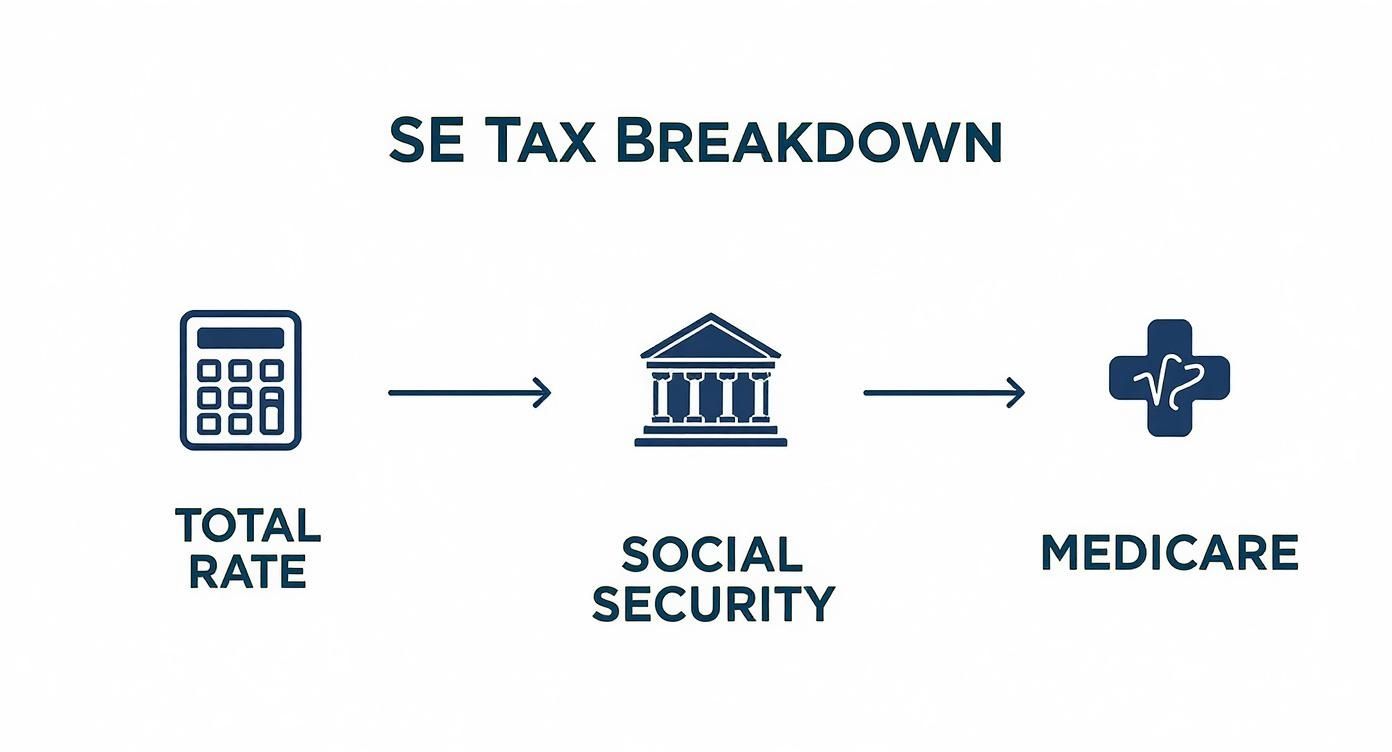
As you can see, the 15.3% is just the 12.4% for Social Security and the 2.9% for Medicare added together, which get applied to that adjusted earnings figure we just calculated.
Step 3: Apply the Social Security and Medicare Rates
Once you have your taxable base, it's time to apply the two parts of the tax. This is where the annual Social Security earnings limit can come into play, but for most people, the calculation is pretty direct.
Let's look at a real-world example.
Example 1: A Freelance Consultant
Say you’re a freelance marketing consultant who had a good year.
- Total Business Income: $85,000
- Total Business Expenses: $25,000
First, we calculate your net earnings.
- Net Earnings: $85,000 – $25,000 = $60,000
Next, find the taxable base by applying the 92.35% adjustment.
- Taxable Base: $60,000 x 0.9235 = $55,410
Because $55,410 is well below the 2024 Social Security limit of $168,600, the entire amount gets hit with both taxes.
- Self-Employment Tax: $55,410 x 0.153 = $8,477.73
And that's it! That’s the total self-employment tax you owe. For an even more in-depth guide, feel free to check out our detailed post on https://alliedtax.com/how-to-calculate-self-employment-tax/.
Step 4: Account for the Social Security Earnings Limit
For higher earners, the calculation has an extra step. Once your income crosses that Social Security wage cap, you stop paying the 12.4% Social Security portion on any earnings above that limit. The 2.9% Medicare tax, however, keeps going no matter how much you make.
Let's run the numbers for a higher-income scenario.
Example 2: A High-Earning Software Developer
Imagine a self-employed software developer with these financials:
- Total Business Income: $220,000
- Total Business Expenses: $30,000
First, find the net earnings.
- Net Earnings: $220,000 – $30,000 = $190,000
Next, determine the taxable base.
- Taxable Base: $190,000 x 0.9235 = $175,465
Now, we apply the two tax rates separately, keeping that $168,600 Social Security limit in mind.
- Social Security Tax: The 12.4% tax only applies to the first $168,600.
- $168,600 x 0.124 = $20,906.40
- Medicare Tax: The 2.9% tax applies to the entire taxable base of $175,465.
- $175,465 x 0.029 = $5,088.49
Finally, add the two parts together for the grand total.
- Total SE Tax: $20,906.40 + $5,088.49 = $25,994.89
As you can see, knowing how that Social Security limit works is absolutely critical for getting your tax liability right, especially as your business income grows.
How Self-Employment Tax and Income Tax Work Together
One of the biggest hurdles for new freelancers is understanding how self-employment tax and regular income tax fit together. Are they the same thing? Do you pay both? The short answer is that they are two totally separate taxes, but they have a crucial—and beneficial—relationship.
Think of your net business profit as a single pool of money. From this pool, you have to fill two different buckets.
- Bucket #1 is for Self-Employment Tax: This money is earmarked specifically for Social Security and Medicare.
- Bucket #2 is for Federal Income Tax: This goes into the general government fund for everything else, from national parks to highways.
You absolutely pay both taxes, but they aren't calculated in a vacuum. How much you pay in one directly affects how much you pay in the other, which creates a fantastic tax-saving opportunity.
The Deduction That Connects Them
Here’s where it gets interesting. You calculate your self-employment (SE) tax first. After you have that number, the IRS lets you take a powerful deduction: you can subtract one-half of what you paid in SE tax from your total income before you calculate your income tax.
This is often called the "employer-equivalent" portion. Since a traditional employer gets to deduct their half of FICA taxes as a business expense, this deduction puts you on a more level playing field. It directly lowers your Adjusted Gross Income (AGI), which is the figure used to figure out how much income tax you actually owe.
A lower AGI means less of your income is hit by income tax rates. The result? A smaller overall tax bill. This is exactly why getting a handle on the connection between these two taxes is so important for seeing the true picture of what you'll owe.
This clever relationship ensures you aren't "double-taxed" on the money you used to pay the employer's share of your SE tax.
Seeing It in Action: An Example
Let’s make this real. We'll go back to our freelance consultant who already calculated a self-employment tax of $8,478.
-
Calculate the SE Tax Deduction: First, we just need to find one-half of the SE tax they paid.
- $8,478 (Total SE Tax) ÷ 2 = $4,239
-
Apply the Deduction to Income: Now, we subtract that amount from the business's net profit to find the new, lower amount subject to income tax.
- $60,000 (Net Earnings) – $4,239 (SE Tax Deduction) = $55,761
This is a big deal. The consultant only has to pay federal income tax on $55,761 of their profit, not the full $60,000. The exact savings will depend on their tax bracket, but every single dollar you can shave off your AGI is a win.
This two-tax system in the U.S. is pretty unique. The flat 15.3% self-employment tax, which covers both the employer and employee sides of Social Security and Medicare, stands apart from the progressive income tax brackets that climb up to 37% at the federal level—and that's before any state taxes kick in. It can be eye-opening to explore how personal income tax rates compare across different countries to get a broader perspective.
At the end of the day, just remember that your SE tax payment isn't just a cost; it also creates a valuable deduction against your income tax. Knowing this helps you better forecast your true tax burden and avoid leaving money on the table.
How to File and Pay Self-Employment Taxes with Schedule SE
Okay, so you’ve got a handle on the math behind self-employment tax. That’s a huge first step. But the next piece of the puzzle is just as critical: actually getting that money to the IRS on time.
When you're self-employed, there's no employer to automatically pull taxes from your paycheck. That responsibility is all yours. This means you can't just ignore your taxes until April and hope for the best. If you do, you're setting yourself up for a nasty surprise in the form of a massive tax bill and, even worse, painful underpayment penalties. The whole system is designed for you to pay as you earn throughout the year.

Making Quarterly Estimated Tax Payments
So, how do you pay as you go? The IRS's tool for this is Form 1040-ES, Estimated Tax for Individuals. Think of it as your personal, quarterly tax payment system. You’ll estimate your income for the quarter and send a payment that covers both your self-employment tax and your regular income tax.
These payments have firm deadlines, so get these dates on your calendar right away.
- Payment 1: For income earned Jan 1 – Mar 31, due April 15.
- Payment 2: For income earned Apr 1 – May 31, due June 15.
- Payment 3: For income earned Jun 1 – Aug 31, due September 15.
- Payment 4: For income earned Sep 1 – Dec 31, due January 15 of next year.
Staying on top of this schedule is the best thing you can do to avoid financial headaches come tax time. For a deeper dive, check out our guide that answers the common question, "what is estimated tax payments?".
Putting It All Together on Your Annual Tax Return
When you file your big annual return, two forms become your best friends: Schedule C and Schedule SE. They work as a team to take your business’s financial story and translate it into the language the IRS understands.
It starts with Schedule C (Form 1040), Profit or Loss from Business. This is where you lay it all out—your gross income from your work and every single deductible business expense you had. The number at the bottom of this form, your net profit, is the key figure that kicks off your tax calculations.
Key Connection: Your net profit from line 31 of Schedule C is the exact number you'll carry over to your self-employment tax form. It’s the bridge between your business activity and your tax liability.
Once you have that net profit, you’ll turn to Schedule SE (Form 1040), Self-Employment Tax. This is where all the math we talked about earlier happens on an official form.
The Schedule SE walks you through the steps methodically:
- You start with your net profit from Schedule C.
- The form applies the 92.35% multiplier to determine your taxable self-employment income.
- It then calculates your Social Security and Medicare taxes, making sure to apply the annual Social Security wage cap correctly.
The final number on Schedule SE represents your total self-employment tax for the year. That amount gets transferred to your main Form 1040 and added to your income tax. The form also calculates the all-important deduction for one-half of your self-employment taxes, which you’ll use on Form 1040 to lower your overall taxable income.
Strategies to Legally Reduce Your Self Employment Tax
Figuring out what you owe in self-employment tax is the first step. The next, more empowering step is learning how to legally shrink that number. Since the tax is calculated on your net business earnings, the smartest strategies all boil down to one thing: lowering your taxable profit through legitimate deductions and contributions.
Think of it this way: your net earnings are what the IRS looks at. The more "ordinary and necessary" business expenses you can claim, the lower that final number becomes. This isn't about tax evasion; it's about smart, proactive financial management.

Maximize Your Business Deductions
The most fundamental way to lower your self-employment tax is to claim every single business deduction you're entitled to. So many freelancers and small business owners accidentally leave money on the table by overlooking common write-offs. Your mission is to identify any personal expense that has a legitimate business purpose and claim it.
Some of the most commonly missed deductions include:
- Home Office Deduction: If you use a specific area of your home exclusively for your business, you can deduct a portion of your rent, utilities, insurance, and mortgage interest.
- Software and Subscriptions: All those monthly and annual fees for tools essential to your work—from accounting software to industry journals—are fully deductible.
- Professional Development: Did you take a course, attend a workshop, or go to a conference to sharpen your skills? The costs can be written off.
- Health Insurance Premiums: This is a big one. As a self-employed person, you can often deduct 100% of what you pay for health, dental, and long-term care insurance for yourself and your family.
Beyond these everyday deductions, don't forget to look for more specialized opportunities. Some businesses can significantly cut their tax bill by exploring specific tax credits like the R&D tax credit, which directly reduces the tax you owe.
Harness the Power of Retirement Contributions
Contributing to a self-employed retirement plan is one of the most powerful financial moves you can make. It's a true win-win: you're building a nest egg for your future while simultaneously scoring a major tax deduction that lowers both your income tax and your self-employment tax.
Popular plans like the SEP IRA or Solo 401(k) are designed for this. Contributions you make to these accounts come straight off your net business income, directly cutting the amount that gets hit with that 15.3% self-employment tax.
Key Insight: A $10,000 contribution to a SEP IRA doesn't just reduce your income tax; it can also save you $1,530 in self-employment taxes right away. This makes retirement saving one of the most efficient tax-reduction strategies available.
This dual benefit—saving for retirement while saving on taxes today—is a cornerstone of smart financial planning for any entrepreneur.
Impact of Deductions on Self Employment Tax Liability
To see these strategies in action, let's look at how deductions can dramatically lower what you owe. The table below shows a simplified comparison for a freelancer.
| Scenario | Gross Income | Deductions/Contributions | Net Taxable Earnings | Estimated SE Tax |
|---|---|---|---|---|
| No Deductions | $80,000 | $0 | $73,920 | $11,310 |
| With Business Expenses | $80,000 | $15,000 | $59,940 | $9,171 |
| With Max Retirement | $80,000 | $15,000 Expenses + $10,000 SEP IRA | $50,850 | $7,780 |
As you can see, actively tracking expenses and contributing to retirement doesn't just chip away at your tax bill—it takes a huge bite out of it.
Consider an S Corporation Election for Higher Earners
As your business thrives and your income climbs, you might outgrow the standard sole proprietor or LLC tax structure. This is when a more advanced strategy, like electing to be taxed as an S Corporation, can become a game-changer.
Here’s the core concept: Instead of your entire business profit being subject to self-employment tax, you pay yourself a "reasonable salary" as a W-2 employee. You'll pay FICA taxes (the employee/employer version of SE tax) on that salary, but any remaining profit can be taken as a distribution, which is not subject to self-employment tax.
This strategic split can create substantial tax savings, but it's not without trade-offs. It introduces more administrative work, like running payroll. To see if this move makes sense for your bottom line, check out our guide on S Corp vs. LLC for small business.
Got Questions About Self-Employment Tax? We’ve Got Answers.
Once you get the basics of self-employment tax down, the real-world questions start popping up. It's one thing to understand the formula, but it's another to know how it applies when life gets complicated. This is where most freelancers and new business owners start feeling a little lost.
Let's clear up some of the most common "what if" scenarios we hear all the time. We'll cover everything from juggling a day job with a side gig to what happens when your business is in the red.
What If I Have a W-2 Job and a Side Hustle?
This is probably the most common setup we see these days. The short answer is yes, you handle taxes for both, but they work together in a way that can actually save you money.
Think of it this way: your W-2 job already takes care of your employee share of Social Security and Medicare taxes (7.65%) through payroll deductions. For your side hustle, you're on the hook for the full 15.3% self-employment tax on whatever you profit.
But here’s the key: the Social Security tax has a ceiling. For 2024, that cap is $168,600 in earnings. Your W-2 wages get counted toward that limit first. If your salary already puts you over that number, you've hit your Social Security contribution max for the year. That means your side hustle profits are only subject to the 2.9% Medicare portion of the self-employment tax.
Let's Break It Down With an Example:
Say you earn a $180,000 salary at your day job. That's already over the $168,600 Social Security cap. You also run a freelance business that brought in $20,000 in net profit. Since you've already paid all your Social Security tax for the year through your W-2 job, you'll only owe the 2.9% Medicare tax on that $20,000 from your business.
Do I Owe Self-Employment Tax If My Business Loses Money?
Here’s a bit of good news. If your business has a net loss for the year, you owe $0 in self-employment tax. It’s that simple.
The entire tax is calculated on your net earnings. If your expenses were more than your income, you didn’t have any profit. No profit means no self-employment tax liability. In fact, a business loss can sometimes work in your favor by offsetting other income (like your W-2 wages), which could lower your overall income tax bill for the year.
What Is the Minimum Income to Pay Self-Employment Tax?
The IRS has a very clear line in the sand. You generally need to file and pay self-employment tax once your net earnings from your business hit $400 or more for the year.
Notice the key phrase there: net earnings. This isn't about your gross revenue. You could have landed a project that paid $2,000, but if you had $1,700 in legitimate business expenses, your net profit is only $300. In that case, you’d be under the filing threshold. This is another reason why meticulous expense tracking is non-negotiable for the self-employed.
It's also a good reminder of how different tax systems can be. While the U.S. sets this $400 threshold, some countries like Denmark and Japan have top tax rates over 55%, while others like the United Arab Emirates have no income tax whatsoever. If you're curious, you can discover more insights about global tax disparities on GlobalCitizenSolutions.com.
Knowing these rules inside and out helps you stay compliant without giving the IRS a dollar more than you owe.
Navigating the complexities of self-employment and business taxes requires expertise. The team at Allied Tax Advisors offers comprehensive solutions, from strategic tax planning to S Corp filings and bookkeeping, to help you minimize your liability and achieve financial success. Visit us at https://alliedtax.com to learn how our dedicated CPAs can support your financial journey.