
Before you jump into the paperwork, you need to be sure the S corp election is the right strategic move for your business. It's not just a box to check. This decision fundamentally changes how your business is taxed and how you get paid, with the headline benefit being significant savings on self-employment taxes.
Deciding If an S Corp Is Right for Your Business
For most small business owners I talk to, the main driver for considering an S corp is the potential to save thousands of dollars a year. It's a powerful incentive, but it comes from a specific tax-saving mechanism you need to understand.
When you're a sole proprietor or a single-member LLC, every dollar of net profit gets hit with the 15.3% self-employment tax for Social Security and Medicare. With an S corp, you get to split your earnings into two buckets:
- A Reasonable Salary: You become an employee of your own company and pay yourself a formal wage. This salary is subject to FICA taxes (which is essentially the same 15.3% tax, but split between you as the employee and your company as the employer).
- Shareholder Distributions: Any remaining profit can be taken out of the business as a distribution. Here's the magic: this part is not subject to self-employment or FICA taxes. You only pay regular income tax on it.
This salary-distribution split is where the savings come from. The trick, of course, is that the IRS requires your salary to be "reasonable" for the work you do, your experience, and your industry. You can't just pay yourself $1 a year and take the rest as a tax-free distribution.
S Corp vs Sole Proprietor Potential Tax Savings
Let's look at a quick, simplified example to see how this plays out. Imagine a marketing consultant with $120,000 in net profit.
| Metric | Sole Proprietor | S Corporation |
|---|---|---|
| Business Net Profit | $120,000 | $120,000 |
| Owner's Salary | N/A | $70,000 |
| Shareholder Distribution | N/A | $50,000 |
| Income Subject to SE/FICA Tax | $120,000 | $70,000 |
| SE/FICA Tax Owed (15.3%) | $18,360 | $10,710 |
| Annual Tax Savings | $7,650 |
As you can see, by simply structuring the business as an S corp and paying a reasonable salary, the consultant puts an extra $7,650 back into their pocket that year. That's a significant difference that can be reinvested into the business or used for personal goals.
Confirming Your Eligibility
Now, before you get too excited, you have to make sure your business actually qualifies. The IRS has a strict checklist.
Your business must:
- Be a domestic corporation (or an LLC that elects to be taxed as one).
- Have only one class of stock.
- Not have more than 100 shareholders.
- Only have allowable shareholders—meaning individuals, certain trusts, and estates. You can't have partnerships, other corporations, or non-resident aliens as shareholders.
- Not be an ineligible type of corporation, like certain banks or insurance companies.
The S corp has become incredibly popular for a reason. Its growth over the last few decades has been nothing short of explosive. Between 1980 and 2021, the number of S corp tax returns filed with the IRS shot up by a staggering 839%, growing from about 545,400 to over 5.1 million. This shift shows just how many entrepreneurs have found value in this structure.
Liability and Compliance Considerations
Beyond the tax savings, forming an S corp also creates a legal wall between your business and your personal life. It establishes the company as a separate legal entity, which helps protect your personal assets—like your house and car—from business debts or lawsuits.
However, this protection isn't absolute. You have to treat the business like a separate entity. That means maintaining formal compliance, running payroll for your salary, and keeping your business and personal finances completely separate. If you start co-mingling funds, you risk a creditor trying to challenge your liability shield by piercing the corporate veil.
Choosing the right entity is a big decision with a lot of moving parts. If you're still weighing your options, you can dive deeper into the nuances in our guide comparing the S corp vs. LLC for small businesses.
Filing Form 2553 to Elect S Corp Status
Alright, you’ve done the analysis and decided the S corp is the right move for your business. Now it’s time to make it official with the IRS. This whole process hinges on one critical document: Form 2553, Election by a Small Business Corporation.
Filing this form is how you formally ask the IRS to change your business's tax classification. Think of it as the switch that flips your company from being taxed as a C corp (the default for corporations) or a disregarded entity (for LLCs) to a pass-through S corp. Getting this step right is absolutely essential to unlock those potential tax savings and avoid the double-taxation trap of C corps.
The chart below gives a great high-level view of the journey: making sure you qualify, figuring out the savings, and then setting up your compensation correctly.
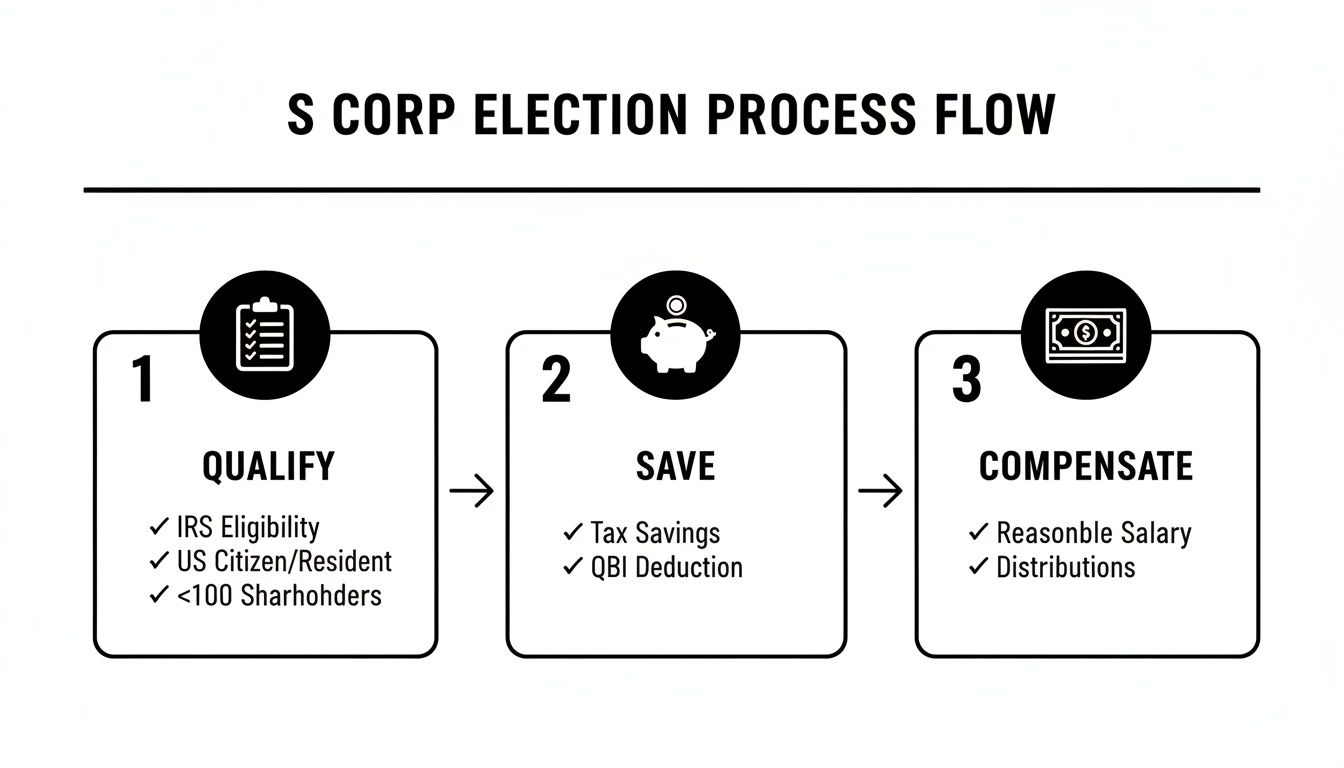
It’s a handy reference for the three pillars of a successful S corp strategy: qualify, save, and compensate.
The Critical Filing Timeline
When it comes to Form 2553, timing is everything. The IRS is a stickler for deadlines, and you have a very specific window to get your election approved for the current tax year.
To have your S corp status kick in for this year, you must file Form 2553 no more than two months and 15 days after the start of your tax year. For most businesses, the tax year starts on January 1st, which makes the hard deadline March 15th. All shareholders must sign the form before it's submitted.
Missed the March 15th window? Don’t panic just yet. You have two main paths forward:
- Elect for Next Year: You can file the form anytime during the current year, and your S corp status will simply begin on January 1st of the next tax year.
- Request Late Election Relief: If you have a legitimate reason for missing the deadline (and many new business owners do), you may qualify for relief. You’ll need to attach a statement to your Form 2553 explaining your "reasonable cause."
My Two Cents: Don't wait until March 14th. I always advise clients to file as early as possible and send it via certified mail. That little green receipt is your golden ticket—irrefutable proof that you filed on time, which can save you a world of headaches if the paperwork gets lost in the shuffle.
Breaking Down the Key Sections of Form 2553
At first glance, Form 2553 can look a little intimidating. It’s a government form, after all. But once you know where to focus, it becomes much more manageable.
Let's walk through the absolute must-get-right parts:
- Part I, Item E – Effective Date: This is where you tell the IRS when you want the S corp election to start. For a timely filing, this will be the first day of your current tax year (e.g., January 1, 2024).
- Part I, Item F – Selected Tax Year: Most small businesses operate on a standard calendar year, so you’ll likely check the box for a tax year ending December 31.
- Part I, Shareholder Information: Pay close attention here. This is where most errors happen. You must list every single shareholder, their address, how many shares they own, and their Social Security number. Most importantly, every shareholder must physically sign and date the form in column K. A single missing signature will get the form rejected, period.
For a more granular, line-by-line guide, check out our deep dive into what Form 2553 is and how to tackle each section.
After You File: What to Expect
You've mailed off your Form 2553. Now what?
The waiting game begins. The IRS will review your election, and if everything is filled out correctly, they will mail you an acceptance letter. This official notice is called a CP261.
You should typically receive this letter within 60 to 90 days. If three months go by and your mailbox is still empty, it’s time to be proactive. Give the IRS Business & Specialty Tax Line a call to check on the status. Just be sure to have a copy of the Form 2553 you filed right in front of you, as they’ll ask for specific information from it.
When that CP261 approval notice finally arrives, treat it like gold. It’s the official proof that your business is recognized as an S corp by the IRS. File it away safely with your permanent corporate records—you’re officially in business.
Getting Your S Corp Ready for Business
You've successfully filed Form 2553. That's a massive step, but it's really the starting line, not the finish line. Running your business as an S corp demands a new level of financial discipline, and the moves you make right now are critical for staying compliant and actually realizing those tax savings you've been working toward.

The whole point of this transition is to build a formal wall between you, the individual, and your business, the S corp. This isn’t just about being organized; it's a legal necessity that protects the very structure you just created. Let's walk through the non-negotiable tasks you need to tackle immediately.
Draw a Hard Line Between Business and Personal Finances
The number one rule of running an S corp is to treat the business as a completely separate financial entity. When you start mixing personal and business funds—a messy practice known as co-mingling—you risk losing the liability protection that was probably a huge reason you formed a corporation in the first place.
Here’s your immediate to-do list:
- Open a Dedicated Business Bank Account: All company income must go into this account, and all business expenses must be paid from it. No gray areas, no exceptions.
- Get a Business Credit Card: This isn't just for convenience. Using a dedicated card for all business purchases keeps your expense tracking clean and reinforces that financial separation.
- Establish Clean Books from Day One: Don't wait. Set up a dedicated accounting system right away. Using a platform like QuickBooks is pretty much standard practice and will make your life infinitely easier when it comes to tracking income, expenses, payroll, and distributions.
These steps aren't just suggestions; they create the clear paper trail needed to maintain your corporate veil and satisfy the IRS.
Set Up a Formal Payroll System
This is where many new S corp owners stumble. You can no longer just transfer money from your business account to your personal account whenever you need it. As an owner-employee, the IRS requires you to pay yourself a reasonable salary through a formal payroll system.
Your salary is subject to FICA taxes (Social Security and Medicare), and a payroll service ensures these are correctly calculated, withheld, and paid on time.
A huge mistake I see new S corp owners make is trying to handle payroll themselves to save a few bucks. It almost always ends in missed deadlines, incorrect filings, and painful penalties. Investing in a reliable payroll service like Gusto or ADP is one of the smartest things you can do.
Getting payroll up and running involves a few key actions:
- Get an Employer Identification Number (EIN): If you were a sole proprietor, you probably used your Social Security Number for taxes. As a corporation with an employee (that's you!), you now need a federal EIN. You can get one for free from the IRS website in minutes.
- Pick a Payroll Provider: These services handle the heavy lifting: tax calculations, direct deposits, quarterly filings (like Form 941), and sending out your W-2 at the end of the year.
- Determine Your Reasonable Salary: You'll need to decide on a salary figure and how often you'll be paid (e.g., monthly, bi-weekly). This number needs to be defensible and based on your industry, experience, and the work you do for the company.
Your Post-Election Financial Checklist
Making the switch can feel like a lot all at once. Use this checklist to stay on track and make sure you're building your S corp on a solid foundation.
- [ ] Apply for an EIN: If your corporation doesn't have one, head to the IRS website and get it done.
- [ ] Open a Business Bank Account: Take your formation documents and EIN to the bank and open a checking account in the corporation's legal name.
- [ ] Set Up Bookkeeping Software: Choose a system like QuickBooks or Xero and get it configured before your first transaction.
- [ ] Select a Payroll Service: Do your research and sign up with a reputable provider to handle your salary.
- [ ] Register for State Payroll Taxes: Your payroll service will likely walk you through this, but it’s your responsibility to register with your state's tax and workforce agencies.
- [ ] Run Your First Payroll: Process your first official paycheck! This makes it real and ensures the tax withholding process starts correctly.
- [ ] Consult a Tax Professional: Schedule a meeting with an advisor, like our team at Allied Tax Advisors, to double-check your setup and start planning for quarterly estimated taxes on your future distributions.
Nailing these tasks transforms your business from an idea on paper into a fully compliant, operational entity. You’re now officially ready to take advantage of everything the S corp structure has to offer.
Managing S Corp Payroll and Tax Obligations
Becoming an S corp isn't just a legal change; it completely shifts how you handle your business's finances. The biggest mental hurdle for new S corp owners is learning to intentionally split their income into two separate streams: a formal salary and owner distributions.
This isn't just about good bookkeeping—it's the entire reason the S corp structure saves you money on taxes.

You now have two distinct roles: you're the owner and you're an employee. Each role gets paid differently, and getting that distinction right is absolutely critical for staying compliant with the IRS.
Determining Your Reasonable Salary
Here's something the IRS is crystal clear about: as an S corp owner-employee, you must pay yourself a "reasonable salary" before you take a single dollar in distributions. This salary is for the actual hands-on work you do—the consulting, the project management, the sales calls.
So, what’s "reasonable"? It's not a number you can just pull out of thin air. The IRS expects your salary to be in line with what another business would pay someone to do your job.
To land on a defensible number, you need to look at a few things:
- Your Role and Responsibilities: What do you actually do every day? Are you the CEO, the lead designer, and the bookkeeper all at once? The more hats you wear, the more complex this calculation becomes.
- Your Experience and Qualifications: A seasoned professional with 20 years of experience commands a higher salary than someone just starting out. Your background matters.
- Industry Benchmarks: Do some homework. See what similar roles are paying in your city or region. You can use data from the Bureau of Labor Statistics or even sites like Glassdoor to get a solid baseline.
- Business Profitability: Your salary has to be something the business can actually afford. It needs to be sustainable month after month.
A classic mistake we see is owners paying themselves a tiny salary just to maximize their distributions. This is one of the biggest red flags you can wave at the IRS, and it often leads to painful audits, back taxes, and steep penalties.
The Power of Salary vs. Distributions
Once you've set your reasonable salary and are running it through a real payroll system, any leftover profit can be paid out as distributions. This is where the magic happens.
Here’s how the IRS treats each type of payment:
- Your Salary: This is regular W-2 income. It’s subject to FICA taxes (the 15.3% for Social Security and Medicare) plus federal and state income taxes.
- Your Distributions: This is the profit the company earned that "passes through" to you as the owner. You'll pay income tax on it, but it is not subject to that 15.3% FICA tax.
Key Takeaway: The tax savings come directly from the distributions. Every dollar you can legitimately take as a distribution instead of salary saves you 15.3% in self-employment taxes. For a business with $50,000 in distributions, that’s a direct savings of $7,650.
Navigating New Tax Forms and Deadlines
Running an S corp means you've graduated from the simple Schedule C. Your tax routine is now a bit more formal and involves a few new players.
Get familiar with these new forms:
- Form 1120-S: This is the S corp's annual tax return. It reports the company’s total income, expenses, and profit. While the S corp itself doesn't pay federal income tax, this form shows the IRS how the numbers are broken down. The filing deadline is usually March 15th.
- Schedule K-1: This form is generated from the 1120-S and goes to each shareholder. It tells you exactly what your share of the business's profit, credits, and deductions are so you can report them on your personal tax return.
The Importance of Quarterly Estimated Taxes
Since your distributions don't have taxes withheld like your paycheck does, you're on the hook for paying the taxes on that income yourself. The IRS expects you to pay as you go by making quarterly estimated tax payments.
If you don't make these payments—or don't pay enough—you can get hit with underpayment penalties at the end of the year. It's a smart move to work with a tax advisor to forecast your total income (salary + distributions) and figure out how much to set aside each quarter.
To get organized and avoid a nasty surprise in April, it’s worth learning more about how to do small business payroll and staying on top of every tax advantage, like the self-employed health insurance deduction. This proactive approach is the key to managing your cash flow and keeping your tax bill predictable.
Common S Corp Mistakes and How to Avoid Them
Making the S corp election can be a game-changer for your tax bill, but it's not a "set it and forget it" situation. I've seen countless business owners get tripped up by simple, avoidable errors that end up costing them dearly in penalties or lost liability protection.
Think of it this way: the IRS gives you a huge tax break, and in return, they expect you to follow a new set of rules. Let's walk through the most common mistakes I see in my practice and, more importantly, how you can sidestep them from the very beginning.
Setting an Unreasonably Low Salary
This is, without a doubt, the biggest red flag for the IRS and the mistake I warn clients about most often. It’s tempting to pay yourself a tiny salary to maximize those tax-free distributions, but this is exactly what auditors are trained to spot. Paying yourself $12,000 a year while taking $100,000 in distributions just isn't going to fly. The IRS calls this "disguised wages," and they will come looking for their payroll taxes.
So, how do you avoid it? You have to pay yourself "reasonable compensation." Start by researching salaries for your specific role, industry, and location. Websites like Salary.com or the Bureau of Labor Statistics are great resources. Document everything. Having a defensible, well-researched number is your best shield if the IRS ever comes knocking.
Mixing Personal and Business Finances
One of the main reasons to form a corporation is to create a legal wall between your business and personal assets. If the business gets sued, your house and savings are safe. But when you start paying your mortgage from the business account or using the company card for groceries, you poke holes in that wall. This is called co-mingling funds, and it can give a court a reason to "pierce the corporate veil" and come after your personal assets.
Actionable Tip: Open a dedicated business checking account and credit card the day you form your entity. All business income goes into that account, and only business expenses come out. This isn't just a suggestion; it's a non-negotiable rule for protecting yourself.
Mishandling Payroll and Tax Filings
The moment you become an S corp, you're not just a business owner anymore—you're also an employee. This shift brings a whole new world of payroll and tax duties that catch many people by surprise.
Here’s where things often go wrong:
- Paying Yourself Incorrectly: You can't just transfer money from the business to your personal account whenever you want. Your salary must be processed through a formal payroll system, like Gusto or QuickBooks Payroll, which handles tax withholding and reporting.
- Missing Payroll Tax Deadlines: The IRS and state agencies are incredibly strict about payroll tax deadlines. Late payments trigger automatic penalties and interest that snowball faster than you can imagine.
- Forgetting Form 1120-S: Your S corp has its own annual tax return, Form 1120-S, which is due by March 15th for most businesses. This is separate from your personal return, and missing the deadline leads to steep penalties.
Failing to Document Distributions
While distributions don't have the same rigid withholding rules as your salary, they still need a clear paper trail. You can't just pull random sums of money out of the business account without any record.
Every time you take a distribution, make sure it's clearly labeled as such in your accounting software. For best practices, have your board (even if it's just you) pass a formal resolution approving the distribution and keep it in your corporate records. This creates a clean distinction between your earned salary and your return on investment as an owner, which is exactly what an auditor wants to see.
Common S Corp Questions Answered
Even after laying out the steps, I know you probably have some specific questions buzzing around. Making the switch to an S corp is a major business decision, so let's tackle the common "what ifs" and "can I's" we hear from clients all the time.
Think of this as the quick-fire round, where we clear up any lingering uncertainties about timing, entity types, and changing your mind.
What Is the Best Time of Year to Make the S Corp Election?
Timing is everything if you want to get the most tax bang for your buck. The sweet spot for filing Form 2553 is right at the start of the year, aiming to get it submitted well before the March 15 deadline.
Why the rush? Filing early makes your S corp status retroactive to January 1st. This means you can begin running payroll and paying yourself distributions under the new rules for the entire year, maximizing your potential tax savings from day one. If you wait, the election will probably only count for the next tax year, and you'll miss out on a full year of benefits.
Can an LLC Become an S Corp?
Yes, and honestly, it’s the most popular route for small businesses. People often get confused here, but an LLC is a legal entity type created by your state, while an S corp is a tax classification granted by the IRS. You aren't changing your business structure, just how the IRS taxes it.
Here’s how it works:
- First, you need to have an LLC already formed (or create a new one) under your state's regulations.
- Then, you simply file Form 2553 with the IRS to choose S corp tax treatment.
Your business remains an LLC in the eyes of the law—keeping that valuable liability protection and operational flexibility—but you'll follow S corp rules when it comes to taxes.
This is all thanks to the "check-the-box" regulation, which gives flexible entities like LLCs the power to choose their tax destiny. It's a game-changer for entrepreneurs looking for that perfect blend of legal protection and tax efficiency.
Can I Switch Back If I Change My Mind?
You can, but it's not a decision to take lightly. Reversing your S corp election involves sending a formal revocation statement to the IRS. It sounds simple enough, but there's a big catch.
Once you revoke your S corp status, you’re generally locked out from re-electing it for five tax years. That five-year waiting period is a serious consequence. This is precisely why we stress the importance of being certain the S corp structure aligns with your long-term vision before you ever file that first form. It’s not a tax strategy you can just toggle on and off.
Navigating the complexities of S corp election, payroll setup, and ongoing compliance requires careful planning. At Allied Tax Advisors, we specialize in helping San Diego business owners make this transition smoothly and effectively, ensuring you maximize your tax savings from day one. Schedule a consultation with our expert team today.