
You've filed your return, opened the IRS notice, and discovered the balance is far larger than your available cash. A self-employed contractor might find $28,000 in unpaid taxes after a slow year, while a family with regular wages may owe a substantial balance because withholding fell short. Paying immediately isn't realistic, but ignoring the notice can make the situation harder to control.
An IRS installment agreement can turn that urgent balance into a structured repayment arrangement. It doesn't erase the debt or freeze every cost, and approval doesn't remove the need to file future returns and pay future taxes on time. The right plan depends on more than the amount owed. Your compliance history, cash flow, payment method, collection window, and potential lien consequences all matter.
Table of Contents
- Understanding an IRS Installment Agreement
- Eligibility and Application Requirements
- Choosing the Right Payment Plan Type
- Fees, Interest, and Repayment Timelines
- How to Apply for an IRS Payment Plan
- Payment Scenarios for Individuals and Businesses
- Installment Agreements and Other Tax Relief Options
- Common Pitfalls and Your Next Steps
Understanding an IRS Installment Agreement
An IRS installment agreement is best understood as a formal repayment arrangement, not a tax settlement. You agree to make scheduled payments, and the IRS agrees to accept those payments under specified terms while you remain compliant. For someone who can't pay the full balance today but can support a realistic monthly amount, that structure may be more practical than waiting for collection activity to intensify.
Return to the contractor with the $28,000 balance. If the contractor files every required return, responds to IRS correspondence, and proposes a payment that fits actual cash flow, an agreement may provide time to resolve the account. The contractor still owes the underlying tax, interest, and applicable penalties, but the arrangement can reduce the immediate pressure of enforced collection while the agreement remains in good standing.

What the agreement changes
A compliant agreement changes when and how you pay. It generally gives the IRS a scheduled collection path instead of requiring immediate full payment. It doesn't mean the IRS has determined that your balance is incorrect, and it doesn't convert the liability into a reduced settlement.
The practical relief can be significant. While you're meeting the agreement's terms, the IRS generally won't move forward with a levy against wages or property solely because the balance remains unpaid. That protection depends on compliance, so a missed payment, a new unpaid tax balance, or an ignored notice can put the arrangement at risk.
What the agreement doesn't change
Interest and applicable failure-to-pay penalties continue until the account is fully paid, as explained in the IRS instructions for Form 9465. A federal tax lien may also remain a possibility, depending on the facts and the type of arrangement. A lien is different from a levy. It represents the government's legal claim against property, while a levy involves seizure or collection from property or income.
You'll also need to keep filing required returns and paying new tax obligations. The IRS doesn't treat an installment agreement as permission to accumulate fresh debt. The arrangement is built around your particular account, so the balance, compliance record, payment channel, and remaining collection period can produce different results for taxpayers who appear similar at first glance.
Eligibility and Application Requirements
Think of an IRS payment plan as a structured repayment loan administered by the tax authority, except the IRS doesn't provide a new lump sum and the balance continues to carry statutory costs. You propose an amount and payment method, but the IRS evaluates whether the arrangement fits its rules and the information available about your account.
Before applying, address four questions.
Is your tax account compliant
The IRS expects required returns to be filed. An installment agreement generally won't solve a problem that includes unfiled returns, missing payroll filings, or ongoing nonpayment of current obligations. Gather the returns and notices connected with the balance, then confirm that no required filing is still outstanding.
Can your proposed payment resolve the account
For qualifying individual Simple Installment Agreements, IRS guidance allows payments to extend to the collection statute expiration date, usually the period during which the IRS can collect the assessed liability. The updated rules mean that a plan's length isn't always controlled by an old fixed-term description. The IRS payment plan guidance should be checked for the current requirements that apply to your taxpayer type and balance.
A larger or more complicated account may require financial disclosure. The IRS can ask for evidence that your proposed amount reflects your ability to pay, and submitting a payment request doesn't guarantee acceptance at the amount you selected.
Can you support the payment method
Direct debit is often useful because it reduces the chance that a check is forgotten or mailed late. Other approved payment methods may be available, but each carries a different administrative risk. Choose a date that matches dependable income, not an optimistic projection.
What information should you gather
Prepare a clear financial snapshot before you submit anything:
| Requirement | What the IRS Expects |
|---|---|
| Filed returns | Required tax returns and related filings should be current. |
| Income evidence | Recent pay records, business receipts, or other documentation supporting current income. |
| Cash and assets | Bank statements and information about property, vehicles, investments, or other assets. |
| Monthly obligations | Housing, utilities, insurance, transportation, food, debt payments, and other necessary expenses. |
| Existing arrangements | Details of prior or current payment plans, notices, and collection contacts. |
The goal isn't to create an impressive-looking budget. It's to propose a payment that you can maintain without creating another tax delinquency.
Choosing the Right Payment Plan Type
Plan labels matter because they describe different levels of review and different practical risks. A taxpayer with steady wages may value predictable automatic withdrawals, while a small-business owner with uneven revenue may need a more careful affordability analysis before accepting a fixed commitment.
| Plan Type | Best For | Key Trade-Off |
|---|---|---|
| Simple or streamlined arrangement | Taxpayers who fit the IRS balance, compliance, and collection-window rules | Less financial disclosure may be required, but the payment still has to remain affordable and compliant. |
| Guaranteed agreement | Taxpayers with a smaller qualifying balance who meet the required conditions | Approval may involve limited review, but the category isn't available simply because the taxpayer requests it. |
| Partial-pay agreement | Taxpayers whose financial position may not support full repayment before collection limits expire | Payments may not fully satisfy the liability, and the IRS can periodically review the arrangement. |
| Direct debit | Wage earners or businesses with dependable bank cash flow | Automatic withdrawals reduce missed-payment risk, but an overdraft can create a new problem. |
| Payroll deduction | Taxpayers who prefer payments taken directly from wages | The arrangement can be reliable, but it requires coordination with the employer and payroll process. |
| Financially reviewed agreement | Taxpayers with larger balances or unusual income and asset situations | The IRS may request detailed financial information and may consider collection protections such as a lien. |
A simplified plan isn't automatically the best plan
Older articles often describe arrangements through fixed terms, such as 72 months, but that description may not reflect the current individual Simple Installment Agreement framework. IRS guidance discussed in the updated 2025 payment-plan analysis explains that qualifying individuals may have payments extending to the collection statute expiration date, usually up to the period the IRS has to collect.
That flexibility can reduce a monthly payment, but a lower payment can also keep interest and penalties running longer. It's a useful option when the shorter payment would force you to miss rent, payroll, or current estimated taxes. It's a poor choice when you can comfortably pay more and the longer term only increases the total cost.
Business taxpayers need a separate analysis
A business shouldn't assume it can use the same terms as an individual. The National Association of Tax Professionals' explanation of business changes describes separate treatment for active businesses, trust-fund liabilities, and non-trust-fund balances. A business arrangement may be easier to administer, yet the IRS can still require collection protections or investigate responsible-person exposure connected with payroll taxes.
The most useful question isn't “Which plan has the lowest payment?” It's “Which arrangement protects compliance, operating cash, and the taxpayer's broader position?”
Fees, Interest, and Repayment Timelines
A taxpayer may choose a payment that fits this month's budget, then discover that the balance remains active much longer than expected. An installment agreement makes repayment manageable, but it does not freeze the account. Interest and applicable penalties generally continue until the liability is paid in full, as stated in the Form 9465 instructions. A lower monthly amount can therefore raise the total cost when the plan lasts longer.
The current IRS fee schedule also treats application and payment methods differently. A short-term arrangement paid within 180 days has a $0 user fee. Qualifying online direct-debit arrangements may have reduced setup costs under the current schedule. Older guidance lists setup fees beginning January 1, 2017, including $225 for standard agreements, $107 for direct debit, $149 for online agreements, and $31 for online direct debit. Eligible low-income taxpayers may have qualified for a reduced fee of $43 in some cases. These older amounts should not replace the current IRS fee schedule when estimating the cost of an application.
| Factor | What to Consider | Possible Effect |
|---|---|---|
| Payment length | What amount can you pay without missing essential expenses or current taxes? | A shorter period may limit continuing interest and penalties. |
| Payment method | Can the bank account support direct debit on the selected date? | Automatic withdrawals may reduce missed-payment risk, while a failed withdrawal can disrupt the arrangement. |
| User fee | Which application route and taxpayer category apply? | Online and direct-debit options may have different fees. |
| Balance growth | Interest and applicable penalties continue while money remains due. | A low payment may leave the account open longer and increase the total paid. |
| Collection window | How much time remains before the IRS collection statute expires? | The remaining period can influence the practical maximum term. |
| Lien exposure | Does the agreement type provide protection from a Notice of Federal Tax Lien? | Approval may still leave public-record and credit-related consequences. |
A payment plan is a case-specific affordability decision, not a fixed-term promise. The balance, compliance history, collection window, payment method, and possible lien consequences all matter. An individual with uneven income may value a payment that leaves room for current taxes. A small business may need to protect payroll and operating cash while addressing the balance, and a failed arrangement can create more pressure than a higher payment that remains sustainable.
Practical rule: Choose the highest payment you can sustain through an ordinary bad month, not the highest amount you can manage during an unusually strong month.
The right timeline balances two risks. Paying too aggressively can leave no room for new tax obligations. Paying too slowly can increase total cost and extend lien or account-management consequences.
How to Apply for an IRS Payment Plan
Start with the account, not the application. Confirm the amount due, the tax periods included, the notices you've received, and whether every required return has been filed. If the balance is wrong because a payment, amended return, or filing hasn't posted, a payment plan may address the wrong problem.
Prepare the request
Individuals and eligible businesses may be able to use an IRS online account or another authorized digital channel. The online route can provide prompt confirmation when a qualifying request is accepted. Have your proposed monthly amount, payment date, bank details if using direct debit, and current financial information ready before you begin.
If the online route isn't available or doesn't fit the account, Form 9465, Request for an Installment Agreement, can be submitted as permitted by the IRS. The form asks for the proposed payment, frequency, and payment method. The IRS may request additional financial statements or supporting documents when the balance, taxpayer type, or circumstances require a closer review.
Select the route that matches the account
Gather recent IRS notices, filed returns, income records, bank statements, asset information, necessary monthly expenses, and details of any existing arrangement. A self-employed taxpayer should also account for current estimated-tax needs, because a payment that ignores future obligations can fail even if the original calculation looks reasonable.
A tax professional can help organize financial statements, compare payment options, and communicate with the IRS. Professional assistance doesn't guarantee approval, and you remain responsible for reviewing the proposed terms.
Track what happens after submission
Some qualifying online requests can be established quickly, while mailed or financially reviewed applications can take longer. Keep the confirmation, copies of every document, and a record of submitted payments. Continue opening IRS correspondence while the request is pending, because an application doesn't make every notice disappear.
For a practical walkthrough of the preparation process, review how to set up an IRS payment plan. If the IRS rejects your proposal or offers different terms, compare the new payment with your actual budget before accepting it.
Payment Scenarios for Individuals and Businesses
The same balance can lead to very different recommendations. These hypothetical examples show why the payment method, income pattern, taxpayer type, and collection consequences deserve as much attention as the amount owed.
Scenario one, a consultant with uneven income
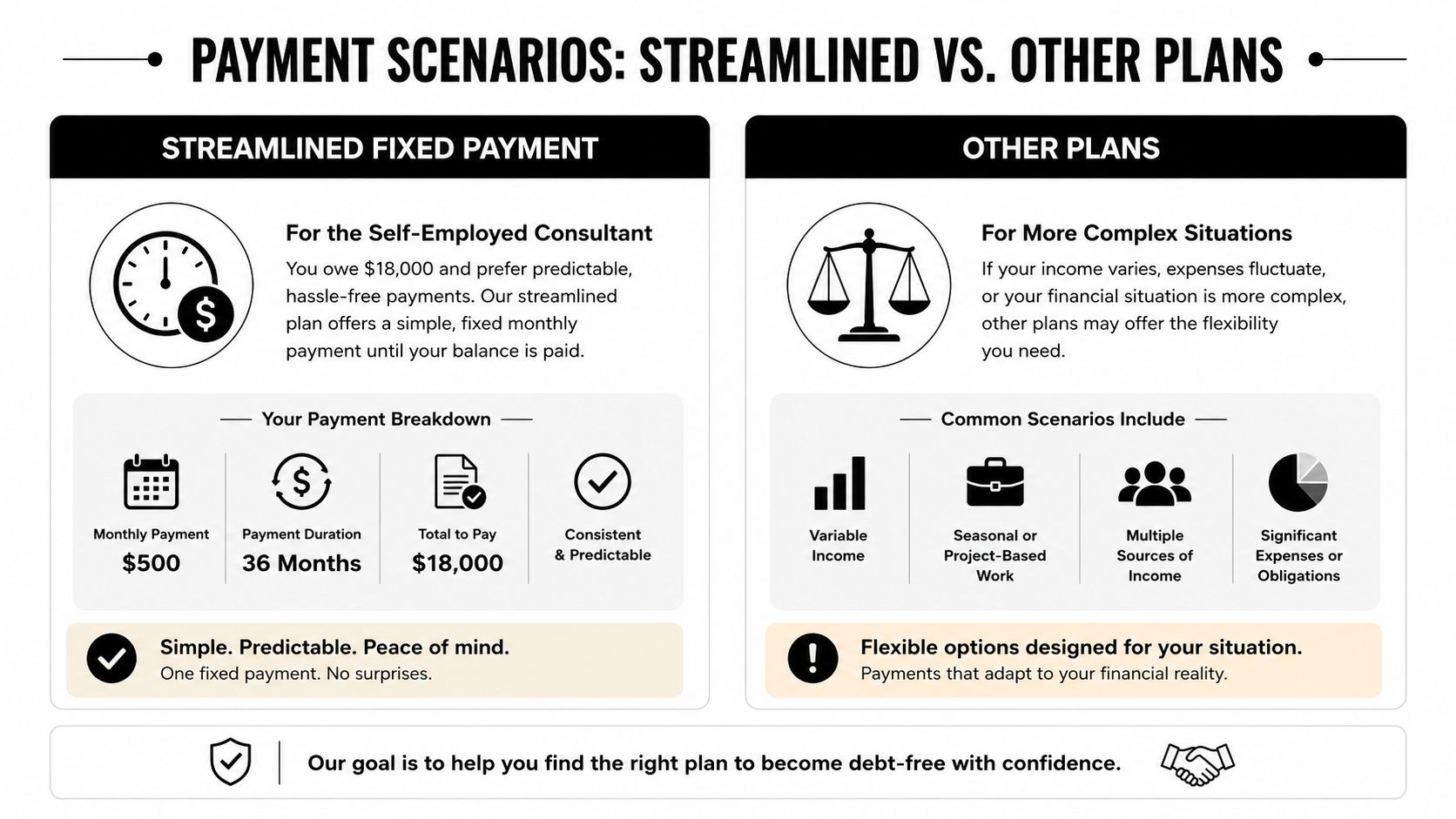
A self-employed consultant owes $18,000 after an income fluctuation. A fixed payment may be appropriate if the consultant's projected ordinary revenue can support it after setting aside money for current taxes and essential expenses.
Direct debit could reduce the risk of forgetting a payment, but only if the account remains funded on the withdrawal date. The consultant shouldn't base the payment on a particularly strong month or assume future contracts will arrive on schedule.
Scenario two, a family with regular wages
A family owes $42,000 and receives predictable wage income. An automatic arrangement may offer administrative simplicity because the household can align the withdrawal date with a regular paycheck.
The family still needs to test the payment against rent, insurance, food, transportation, and future withholding. A direct-debit plan is only helpful when the withdrawals remain affordable. If the payment causes recurring overdrafts, the convenience becomes a liability.
Scenario three, a business with payroll-tax debt
A business owes $75,000 in payroll-tax debt. That account requires a different analysis because trust-fund taxes can create personal exposure for responsible officers. A standard monthly plan may not be the best first move if the business hasn't identified the responsible-person issues, current filing problems, and cash required to keep payroll compliant.
The owner may compare a payment plan with a partial-pay arrangement or another resolution path. The business should also assess whether a lien could affect financing, property, or operations. A low payment isn't a success if it leaves current payroll taxes unpaid or creates personal liability.
The amount owed starts the conversation. It doesn't finish the analysis.
Each scenario should answer the same practical questions: Can the taxpayer pay the proposed amount during a weak period? Are all filings current? What collection action is pending? Will automatic withdrawals work? Could a lien affect property, borrowing, or business continuity? Those answers shape the appropriate arrangement more reliably than a plan label alone.
Installment Agreements and Other Tax Relief Options
An installment agreement fits a taxpayer who can ultimately repay the full liability within the available collection period. It provides time, not forgiveness. If the full balance is unrealistic even with a sustainable payment, another resolution option may better reflect the taxpayer's financial reality.
| Factor | Installment Agreement | Offer in Compromise | Currently Not Collectible |
|---|---|---|---|
| Basic purpose | Repay the liability over time | Seek settlement for less than the full balance when eligibility requirements are met | Pause active collection because payment would prevent basic living expenses |
| Affordability test | Can the taxpayer maintain scheduled payments? | Do assets and income support a reduced settlement? | Is there no meaningful ability to pay after necessary expenses? |
| Financial disclosure | May be limited for qualifying arrangements, but complex cases can require detail | Requires extensive financial information | Usually requires financial documentation supporting hardship |
| Debt outcome | Balance generally remains payable, with continuing statutory costs | Accepted terms can resolve the covered liability under the offer rules | Debt isn't eliminated, and statutory costs continue |
| Future refunds | Refunds may be applied to the balance | Treatment follows the offer terms and IRS requirements | Future refunds may be applied to the debt |
| Review risk | Terms can fail if the taxpayer defaults or becomes noncompliant | The IRS reviews the offer and requires continued compliance | The IRS may review the taxpayer's finances later |
An Offer in Compromise isn't just a request for a discount. The IRS examines income, allowable expenses, assets, and the amount it could reasonably collect. Detailed preparation matters, so taxpayers considering that path can review what an Offer in Compromise is.
Currently Not Collectible status serves a different purpose. It can pause active collection when a taxpayer can't make payments without sacrificing basic living needs, but interest and penalties can continue and the IRS may reassess the financial situation.
The decision should focus on total affordability over the life of the resolution, not just the first monthly figure. A payment that appears manageable may be unsuitable if it leaves no room for current taxes, emergencies, or ordinary household changes.
Common Pitfalls and Your Next Steps
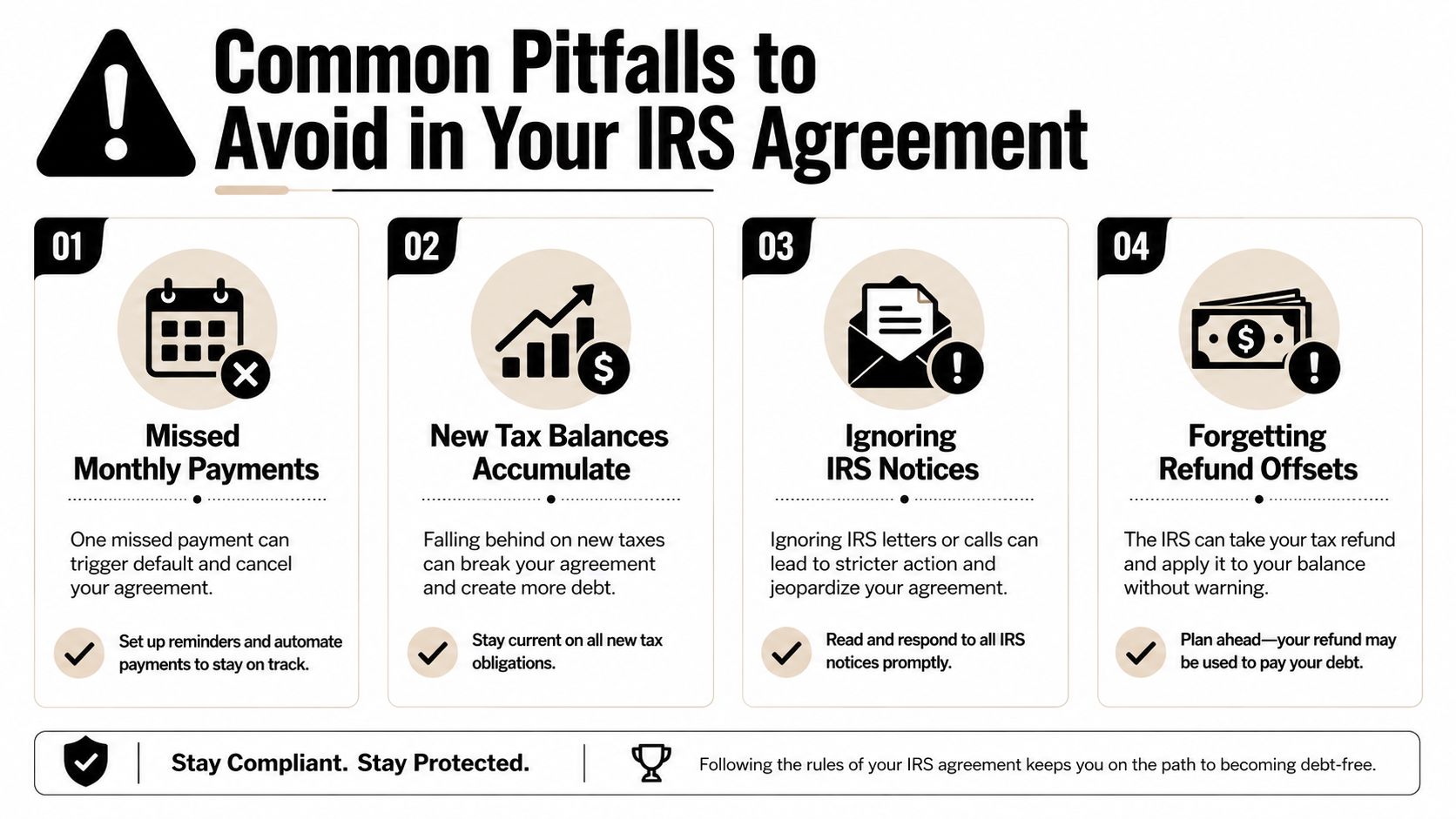
Installment agreements most often fail through routine oversights. A payment date passes, a new balance appears, or an online request is mistaken for an activated direct debit. An unanswered notice can move a manageable account toward stricter collection activity. The practical risk is allowing a small administrative problem to become a default before you recognize it.
Prevent failure and know when to escalate
After approval, confirm that the agreement is active, the payment amount is correct, and the first withdrawal or payment date is clear. Keep the confirmation and bank details where you can find them. An online submission alone does not always mean the payment arrangement has begun.
Set aside funds for new tax obligations instead of treating every available dollar as payment toward older debt. A self-employed taxpayer, for example, can make progress on the installment balance while creating another problem by falling behind on current estimated taxes.
Open IRS notices promptly. Save payment confirmations and written responses, then compare each notice with your records. A future refund may be applied to the balance, changing the expected payoff path and the cash available for household or business needs.
Seek help before a missed payment becomes a default, particularly when income changes sharply, payroll-tax debt involves responsible officers, the balance exceeds the simplified-plan ceiling, or a federal tax lien may affect property or financing. If a lien has been filed, tax lien removal options depend on the account facts and IRS requirements.
Allied Tax Advisors can review notices, filing status, cash flow, payment-plan eligibility, and alternative resolution options. Visit Allied Tax Advisors to request a case-specific review before accepting a payment that may shape your finances for years.