
You open the mailbox, see an IRS notice, and your stomach drops. Maybe the balance is larger than you expected. Maybe you already knew you were behind and hoped you could catch up later. Either way, the pressure gets real fast when the government starts the conversation.
The good news is that irs tax relief fresh start isn't a myth. There are legitimate IRS relief paths that can reduce pressure, stop collection momentum, and put a structured plan in place. The bad news is that many people misunderstand what Fresh Start is, and that confusion leads to bad decisions, missed deadlines, and rejected applications.
Most guides stop at “you may qualify.” That's not enough if you're trying to protect your bank account, your business cash flow, or your peace of mind. What matters just as much is what happens after approval, what the IRS expects month to month, and what can cause relief to fall apart.
Table of Contents
- Demystifying the IRS Fresh Start Initiative
- Core Requirements for Tax Relief Eligibility
- Choosing Your Path Installment Agreement vs Offer in Compromise
- The Application Process Forms and Documentation
- Common Mistakes and How to Stay Compliant After Approval
- When to Call for Help How Allied Tax Advisors Can Guide You
Demystifying the IRS Fresh Start Initiative
The first thing to understand is simple. Fresh Start is not one standalone IRS program with one form and one approval letter. It's a label people use to describe a set of more flexible IRS collection policies.

What Fresh Start actually means
The IRS Fresh Start initiative launched in 2011 as an umbrella set of collection-policy changes in the aftermath of the Great Recession, and it expanded access to tools such as simplified installment agreements, lien withdrawals, and offer-in-compromise pathways, according to the Taxpayer Advocate Service discussion of the Fresh Start initiative.
That matters because many taxpayers still think Fresh Start means the IRS is offering broad tax forgiveness. It isn't. The IRS didn't create a magic reset button. It made several existing resolution paths more accessible for people who are under real financial strain.
In practice, that means Fresh Start usually points to a few core outcomes:
- Payment over time: You may qualify to pay the debt through an installment agreement instead of all at once.
- Negotiated settlement: In some cases, the IRS may consider accepting less than the full balance through an Offer in Compromise.
- Collection relief: Some taxpayers can pursue lien-related relief or hardship status when payment isn't currently realistic.
Practical rule: If someone tells you Fresh Start automatically wipes out tax debt, they're oversimplifying it.
Why the name causes confusion
The phrase sounds like a formal application. Clients often ask where to “apply for Fresh Start” as if it were a single portal. That's not how the IRS handles it. You pursue a specific relief path based on your facts, your filings, your income, your assets, and your ability to pay.
That distinction is important because it changes how you prepare. You're not selling the IRS on a slogan. You're showing, with records, why a payment plan, settlement, or hardship status fits your case.
A better way to think about irs tax relief fresh start is this. It's a framework for resolution, not a shortcut. If you approach it with accurate records and realistic expectations, it can help. If you approach it like a one-time forgiveness campaign, you'll probably waste time.
Core Requirements for Tax Relief Eligibility
Approval usually turns on a few basic compliance points. If those are not in place, the IRS often will not seriously review a payment plan, hardship request, or settlement package. In client files, this is often the stage that decides whether the case moves smoothly or stalls for months.

The Core Requirements
Start with filing compliance. If returns are missing, the IRS generally wants those filed before it considers meaningful relief. That includes older years taxpayers may have put off because they were afraid of the balance due.
Current compliance matters just as much. If you are self-employed, making estimated payments usually needs to be addressed before the IRS will approve or keep approving relief. The same goes for payroll deposits if a business owner is trying to resolve business tax debt.
Your balance and financial profile also affect what programs are realistic. The IRS explains standard installment agreement rules and related payment options on its own IRS payment plan guidance. If a full settlement may be on the table, it helps to understand how the IRS evaluates an Offer in Compromise based on ability to pay.
Bankruptcy can change the timing and the strategy. An active case often limits what the IRS can do and what resolution path is available, which is one reason taxpayers sometimes ask how tax relief compares with Chapter 7 bankruptcy in Wisconsin. That comparison matters, but it should be made carefully because bankruptcy and IRS resolution do not solve the same problems in the same way.
Hardship claims also require proof. The IRS will want to see income, living expenses, asset values, and supporting documents. Broad statements like "I can't afford it" do not carry much weight without records.
A practical self-check
Before filing anything, answer these questions truthfully:
- Are all required returns filed? If not, fix that first.
- Are current taxes being paid or deposited on time? This is a frequent issue for contractors, freelancers, and business owners.
- Do you have the records to support what you're claiming? Bank statements, pay stubs, bills, and asset information matter.
- Are you choosing a path that matches your real finances? A payment plan is often more realistic than a settlement request.
- Can you stay compliant after approval? Relief that falls apart six months later usually traces back to this point.
That last question gets ignored too often. Getting approved is only part of the job. The IRS expects you to stay current on future filings and payments, and many resolutions can default if you fall behind again.
Choosing Your Path Installment Agreement vs Offer in Compromise
A taxpayer gets current, opens the IRS notices, and wants one clear answer. Should they ask for a monthly payment plan or try to settle for less? The right choice depends less on what sounds appealing and more on what the IRS will accept based on actual income, assets, and future ability to stay compliant.
An Installment Agreement fits cases where full payment is still realistic over time. It gives the debt a payment structure, but the balance continues to accrue interest and, in many cases, penalties until paid. For taxpayers with steady wages or business income, that trade-off is often more manageable than people expect because approval is generally more attainable and the terms are easier to maintain.
An Offer in Compromise is a settlement tool for taxpayers who do not have a realistic path to full payment within the IRS collection period. These cases get close review for a reason. The IRS wants a clear financial record showing that the amount offered reflects what it could reasonably collect. If the numbers show available equity, disposable income, or the ability to pay through a plan, the offer usually struggles.
The payment rules matter too. A lump-sum offer generally requires a payment with the application and the remaining accepted amount is paid on a short schedule. A periodic payment offer requires ongoing payments while the IRS reviews the file and, if accepted, continues on a longer schedule. That is one reason I often tell clients not to focus only on getting approved. The better question is whether the resolution will still be workable six months and two tax deadlines from now.
If you want more detail on how the IRS reviews settlement requests, this explanation of what an Offer in Compromise is is a helpful companion.
IRS Tax Relief Options At a Glance
| Feature | Installment Agreement (IA) | Offer in Compromise (OIC) |
|---|---|---|
| Best fit | Taxpayer can pay in full over time | Taxpayer cannot realistically pay in full |
| Main purpose | Spread payments out | Settle for less if hardship is well documented |
| Complexity | Usually more straightforward | More document-heavy and highly scrutinized |
| Financial disclosure | Sometimes limited, depending on case type | Detailed disclosure is central |
| Effect on full debt | Does not erase penalties or interest, it structures payment | Can reduce the amount if accepted |
| Risk of wrong fit | Monthly payment may become hard to maintain | Rejection is common if ability to pay exists |
| Typical taxpayer profile | Wage earner or business owner with predictable cash flow | Taxpayer with stronger hardship facts and limited collection potential |
If you can pay over time, the IRS will often expect a payment plan instead of a compromise.
How to choose the path that holds up after approval
The practical difference between these options shows up after the acceptance letter arrives.
With an installment agreement, the ongoing risk is affordability. A payment that looked reasonable during a strong month can fail during a slow quarter, especially for self-employed taxpayers with uneven cash flow. With an offer in compromise, the ongoing risk is compliance. If you miss future filing or payment obligations after acceptance, the IRS can default the agreement and restore the original liability, adjusted for prior credits and payments.
That is why I usually compare these options through a maintenance lens. A slightly less aggressive plan that a taxpayer can keep is often better than a settlement request that looks good on paper but falls apart under real-world cash flow pressure.
When another route may make more sense
Some taxpayers should broaden the analysis before choosing either option. If debt problems extend beyond tax liability, or insolvency is part of the picture, it may help to compare IRS resolution with Chapter 7 bankruptcy in Wisconsin. Bankruptcy and tax relief solve different problems, and the order in which you consider them can matter.
There are also cases where neither an IA nor an OIC is the first move. Penalty abatement, currently not collectible status, or resolving missing deposits and filing gaps may need attention first. In practice, the best path is often the one that not only gets approved, but also keeps the taxpayer in compliance after the case is closed.
The Application Process Forms and Documentation
By the time a case reaches the application stage, the IRS is looking for proof, not a pitch. A strong filing shows a clear timeline, complete returns, and financial records that match the forms you submit.
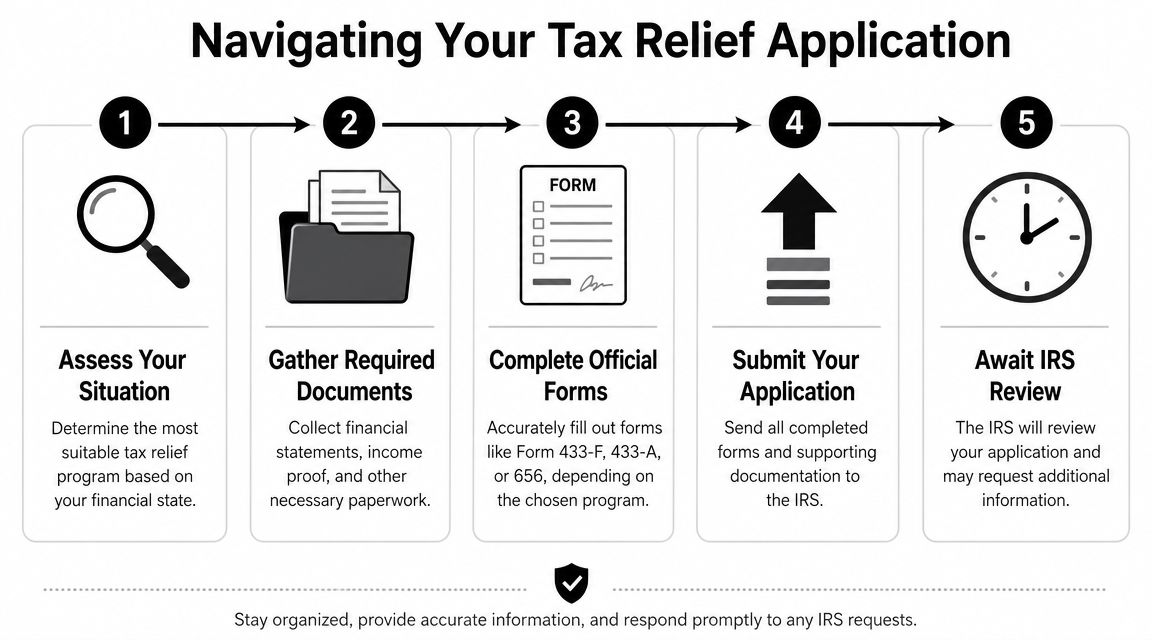
Start with the right sequence
Fresh Start is not one form. It is a collection process with several entry points, and the sequence affects how quickly the IRS can act on your request.
In practice, the order is usually straightforward. First, get all required tax returns filed. Next, confirm the balance and identify whether the case points toward an installment agreement, an offer in compromise, or another collection alternative. If full payment is not realistic, prepare a financial disclosure using Form 433-A, 433-B, or 433-F, depending on the taxpayer and the resolution being requested. The IRS instructions for Form 433-A (OIC) lay out the financial information the agency expects for offer cases.
Taxpayers often lose time by filing out of order. I see this when someone sends in a settlement request before missing returns are filed or before their income records are current. The IRS usually responds with delays, requests for more information, or a rejection that could have been avoided.
If you expect a monthly plan to be the better fit, this guide on how to set up an IRS payment plan can help you compare the paperwork and approval steps.
What the IRS will expect you to document
The exact package depends on the relief option, but the underlying question stays the same. What can you realistically pay, and can the numbers be verified?
For many taxpayers, that means pulling together:
- Income records: Pay stubs, profit and loss statements, benefit income, or other records that reflect current earnings
- Bank statements: Recent statements that show deposits, account balances, and spending patterns
- Living expense support: Rent or mortgage, utilities, insurance, medical bills, transportation, child support, and other necessary expenses
- Asset details: Real estate, vehicles, retirement accounts, investment accounts, cash value life insurance, and business ownership interests
- Tax file records: IRS notices, account transcripts, and confirmation that all required returns have been filed
Business owners usually need more cleanup before they apply. Personal spending through business accounts, irregular owner draws, and outdated bookkeeping can all create credibility problems if the form says one thing and the statements show another.
Where applications tend to break down
The IRS does not reject cases only because the debt is large. Cases stall because the file is incomplete or inconsistent.
A common example is simple. The form lists monthly income based on a recent slowdown, but the bank statements still show higher deposits from prior months, and no explanation is attached. That gap invites questions. The same problem comes up with claimed expenses that are real, but not documented well enough to survive review.
Watch for these trouble spots:
- Missing statement pages: Even one omitted page can trigger follow-up
- Old financials: A stale snapshot weakens hardship arguments
- Unsupported expense claims: Verbal explanations do not carry much weight without records
- Mixed personal and business activity: This makes self-employed cases harder to verify
- Unfiled returns: Relief requests usually do not move far until filing compliance is fixed
Good applications also make the next stage easier. If the financial disclosure is accurate at the start, it is easier to maintain the agreement later because the payment or settlement was built on numbers the taxpayer can support.
Accuracy beats speed here. A complete filing usually gives the IRS fewer reasons to stop the process and fewer reasons to question your ability to stay compliant after approval.
Common Mistakes and How to Stay Compliant After Approval
The biggest misunderstanding about tax relief comes after the acceptance letter. People think the hard part is over. In reality, approval is often the point where discipline starts to matter most.

Why approval is not the finish line
A major pitfall is treating Fresh Start like a one-time fix. The IRS requires ongoing compliance, and missing future estimated payments or failing to file a future return on time can cause an approved Installment Agreement or Offer in Compromise to default, which can reinstate the original tax debt plus penalties and interest, according to the IRS guidance on getting help with tax debt.
That is where many self-employed taxpayers run into trouble. They solve the old balance, then underpay the current year. A few quarters later, the agreement is in danger because the IRS sees a new compliance problem.
The same problem shows up with wage earners who change jobs and don't update withholding. The old debt may be under control, but a new balance starts forming in the background.
The habits that keep relief in place
The taxpayers who keep their relief usually build simple routines around compliance. Nothing fancy. Just consistent controls.
A workable maintenance plan often includes:
- File every future return on time: Even if you can't pay in full, the return itself has to be timely.
- Pay current taxes as they come due: This matters for estimated taxes, payroll taxes, and annual balances.
- Watch your agreement terms: Know the due date, amount, and any conditions attached to your resolution.
- Open every IRS notice: Some defaults happen because people ignore follow-up correspondence until the problem is much larger.
- Review cash flow regularly: If income changes, act early instead of waiting for a missed payment.
Approved relief is monitored. The IRS expects current compliance while the old issue is being resolved.
One practical tip for business owners is to separate old debt strategy from current tax operations. Don't let the payment on yesterday's liability crowd out today's payroll deposits or estimated taxes. That trade-off can undo months of progress.
Another common mistake is assuming the IRS will automatically excuse one late payment or one late return because you were previously approved. Sometimes there's room to fix a problem quickly. Sometimes there isn't. The safer move is to treat every deadline as critical.
When to Call for Help How Allied Tax Advisors Can Guide You
Some tax relief cases are manageable without much support. Others become risky very quickly.
Situations that usually need professional handling
You should think seriously about getting help if your facts are layered, unstable, or hard to present cleanly. That includes cases where the balance goes beyond the simplified threshold discussed earlier, where a business is involved, or where your finances include rental property, crypto activity, or irregular self-employment income.
You should also get help if you're facing pressure from collection activity and you're not sure how fast things can escalate. For context on urgent collection risk outside the tax context, this breakdown of entities that can take your wages unexpectedly is useful because it shows how little warning some debt enforcement actions can involve.
Professional help also matters when the actual issue isn't eligibility. It's presentation. A valid hardship case can still fail if the forms are inconsistent, expenses are poorly documented, or the taxpayer asks for the wrong resolution path.
What professional representation changes
A tax professional can help organize the facts, match the case to the right IRS option, and respond to notices before they turn into bigger problems. That includes evaluating whether a payment plan is the more durable route, whether an OIC package is realistically supportable, and whether compliance issues need to be cleaned up before any application goes out.
For taxpayers who want structured support, professional tax accountant help for IRS issues can be useful when the case involves negotiation, documentation, and ongoing follow-through. Allied Tax Advisors handles IRS and state resolution matters as one available option for taxpayers who want help preparing filings, evaluating relief paths, and managing communication with the taxing authority.
The value of representation is usually not drama. It's fewer preventable errors, clearer records, and better decisions at the point where one wrong move can cost time and money.
If you're dealing with IRS notices, back taxes, or an agreement you're afraid could default, Allied Tax Advisors can help you evaluate the facts, organize the paperwork, and choose a realistic path toward resolution.