
In nearly every case, the IRS says no, rental income is not earned income. Instead, the money you collect from tenants falls into a different bucket: passive income.
This isn't just a bit of tax jargon—it's a critical distinction that completely changes how your rental earnings are treated on your tax return.
Why Rental Income Is Usually Passive
Think of it this way: earned income is what you get for actively trading your time and effort for money, like the salary from your day job. You show up, you do the work, you get paid. It's a direct result of your labor.
Rental income, however, works differently. You do the upfront work—finding and buying the property, getting it ready for tenants—but after that, the asset itself generates the income. It's more like owning a vending machine; once it's set up and stocked, it makes money for you without you having to stand there for every transaction.
This is the core of the passive income concept. It’s income derived from an asset you own, not from your direct, ongoing sweat equity.
This classification has real-world consequences. For instance, if you bring in $24,000 a year from a rental but spend $6,000 on deductible expenses like maintenance and property taxes, your taxable passive income is $18,000. More importantly, this $18,000 isn't subject to the same taxes as your salary. You can learn more about the specifics of reporting by reviewing this guide on rental income from tax professionals.
Getting a firm grip on this difference is the first step to mastering your finances as a landlord. To make it even clearer, let's break down the two income types side-by-side.
Earned vs Passive Income At a Glance
Here’s a quick comparison to highlight the fundamental differences between earned and passive income.
| Characteristic | Earned Income | Passive Income (e.g. Rental) |
|---|---|---|
| Source | Active work (job, self-employment) | Asset ownership (real estate, business) |
| Effort Required | Material participation required | Minimal ongoing effort |
| IRA Contributions | Can be used for contributions | Generally cannot be used |
| Tax Treatment | Subject to FICA taxes | Not subject to FICA taxes |
As you can see, the source of the money and the taxes it's subject to are completely different, which is why understanding this from day one is so important for any property owner.
Your Money Flows in Three Different Streams
To get why the IRS almost never considers rental income to be "earned income," you first have to see your finances the way they do. Imagine your money coming from three totally separate streams. Each one is taxed differently, and knowing how to tell them apart is the key to smart tax planning.
The one we all know best is earned income. This is the money you get for actually doing a job. We're talking about your salary, hourly wages, tips you collect, or the profits you make from a business you're actively running day in and day out. Bottom line: if you're trading your time and effort for cash, it's earned income.
Passive and Portfolio: The Other Two Streams
Then you have portfolio income. This is the money that your money makes. It flows from investments like stocks, bonds, and mutual funds. When you sell a stock for a profit, get a dividend check, or earn interest from a savings account, that’s all portfolio income.
Finally, we get to the one that matters most for landlords: passive income. This is money you make from an enterprise where you aren't "materially participating." The textbook example? Rental income. You own the asset, but you aren't working on it like it's your full-time job.
The Big Idea: The IRS cares about how you get your money. Direct work is earned. Investing is portfolio. Hands-off ownership is passive.
This quick visual breaks down where rental income fits into the bigger tax picture.
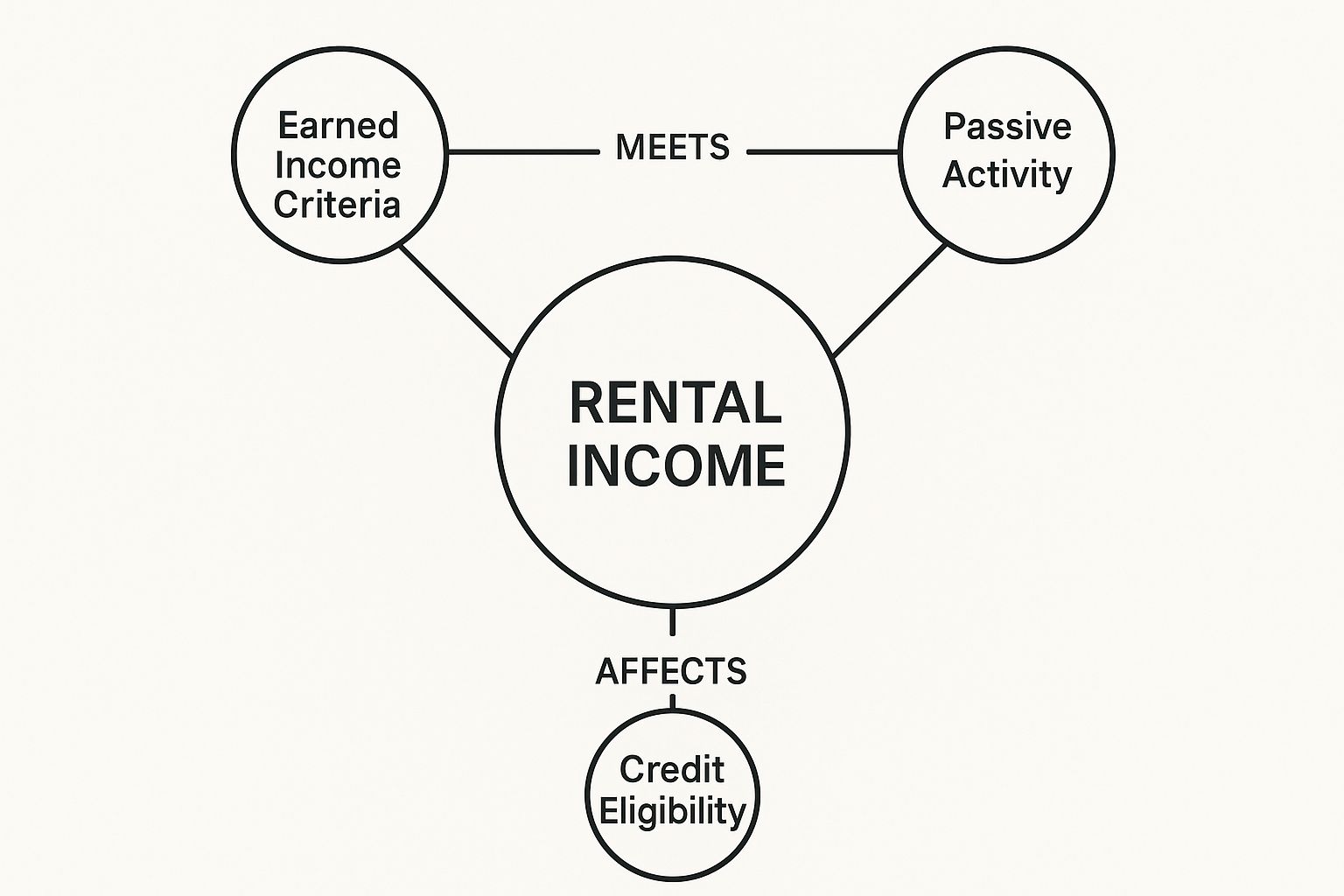
As you can see, rental income sits squarely in the passive category for most people. This classification affects your taxes and even what credits you might be eligible for. The trick to making the most of it is to work within that passive framework, using strategies like finding all the rental property tax deductions you're entitled to.
Why Most Landlords Have Passive Income

The big question—"is rental income earned income?"—all boils down to a concept the IRS calls material participation. Think of it as the government's official dividing line between being a hands-on operator and a passive investor. If you don't cross that line, your rental income is passive by default.
For the vast majority of landlords, their day-to-day involvement just doesn't meet the IRS's strict standard. You might screen a new tenant or call a plumber once in a while, but that's a far cry from the significant, regular, and continuous time commitment needed to be considered "active."
The Landlord's Time Commitment
So what does it take to cross that line? The IRS has a few different tests, but one of the most common benchmarks is the 500-hour rule. To qualify, you have to prove you spent more than 500 hours working on your rental activities during the year.
Let’s put that into perspective. That’s almost 10 hours a week, every single week. Most landlords, especially those with just a property or two, or anyone who wisely hires a property manager, don't even come close.
Here’s a simple comparison to see the difference in action:
- The Passive Landlord: Let’s call her Anna. She owns a duplex but hired a property management company to handle the nitty-gritty. They collect rent, deal with clogged toilets, and find tenants. Anna’s main job is to cash the checks and review a monthly statement. Her income is clearly passive.
- The Potentially Active Landlord: Ben, on the other hand, self-manages a four-plex. He does everything himself—marketing vacant units, screening applicants, handling all repairs, doing the landscaping, and managing the books. If Ben tracks his time like a hawk and can prove he’s putting in the hours, he might be able to classify his income as active.
The IRS automatically assumes rental income is passive. The responsibility is on you, the property owner, to meticulously document your time and prove that you meet the material participation tests if you want it treated as active income.
Getting a handle on these tax distinctions is crucial. Once you understand where you stand, you can start exploring effective strategies for maximizing rental income and making your properties work harder for you. For a deeper look at the specific tax rules, our guide on https://alliedtax.com/taxes-on-rental-income/ is a great next step.
When Rental Income Breaks the Passive Mold

While the IRS usually pegs rental income as passive, there are a couple of important exceptions. If your role as a landlord goes way beyond just collecting a check and calling a plumber, you might be able to flip the script.
It's a critical distinction to understand. Shifting your rental earnings from passive to active fundamentally changes your tax picture, so let's dig into the two main ways this can happen.
Becoming a Real Estate Professional
The first path is to qualify as a Real Estate Professional in the eyes of the IRS. This isn't just a title you can give yourself—it's a formal status with some pretty tough tests you have to meet. Essentially, you have to prove that real estate isn't just a side hustle; it's your career.
To get this designation for a tax year, you need to clear two hurdles:
- You must spend more than half of your total working hours on real estate activities where you materially participate.
- You must dedicate more than 750 hours during the year to those same real estate activities.
Meeting these requirements takes a serious, well-documented time commitment. It’s not for the casual landlord. Think of it this way: a passenger on a plane is passive, but the pilot actively flying the plane is anything but. The IRS wants to see you in the cockpit.
Providing Substantial Services
The other way to generate active income is by providing "substantial services" to your tenants. This is where your rental starts looking less like a traditional lease and more like a hospitality business.
The big question here is whether the services are for the tenant's convenience and go well beyond what's normally included in a standard rental agreement.
For instance, if you have a long-term rental and just handle basic maintenance and utilities, that's classic passive income. But what if you run a bed and breakfast? If you're providing daily cleaning, fresh linens, and cooking breakfast, that's a different story.
That income isn't considered rent anymore. It’s active business income, taxed accordingly. This concept isn't unique to the U.S., either. Many countries view rental profits similarly, taxing them after allowing for deductions. For a broader perspective, you can explore more about international housing tax policies in an OECD report.
How This Classification Impacts Your Wallet
So, why does the distinction between passive and earned income actually matter? It’s not just tax jargon—it has a real, tangible impact on your wallet, your retirement planning, and your overall financial strategy. Getting this right can save you a lot of headaches and money down the road.
One of the first places you'll feel the pinch is with retirement savings. The IRS is very clear: you can only contribute to accounts like a traditional IRA or a 401(k) with earned income. Since your rental cash flow is almost always considered passive, you can't use it to fund these crucial retirement vehicles. That’s a game-changer for anyone banking on their rental properties to build their nest egg.
Bumping into Loss Limitations
The rules around losses are another critical area where this distinction comes into play. If you have a tough year and your rental property loses money, you can't just write that loss off against your regular job's salary.
This is thanks to the IRS’s Passive Activity Loss (PAL) rules. These rules are designed to stop investors from using paper losses from passive ventures to shelter their active income from taxes.
The Bottom Line: A loss from your rental property can generally only be used to offset gains from other passive activities. You can't use it to shrink the tax bill on your W-2 income.
For higher-income individuals, there's another layer to consider: the Net Investment Income Tax (NIIT). This is an additional 3.8% tax that can apply to passive income, including the rent you collect. Making sure you understand all these moving parts is key, and a good overview can walk you through the specifics of the tax on rental income.
This income classification also plays a role in bigger financial moves, like getting a loan. Lenders will look closely at your finances, and it's worth understanding your debt-to-income ratio for mortgages to see how your rental income fits in.
Got Questions About Rental Income and Taxes? You're Not Alone.
It's easy to get tangled in the web of rules surrounding rental income. But once you get a handle on a few common scenarios, things start to click into place. Let's walk through some of the questions I hear most often from landlords trying to figure out their taxes and financial plans.
A big one is Social Security. People always want to know if their rental profits will boost their future benefits. Since most rental income is passive, it doesn't count as earnings for Social Security purposes. That’s good news because it means you aren't paying Social Security and Medicare (FICA) taxes on it. The flip side is that it won't increase your future Social Security checks, which are calculated based on your history of earned income.
What’s the Deal with Short-Term Rentals like Airbnb?
The explosion of platforms like Airbnb and VRBO has thrown a wrench into the works for a lot of property owners. Is that money you’re making from weekend guests considered earned income? Well, it really boils down to how involved you are.
If you’re just a hands-off host—basically handing over the keys to a clean space and not much else—the IRS will likely still see that income as passive. But if you start acting more like a hotel operator, the game changes completely.
Here's the bottom line: When you start providing substantial services for your guests' convenience—think daily cleaning, fresh linens, or providing meals—your rental income can suddenly be reclassified from passive to active business income.
This shift is a big deal. It means that income is now on the hook for self-employment taxes, but it also counts as earned income for things like contributing to an IRA.
Common Questions When It's Time to File
Okay, you've figured out if your income is active or passive. Now, what about the nitty-gritty of filing your taxes? Here are some quick answers to the questions that pop up every year.
- Can I just not pay taxes on rental income? In a word, no—not legally, anyway. The real goal is to dramatically lower what you owe. You do this by being a hawk with your record-keeping and claiming every single deductible expense you're entitled to, from mortgage interest and property taxes to repairs, insurance, and depreciation.
- What if I only rent my place out for a week or two? Ah, the "Masters Rule!" If you rent out a property (even your own home) for 14 days or fewer all year, you generally don't have to report a dime of that income to the IRS. It’s a fantastic, and often overlooked, perk.
- I live in Texas but own a rental in Colorado. Do I pay Colorado state tax? Yes, you do. You almost always have to file a state tax return and pay income tax in the state where your rental property is physically located, regardless of where you call home.
Getting a firm grasp on these specific situations is how you take the big ideas—passive vs. earned income—and apply them to what you're actually doing as a landlord. It’s the key to staying on the right side of the IRS and making smarter financial moves.
At Allied Tax Advisors, we live and breathe this stuff. Our team specializes in helping real estate investors sort through these exact questions, making sure you're taking advantage of every deduction and keeping your tax bill as low as possible. Learn more about our services for real estate investors.