
You formed the LLC or corporation, started operating, maybe even told your accountant you wanted S corporation treatment, and then the deadline came and went. Now you're staring at Form 2553, old returns, and a growing suspicion that one missed filing just turned into an expensive tax problem.
In most cases, it hasn't. A late S corp election is often fixable. The IRS has a procedure for businesses that intended to be taxed as S corporations but didn't file the election on time. The hard part usually isn't the concept. It's presenting the facts cleanly, especially the reasonable cause statement that explains why the election was late and why relief should still be granted.
That statement is where many filings get weak. Business owners either over-explain, under-explain, or submit something so generic that it reads like an excuse instead of a credible tax filing narrative. A strong package does the opposite. It shows eligibility, consistency, and a believable chain of events that led to the late filing and prompt correction.
Table of Contents
- You Missed the S Corp Deadline Now What
- Confirming Your Eligibility for Late Election Relief
- Assembling Your Late Election Filing Package
- How to Write a Winning Reasonable Cause Statement
- Understanding IRS Relief Procedures and Timelines
- Common Mistakes and When to Hire a Professional
You Missed the S Corp Deadline Now What
If you missed the deadline, the first step is to stop guessing and start framing the issue correctly. This isn't usually a question of whether the IRS allows late relief in theory. It does. The question is whether your facts fit the relief procedure and whether your filing package proves that clearly.
For many businesses, the missed deadline happens in a familiar way. The owner formed an LLC, heard that S corporation treatment would be a smart tax move, assumed the accountant or formation service handled it, and then kept operating as if the election were already in place. Sometimes payroll was delayed. Sometimes no one realized Form 2553 had never been filed until tax season. Sometimes the owner learned about the issue only after preparing a return.
The fix typically comes down to three moving parts:
- Eligibility: The business must have qualified for S corporation treatment during the intended period.
- Paperwork: The filing package has to be complete, signed, and consistent.
- Reasonable cause: The explanation for the late filing has to sound like a real chronology, not a canned excuse.
Practical rule: The IRS doesn't need drama. It needs a coherent timeline, consistent reporting, and a credible reason the form wasn't filed on time.
There's also a mental shift that helps here. A late S corp election is not an open-ended request for mercy. It's a defined IRS procedure for taxpayers who intended one result, were otherwise eligible, and failed on timing. That distinction matters because it tells you how to prepare. You aren't asking the IRS to invent a remedy. You're asking it to apply an existing one to facts that fit.
Business owners often make the process harder by focusing on the wrong thing. They get stuck on whether the missed deadline makes them look careless. That's not the core issue. The better question is whether the records show an actual intent to be an S corporation and whether the business moved quickly once the mistake was discovered.
A calm, organized filing usually beats a defensive one. State the intended effective date. Identify what happened. Explain why the election wasn't filed. Show that the business and owners treated the entity consistently. Then correct the problem without adding side issues that don't help.
Confirming Your Eligibility for Late Election Relief
Before drafting language, confirm that the case belongs in the relief procedure at all. Many owners save time by taking this step. If the facts don't fit, the statement won't rescue the filing.
The IRS is looking for a narrow set of facts
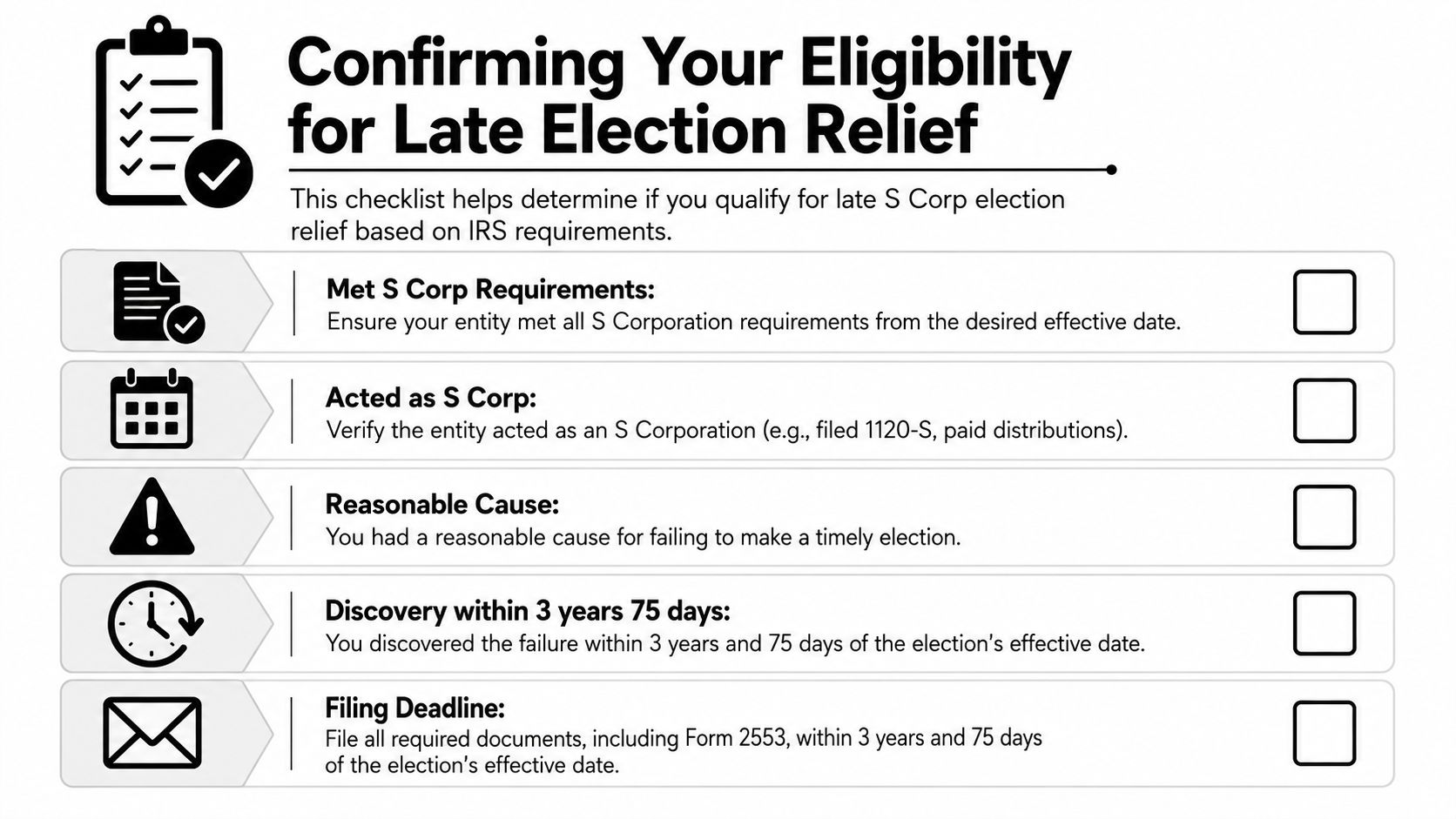
The IRS states that late-election relief is generally available within 3 years and 75 days after the intended effective date, and the entity must generally show that it intended to be an S corporation, was eligible, missed the deadline only because the election was untimely, had reasonable cause, and that the entity and all shareholders reported income consistently with S corporation status for the relevant year and later years. The IRS also describes an exception beyond that window for certain corporations if at least 6 months have passed since the corporation filed its first-year return, and neither the corporation nor shareholders received IRS notice of a problem within 6 months of filing Form 1120-S, as outlined on the IRS guidance for late election relief.
That tells you two important things. First, relief is structured. Second, consistency matters just as much as intent. A business that says, "We meant to be an S corporation," but filed and reported like a sole proprietorship or partnership creates a harder record to defend.
A practical eligibility checklist
Use this checklist before you prepare anything:
- You intended S status from a specific date: There should be some real-world sign of intent, such as internal emails, onboarding notes with your tax preparer, payroll planning, or owner discussions tied to a start date.
- Your entity was otherwise eligible: The election can't fix a business that didn't qualify for S corporation treatment in the first place.
- The only failure was timing: Late-election relief is for a missed filing deadline, not for broader structural defects.
- You can explain the miss in plain English: Reasonable cause needs facts, dates, and actions.
- Owners reported consistently: If shareholder returns or the business return point in different directions, fix that issue before sending the package.
A quick self-test helps. Ask whether an IRS reviewer could look at your file and conclude, "This business meant to elect S status, acted that way, and discovered a missed form." If the answer is yes, the case is usually worth pursuing. If the answer is, "We changed our mind later and want retroactive treatment because it saves tax," that's a very different story.
Late relief works best when the filing tells one story from start to finish. Intent, reporting, and correction all need to point the same way.
Some files sit in a gray area. The owner intended S status, but payroll never started. Or the return preparer wasn't given complete information. Those cases can still be workable, but they need tighter drafting and cleaner support. The more uneven the facts, the more carefully the reasonable cause statement has to be written.
Assembling Your Late Election Filing Package
Once eligibility looks solid, build the package like you're preparing it for someone who knows the rules but knows nothing about your business. That usually means less narrative in the form itself and more clarity in the attachments.
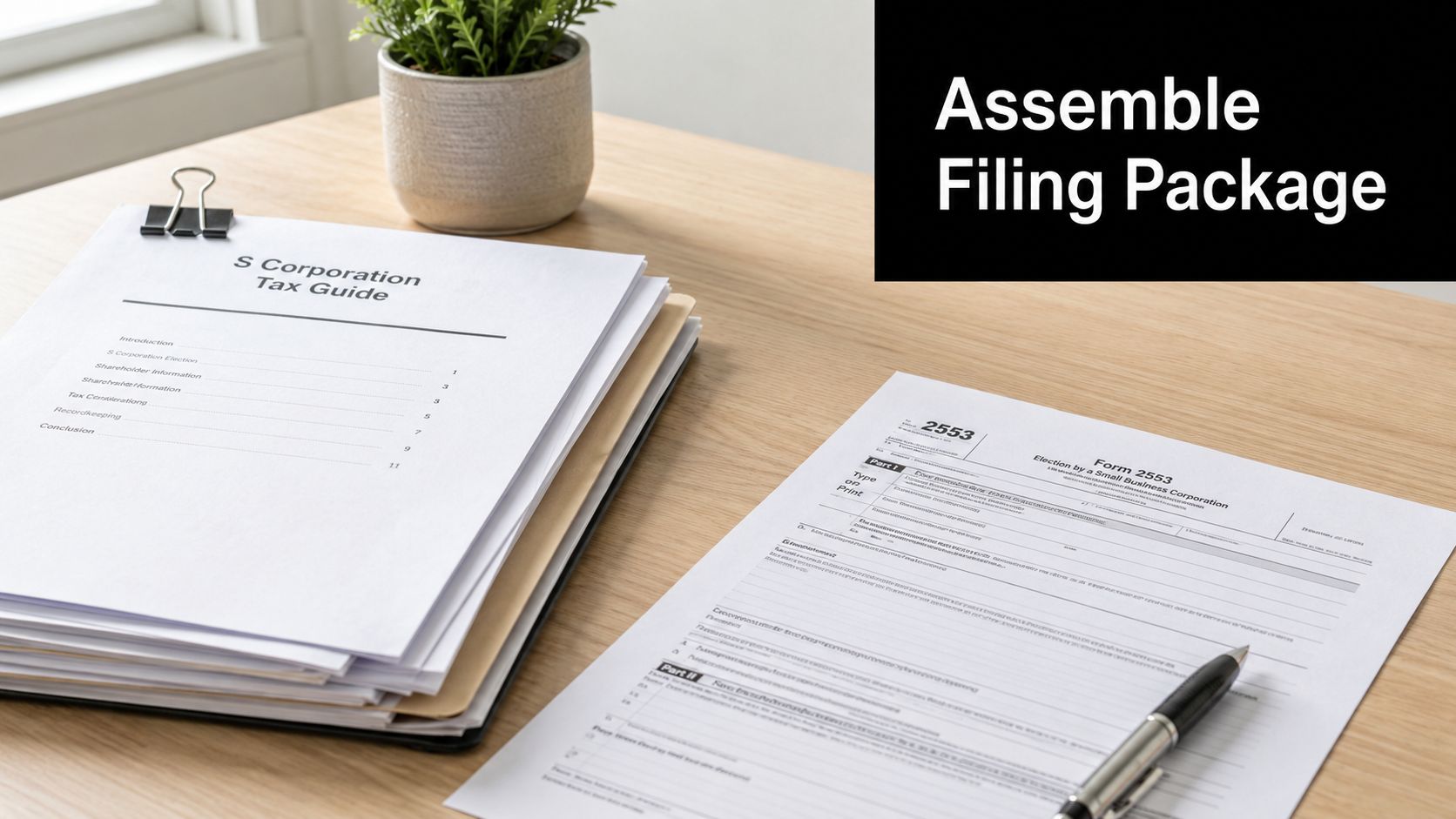
What goes into the package
The core document is Form 2553. If you need a line-by-line refresher, Allied's guide to what Form 2553 is and how it works is useful background before you complete the late filing.
Most late election packages should include:
- Completed Form 2553 with the intended effective date.
- All required shareholder consents and signatures in the shareholder consent area.
- A reasonable cause statement attached to the form.
- Supporting documents if they strengthen the statement, such as adviser emails, engagement records, internal notes, or records showing prompt correction after discovery.
- Any related return coordination needed to keep the filing position consistent.
The most common technical problem is simple. The owner submits Form 2553 but treats the reasonable cause statement like an afterthought. That's backwards. In a late S corp election, the statement is often the first thing that determines whether the rest of the package feels credible.
How to organize it so an IRS reviewer can follow it
A clean packet usually follows this order:
| Document | What it should do |
|---|---|
| Form 2553 | State the election clearly and show proper signatures |
| Attachment 1 | Explain reasonable cause in chronological order |
| Attachment 2 | Add support only if it helps prove the timeline |
| Cover note if needed | Briefly identify the package as a late S election relief submission |
Keep the writing factual. Don't bury dates in dense paragraphs. Don't attach every email you've ever exchanged with your accountant. Include only what supports the chain of events.
Here is the structure I prefer for the reasonable cause attachment:
- Opening paragraph: Identify the entity, EIN, intended effective date, and that the entity intended to be taxed as an S corporation.
- Timeline paragraph: Describe what the owners did, what they believed had occurred, and where the filing failure happened.
- Discovery paragraph: State when and how the issue was discovered.
- Correction paragraph: State what was done immediately after discovery.
- Consistency paragraph: Confirm that the entity and shareholders reported consistently with the intended S corporation treatment, if that statement is accurate.
A well-prepared package reads like a file memo, not a plea letter.
What doesn't work is a loose stack of forms with a one-sentence note saying the owner was busy. The IRS reviewer shouldn't have to reconstruct your facts. If they have to hunt for the explanation, the filing starts weak.
Signatures also derail a surprising number of cases. If multiple shareholders are involved, make sure each required consent is complete and legible. Late election relief is technical. A strong narrative won't compensate for missing execution.
How to Write a Winning Reasonable Cause Statement
This is the center of the case. A late S corp election usually rises or falls on whether the statement makes the missed filing understandable, documented, and promptly corrected.
The modern framework for these filings comes from Revenue Procedure 2013-30, which created a more structured path for taxpayers who missed the Form 2553 deadline but otherwise acted like an S corporation. In practice, the filing deadline for an existing business is typically March 15, while new businesses generally have 75 days from the start of the tax year or entity formation to make the election. When relief is accepted, the tax effect can be significant. One tax advisory source notes that on $100,000 of net business income, the savings from S corporation treatment may be about $8,000 to $10,000, reflecting reduced exposure to self-employment taxes, as discussed in this explanation of late S corp election relief and Revenue Procedure 2013-30.
What a strong statement does
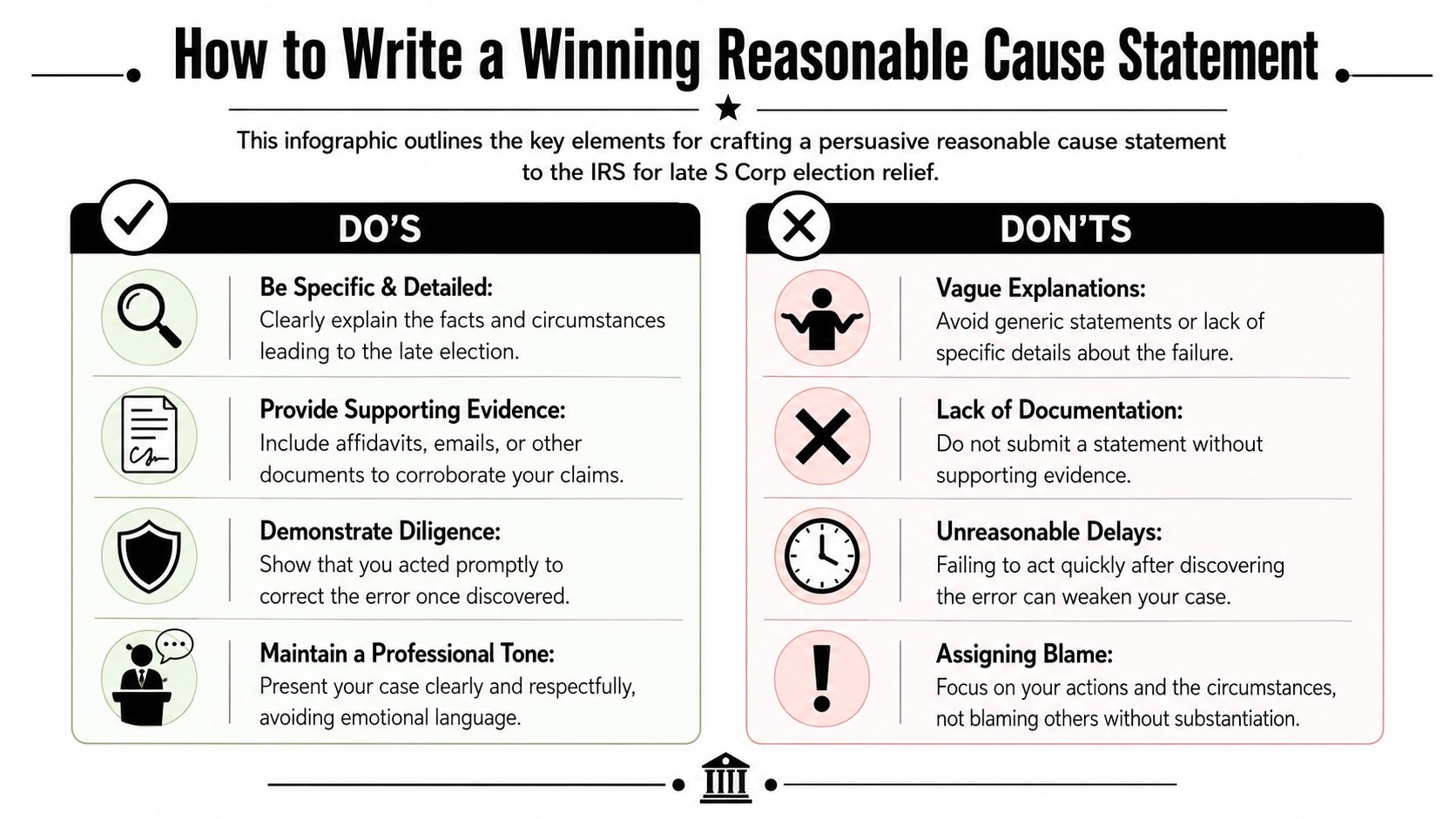
A persuasive statement usually does four things well:
- It identifies a real cause, not a vague excuse. "I forgot" isn't enough. "I instructed my return preparer to file the election during onboarding, believed it had been filed, and learned during return preparation that it had not been submitted" is far better.
- It pins facts to a timeline. Dates matter because they show that the owner's belief and actions were reasonable.
- It shows diligence after discovery. Delay after discovery weakens the narrative fast.
- It avoids emotional overreach. The best statements are measured and specific.
If you need a broader model for how tax narratives are framed persuasively, this overview of reasonable cause penalty abatement is helpful because the same drafting discipline applies here.
Weak wording versus persuasive wording
Here is the difference in practice.
We were busy growing the business and missed the deadline.
That line tells the IRS almost nothing. It doesn't say who was responsible, what they intended, when the error occurred, or why the failure was reasonable rather than careless.
Compare it to this:
The members intended for the LLC to be taxed as an S corporation effective as of the beginning of the tax year. During startup, the members engaged a tax professional for entity and tax setup and believed the S election would be filed as part of that process. The members later learned, during tax return preparation, that Form 2553 had not been submitted. Upon discovering the issue, the entity promptly prepared and filed the election and sought late-election relief.
The second version works because it gives the reviewer something to evaluate. It contains intent, reliance, discovery, and correction.
Sample language you can adapt
Below are examples of the kind of language that tends to work when it's true and supportable.
Reliance on a tax professional
The entity intended to elect S corporation status effective [intended date]. The owners discussed that intention with their tax adviser during the entity setup process and understood that the election would be prepared and filed as part of the initial tax setup. The owners operated under that belief until the omission was discovered during review of the entity's tax filings. Once the issue was identified, the entity acted promptly to prepare Form 2553 and request late-election relief.
This is often the cleanest fact pattern, but it still needs support. An email, engagement note, organizer, or onboarding checklist helps.
Serious personal disruption
At the time the election should have been filed, the owner was handling an acute personal event that significantly disrupted the owner's ability to manage administrative and tax matters for the business. During that period, attention was directed to the immediate personal situation, and the election filing was not completed. After the issue was discovered, the owner promptly gathered the necessary records and submitted the election request.
This can work, but it needs restraint. State facts plainly. If you have records that corroborate the disruption, include them only if they add clarity.
Good-faith misunderstanding during formation
The owner formed the LLC with the intention that it be taxed as an S corporation and believed that filing the formation documents and obtaining an EIN completed the federal tax election process. The owner later learned that a separate Form 2553 election was required. After learning of that requirement, the owner immediately moved to prepare and file the election and request relief.
This is viable only if the misunderstanding was genuine and the rest of the record doesn't suggest the owner ignored repeated advice.
Drafting choices that improve credibility
Use these habits when writing:
- Name the actor: Say who was responsible for filing, who gave instructions, and who discovered the problem.
- Use dates or periods where possible: A timeline feels credible because it can be tested.
- Describe actions, not conclusions: "Sent records to preparer" is better than "acted responsibly."
- Show prompt correction: The shorter and cleaner the correction narrative, the better.
- Keep blame controlled: If a preparer dropped the ball, say so factually. Don't turn the statement into an accusation.
The strongest statements don't sound polished. They sound accurate.
A final drafting note. Don't copy internet templates word for word. IRS reviewers see repetitive phrasing all the time. A custom statement built around your actual file is almost always stronger than generic language, even if it's shorter.
Understanding IRS Relief Procedures and Timelines
Once the package is filed, most owners want to know two things. Which procedure applies, and how long this is going to hang over them.
The simplified route versus a ruling request
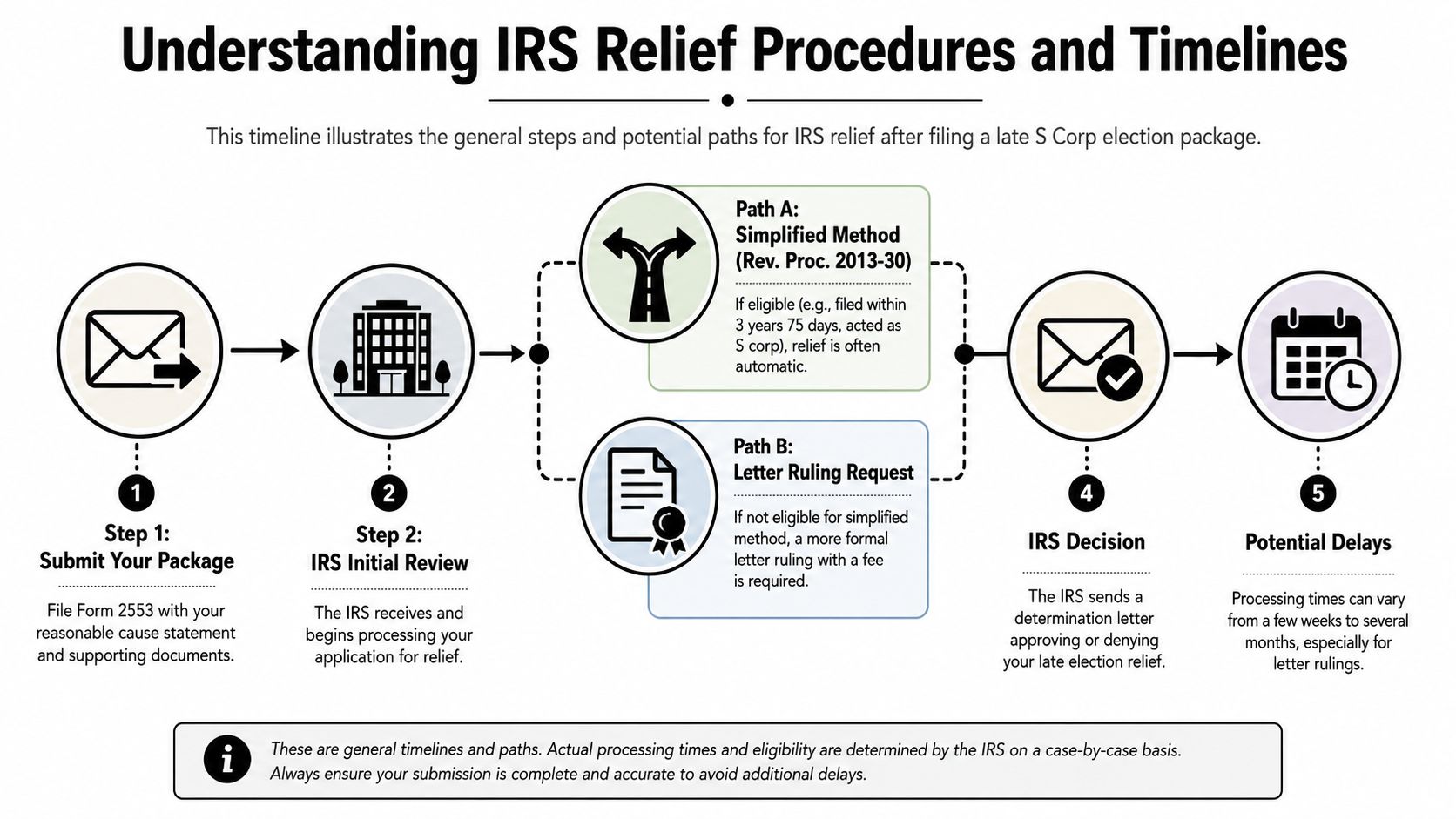
Most workable cases fit the simplified late-election process under the revenue procedure discussed earlier. That route is designed for businesses whose facts align with the IRS relief framework and whose filing package is complete.
A smaller group of cases falls outside that simpler path. Those are the matters where advisers start considering a more formal ruling request. That route is more technical, more document-intensive, and usually not something an owner should tackle casually.
The practical distinction is straightforward:
- Simplified relief cases usually involve a missed deadline with otherwise supportable facts.
- Ruling-style cases often involve a timing problem outside the usual relief window, procedural complications, or facts that don't fit neatly.
If you're also trying to sort out return timing around the entity filing itself, Allied's summary of the 1120-S due date helps clarify the return side of the calendar.
What happens after submission
IRS processing is not especially dramatic. The package is received, reviewed, and either accepted, questioned, or denied. The waiting is often the hardest part because the owner has already done the corrective work and now has no direct control over pace.
A few practical expectations help:
| Stage | What to watch for |
|---|---|
| Submission | Keep proof of mailing or transmission and a copy of the full package |
| Review | Be ready to match any IRS question to the exact document submitted |
| Determination | Save the IRS response with permanent entity records |
Don't create extra problems while waiting. If the business is now operating as an S corporation, keep ongoing compliance aligned with that position. If a related return needs amendment or coordination, handle that carefully and consistently.
Some owners assume no news means something went wrong. Usually it just means the file is still in process. Repeated panic calls rarely improve the outcome. Good recordkeeping does.
Common Mistakes and When to Hire a Professional
Late election cases fail for ordinary reasons. Usually the facts were fixable, but the package was sloppy, inconsistent, or too casual about reasonable cause.
Errors that sink otherwise fixable cases
These are the mistakes I see most often:
- Generic reasonable cause language: A template that says the owner was busy, overlooked the filing, or misunderstood the rules without any supporting timeline.
- Incomplete signatures: One missing shareholder consent can turn a clean case into a preventable delay.
- Inconsistent reporting: The business claims intended S status, but prior filings tell a different story.
- Too much blame, not enough proof: Pointing at a prior adviser without documents or a clear chronology doesn't help.
- Messy attachments: Reviewers shouldn't have to piece together what happened from random emails and unlabeled exhibits.
If you're gathering support documents, organized admin help matters. For businesses that need assistance collecting records, correspondence, or filing support, experienced Legal assistants can help impose order on the file before it goes to a CPA or enrolled agent.
When this stops being a DIY project
Some late S corp election filings are manageable for an organized owner. Others aren't.
You should strongly consider professional help if:
- The timing is outside the standard relief structure.
- The ownership is more complicated than a simple single-owner setup.
- The business and shareholder returns don't line up cleanly.
- The IRS has already sent a notice.
- You need the reasonable cause statement to reconcile multiple mistakes, not just one missed form.
This is also the point where one mention is appropriate. Firms such as Allied Tax Advisors handle S corporation filings, compliance, and IRS resolution work, which can be relevant when the late-election issue overlaps with return cleanup or notice response.
A professional adds the most value when the facts are imperfect. Clean facts don't need magic. They need careful assembly. Imperfect facts need strategy, restraint, and a statement that tells the truth without creating new problems.
If you're dealing with a late S corp election and want the filing package reviewed before it goes to the IRS, Allied Tax Advisors can help assess eligibility, draft the reasonable cause statement, and coordinate the election with the related tax filings so the case is presented consistently.