
You’re probably in the same spot as a lot of small business owners. Your current vehicle is getting older, repair bills are becoming annoying, and you’re trying to decide whether leasing a newer car gives you a real tax benefit or just a nicer monthly payment.
The answer is simple. A leased car tax deduction can absolutely help, but only if you choose the right deduction method, track business use correctly, and avoid the mistakes that cause business owners to lose part of the write-off. The deduction itself isn’t complicated. The strategy behind it is where people usually get it wrong.
I see this most often with consultants, real estate professionals, contractors, and solo operators. They lease a vehicle because the payment fits cash flow, then they assume the full payment is deductible. It usually isn’t. Others use the wrong mileage totals, mix commuting with business driving, or miss how EV leases are taxed. Those errors are avoidable.
If you’re still weighing the bigger lease-versus-buy question, this breakdown of car lease vs buy tax benefits is a useful companion. For now, focus on this: if you lease, your tax result depends less on the contract and more on how you use the vehicle and how you report it.
Is a Leased Car Tax Deduction Right for Your Business
Your truck is aging, repairs are stacking up, and a dealer offers a lease with a payment that fits your budget. The tax question is not whether a lease creates a deduction. The question is whether leasing gives your business a better deduction and better cash control than buying.
Start with the business decision, not the sales pitch. A lease is usually the right move when you want lower upfront cash outlay, a newer vehicle every few years, and a deduction that tracks operating cost instead of long-term ownership. If you expect to replace vehicles often, leasing deserves a hard look. If you want the bigger strategic comparison, review these car lease vs buy tax benefits before you sign anything.
Leasing also works well when the numbers support the deduction method you plan to use. For some owners, the standard mileage rate produces the better write-off. For others, actual expenses make the lease more valuable, especially if the vehicle has high payments, insurance, and operating costs. That choice affects the tax result more than the word "lease" on the contract.
Here is my rule. Lease for business use, cash flow control, and planned replacement cycles. Do not lease because a salesperson or friend called it a write-off.
Leasing is often a poor fit if you want to keep the vehicle for many years, drive very little for business, or expect ownership-related tax benefits to beat the lease deduction over time. It is also a bad fit for owners who are sloppy with mileage logs. A leased vehicle with weak records turns into a partial deduction fast. The same problem shows up with EV leases, where owners assume incentives or special rules automatically improve the tax outcome. Sometimes they do. Sometimes they do not. You need to run the numbers first.
A common mistake is focusing only on the monthly payment. That is backwards. You should compare four things before signing: upfront cash required, expected business-use percentage, the deduction method you will use, and how long you realistically plan to keep the vehicle. If those four items line up, leasing can be a smart tax choice. If they do not, you are just financing convenience.
Who Can Claim the Leased Car Tax Deduction
You lease an SUV for the business, use it for client visits three days a week, and also drive it to dinner and school pickup. Only the business share is deductible. That is the rule that decides who qualifies and who does not.
If you use a leased vehicle in an active trade or business, you can usually claim the business portion of the deduction. That includes sole proprietors, independent contractors, single-member LLC owners, partners, and corporations that provide or reimburse a vehicle under a properly documented arrangement. The tax benefit belongs to the business or business owner with the legal right to deduct the expense, not the person who drives the car.
W-2 employees need to be careful here. Under current federal law, unreimbursed employee vehicle expenses generally are not deductible on an individual return. If your employer expects you to use your own leased car, the right fix is usually an accountable reimbursement plan, not a weak deduction claim.
Business use percentage decides the deduction
The IRS starts with mileage. You need a real business-use percentage based on records, and the formula is simple:
Business miles ÷ total miles = business-use percentage
Say you drove 12,000 total miles during the year and 8,000 of those miles were for business. Your business-use percentage is 66.67%. If your annual lease payments were $7,200, the deductible lease portion under the actual expense method would be $4,800, before any other limits apply.
That percentage also lives or dies on whether you classify trips correctly. Daily commuting from home to your regular office is usually personal, even if you answer business calls in the car. If you are fuzzy on that line, read our guide on business miles vs. commuting miles. Misclassifying commuting is one of the fastest ways to overstate this deduction.
Taxpayers who usually qualify
I would expect these taxpayers to qualify if the vehicle is used for legitimate business driving and the records are clean:
- Sole proprietors
- Independent contractors and freelancers
- Single-member LLC owners
- Partners using the vehicle for partnership business
- S corporation owners with the vehicle handled properly through payroll or reimbursement
- Businesses that lease a vehicle directly for company use
What counts as business driving
Qualifying use usually includes travel to client meetings, job sites, temporary work locations, suppliers, properties, and separate business locations. A real estate agent driving from the office to a listing appointment has business mileage. An electrician driving from one customer site to the next has business mileage. The drive from home to your main office usually does not qualify.
Keep your standard high. If a trip does not have a clear business purpose you can explain in one sentence, leave it out of the log.
One more practical point. If you plan to use the actual expense method, you need support for the operating costs tied to the vehicle, including repairs. A major repair bill can increase the deduction, which is one reason some owners compare mileage logs and receipts against expected costs such as alternator replacement cost before choosing how aggressively to track actual expenses.
High-value leases have an extra limit
A more expensive vehicle can trigger a smaller deduction than owners expect. The IRS requires a lease inclusion amount for certain leased autos with a fair market value above the annual threshold published in IRS guidance, including IRS Publication 463. The rule applies to luxury and high-value vehicles, and it matters more than many owners realize.
This issue shows up often with premium SUVs and EV leases. Business owners assume the higher payment creates a bigger write-off. Sometimes it does. Sometimes the inclusion amount cuts that benefit back. You still may have a good tax result, but you need to qualify first, track business use correctly, and understand that a high-end lease comes with extra limits.
Choosing Your Deduction Method Actual Expenses vs Standard Mileage
You sign a lease expecting an easy write-off. Then tax season arrives, and the bigger question is not whether the car is deductible. It is which method gives you the better result for the full lease term.
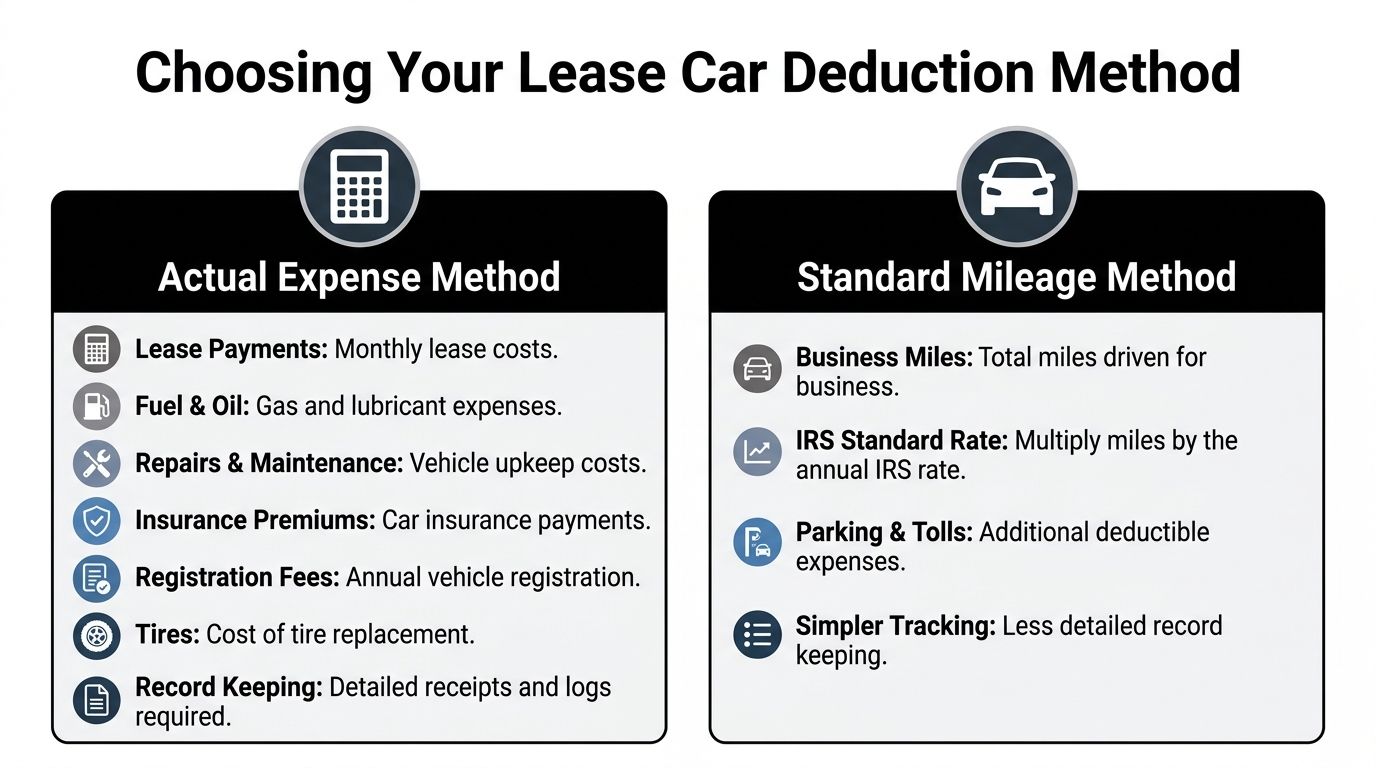
For a leased vehicle, this choice deserves real attention. If you start with the standard mileage method, that choice generally sticks for the entire lease period, including renewals on the same car. If you choose badly, you do not fix it later with better bookkeeping. You live with it.
Actual expense method
Use actual expenses when the lease is costly, business mileage is modest, and you are willing to keep records that can survive an IRS review.
With this method, you deduct the business-use share of vehicle costs such as:
- Lease payments
- Gas, electricity, and oil
- Repairs and maintenance
- Insurance
- Registration and licensing fees
- Tires
- Parking and tolls related to business driving
The math is simple. If 80% of the vehicle use is business use, you generally deduct 80% of the eligible costs, subject to the lease rules covered elsewhere in this article.
This method often wins for owners with high fixed costs and lower annual mileage. It also becomes more attractive in years with major repairs. A single repair bill can swing the result, which is why some owners compare likely operating costs, including something like alternator replacement cost, before deciding how closely to track actual expenses.
Standard mileage method
Use standard mileage when you drive a lot for business and want the cleaner system.
Instead of tracking every operating expense, you multiply business miles by the IRS standard mileage rate for the year. For a leased car, this method is attractive because administration is lighter and the deduction can outperform actual expenses when the vehicle is used heavily for client visits, sales calls, site checks, or service work.
The catch is straightforward. You do not get to deduct lease payments separately if you use the mileage rate. You are choosing one system.
A practical way to choose
Run the numbers before the lease starts. Do not guess.
Start with three estimates:
- Annual business miles
- Annual lease and operating costs
- Business-use percentage
Then compare them side by side. Here is the pattern I see most often with small business clients:
- High business miles, moderate vehicle costs usually favor standard mileage
- Lower business miles, higher lease payments, higher insurance, or large repair costs often favor actual expenses
- Weak recordkeeping pushes the answer toward standard mileage, because a deduction you cannot support is not a deduction you keep
Here is a clean example. If your leased vehicle generates substantial annual costs but only limited business mileage, actual expenses may produce the better write-off. If that same vehicle is driven heavily for business all year, standard mileage can easily come out ahead. The winner is not the method that sounds better. It is the method that fits your actual use pattern.
The mistake that costs owners money
Small business owners often compare methods using inflated business mileage. That error usually comes from counting commuting miles that do not qualify.
Fix that before you run the comparison. If you need a cleaner line between deductible driving and personal travel, review this guide on business miles vs commuting miles.
Another frequent mistake is assuming an EV lease automatically creates a better tax result. It does not. An electric vehicle may lower fuel and maintenance costs, which can make the actual expense method less impressive than expected. On the other hand, heavy business driving can make the mileage method look stronger. EV leases need the same side-by-side analysis as any other vehicle.
Actual Expenses vs Standard Mileage at a Glance
| Consideration | Actual Expense Method | Standard Mileage Method |
|---|---|---|
| Core calculation | Deduct the business-use share of lease and operating costs | Multiply business miles by the IRS rate |
| Best fit | Higher fixed costs and lower business mileage | Higher business mileage and simpler administration |
| Records required | Receipts, lease statements, and a mileage log | A reliable mileage log |
| Lease-specific issue | Business-use percentage drives the deduction | Lease payments are not deducted separately |
| Audit risk | Higher if receipts or use percentage are weak | Higher if mileage logs are sloppy |
| Long-term impact | Strong when costs stay high | Strong when miles stay high |
My recommendation
Start with the method that matches how you use the car, not the one that feels more generous.
If you expect heavy business driving, test standard mileage first. If the lease is expensive, the car is driven less, or operating costs are high, test actual expenses carefully. For EV leases, be even more deliberate. Lower operating costs can change the answer fast.
Choose once, choose carefully, and document the reason. That is how you maximize the deduction without creating a compliance problem later.
Navigating Lease Inclusion Amounts and Other Limits
You sign a lease on a high-end SUV, assume the business will write off most of it, and then your tax return says otherwise. That surprise usually comes from one rule. The lease inclusion amount.
It applies to higher-value leased vehicles and reduces the deductible lease expense under the actual expense method. For 2024, the IRS applies this rule if the vehicle’s fair market value was more than $60,000 when the lease began, as shown in the IRS annual inclusion table in Topic no. 510, Business use of car.

What the inclusion amount actually means
The IRS does not let a luxury lease produce a bigger tax break than a comparable owned vehicle. So if you lease an expensive car, part of your deduction gets added back.
Here is the practical point. A bigger lease payment does not automatically create a better deduction.
That matters most for small business owners choosing between a modest vehicle and a premium one. If tax efficiency is the goal, an expensive lease usually loses ground fast once the inclusion amount and your business-use percentage both cut the deduction.
A simple way to evaluate the tax impact
Run the numbers before you sign. Use this sequence:
- Confirm the vehicle’s fair market value at lease inception.
- Check whether it crosses the IRS threshold for that year.
- Estimate your business-use percentage accurately.
- Calculate your expected actual-expense deduction after the inclusion adjustment.
- Compare that result to standard mileage if you are still at the decision stage for the lease.
Owners often make expensive mistakes. They price the monthly payment, but they do not test the after-tax result.
EV leases need the same discipline. The rules are not more generous just because the vehicle is electric. In fact, many leased EVs have sticker prices high enough to trigger the inclusion amount, which cuts into the deduction owners expected.
Other limits that change the real deduction
Federal tax rules get the attention, but the lease inclusion amount is not the only limit. Your deduction can also shrink because of:
- Personal use that lowers the business-use percentage
- Sales tax and local tax treatment on lease payments
- Fees rolled into the lease that are partly nondeductible or must be allocated
- Poor documentation for business use
- Upfront payments that may need to be spread over the lease term instead of deducted immediately
If your receipts and lease paperwork are scattered, fix that before year-end. A good system for organizing business receipts makes these adjustments much easier to support.
My recommendation on expensive and EV leases
Do not lease an expensive vehicle because you expect the tax deduction to bail out the economics. It usually will not.
Lease the vehicle because it fits cash flow, operating needs, or replacement strategy. Then test the tax result with real numbers. If the vehicle is near or above the inclusion threshold, assume the deduction will be less attractive than the payment suggests. If it is an EV lease, check the fair market value early and do not confuse EV marketing with better tax treatment.
Premium vehicles can still be legitimate business vehicles. They are rarely the smartest choice if your main goal is maximizing the deduction.
Essential Recordkeeping for an Audit-Proof Deduction
A vehicle deduction without records is just a story. If the IRS asks questions, your deduction survives on documentation, not memory.
That means your system matters as much as your tax method.

What you need to keep
For a leased car tax deduction, keep these records together:
- Signed lease agreement that shows the payment terms
- Mileage log for all business driving
- Odometer readings at the beginning and end of the year
- Receipts for gas, maintenance, insurance, tires, and registration if using actual expenses
- Proof of taxes paid on the lease
- Any upfront payment records tied to the lease
If your current filing system is a glove box and a stack of email confirmations, fix that. This guide on how to organize business receipts is a solid starting point.
What a compliant mileage log should show
A proper log should include:
- Date of the trip
- Starting and ending odometer readings
- Mileage driven
- Business destination
- Business purpose
“Client work” isn’t enough if it’s repeated all year with no detail. Write what happened.
Use tools that make this easy
You don’t need to do this manually if you hate paperwork. Apps like MileIQ and Everlance can help track trips as they happen. They’re not magic, but they’re much better than rebuilding a mileage log months later.
For actual expense users, save receipts digitally as you incur them. A cloud folder, bookkeeping app, or document portal works better than a paper pile.
My checklist for clients
Here’s the audit-proof version:
- Track mileage contemporaneously. Same day is best.
- Keep the lease contract. Don’t rely on dealership summaries.
- Save actual expense receipts if you elected actual.
- Separate personal and business use accurately.**
- Retain annual summary reports from your mileage app or bookkeeping system.
Good records don’t just protect the deduction. They let you choose the better method with confidence.
Most vehicle deduction problems aren’t tax law problems. They’re recordkeeping failures.
How to Report Your Lease Deduction on Tax Forms
You tracked the miles, saved the lease statements, and paid the bills. Now you need to put the deduction in the right place on the return. Small business owners frequently make avoidable mistakes.
For a sole proprietor or single-member LLC filing on Schedule C (Form 1040), a leased vehicle deduction usually gets split across more than one line item. Do not lump the full cost into one bucket.
Where the lease amount goes
Under the actual expense method, the business portion of your lease payments is generally reported as a vehicle expense on Schedule C, while parking, tolls, gas, insurance, and other operating costs are handled under their own expense categories or with your car and truck expenses, depending on how the return is prepared. The IRS instructions for Schedule C and Publication 463 are the right references here, not a dealership summary or blog post (IRS Publication 463).
The practical rule is simple. Report the lease cost as lease cost. Report the rest where it belongs. If your tax software imports everything into one auto-expense line, review it before you file.
Your method controls what gets reported
If you chose the standard mileage rate in the first year the lease was placed in service, you do not separately deduct the lease payment itself. The mileage rate already covers the vehicle's operating cost, subject to the usual rules for parking and tolls.
If you chose actual expenses, deduct the business-use share of:
- Lease payments
- Gas or charging costs
- Insurance
- Repairs and maintenance
- Registration and property taxes, if applicable
- Parking and tolls for business trips
That choice matters on the form because it changes the numbers everywhere. It also affects your planning. A high-payment lease with modest business mileage often favors actual expenses. A lower-cost vehicle driven heavily for business often makes the mileage method more attractive. Run the numbers before you file, not after.
Watch the lease inclusion amount
Some higher-value leased vehicles require a lease inclusion amount, which reduces the deduction slightly. If it applies, you do not ignore it. You reduce the deductible lease expense and keep the worksheet with your tax file.
This is one of the most missed adjustments I see. The return may still process, but the deduction will be overstated.
EV leases add another layer of confusion. Business owners often assume the clean vehicle tax credit works the same way for a lease as it does for a purchase. It does not. In many lease deals, the lessor gets the credit and may or may not pass the benefit through in pricing. If you are comparing EV lease economics, review the details carefully and do not assume the monthly payment tells the full tax story. This overview of Company Car Tax on Electric Vehicles is useful background if an electric company car is part of your planning.
Self-employed owners and employees are treated differently
A business owner filing Schedule C may be able to deduct qualified vehicle use. A W-2 employee usually cannot deduct unreimbursed employee vehicle expenses on the federal return.
Do not force a deduction that no longer exists.
What I want clients to reconcile before filing
Use this quick check before you sign the return:
| Item | What it should match |
|---|---|
| Lease expense claimed | Lease agreement and payment history |
| Business-use percentage | Mileage log |
| Inclusion amount adjustment | Your annual worksheet, if required |
| Other vehicle costs | Receipts and bookkeeping records |
| Sales tax or property tax claimed | Lease invoices and registration records |
If those numbers do not tie out, fix them first. Clean reporting is how you maximize the deduction and stay out of trouble.
Strategic Tax Planning with Leased Vehicles
A client comes in deciding between a lease and a purchase because the monthly lease payment looks easier to swallow. That is not the right starting point. Start with the tax result, the cash flow impact, how long you plan to keep the vehicle, and whether you need ownership-based write-offs.
Leasing works best for businesses that want predictable vehicle costs, replace cars every few years, and do not need the deductions that come with owning the asset. You deduct the business-use share of the lease cost over time, which usually gives you a steadier write-off and less upfront cash pressure. For many service businesses, that is the cleaner answer.
Buying is often better if your strategy depends on depreciation, Section 179, bonus depreciation, or building equity in the vehicle. If that is your goal, do not lease just because the payment feels lower. A lower payment can still produce a worse tax result.
Run the numbers before you sign
I tell clients to compare three things on one sheet of paper:
- total out-of-pocket cost over the period you expect to use the vehicle
- total expected tax deduction under the lease
- total expected tax deduction if you buy instead
Then test the actual-expense method against the standard mileage method using your expected business miles. If the vehicle is expensive to lease and you drive heavily for business, actual expenses may produce the larger deduction. If the car is modestly priced and your operating costs stay low, standard mileage can be simpler and sometimes better.
Do not guess here. A bad choice in year one can lock you into a weaker deduction pattern for years.
The expensive mistake small business owners make
Owners routinely focus on the payment and ignore the business-use percentage. That is where deductions get lost.
If you lease a vehicle with a $900 monthly payment but only use it 55 percent for business, only that business portion belongs on the return, subject to the normal rules and adjustments. If another vehicle has a lower payment but 90 percent business use, the lower-cost vehicle can produce the better tax outcome after allocation. The right answer is not always the nicer car or the cheaper payment. It is the vehicle that fits your actual business use and your broader tax plan.
A second mistake is treating a lease like a purchase after the paperwork is signed. They are different tax structures. Keep them separate in your books and in your planning.
EV leases need closer review than gas vehicles
EV leases confuse business owners because the tax benefit is often built into the deal rather than claimed directly on the return. The lessor may receive the federal incentive and choose to pass along some of that value through lower lease pricing. Or not.
That means you need to read the lease worksheet, not just the ad. Look for how the credit affects capitalized cost, monthly payment, fees, and any upfront amount due. If the dealer cannot show where the benefit went, assume you are not getting the full value.
For readers comparing broader employer-side EV tax issues, especially in another tax system, this guide to Company Car Tax on Electric Vehicles offers useful context on how electric vehicle tax treatment can differ.
My recommendation
Lease when you want stable costs, frequent vehicle turnover, and a deduction tied to actual business use without the ownership planning that comes with buying.
Buy when you want ownership-based deductions or expect to keep the vehicle long enough for that strategy to pay off.
Before you sign anything, run both scenarios with real numbers. That step saves more tax than chasing the wrong deduction after the fact.
Leased Car Tax Deduction FAQs
Can I deduct an upfront payment on a lease all at once
No. A down payment, cap cost reduction, or other prepaid lease amount is generally deducted over the life of the lease, not all in year one. If you use the car 80% for business and prepay part of a 36 month lease, you spread that business portion across those 36 months.
That rule matters because business owners often expect a large first-year write-off and build the deal around it. Do not do that. Read the lease agreement and identify what is prepaid, what is monthly rent, and what is a fee.
Is leasing better than buying for taxes
Leasing is better when you want predictable deductions tied to actual business use, lower upfront cash, and no need to plan around depreciation rules. Buying is better when ownership deductions are the point of the strategy, especially if you expect to keep the vehicle long enough for depreciation to outperform lease write-offs.
Run both options before you sign. Compare the after-tax cost, expected business-use percentage, lease payments, buyout terms, and how long you will keep the vehicle. If you skip that analysis, you are guessing.
What happens if I buy out the lease later
The tax treatment changes on the buyout date. Before that date, you are deducting lease costs based on your chosen method. After that date, the vehicle becomes owned property and the rules shift to basis, depreciation, and other ownership rules.
Set up that change correctly in your books right away. Do not keep posting payments to lease expense after the buyout.
Can I terminate a lease early and deduct the cost
Sometimes, but the answer depends on the contract and the reason for the termination. Early termination fees may be deductible, partially deductible, or need different treatment based on what the charge covers.
Review the closing statement before you book anything. A termination penalty is not the same as a purchase payment, and mixing them up creates bad deductions fast.
Can I switch methods during the lease
No. If you choose the standard mileage rate for a leased vehicle, you generally must continue using it for the entire lease period, including renewals, if you keep leasing the same vehicle. The IRS explains this in Publication 463.
Choose carefully at the start. If your actual costs will be high, the wrong election can cost you real money for years.
What’s the biggest mistake small business owners make
They claim too much personal use. That is the audit issue I see most often.
The next mistake is sloppy records. The third is misunderstanding EV leases. Many business owners assume they personally get the federal EV credit on a lease. Usually, the lessor gets that benefit and may or may not pass it through in the pricing. If you lease an EV, inspect the numbers on the lease worksheet and confirm whether the tax benefit reduced your cap cost or payment.
If you want help deciding whether a lease benefits your business, or you need someone to review your mileage logs, lease terms, and filing treatment before you claim the deduction, talk to Allied Tax Advisors. We help small business owners turn vehicle write-offs into clean, defensible tax strategy instead of guesswork.