
You can have a profitable year, then one bad quarter wipes out the next. A restaurant owner buys new equipment, a contractor gets hit by a project delay, or a landlord takes a rental loss after repairs and vacancy. That's where the net operating loss deduction matters, because it can turn a rough year into a tax asset instead of just a painful spreadsheet number.
Table of Contents
- What the Net Operating Loss Deduction Is
- Who Qualifies for the Net Operating Loss Deduction
- How Federal Carryback and Carryforward Rules Changed
- Understanding the 80 Percent Taxable Income Cap
- Federal Versus State Net Operating Loss Treatment
- How to File for a Net Operating Loss Deduction Step by Step
- Net Operating Loss Planning Strategies and When to Get Help
What the Net Operating Loss Deduction Is
A San Diego owner can have a strong year, then the next year turns bad fast. Sales soften, repairs pile up, or a contract falls through after the work is already done and paid for. The tax system treats those years as connected, and that is why the net operating loss deduction exists.
The deduction lets a loss from one year reduce taxable income in another year. Federal rules may allow the loss to reach backward to an earlier return or carry forward to a later one, depending on the year and the taxpayer's facts. That is what turns a business loss into tax relief instead of leaving it stranded in the year it happened.
The deduction is not the same as the accounting loss on your books. Treasury regulation 26 CFR § 1.172-1 says the NOLD is computed by first determining the NOL for each loss year, then applying the carryback or carryforward to the target year, and then combining those amounts into the deduction. Treasury regulation on NOLD computation
That sequencing matters in real filings. Tax software and workpapers do not pour every loss into one bucket, because each loss year can carry its own rules, limits, and timing consequences. Older losses and newer losses can sit side by side, and they do not always produce the same result. If you are still working through the mechanics of taxable income and year-end adjustments, this overview of net income calculation helps show how those numbers feed into the return.
The policy behind the rule is straightforward. Businesses do not earn income in a straight line, so the tax code gives some room to smooth the ups and downs. Without that relief, a company could owe tax in a profitable year and get little immediate benefit when the cycle turns down. With it, the tax result follows the business reality more closely.
Who Qualifies for the Net Operating Loss Deduction
Eligibility starts with the source of the loss. The deduction is aimed at business-related losses, not personal spending or ordinary household losses dressed up as tax deductions. That's why the first question is always whether the loss came from an activity that the tax rules treat as part of a trade or business.
Entity type matters, but the core test is the same
Sole proprietors can generate NOLs from Schedule C operations when deductions exceed income. C corporations can also generate NOLs at the corporate level. Partnerships and S corporations usually pass items through to the owners, so the NOL benefit often shows up on the partner's or shareholder's return rather than at the entity level.
For individuals, the line between usable and unusable losses is critical. A rental property loss may matter, but passive-activity limits can affect when it helps. Casualty losses, business expenses, and other items can also interact with the NOL calculation, but only to the extent the tax rules let them be part of the loss computation. Personal expenses generally don't create an NOL just because they made the year feel expensive.
The practical filter is this, if the loss belongs to a business or another eligible income-producing activity, it may feed an NOL. If it's personal consumption or a nondeductible item, it won't.
What to check before you assume you qualify
- Business source: Confirm the loss came from a trade, business, or other item allowed in the NOL computation.
- Entity flow-through: If you own an S corporation or partnership, check whether the loss is passing through to your return and whether other limitation rules reduce it first.
- Separate buckets: Keep rental, operating, investment, and personal items separate. Mixing them is one of the fastest ways to misread the result.
- Return position: Make sure the loss survives the other limitation layers before you call it an NOL.
The taxpayer who benefits most is usually the one who tracks the loss early, not the one who tries to reconstruct it after the return is filed. That distinction matters because a seemingly large loss can shrink once the underlying tax rules are applied in order. If the return's other limitation layers are already eating part of the loss, the NOL may be smaller than expected.
How Federal Carryback and Carryforward Rules Changed
A loss is only useful if you know which rule set applies to it. A business owner who expects an immediate refund from an NOL can be in for a surprise if the loss year falls under a different federal regime than the return year. The federal NOL story is mostly a record of Congress changing the rules after different rounds of pressure, then leaving taxpayers to match the right vintage to the right filing year. For decades, carrybacks were a common way to recover cash from prior profitable years. Then the Tax Cuts and Jobs Act of 2017 changed the structure, generally eliminating carrybacks, replacing the old 20-year carryover limit with indefinite carryforwards for many taxpayers, and introducing the modern 80% of taxable income limitation for post-2020 years. Congressional Research Service summary of TCJA and NOL changes

The rule set depends on the loss year
The CARES Act temporarily reopened carrybacks for certain NOLs from 2018, 2019, and 2020, allowing a five-year carryback window. That matters because the same business loss can produce a refund in one year and only a future deduction in another. A loss from the CARES window might have been eligible for prior-year refunds, while a later loss generally falls back into the post-TCJA framework. The practical difference is cash timing, not just paperwork.
The ordering of vintages is where many returns get messy. For tax years beginning after December 31, 2020, older pre-2021 NOLs are generally applied first, and post-2017 NOLs then absorb only the remaining room under the cap. In practice, that sequence affects how much taxable income is left exposed in the carryover year, which is why the schedule has to be built carefully instead of guessed at.
If you are trying to sort out whether a loss year still has carryback value or only future value, the loss year and the filing year both matter. A 2020 loss lives in a different regime than a 2022 loss, and the difference can be the gap between a refund now and a deduction later. For readers following the broader federal changes tied to recent legislation, this overview of recent federal tax changes helps explain why the timing of a loss still affects the tax bill.
The business takeaway
The tax code does not treat every NOL the same. You need the loss year, the return type, and the vintage of the carryover to know what is available. That is why a clean NOL schedule is more valuable than a one-line number on the return.
Understanding the 80 Percent Taxable Income Cap
A profitable year can still leave you with federal tax. That is the part many owners miss until the return is already being prepared. For tax years beginning after December 31, 2020, prior-year NOLs generally cannot reduce taxable income below 80% of the carryover-year taxable income, as explained in Tax Notes summary of IRC section 172.
A straightforward example shows the limit in practice. If a business has $10 million of taxable income and enough NOL carryforwards, the deduction is generally capped at $8 million. That leaves $2 million still subject to federal tax, even though the loss balance might otherwise appear large enough to eliminate the full amount. Bloomberg Tax discussion of the federal NOL cap
Why the cap changes cash planning
Owners often plan around the size of the loss, then get caught by the ceiling. A large NOL balance does not automatically mean a zero tax bill. Estimated tax payments, deferred tax calculations, and cash-flow forecasts all have to reflect the cap, or the business can end up short on cash when the return is filed.
The order of the carryovers matters too. Pre-2021 NOLs are generally applied first, and post-2017 NOLs then apply only to the taxable income that remains under the 80% limit. That ordering can make older losses more valuable in practice, especially when different vintages are sitting on the books at the same time. Tax Notes summary of ordering rules
A business owner also needs to separate tax relief from tax elimination. The rule gives you timing relief, because the loss still reduces current tax. It does not always wipe out the whole current-year liability, which is why a return can show a meaningful NOL benefit and still produce a federal balance due.
When you are comparing federal and state returns, the cap can create another layer of mismatch. Some states conform to the federal limitation, while others calculate NOL usage differently or do not follow the same ordering rules. If a state return has to be corrected after the federal filing, how to amend a state tax return becomes part of the planning conversation.
Bottom line: a large NOL bank can still leave you with a federal tax bill, because the law generally protects at least 20% of taxable income from being offset by those losses.
The practical result is deferred tax relief, not always immediate full relief. That distinction matters most for cyclical businesses, real estate portfolios, and owners whose income swings sharply from one year to the next. It also explains why the same NOL can feel generous in one year and frustrating in another.
Federal Versus State Net Operating Loss Treatment
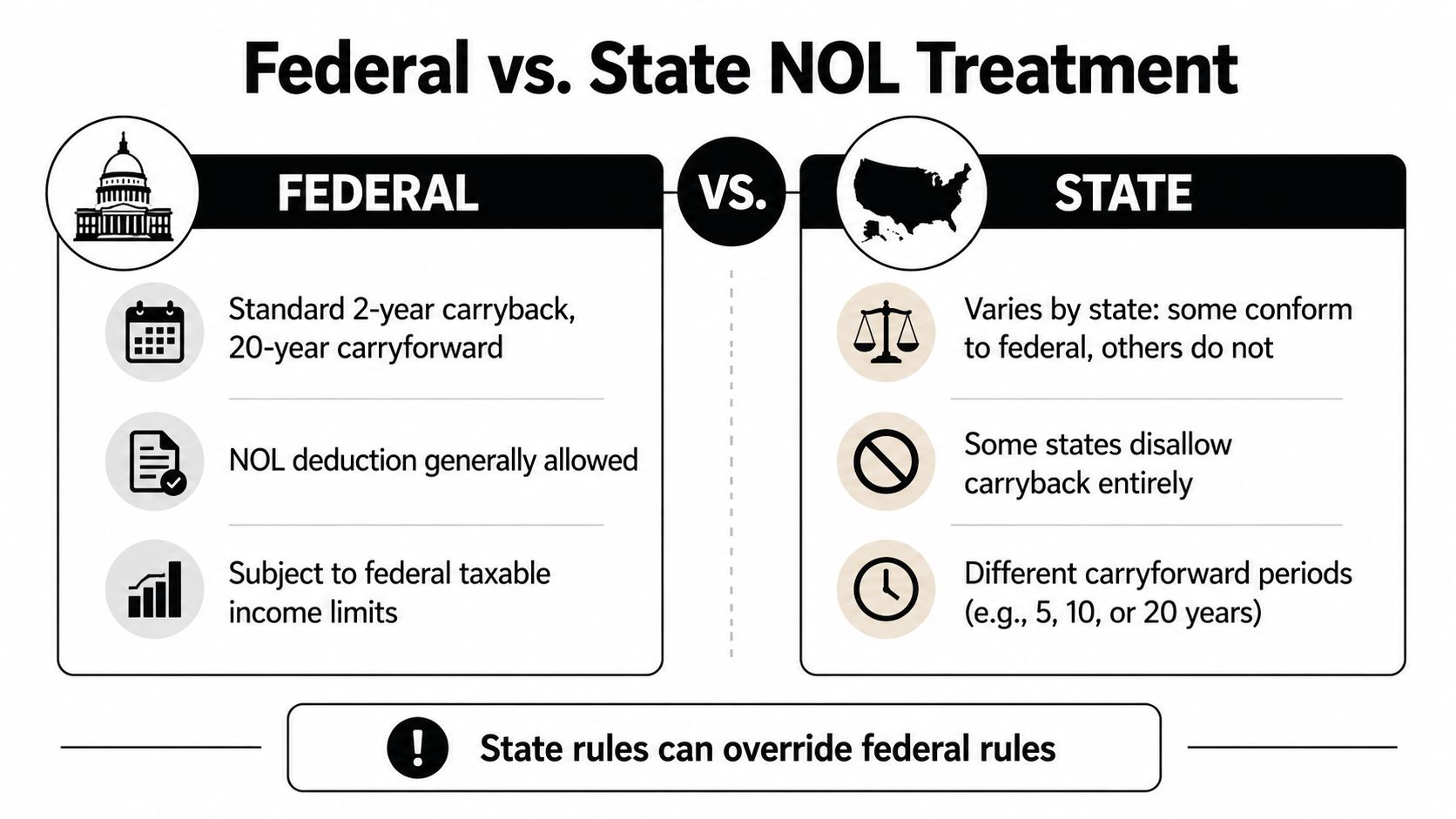
A federal NOL can look useful on paper and still leave the state return telling a different story. That is the part many owners miss. States do not all match federal carryback rules, carryforward periods, or the 80% limitation, so the same loss can produce one answer for the IRS and another for the state revenue department. California also has its own NOL rules and suspension guidance, which is one reason I tell clients to check the state return before they assume the federal result will carry over cleanly.
Where the mismatch usually shows up
Federal law may allow a deduction that a state limits, suspends, or calculates differently. Some states conform closely to the federal rules, some follow only part of them, and some use their own system entirely. The result is a common planning trap, one return shows a benefit, while the other shows little or no benefit at all.
That gap matters most for multistate businesses, landlords with properties in more than one state, and pass-through owners whose income lands in several filing jurisdictions. A federal NOL can cut the IRS bill and still leave a state liability largely unchanged. The reverse also happens, especially when a state uses a different NOL vintage or ordering rule than the federal return.
A common mistake is assuming one NOL schedule fits every return. It does not. The federal calculation is only the starting point, and each state filing needs its own review before you rely on the savings.
State level questions to ask
- Conformity: Does the state follow federal NOL rules, or only part of them?
- Carryforward period: Does the state allow the same carryforward timing as federal law?
- Carryback availability: Is carryback allowed, limited, or disallowed entirely?
- Suspensions or caps: Does the state impose its own temporary suspension or percentage cap?
For state-level cleanup, this guide to amending a state tax return is useful when a prior-year filing needs to be corrected after the NOL treatment is recalculated. If the state filing drives a separate due date or refund claim, coordinate that work with your records and, for businesses that still need reliable document delivery, financial services mailing solutions can help keep notices and amended-return packages organized. The key is to treat the state result on its own terms instead of assuming the federal answer transfers over.
The wallet impact can be meaningful even when the federal math looks straightforward. If you operate across state lines, the NOL strategy has to be built return by return, with each state checked against its own rules.
How to File for a Net Operating Loss Deduction Step by Step
The filing path depends on whether you're trying to use the loss now or later. A carryback claim usually means a refund request, while a carryforward means the NOL sits on record and reduces a future year's taxable income. For businesses and individuals alike, the first step is always to separate the loss year from the year you're applying it to, because the form follows that choice.
Choose the right return path
For a carryback claim, individuals generally use Form 1045 when the rules allow a quick refund procedure, and corporations use Form 1139. For a regular carryforward, the NOL is reported on the applicable income tax return, often Form 1040 for an individual or the relevant business return for an entity. The taxpayer doesn't get to skip the recordkeeping just because the loss is old.
Keep the loss schedule, supporting workpapers, and amended or carryback filings together. If the numbers don't tie, the IRS will usually care about the mismatch before it cares about your explanation.
A practical carryforward example
Assume a sole proprietor has a $50,000 NOL carryforward and $80,000 of current-year taxable income. If the entire NOL were usable, taxable income would fall to $30,000. If a federal limitation prevents full use in that year, the remaining loss stays on the books for a later return, and the tax savings are deferred instead of lost.
That's why the filing steps matter:
- Verify the loss vintage. Make sure you know which tax year created the NOL and whether it's subject to carryback or carryforward treatment.
- Recompute the target year. Apply the NOL using the federal ordering rules before you finish the return.
- Use the correct form. Choose Form 1045 or Form 1139 for carrybacks, or report the carryforward on the current return.
- Keep the schedule current. Update the running balance so the same loss isn't used twice.
If you're managing owner notifications, return packets, or tax document delivery alongside the filing itself, operational tools like financial services mailing solutions can help organize time-sensitive client communications around refund claims and amended filings without making the process harder than it already is.
The cleanest filings are the ones where the support is obvious. Taxpayers who track the loss year, the carry period, and the target return separately usually avoid the most frustrating mistakes, because they can prove what went where and why.
Net Operating Loss Planning Strategies and When to Get Help
Good NOL planning starts before the year ends. If a business expects a loss, accelerating deductible expenses into that year can increase the NOL, while deferring income to a year with available NOLs can improve the offset. The same idea works in reverse when a business wants to preserve cash by timing gains or deductions around the available loss bank.
What usually works
- Track vintages separately: Pre-2018, post-2017, and later losses don't behave the same way, so they shouldn't be blended.
- Match losses to income timing: If a profitable year is coming, the loss should be positioned to offset as much taxable income as the rules allow.
- Watch state returns first: A federal benefit doesn't guarantee state benefit, especially in multistate filings.
- Review entity structure: Owners of pass-through entities need to know whether the loss is trapped at the entity level or flows through to the return.
A common mistake is treating all NOLs as interchangeable. They're not, and that mistake often costs money because the oldest or most flexible loss sits unused while a less favorable one gets applied first. Another mistake is assuming the federal work is done once the IRS schedule is complete. The state return can still change the economics.
For practical planning ideas that focus on owner-level tax moves, these Northeast Florida small business tax tips are a useful reminder that tax planning gets better when it's tied to actual business timing, not just year-end cleanup. The principle is the same everywhere, even if the local facts differ.
When to bring in help
A simple single-state return with one clean NOL may be manageable in-house. Complex situations are different. Multistate income, rental portfolios, consolidated groups, older loss vintages, and amended returns are the places where professional review usually pays for itself.
If you're in San Diego and dealing with business losses, rental losses, or a return that needs a careful NOL schedule, Allied Tax Advisors can help you sort the federal and state pieces without guessing. The value isn't just filing the return, it's making sure the loss is used in the year and jurisdiction where it saves you money.
If you're trying to use an NOL the right way, Allied Tax Advisors can help you trace the loss vintage, check the federal cap, and separate state treatment from federal treatment before you file. Visit Allied Tax Advisors to get help with NOL planning, amended returns, and the kind of return cleanup that keeps a loss from turning into a missed opportunity.