
You're running payroll on a Thursday night, the first direct deposits are queued up, and then the numbers hit you. Gross wages are only the headline. The significant damage comes from the taxes layered underneath, the filings that follow, and the cash you've got to hold back before the money even leaves your account.
That's the part many owners miss. Payroll tax for small business isn't a once-a-year chore, it's a recurring obligation tied to every pay cycle, every new hire, and every state you touch. If you treat it like a background admin task, it will punish you fast.
Table of Contents
- What Payroll Tax Actually Means for Your Business
- Federal Payroll Tax Obligations Explained
- California State Payroll Tax Requirements
- Deposit Schedules and Filing Deadlines
- Choosing Between Payroll Software and Professional Services
- Penalties and Consequences of Payroll Tax Mistakes
- Your Payroll Tax Compliance Checklist and Next Steps
What Payroll Tax Actually Means for Your Business
The first payroll run fools a lot of founders. You approve a salary of $4,000, expect the employee to get something close to that, and then the net pay lands much lower because taxes are already carved out. That gap is payroll tax, not the tidy version people talk about in meetings.
What you pay and what you withhold
Payroll tax has two sides. Some amounts come out of the employee's wages, while other amounts are the employer's burden. On the federal side, the core structure is built around FICA, which is split between employer and employee, while FUTA is generally an employer cost only. The IRS reports payroll-tax data on Form 941, which is the quarterly filing that keeps this whole system moving, and ADP's payroll-tax overview breaks down that layered structure clearly in its small business payroll taxes guide.
That distinction matters because the money doesn't sit in your operating account for long. You're holding some of it in trust, passing some of it through, and funding some of it from your own pocket. If you don't separate those buckets from day one, your cash flow gets blurry and your tax liabilities get messy, which is exactly why payroll belongs in the same conversation as bookkeeping and budgeting. For a practical framing of those liabilities, see payroll liabilities explained.
Practical rule: If you can't say which part of a payroll run is employee withholding and which part is employer tax, you're not ready to do payroll manually.
Why this is a cash-flow problem, not just a filing problem
Many owners believe the sole danger is overlooking a form. That perspective is too limited. The primary risk lies in setting aside insufficient funds for the tax portion of each payroll, which leads to scrambling when the deposit deadline arrives and your operating account is lower than anticipated.
That's why payroll tax for small business has to be planned like rent or inventory. You don't wait until the bill arrives to decide whether you can pay it. You build the liability into the payroll cycle itself, then keep the tax money mentally and physically separate from spendable cash.
If you're still early in the process, a solid HR payroll guide for founders can help you understand how payroll, onboarding, and compliance connect before the first payroll run goes out. The point isn't to make payroll feel complicated. The point is to make it predictable.
Federal Payroll Tax Obligations Explained
A first payroll run can make the federal side look simple until the cash leaves your account. Every payroll creates a stack of obligations, and if you don't separate them cleanly, you end up short on deposits and behind on filings.
FICA and FUTA are not the same thing
FICA covers Social Security and Medicare. The employer and employee each pay 6.2% for Social Security and 1.45% for Medicare, for a combined 15.3% rate on covered wages. FUTA is different. Employers generally owe 6.0% on the first $7,000 of each employee's wages, and state unemployment-tax credits can reduce the net FUTA rate. The IRS tracks payroll-tax reporting through Form 941. That is the federal return you keep hearing about because it sits at the center of the payroll cycle. Source: ADP's small business payroll tax breakdown.
Here's the clean way to think about it.
| Federal Payroll Tax Breakdown | Employer Rate | Employee Rate | Wage Base | Filing Form |
|---|---|---|---|---|
| Social Security | 6.2% | 6.2% | Covered wages | Form 941 |
| Medicare | 1.45% | 1.45% | Covered wages | Form 941 |
| FUTA | 6.0% | 0% | First $7,000 per employee | Form 941 |
A simple payroll example makes the split easier to see. If you pay a worker $4,000 in a pay period, the employee side of FICA is withheld from gross wages, and the employer matches that FICA amount. FUTA does not run on that full $4,000 forever, because the FUTA wage base caps at the first $7,000 of wages. That cap is why FUTA feels small in some months and then drops out later in the year for each worker.
Federal withholding still has to be handled correctly
Federal income tax withholding sits in the same payroll process, even though the only verified figures provided here are for FICA and FUTA. You still have to calculate withholding accurately, pull it from wages, and deposit it on time. If you guess, you'll regret it.
Candid advice: Most payroll mistakes start with bad setup, wrong employee data, or a deposit missed because nobody owned the calendar.
That is also why Form 941 matters so much. It is the recurring federal checkpoint where your withheld taxes and employer payroll taxes get reported. If your payroll software or service cannot keep that filing clean, it is not saving you time, it is creating future cleanup.
California State Payroll Tax Requirements
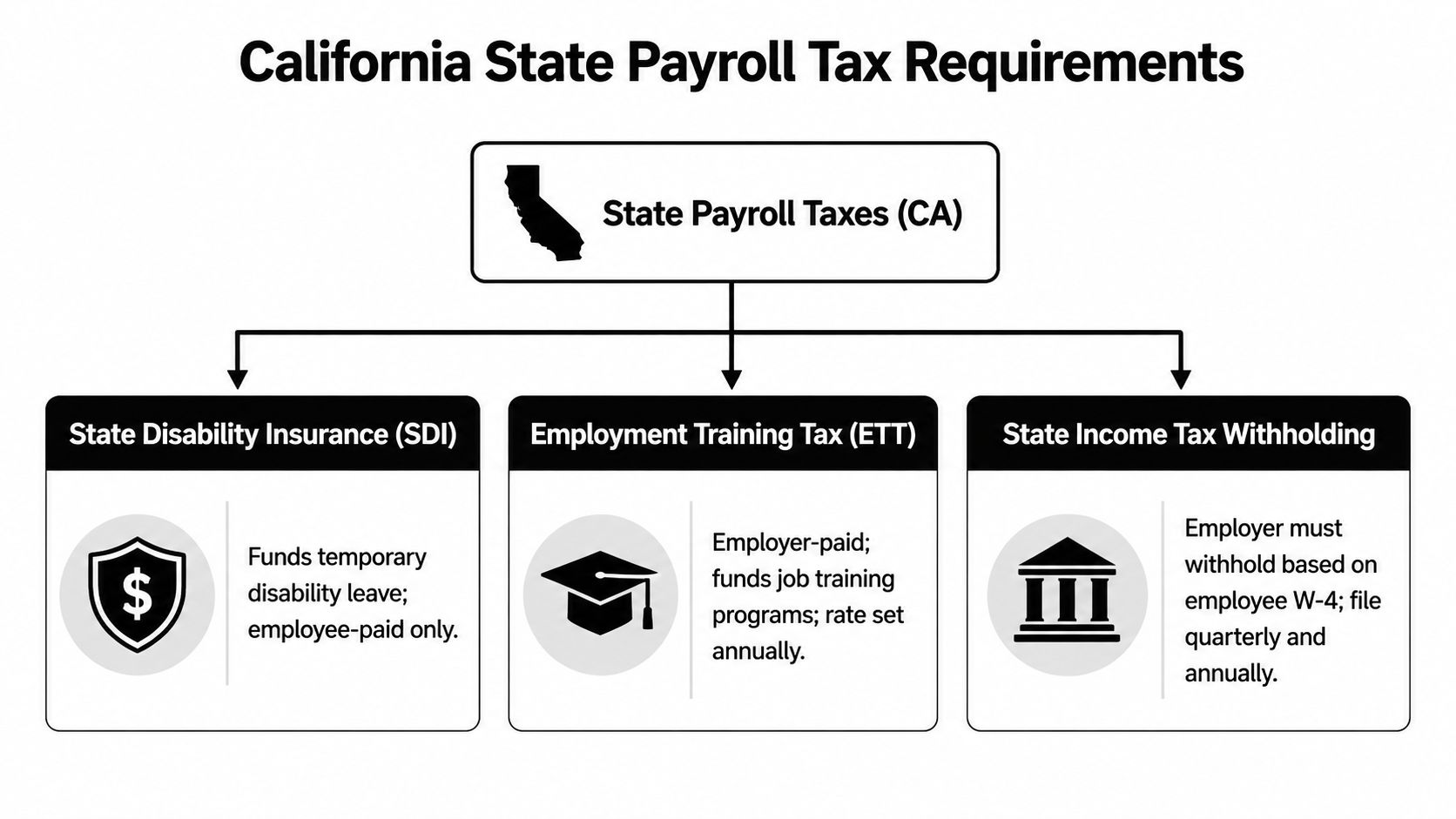
California adds another layer, and it's a layer that catches out-of-state owners all the time. Hire someone in California, and suddenly federal payroll isn't enough. You're dealing with state withholding, state unemployment rules, and EDD reporting too.
The state layer sits on top of federal payroll
The practical issue in California is that payroll tax isn't just one state form or one deduction. It's a combined system administered through the Employment Development Department, and it runs alongside the federal obligations already described. You'll see state income tax withholding, unemployment-related reporting, and other state-specific payroll items all handled in one place from the employer side.
California employers also need to stay disciplined about quarterly reporting. The state's payroll reporting cycle doesn't care whether you're busy, short-staffed, or in the middle of a product launch. If you've got California employees, the state expects the paperwork and the deposits to show up on time.
Why California is different from other states
The big mistake is assuming your home state rules travel with you. They don't. A remote employee in California can create payroll obligations there even if your business is organized elsewhere. That's where owners get surprised, because the federal setup looked complete until the state side entered the picture.
California's unemployment system also interacts with federal payroll in a way many owners overlook. The federal FUTA credit can be affected by state unemployment-tax credits, so the state layer isn't separate in the way people imagine. It affects the total payroll cost in the background, even when you're only looking at one employee on one payroll.
If you want a reference point for the California reporting side, the EDD's payroll process is the place to anchor your system. The main point is simple. California payroll compliance is not optional, and it's not passive. It needs its own account setup, its own filing rhythm, and its own review process before the first paycheck goes out.
Deposit Schedules and Filing Deadlines
Many smart owners still trip. They know the tax. They miss the timing. Payroll tax punishments usually start with a missed deposit, not a complicated audit issue.
Your deposit rhythm has to match your liability
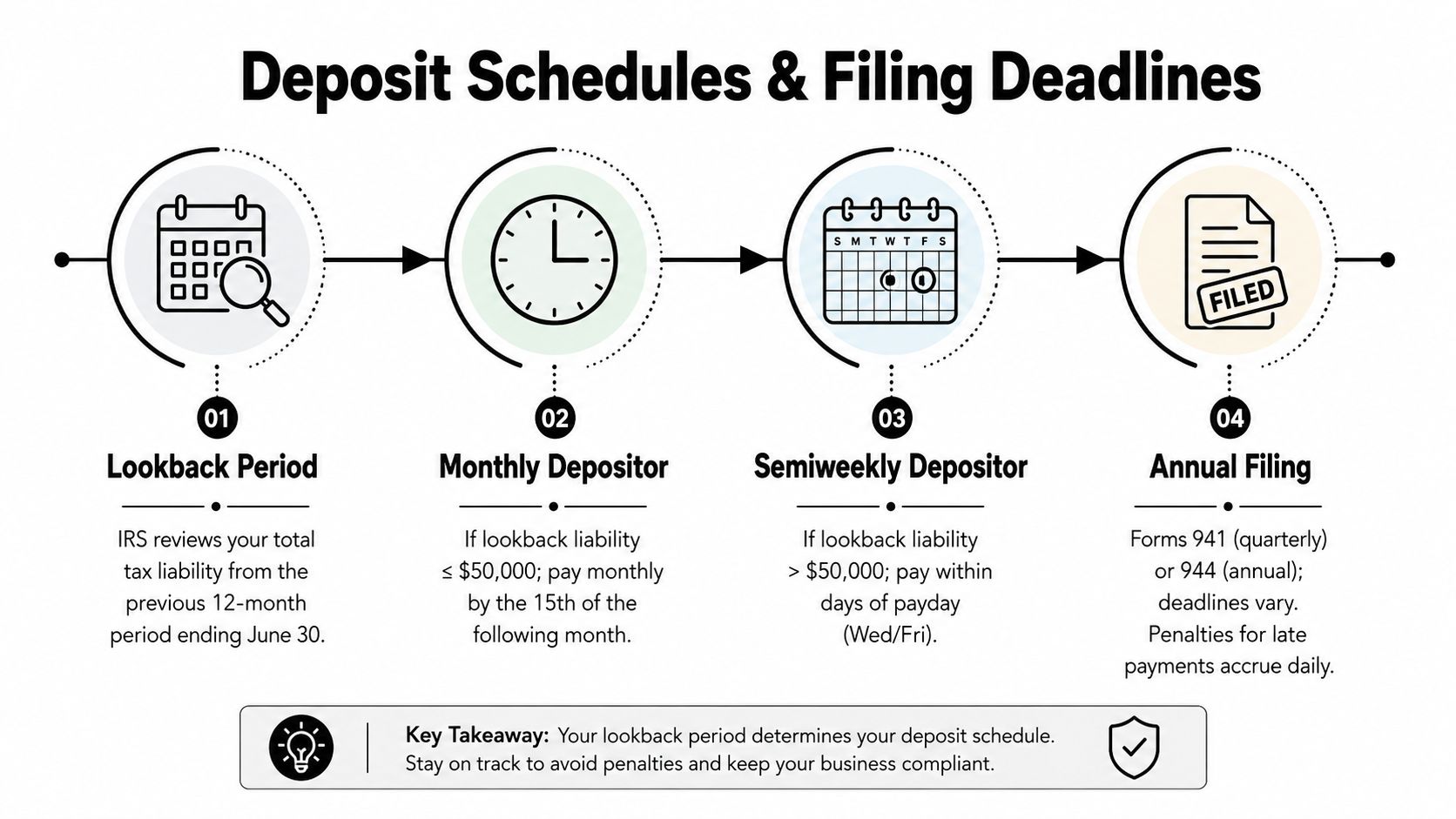
The IRS uses a deposit schedule system tied to your prior payroll-tax liability. That's why one business deposits monthly while another has to move faster. A growing company can also get hit with the next-day deposit rule if it crosses the threshold, which is exactly the kind of thing that blindsides owners who think they're still “small.”
The fix is not to memorize every rule by brute force. The fix is to assign someone to monitor the deposit rhythm every payroll cycle. If you're not checking it, you're guessing.
Here's the clean operational approach.
- Identify your depositor status early. Don't wait until a busy month to find out how the IRS classifies you.
- Set the payroll calendar first. Build deposits and filings into the calendar before wage runs start.
- Reconcile after each payroll. The liability should match what you think you owe.
- Watch growth closely. Rapid hiring changes deposit timing faster than owners expect.
For a deeper scheduling reference, the payroll tax deposit schedule guide is a useful internal resource because it keeps the timing conversation separate from the calculation conversation.
California deadlines deserve their own calendar
Don't mix state and federal deadlines into one vague reminder and hope for the best. California payroll reporting runs on its own schedule through the EDD, and that means a separate calendar, separate logins, and separate review steps. Owners who bury everything in one task list usually miss something.
Simple rule: If payroll is recurring, your deadlines should be recurring too. One calendar is fine for visibility, but not if it hides the differences between federal and state due dates.
A small business with five employees doesn't need a giant compliance department. It does need one person who knows when the money leaves, when the return is due, and which agency gets the deposit. That's the difference between a process and a panic.
Choosing Between Payroll Software and Professional Services
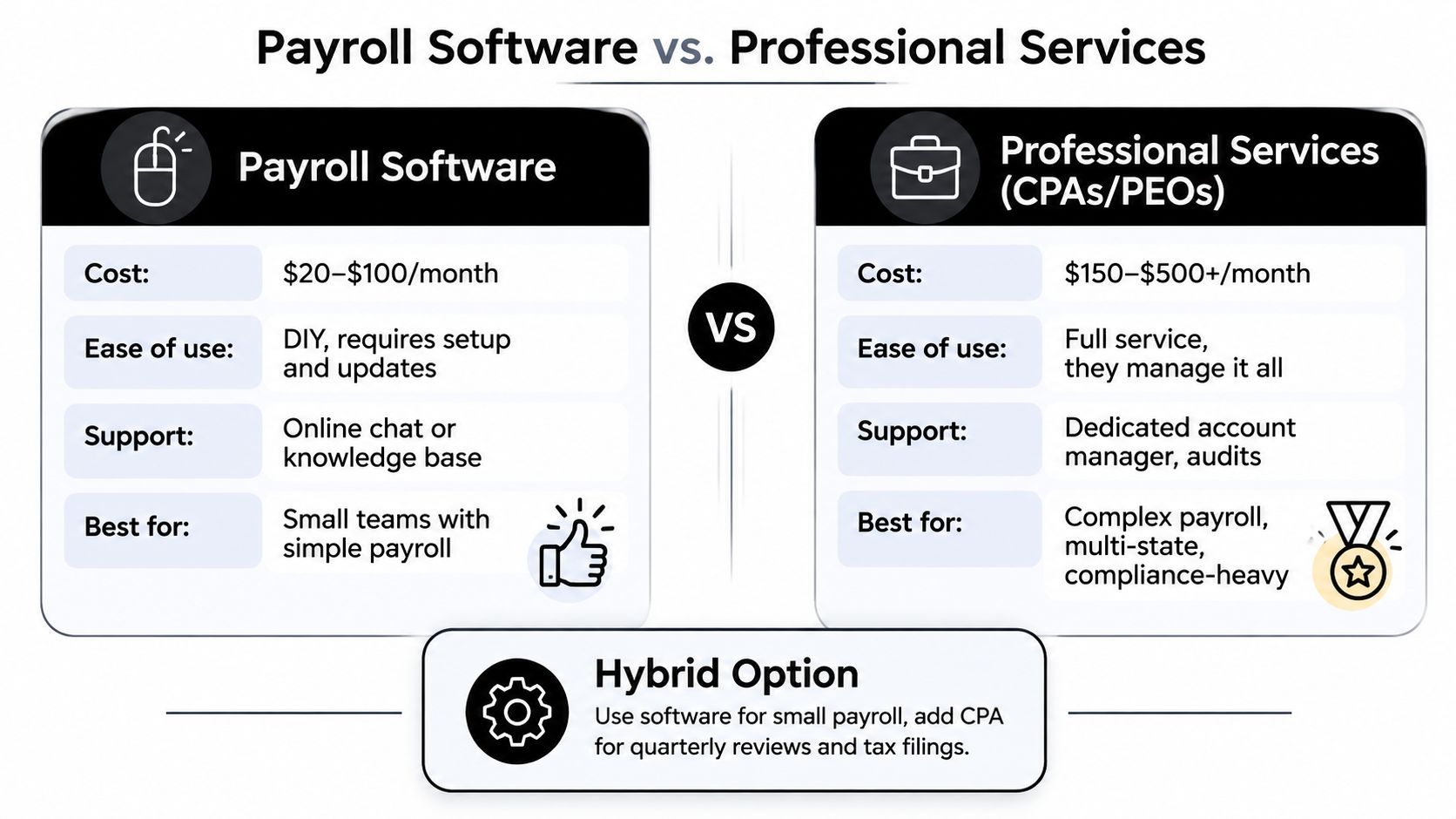
A small business owner can run payroll two ways, but the choice has to match the risk. Software works when the payroll is straightforward and someone still reviews the output. Professional help makes more sense when the structure gets messy, the cash flow gets tight, or California filings start stacking up.
Use software if the payroll is clean and the structure is simple
If you have one location, predictable wages, and no ownership complications, payroll software can do the job. It calculates pay, withholds taxes, and produces the filings without turning each payroll run into a manual project. For many owners, that is enough.
If you are comparing tools, start with Allied Tax Advisors' payroll software resource and then compare it with Cloudvara's payroll software review for small business. The right software choice is not about features on a sales page. It is about whether the system fits your filing rhythm, your state footprint, and your ability to catch errors before money leaves the account.
Use professional services when the risk starts to multiply
Once you add California employees, owner pay decisions, multiple entities, or cleanup work, DIY payroll stops being a good bet. At that point, you are not just entering wages. You are managing withholding, deposits, reporting, and the fallout if one filing is late or wrong.
A payroll service handles the mechanics. A CPA-led advisory model goes further and checks the structure behind the payroll, which is where many owners get burned. Allied Tax Advisors fits that middle ground when payroll has to stay connected to broader tax planning. The point is simple, the payroll should not sit in a vacuum while the rest of the return is handled somewhere else.
Use this filter before you choose:
- Choose software if payroll is routine, bookkeeping is current, and you are comfortable reviewing filings yourself.
- Choose a service if you want the calculations and deposits handled, but your setup is still standard.
- Choose advisory support if payroll touches ownership strategy, multiple states, California issues, or past compliance problems.
A good system lowers error risk without creating more work than it removes. If software still leaves you guessing about deposits, filings, or owner compensation, stop pretending it is saving money. That is usually when outsourcing pays for itself.
Penalties and Consequences of Payroll Tax Mistakes
Payroll tax errors are not treated like harmless admin slips. The IRS treats withheld employee taxes as trust fund money. That means the government views missed payroll tax deposits very differently from a late vendor bill.
The government cares because the money was already collected
If you withhold taxes from wages and don't remit them, you're holding money that belonged elsewhere from the start. That's why payroll tax penalties can escalate quickly and why silence makes the problem worse. The longer a business waits, the fewer clean options it has.
The most dangerous part is personal exposure. In serious cases, business owners can face personal liability for unpaid payroll taxes through the Trust Fund Recovery Penalty. That's the part many first-time owners don't believe until they're staring at notices.
IRS and state issues can stack
Federal problems do not stay federal. California can add its own penalties and collection pressure through the EDD, which means one payroll mistake can create two enforcement tracks at the same time. That overlap is what turns a bookkeeping problem into a real business problem.
Once notices start arriving, ignore them at your own risk. The government does not treat silence as confusion. It treats silence as inaction.
Direct advice: If payroll tax is already overdue, stop improvising. Get the books reconciled, the filings sorted, and a resolution path on paper before the notices multiply.
That's where resolution support matters. A clean response can limit damage, preserve cash, and get the business back into filing rhythm. A messy response usually just adds more cleanup later.
Your Payroll Tax Compliance Checklist and Next Steps
The best payroll system is the one you can run without guessing. If you want payroll tax for small business to stay manageable, start with the basics and make them essential.
Audit your setup before the next payroll
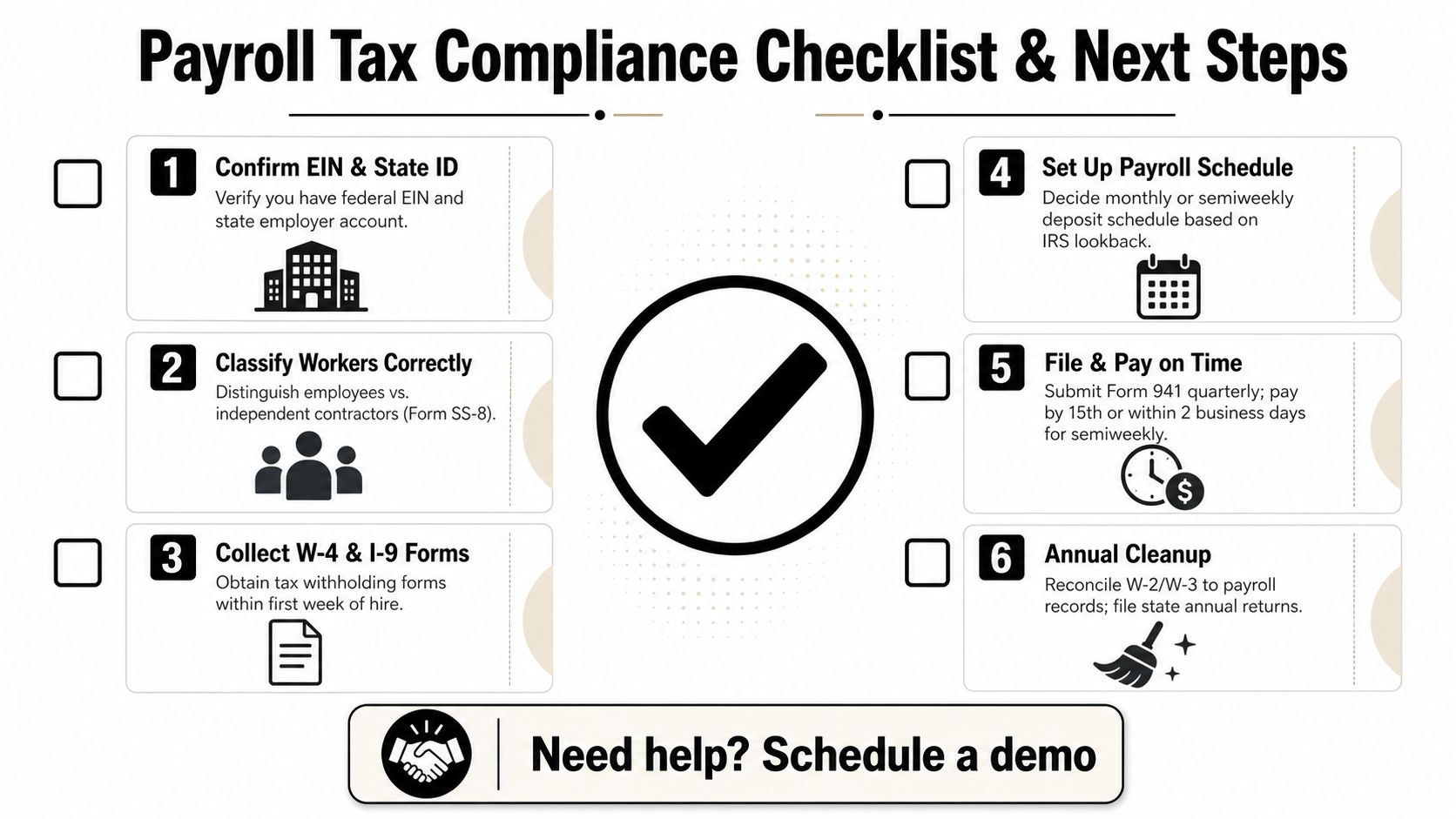
Use this as a real checklist, not a feel-good list.
- Confirm your EIN and state account setup. If you're paying employees, the federal and state employer registrations have to exist before payroll runs.
- Classify workers correctly. Employees and independent contractors are not the same thing, and the payroll system needs to reflect that from day one.
- Collect tax forms immediately. W-4 and I-9 paperwork should be on file before wages start flowing.
- Lock in the payroll schedule. Decide how often payroll will run and who reviews each cycle.
- Match deposits to the IRS schedule. Monthly or semiweekly timing has to be built into your calendar, not remembered casually.
- Reconcile quarterly and annually. Form 941, year-end wage reporting, and state filings should all tie back to your payroll records.
The qualified small business payroll tax credit for increasing research activities can also matter if your company does eligible research work. The IRS allows qualifying firms to elect up to $500,000 against payroll tax liability for tax years beginning after December 31, 2022, and the claim requires coordination of Forms 6765, 8974, and 941. If that sounds like your business, it's worth looking at before you assume payroll tax is fixed.
When to stop doing it yourself
DIY is fine until it isn't. If your payroll is getting more complex, if you're hiring across state lines, or if you've already missed filings, get help before the cleanup snowballs. That's the right time to lean on a firm that handles payroll processing, federal and state e-filings, and broader tax support together.
The cleanest next step is simple. Review your current payroll setup this week, confirm every deadline on your calendar, and decide whether software alone is still enough. If it's not, bring in support before the next payroll run, not after the notice arrives.
Allied Tax Advisors helps small businesses handle payroll processing, federal and state filings, and tax cleanup without turning compliance into a monthly fire drill. If your payroll setup feels fragile, or if you want a second set of eyes on deposits, filings, and owner compensation, visit Allied Tax Advisors and get the process checked before the next deadline hits.