
A Clairemont business owner discovers the missed Form 1120-S deadline while reviewing the books in mid-March. The bookkeeper left, a key employee departed with access to the records, and nobody confirmed that the S corporation return had been filed. The owner expects a routine catch-up filing, but the IRS measures the penalty for late filing 1120-S by shareholder count and by each month, or part of a month, that the return remains late.
The federal exposure is only one part of the problem. California can impose its own late-filing consequences, sales-tax obligations may continue through the California Department of Tax and Fee Administration, and shareholders may be unable to use pass-through income, losses, and deductions on their personal returns until the corporation files the information return and issues accurate Schedule K-1s. The Form 1120-S overview from Allied Tax Advisors is a useful starting point if you're still sorting out the corporation's filing obligations.
This is a decision problem, not a paperwork problem. The right response may be to file immediately, pay what can be paid, document reasonable cause, or pursue penalty relief after filing. The sections below separate those choices, show the federal math, explain the California overlay, and give San Diego owners a practical 60-day response plan.
Table of Contents
- The 1120-S Late Filing Nightmare San Diego Owners Face
- How the IRS Calculates the Failure-to-File Penalty on Form 1120-S
- Late Filing Versus Late Payment and Why S Corps Often Face Only One
- Real-World Penalty Calculations for Single and Multi-Shareholder S Corporations
- Extensions, Reasonable Cause, and First-Time Penalty Abatement Explained
- California FTB and San Diego Filings That Stack on Top of the IRS Charge
- What to Do in the Next 60 Days to Stop the Penalty From Growing
The 1120-S Late Filing Nightmare San Diego Owners Face
A Clairemont owner may find the missed Form 1120-S deadline during a payroll cleanup, after an office manager leaves, or when a shareholder discovers that the personal return was prepared without a complete corporate filing. The immediate red flag is simple: no accepted 1120-S and no finalized K-1 package.
That discovery starts a decision tree. If the books are ready, filing now with any available payment is usually smarter than waiting for a perfect package. An extension helps only when obtained before the deadline. It does not erase a late filing, and it does not solve missing records after the deadline has passed. If the return needs reconstruction, document who had the records, what failed, and when the problem was found. That record supports a later reasonable-cause request.
Federal exposure depends on shareholder count and how long the return remains outstanding. Section 2 explains the monthly rate and cap. The practical point here is that ownership count can make a delay materially more expensive, while the corporation may still need to file even if its pass-through structure leaves little entity-level tax.
California changes the decision. A late state return can create its own charge, and the $525 minimum for certain late Form 1120-S returns required to be filed in 2026 can make immediate filing and payment cheaper than postponing the problem. San Diego companies with a seller's permit should also check unresolved CDTFA filings or payments, which are separate from the income-tax return.
The Form 1120-S overview from Allied Tax Advisors can help owners identify the corporation's filing obligations before they choose a response.
Shareholders may lack final K-1 information for their personal returns until the corporation files. Do not wait for an IRS notice. Pull the records, estimate the federal and California exposure, file when the numbers are supportable, and then pursue reasonable-cause or first-time relief where the facts justify it.
How the IRS Calculates the Failure-to-File Penalty on Form 1120-S
The federal calculation turns on three inputs: the applicable monthly rate, the number of shareholders, and the number of late months. Use the rate for the return's due year, as outlined earlier, then count each calendar month in which any portion of the return remains late. A partial month receives the full monthly charge.
The IRS instructions for Form 1120-S explain the filing and penalty framework, including the minimum that may apply once a return is more than 60 days late.
The formula owners should use
Multiply the applicable monthly rate by the number of shareholders who held stock during any part of the tax year. Multiply that amount by the number of late months, subject to the 12-month cap.
For example, a two-shareholder corporation receives two monthly charges for every month the return remains outstanding. The ownership multiplier applies whether the shareholders worked in the business or received distributions. Stock ownership during the tax year controls.
| Calculation step | What to use |
|---|---|
| Monthly base | Applicable rate for the return's due year |
| Ownership factor | Each shareholder who held stock during the tax year |
| Late period | Every calendar month, or part of a month, after the deadline |
| Federal cap | 12 months of the per-shareholder charge |
The cap applies separately to each shareholder. A five-shareholder S corporation can therefore reach five times the one-shareholder maximum for the same filing delay. That per-shareholder math should drive a San Diego owner's response. Filing immediately may limit additional monthly charges, while waiting to perfect every record can increase the federal balance for the entire ownership group.
Why the month count matters
A return filed one day into a new month can trigger the full monthly amount for that month. The calendar controls, not the number of days late. File as soon as the figures are supportable, even if the business must later correct an error through an amended return.
The filing charge stands apart from the corporation's tax balance. If the S corporation owes entity-level tax, the IRS may assess failure-to-pay charges and interest separately. If no federal tax is due at the entity level, the shareholder-based failure-to-file charge can still apply.
That distinction affects the payment decision. If the return is ready and payment is due, filing with payment can be smarter than relying on an extension that does not replace the filing requirement or erase an existing delinquency. For California corporations, compare that federal exposure with the state filing charge, including the $525 minimum for certain late Form 1120-S returns required to be filed in 2026. The combined cost can justify filing and paying now, then requesting reasonable-cause or first-time relief when the facts support it.
Late Filing Versus Late Payment and Why S Corps Often Face Only One
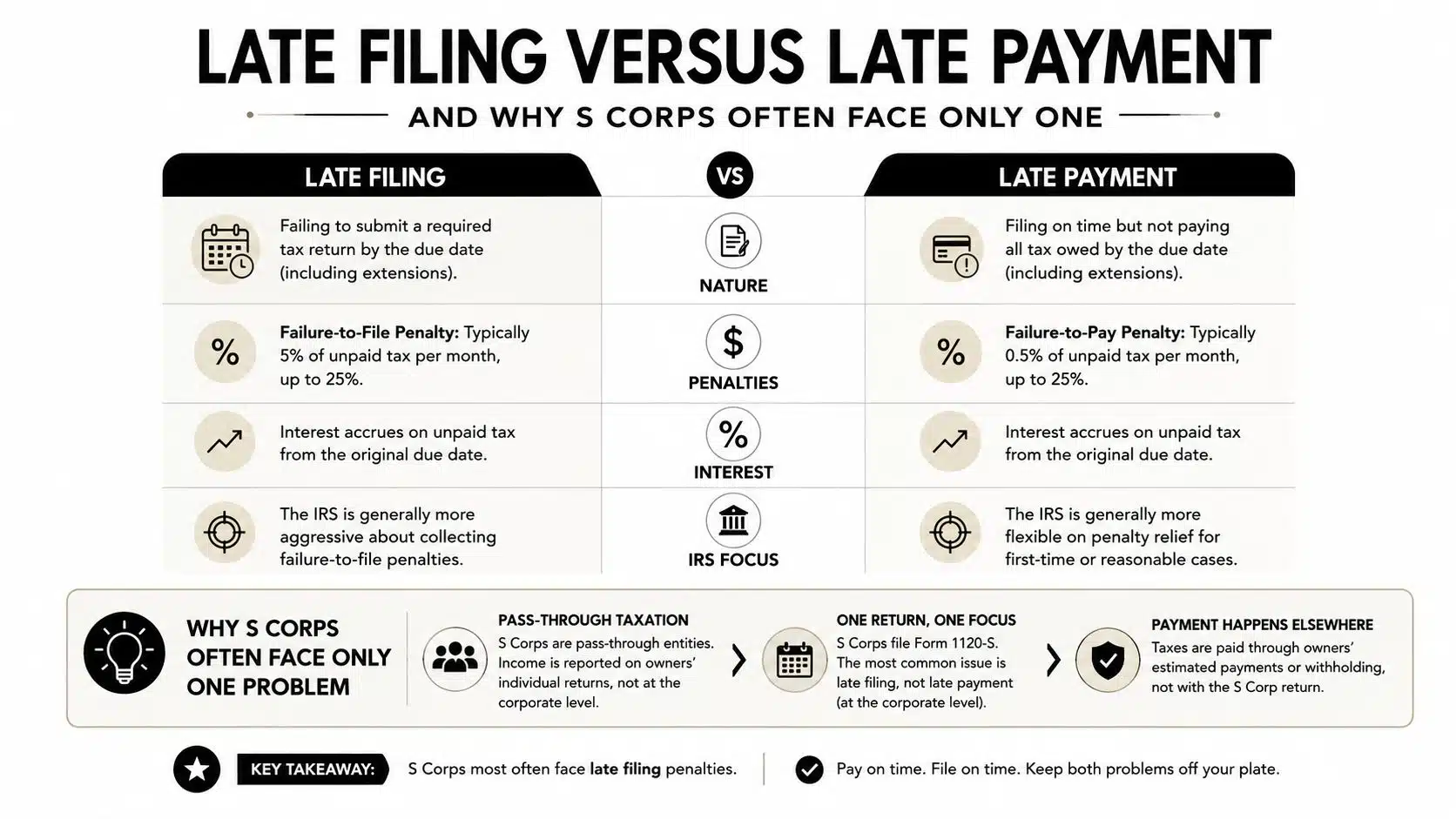
Late filing and late payment are separate compliance failures. Filing concerns whether the corporation submitted Form 1120-S by its deadline. Payment concerns whether an amount owed was paid on time. Interest is separate from both penalties and can continue until the balance is resolved.
For an S corporation, the filing penalty is tied to the number of shareholders and the months the information return remains late. A payment-related charge applies to unpaid entity-level tax. Those charges can exist together, but they address different problems. The comparative chart explaining the differences between late filing and late payment penalties for S Corps. makes that distinction easier to review with a client.
Why many S corporations have only one federal penalty
Many San Diego S corporations pass income through to shareholders instead of paying regular federal income tax at the entity level. Their primary federal exposure may therefore be the shareholder-based filing penalty, rather than a failure-to-pay charge on corporate income tax.
Shareholders can still owe tax on K-1 income. Personal returns, distributions, withholding, and estimated payments require separate review. The corporation's late information return is a different compliance event from each shareholder's personal tax balance.
The practical filing decision
Start with the return's status and the amount due. If the return is ready, filing promptly usually addresses the main federal problem. If the corporation owes tax, pay what it can while filing. Section 4 covers the full failure-to-pay calculation. Paying sooner limits the period during which payment-related additions and interest continue, but payment does not remove the filing penalty.
An extension changes the filing deadline only when properly filed. It does not extend the payment deadline or cure an already late return.
For a San Diego owner, compare the federal per-shareholder exposure with California's filing charge, including the $525 minimum for certain late Form 1120-S returns required to be filed in 2026. That state minimum can make filing now and seeking reasonable-cause or first-time relief later more practical than waiting for every record to be perfect.
Real-World Penalty Calculations for Single and Multi-Shareholder S Corporations
Use the calculation as a planning tool, not as a substitute for reviewing the actual notice. The rate depends on the return's due period, the shareholder count, and the months late. The following examples use only the IRS rates and limits described in the verified IRS materials.
Example one, a single-shareholder consultant
A Clairemont consulting corporation with one shareholder files a return due in 2024 six months late. The calculation is:
$235 × 1 shareholder × 6 months = $1,410.
At twelve months, the same return reaches $2,820, the one-shareholder maximum for that rate. If the return is more than 60 days late and the applicable minimum exceeds the calculated charge, the IRS minimum rule can control instead.
Example two, five shareholders
Consider a corporation with five shareholders and a return due after December 31, 2025. At the applicable $255 monthly rate, the business accrues:
$255 × 5 shareholders = $1,275 per month.
After three months, the calculated charge is $3,825. After twelve months, it reaches $15,300, before any separate tax-related additions. The ownership structure matters more than many owners expect. A multi-shareholder entity doesn't receive one flat corporate penalty. Each shareholder adds another monthly unit.
Example three, a return with tax due
Suppose an S corporation owes federal tax and files late. The shareholder-based failure-to-file calculation still applies. The IRS can also add 5% of unpaid tax for each month or part of a month, capped at 25% of unpaid tax, when the return and tax payment are late, as stated in the IRS guidance.
That means the owner must model two tracks:
- Filing track: applicable monthly rate multiplied by shareholders and late months, capped at twelve months.
- Tax track: 5% of unpaid tax for each late month or part of a month, capped at 25% of unpaid tax, plus applicable interest.
| Scenario | Shareholders | Base Per Month | Months Late | Penalty Before Cap | Minimum Applied | Final Penalty |
|---|---|---|---|---|---|---|
| Single owner, 2024-due return | 1 | $235 | 6 | $1,410 | Review applicable minimum | $1,410 unless a higher minimum applies |
| Five owners, return due after December 31, 2025 | 5 | $255 | 3 | $3,825 | Review applicable minimum | $3,825 unless a higher minimum applies |
| Five owners, return due after December 31, 2025 | 5 | $255 | 12 | $15,300 | Review applicable minimum | $15,300 unless a higher minimum applies |
A six-month delay for one shareholder produces $1,410 at the 2024 rate. A three-month delay for five shareholders produces $3,825 at the later rate. The shorter delay costs more because the ownership multiplier dominates the calendar.
For returns required to be filed in 2026, the IRS says the minimum penalty for a Form 1120-S more than 60 days late is the smaller of the tax due or $525. That minimum deserves a separate check in every calculation. It can matter when the formula produces a comparatively small amount, especially where tax due is limited.
Extensions, Reasonable Cause, and First-Time Penalty Abatement Explained
An extension is useful only when filed on time. Form 7004 can provide an automatic six-month filing extension, but it doesn't extend the deadline for paying tax. A corporation that extends the filing date but leaves an unpaid tax balance can still face failure-to-pay additions and interest.
That creates an important San Diego decision tree. If the original deadline hasn't passed, file Form 7004 and estimate the payment. If the deadline has passed, don't treat a late extension as a cure. Finish and submit the return, pay what the corporation can pay, and prepare a relief request if the facts support it.
Match the relief request to the facts
Reasonable cause requires facts showing that the corporation exercised ordinary business care and prudence but couldn't file on time. Typical facts can include a serious illness, a natural disaster affecting business operations, or reliance on a preparer who became unavailable or defunct. The explanation should identify what happened, when it happened, how it prevented filing, and what the corporation did after the obstacle ended.
Attach a detailed written statement to the delinquent return or submit the explanation in response to the IRS notice. Keep supporting records, such as medical documentation, disaster records, engagement correspondence, file-transfer evidence, and a timeline showing corrective action. The reasonable-cause penalty abatement guidance from Allied Tax Advisors can help owners organize that presentation.
First-time penalty abatement is different. It generally requires a clean compliance history for the prior three years, with no penalties other than estimated-tax shortfalls, and the corporation must have filed required returns and addressed any tax balance. It isn't a substitute for a factual reasonable-cause argument when the compliance history doesn't qualify.
Decision point: File immediately when the return is ready. Reserve the relief request for documented facts, not a general statement that the business was busy.
For perspective, businesses dealing with penalties in other tax systems may find the discussion of appealing HMRC penalty notices useful as a reminder that procedural deadlines and written evidence matter. The governing rules differ, so don't import an HMRC strategy into an IRS or California matter without professional review.
California FTB and San Diego Filings That Stack on Top of the IRS Charge
California doesn't cancel the federal penalty because the corporation filed a state return. The IRS and the California Franchise Tax Board administer separate filing systems, issue separate notices, and evaluate separate relief requests.
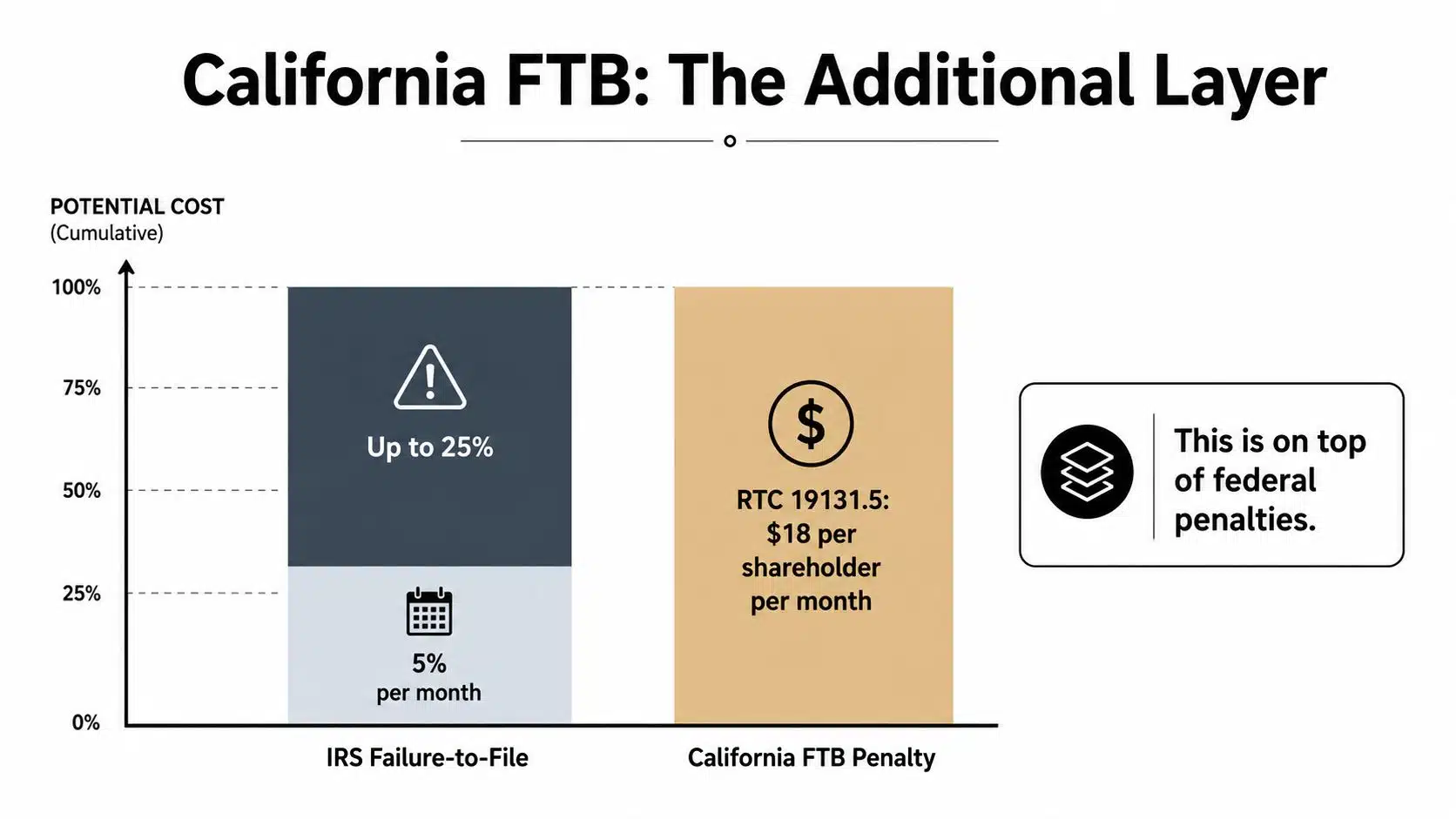
California's failure-to-file rules can add a $18 per-shareholder monthly charge, up to a 12-month cap, under Revenue and Taxation Code Section 19131.5. A $135 minimum can apply when tax is unpaid, and the corporation may also face California's $800 minimum franchise tax when the applicable conditions are met. These amounts must be confirmed against the corporation's tax year, filing status, and current FTB instructions before relying on them.
Keep the state filings separate
A California Form 100-S extension doesn't protect the federal Form 1120-S filing. The reverse is also true. Owners need a calendar that tracks the federal return, the California return, payroll filings, seller's permit filings, and shareholder personal returns independently.
A corporation selling taxable goods or services may have CDTFA reporting duties that continue even when its income-tax return is delayed. Those filings can involve sales tax collected, filing frequency, payment status, and account correspondence. Don't assume that resolving the 1120-S resolves the seller's permit account.
K-1 income can also affect an owner's personal California return. The corporation's filing, the shareholder's federal return, and the shareholder's California return should be reconciled rather than prepared from inconsistent estimates.
The combined exposure requires one workpaper
Build one schedule showing:
- Federal filing charge: shareholder count multiplied by the applicable monthly rate and late months.
- Federal tax track: unpaid tax, applicable failure-to-pay additions, and interest.
- California income-tax track: FTB filing penalties, minimums, and franchise-tax obligations.
- Sales-tax track: CDTFA returns, payments, and notices where the corporation holds a seller's permit.
- Shareholder track: corrected K-1 data and any affected personal filings.
If the federal and California balances are large enough to affect cash flow, bankruptcy and tax-discharge questions require a qualified attorney, not a guess based on an online summary. Owners can consult Morgan Morgan Attorneys at Law P for legal guidance on bankruptcy and income-tax issues.
What to Do in the Next 60 Days to Stop the Penalty From Growing
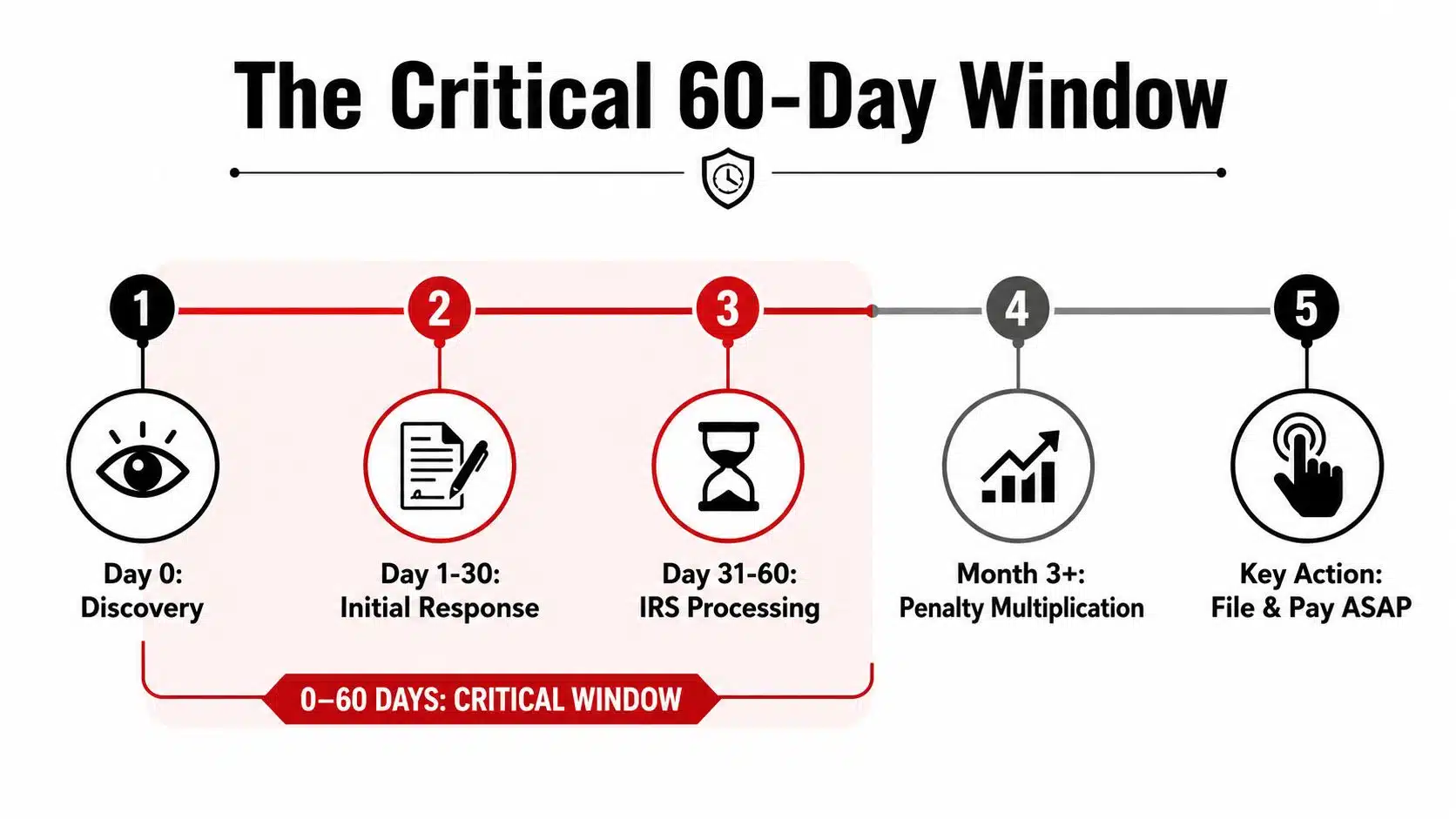
The first 60 days after discovery should be treated as an operating emergency. Each additional late month can increase the federal shareholder-based charge, and California's minimum rules can make a seemingly small delay expensive. Waiting for an IRS notice doesn't improve the facts or reduce the calculation.
Days 0 through 10
Pull the last accepted Form 1120-S, the current general ledger, bank statements, payroll reports, fixed-asset records, shareholder ledger, and prior K-1s. Confirm who held stock during the tax year. Then check whether Schedules K-2 and K-3 are required for the corporation's activities and gather the information needed to complete them.
Don't start with the penalty notice. Start with the missing return. The Form 1120-S due-date guidance from Allied Tax Advisors can help you verify the applicable federal filing calendar before deciding how to proceed.
Days 11 through 30
Prepare a late-filing timeline. If a bookkeeper left, identify the departure date and the records that became unavailable. If illness or a disaster interrupted operations, collect the supporting documentation. If a preparer failed to act, preserve engagement letters, emails, portal records, and requests for missing information.
At the same time, calculate the federal and California exposure separately. Decide whether the corporation can file accurately now and pay the balance, or whether a payment arrangement and a relief request should accompany the filing. Filing with an unsupported estimate can create a second problem if the later correction changes K-1 information.
Days 31 through 60
Submit the completed return and required K-1s as soon as the work is reliable. Pay the undisputed amount, then respond to IRS and FTB notices with a clear reconciliation. If the corporation qualifies for first-time abatement, verify the compliance history before requesting it. If the facts support reasonable cause, attach a chronological statement and evidence rather than a short apology.
Use a practitioner when shareholders, amended personal returns, payroll issues, CDTFA accounts, or multiple agency notices are involved. A representative can coordinate the federal filing, penalty-abatement request, California response, and shareholder corrections before the matter escalates into a more formal collection or examination process.
The cheapest resolution is usually the one that stops the next monthly calculation and preserves the evidence while it remains available. Allied Tax Advisors handles Form 1120-S filing, shareholder K-1 preparation, IRS and California notice response, penalty-abatement requests, and coordination of related business tax obligations. Visit Allied Tax Advisors to request help reviewing the late return and containing the federal and California exposure.