
If you’re self-employed or a small business owner, the QBI deduction is one of the most powerful tax breaks on the books. It can slash your taxable income by up to 20%, but figuring out if you qualify—and for how much—can feel like navigating a maze. That’s where a good QBI deduction calculator becomes your best friend. It crunches the numbers for you, translating the tax code’s complex rules into a clear, bottom-line figure.
Understanding the Qualified Business Income Deduction
Let's demystify this. The Qualified Business Income (QBI) deduction, also called the Section 199A deduction, is a huge win for pass-through businesses. This isn't some small credit; it’s a direct deduction from your taxable income that can be worth tens of thousands of dollars.
Think about it this way: if you're a consultant in San Diego with a $150,000 profit, the QBI deduction could potentially shield $30,000 of that income from federal taxes. The catch? The calculation is anything but simple, which is exactly why a QBI deduction calculator is practically a necessity.
Key Factors That Influence Your Deduction
The final number you can deduct isn't a one-size-fits-all formula. It’s a moving target that depends on several key variables, and a calculator helps you track them all.
Here's what really matters:
- Your Taxable Income: This is the starting line. The IRS sets income thresholds each year that determine if you get the full deduction or if limitations kick in.
- Your Business Type: The rules are different for a regular trade or business versus what’s called a "Specified Service Trade or Business" (SSTB). If you're in a field like law, health, or consulting, you're likely an SSTB and will face stricter income caps.
- W-2 Wages Paid: Once your income crosses a certain threshold, your deduction might get capped based on the W-2 wages your business pays its employees.
- Qualified Property: The deduction can also be limited by a mix of wages and the original purchase price (the "unadjusted basis") of business property you own, like equipment or real estate.
Expert Insight: I've seen countless business owners assume the QBI deduction is too complex to even bother with. The truth is, you don't need to memorize the formulas. You just need to understand the inputs. With the right tools, millions of taxpayers successfully claim this deduction every year.
The QBI deduction allows owners of sole proprietorships, S-Corps, and LLCs to deduct up to 20% of their qualified business income. A small business with $200,000 in QBI, for example, could see a $40,000 reduction in their taxable income.
The income thresholds are the real gatekeepers. For the 2026 tax year, single filers with taxable income under $203,000 (and joint filers under $406,000) can generally take the full deduction. Go over those limits, and your deduction might get capped based on either 50% of W-2 wages or a combination of 25% of wages plus 2.5% of the unadjusted basis of qualified property.
Your business structure plays a big role in all of this, and you can learn more about how that works by exploring the tax advantages of an LLC. As an interesting side note, a legislative update will introduce a $400 minimum deduction starting in 2026 for anyone with at least $1,000 in QBI. For a deeper dive into the numbers and rules, Thomson Reuters Tax & Accounting offers excellent resources.
2026 QBI Deduction Thresholds at a Glance
To give you a quick snapshot of where you might stand, here are the key income thresholds for the QBI deduction for the 2026 tax year. Find your filing status to see the limits that apply to you.
| Filing Status | Full Deduction Threshold | Phase-Out Range Ends (Non-SSTB) | Phase-Out Range Ends (SSTB) |
|---|---|---|---|
| Single & All Others | $203,000 | $253,000 | $253,000 |
| Married Filing Jointly | $406,000 | $506,000 | $506,000 |
These thresholds are the dividing line. If your taxable income is below the "Full Deduction Threshold," your calculation is relatively straightforward. If it falls within the phase-out range, the wage and property limitations will start to apply, making a calculator all the more valuable.
How the QBI Calculation Actually Works
Alright, let's pull back the curtain and look at the actual math behind the Section 199A deduction. It's not just a flat percentage—it’s a layered calculation. While a good QBI deduction calculator handles the heavy lifting, understanding what's happening in the background is key to making sure you get it right.
At its core, the calculation starts by comparing two numbers:
- 20% of your Qualified Business Income (QBI)
- 20% of your taxable income (before this deduction and minus any net capital gains)
Your potential deduction is simply the lesser of those two figures. For a lot of small business owners, especially if your income is comfortably below the IRS thresholds, that’s all there is to it.
Defining Qualified Business Income
Of course, that begs the question: what is "Qualified Business Income"? Getting this definition right is critical. QBI is the net profit your business generates here in the U.S. If you're a sole proprietor, this is usually the bottom-line profit from your Schedule C. You can get a full rundown on that form in our guide on what a Schedule C form is.
But it’s also about what doesn't count. I've seen plenty of errors from people accidentally including income that should be left out. When calculating your QBI, you have to exclude:
- W-2 wages paid to yourself as an S-Corp owner
- Guaranteed payments made to partners
- Any interest, dividend, or capital gains income
- Income generated outside the United States
This flowchart gives you a great visual for that first big decision point in the QBI journey, which is all about your taxable income.
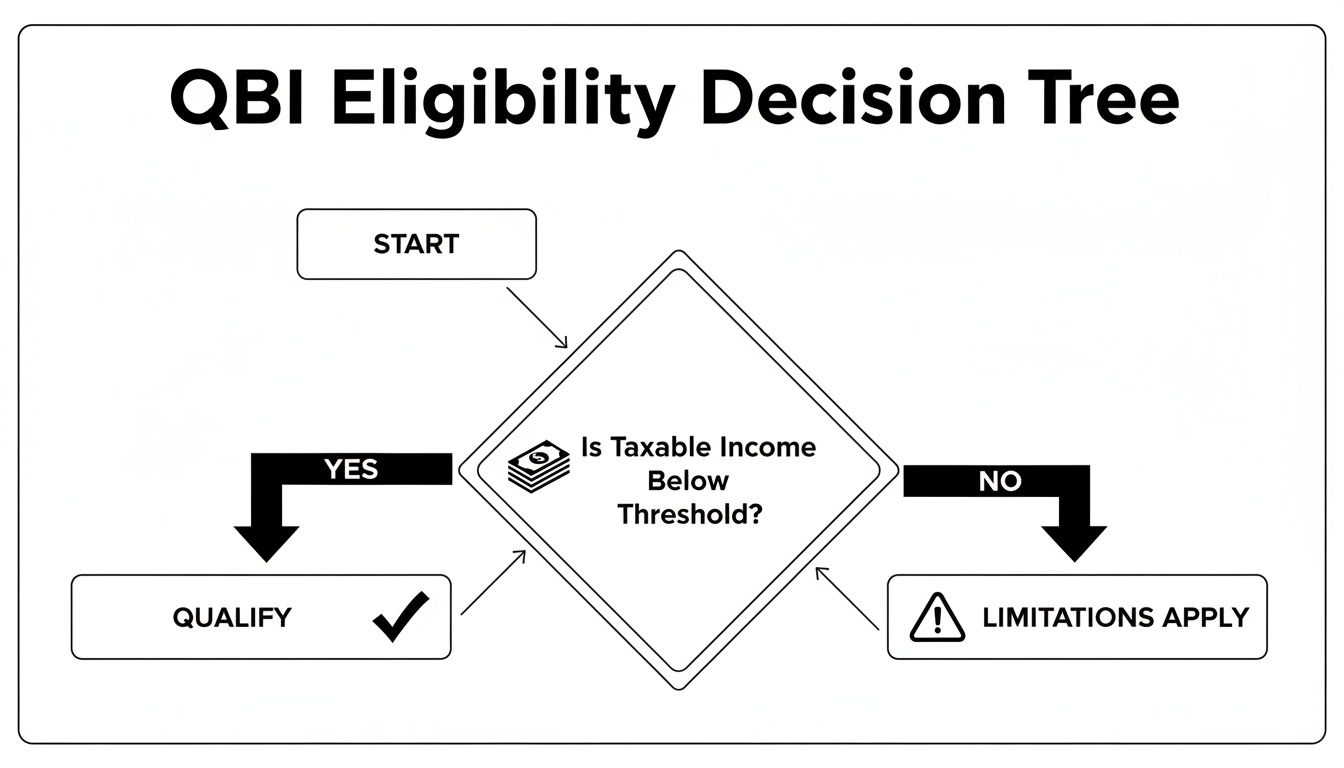
Think of your taxable income as the gatekeeper. It determines whether your calculation will be simple or if you’ll have to navigate some more complex limitations.
Simple vs. Complex Calculation Scenarios
Let's break down the three paths your calculation can take.
The Straightforward Calculation
If your taxable income is below the annual threshold, you can breathe a sigh of relief. The math is simple: you calculate 20% of your QBI and 20% of your taxable income (less capital gains), and your deduction is the smaller of the two. No extra hoops to jump through.
For example, a freelance writer with $80,000 in QBI and $70,000 in taxable income would get a $14,000 deduction. That's 20% of their taxable income, since it's the lesser amount.
The Phase-Out Predicament
Things start getting tricky if your income lands in the "phase-out" range. Here, the deduction gets chipped away based on how far your income is into that range. This is where a QBI deduction calculator really earns its keep by applying the precise reduction formula, which can be a headache to do by hand.
The High-Income Limitations
Once your income is above the phase-out range, the rules get even stricter. Your deduction gets capped by one of two tests, and you can use whichever one gives you a better result:
- The 50% W-2 Wage Test: Your deduction is limited to 50% of the total W-2 wages your business paid out.
- The UBIA + Wage Test: Your deduction is limited to 25% of W-2 wages plus 2.5% of the "unadjusted basis immediately after acquisition" (UBIA) of your qualified property.
UBIA is just the fancy term for the original purchase price of your business's tangible assets, like buildings or equipment. This second test is a real lifeline for capital-intensive businesses that might not have a huge payroll. A calculator will run both scenarios and automatically pick the one that benefits you most.
These rules are precisely why so many business owners lean on software or a tax pro. And with an estimated 94% of small businesses structured as pass-throughs, mastering this is more important than ever.
Getting a Handle on the Specified Service Trade or Business Rules
One of the biggest tripwires I see business owners encounter with the QBI deduction is the "Specified Service Trade or Business" (SSTB) classification. Getting this wrong can be costly. It’s a critical distinction that completely changes how your deduction is calculated, especially as your income climbs. This is precisely where a good QBI deduction calculator becomes non-negotiable.
So, what’s an SSTB? The IRS gets a little fuzzy here, defining it as a business where the main asset is the reputation or skill of its owners or employees. In practice, though, they have a pretty clear list of fields they’re targeting.
What Counts as an SSTB?
If your business falls into one of these categories, you're likely an SSTB:
- Health: Physicians, dentists, nurses, and veterinarians.
- Law: Attorneys, paralegals, and related legal services.
- Accounting: CPAs, enrolled agents, and tax professionals.
- Actuarial Science: The folks who analyze financial risk.
- Performing Arts: Actors, musicians, dancers, and other performers.
- Consulting: Anyone providing professional advice and counsel.
- Athletics: Professional athletes, coaches, and team managers.
- Financial Services: Includes wealth managers and investment advisors.
- Brokerage Services: Involving the buying and selling of securities or commodities.
Now, here’s a common and expensive myth: that being an SSTB means you get zero QBI deduction. That's flat-out wrong. What it really means is that you’re subject to much stricter income limits. You can still get the full deduction if your income is below the threshold, but the benefit phases out and eventually disappears much faster than it does for a non-SSTB.
My Key Takeaway: Don't assume you're disqualified just because you're an SSTB. It just means you have to be extra careful about the income phase-out rules, which kick in at a lower taxable income level.
The SSTB Phase-Out in Action
This is where the math can get a little hairy and a QBI deduction calculator proves its worth. The deduction doesn't just switch off; it's reduced proportionally once your taxable income crosses a certain line.
Let's look at a real-world example.
SSTB Example: A Physician's Deduction
Meet Dr. Evans, a physician in San Diego. She's married, files a joint return, and her medical practice (an S-Corp) is definitely an SSTB.
- Filing Status: Married Filing Jointly
- Qualified Business Income (QBI): $400,000
- Taxable Income (before QBI): $456,000
For the 2026 tax year, the SSTB phase-out for joint filers starts at a taxable income of $406,000 and is gone completely by $506,000. That's a $100,000 window.
Dr. Evans's taxable income of $456,000 falls squarely in that window, so her deduction gets haircut. Here’s how the calculation works under the hood.
First, we figure out how far she is into the phase-out range.
$456,000 (Her Taxable Income) – $406,000 (The Threshold) = $50,000
Next, we see what percentage of the total range that $50,000 represents.
$50,000 (Excess Income) ÷ $100,000 (Total Phase-Out Range) = 50%
This means Dr. Evans loses 50% of her potential deduction. She only gets to keep the other 50%.
Finally, we calculate her allowed deduction. Her full potential deduction would have been 20% of her QBI, or $80,000 (that's 20% of $400,000). But since she's halfway through the phase-out, we have to reduce that amount by half.
$80,000 (Potential Deduction) x 50% (The Allowed Percentage) = $40,000
Dr. Evans’s final QBI deduction is $40,000. It’s easy to see how someone in her position might mistakenly think they get nothing once their income crosses that $406,000 line. This precise, tiered reduction is a crucial detail that saves thousands for service professionals who know the rules.
Real-World Scenarios Using a QBI Deduction Calculator
The QBI rules can feel abstract until you apply them to real numbers. The best way to really get a feel for how the deduction works is to see it in action. Let's walk through a few common business scenarios to see how a QBI deduction calculator would handle them, from the initial inputs to the final deduction amount.

These examples cover the most frequent situations we see, making the calculator’s logic clear and easy to follow.
Scenario 1: The Freelance Graphic Designer
First up is Alex, a freelance graphic designer who operates as a sole proprietor. He’s single, has no employees, and his design work isn't considered a Specified Service Trade or Business (SSTB).
Here are the key figures for his tax year:
- Qualified Business Income (QBI): $90,000
- Taxable Income (before QBI): $75,000
- W-2 Wages Paid: $0
- UBIA of Property: $0
Because Alex's taxable income is well below the 2026 single-filer threshold, his calculation is refreshingly simple. A QBI calculator just needs to compare two numbers:
- 20% of his QBI: $90,000 x 20% = $18,000
- 20% of his Taxable Income: $75,000 x 20% = $15,000
The rule is to take the lesser of these two figures. For Alex, that means his final QBI deduction is $15,000. The complex wage and property limitations don't come into play at all since his income is below the statutory threshold.
Scenario 2: The S-Corp Marketing Agency
Now, let's look at a slightly more complex case. Maria owns a marketing agency structured as an S-Corporation and files a joint return with her spouse. Her business has employees, and their combined income puts her squarely in the phase-out range.
Here are the inputs for her QBI calculation:
- Qualified Business Income (QBI): $300,000
- Taxable Income (before QBI): $456,000
- W-2 Wages Paid by Business: $150,000
- UBIA of Property: $20,000
With a taxable income in the 2026 phase-out range for joint filers ($406,000 to $506,000), her deduction is no longer a simple 20% calculation. The wage and property limitations begin to apply. Her income is $50,000 into the $100,000 phase-out range, so the limitations are phased in at 50%.
The calculator first determines her potential deduction and then checks it against the wage/property limit.
- Initial Deduction (20% of QBI): $300,000 x 20% = $60,000
- W-2 Wage Limit (50% of wages): $150,000 x 50% = $75,000
Her initial deduction of $60,000 is already less than her wage limit of $75,000, so the limitation doesn't reduce her deduction. Maria's final QBI deduction is $60,000. It's easy to see how a lower payroll would have hurt her here—if her wages were only $100,000, the limit would have been $50,000, capping her deduction at that amount.
Key Takeaway: For business owners in the phase-out range, having sufficient W-2 wages becomes critical. A calculator helps model how increasing payroll could directly increase your deduction.
Scenario 3: The Real Estate Investor
Finally, let's analyze David, a high-income real estate investor filing a joint return. His portfolio of rental properties has been aggregated to qualify as a trade or business. While he has no employees, the value of his property is substantial.
Here are his financials:
- Qualified Business Income (QBI): $400,000
- Taxable Income (before QBI): $600,000
- W-2 Wages Paid: $0
- UBIA of Qualified Property: $2,000,000
David's income is well above the phase-out threshold, which means the limitations apply in full. This is a classic scenario for real estate professionals. With zero W-2 wages, the first test (50% of wages) would completely wipe out his deduction.
This is where the second test, based on property, becomes a lifeline. A QBI calculator runs both limitation formulas:
- Test 1 (50% of Wages): $0 x 50% = $0
- Test 2 (25% Wages + 2.5% UBIA): ($0 x 25%) + ($2,000,000 x 2.5%) = $50,000
The calculator takes the greater of the two limits, which is $50,000. David’s potential deduction was $80,000 (20% of his $400,000 QBI), but the limitation caps it at $50,000.
To put it all together, here is a table comparing the inputs and final deduction for each scenario.
QBI Calculation Example Walkthrough
| Scenario | QBI | Taxable Income | W-2 Wages | UBIA of Property | Calculated QBI Deduction |
|---|---|---|---|---|---|
| 1. Freelancer | $90,000 | $75,000 | $0 | $0 | $15,000 |
| 2. S-Corp | $300,000 | $456,000 | $150,000 | $20,000 | $60,000 |
| 3. Real Estate | $400,000 | $600,000 | $0 | $2,000,000 | $50,000 |
This side-by-side comparison highlights just how much the final deduction can swing based on income levels, business type, wages, and property investments.
Since its introduction, the QBI deduction has reshaped tax planning for over 25 million pass-through entities. As these examples show, the rules are layered and full of nuance. In our experience at Allied Tax Advisors, applying these rules precisely often uncovers 15-20% in tax reductions for clients. Given that pass-throughs represent 95% of U.S. businesses, using a precise QBI deduction calculator isn't just helpful—it's essential. You can find more official guidance and details on the IRS website.
Strategic Planning to Maximize Your QBI Deduction
A QBI deduction calculator is great for getting a snapshot of where you stand today. But its real value isn't in looking backward—it’s in planning forward. This is where you shift from simply reacting to your tax bill to proactively shaping it for the better.
It all starts with your business structure. Are you a sole proprietorship? An S-Corp? The choice has massive implications for your Section 199A deduction. For instance, S-Corporation owners have to pay themselves a "reasonable salary," which doesn't count as QBI. But that very same salary becomes a critical factor if your income pushes you past the deduction's thresholds.

It's a delicate balancing act between salary and profit distributions. We get a lot of questions about this, which is why we put together a detailed guide on what the IRS considers a reasonable salary for an S-Corp owner. Nailing this is a cornerstone of smart QBI planning.
Optimizing Wages and Property for High Earners
Once your taxable income climbs above the phase-out thresholds, the QBI game changes completely. Your deduction is now capped by either your W-2 wages or the value of your business property. This might sound like a limitation, but I see it as an opportunity—it gives you two clear levers to pull.
Here’s where you can really move the needle:
Boost Your Payroll: If your deduction is getting slashed by the 50% W-2 wage limit, increasing payroll can pay for itself in tax savings. This could mean hiring that new employee you've been considering or adjusting salaries for your team (including your own S-Corp salary, within reason).
Invest in Qualified Property: The other option is a test based on 2.5% of the unadjusted basis immediately after acquisition (UBIA) of your qualified business property. Big-ticket purchases—a new facility, upgraded machinery, or a fleet of vehicles—directly increase this limitation, creating more room for your deduction to grow.
I recently worked with a manufacturing client whose income was well over the QBI limits, and their small payroll was handcuffing their deduction. We mapped out a plan for them to purchase $500,000 in new equipment. That single move added $12,500 ($500,000 x 2.5%) to their QBI limitation base, directly boosting their final deduction.
Of course, making these strategic moves depends on having clean numbers. Year-round discipline in organizing deductible expenses is non-negotiable if you want to plan effectively.
The Power of Aggregating Businesses
Do you own more than one business? If you're calculating the QBI deduction for each one separately, you might be leaving serious money on the table. The IRS gives you the option to formally "aggregate," or group, your businesses for the QBI calculation.
This is one of the most powerful—and often overlooked—strategies out there. It's perfect for a situation where you have one company with high profit but low wages, and another with modest profit but high wages or property. By combining them, you can use the wages and property from one to support the QBI from the other.
To make this work, your businesses have to be related in specific ways:
- The same person or group must own 50% or more of each business being grouped.
- They must have a certain level of integration, like offering related services, sharing a central office, or operating in a coordinated way.
Aggregation is an advanced move, but it’s a perfect example of how thinking beyond a single tax form can lead to substantial savings. It allows you to calculate the deduction based on your entire enterprise, not just its individual parts.
Frequently Asked Questions About the QBI Deduction
Once you get a handle on the basics of the QBI deduction, the real questions start popping up. It's in these details where your final tax bill can swing dramatically. Let's walk through some of the most common gray areas I help business owners navigate. Even the best QBI deduction calculator needs you to get these answers right first.
Does Rental Real Estate Income Qualify for QBI?
This is a big one, and the honest answer is, "it depends." Just collecting a rent check from a hands-off, triple-net lease property probably isn't going to get you the deduction. For your rental income to qualify, the IRS needs to see it as a real trade or business, not just a passive investment.
Thankfully, the IRS gave us a roadmap with Revenue Procedure 2019-38. This created a safe harbor for rental real estate, meaning if you check all the boxes, your rental activity is automatically treated as a business for QBI purposes.
Here’s what you need to do:
- Keep Separate Books: You have to maintain individual books and records for each rental property or enterprise.
- Hit Your Hours: A minimum of 250 hours of rental services must be performed each year. This isn't just repair work; it includes advertising vacancies, screening tenants, collecting rent, and managing the property.
- Log Everything: You must keep contemporaneous records—a fancy way of saying you need to log your activities as they happen. This means tracking hours, what was done, and when it was done.
Expert Tip: That 250-hour rule is no joke. I always tell my clients to open a simple spreadsheet or download a time-tracking app on January 1st. Log every call, every email, every trip to the property. Trying to "estimate" your time at the end of the year is a red flag for the IRS.
Even if you fall short of the safe harbor requirements, all is not lost. You might still qualify as a trade or business based on your specific facts and circumstances. If you are regularly and continuously involved in managing your properties, you could still be eligible.
How Does QBI Work for Cryptocurrency Investors?
The world of crypto brings its own set of rules. Whether your crypto gains can get the QBI deduction comes down to one critical distinction: are you an investor or a trader?
A typical buy-and-hold investor is not running a trade or business. Their profits are from long-term price appreciation, and those capital gains simply don't qualify as QBI. It’s no different than holding a stock for a few years.
An active trader, on the other hand, might have a shot. If you are trading frequently and consistently, trying to profit from the market’s short-term swings, the IRS may view your activity as a business. If you clear that high bar, your net trading profits could be considered qualified business income, opening the door for that 20% deduction. This is a tricky classification to make, so getting professional guidance is always a good idea.
What Are the Most Common QBI Calculation Mistakes?
The Section 199A rules are full of landmines. A QBI deduction calculator is a powerful tool, but it's only as accurate as the numbers you put into it. One small mistake can throw off your entire calculation.
From my experience, here are the errors that pop up most often:
- Misclassifying Your Business: Getting the SSTB designation wrong is a huge one. Incorrectly claiming you're not a Specified Service Trade or Business when you are (or vice versa) can completely invalidate your deduction.
- Counting S-Corp Owner Salaries: I see this all the time. An S-Corp owner includes the W-2 salary they pay themselves in their QBI calculation. That salary is specifically excluded from qualified business income.
- Forgetting the Final Limit: The QBI deduction can’t be more than 20% of your taxable income (minus net capital gains). People often calculate 20% of their QBI and forget to apply this final, crucial limitation.
- Not Claiming It at All: Honestly, the biggest mistake is being so intimidated by the rules that you don't even try. I've seen business owners leave thousands of dollars on the table because they assumed they wouldn't qualify.
Navigating the QBI deduction requires precision and a real-world understanding of how tax laws apply to your specific business. At Allied Tax Advisors, our team of CPAs and enrolled agents specializes in turning these complex rules into actionable savings strategies for individuals and businesses in San Diego and beyond. Don't leave money on the table—let us help you optimize your tax situation. Explore our comprehensive tax services and schedule a consultation today.