
You renovated your space because you had to. The dining room looked dated. The office layout no longer worked. The tenant turnover left you with tired flooring, bad lighting, and plumbing that needed attention. In San Diego, that's everyday business reality.
What most owners miss is this: a lot of that interior renovation spend may be qualified improvement property, and the tax treatment can be far better than they expect. If you paid for interior work on a commercial building or a qualifying rental setup, you may have a current deduction opportunity and, in many cases, a retroactive catch-up opportunity if those costs were shoved into a long depreciation schedule by mistake.
That matters right now. Plenty of local owners spent heavily on tenant improvements, retail refreshes, office remodels, and short-term rental upgrades, then let those costs sit on the books the wrong way. If that's you, don't assume the window closed. It may not have.
Table of Contents
- Your San Diego Renovation Is a Tax Goldmine
- What Is Qualified Improvement Property
- The Legislative Rollercoaster Why QIP Is a Hot Topic Now
- Maximizing Your Deduction Federal Tax Treatments of QIP
- From Plan to Paperwork How to Claim QIP Deductions
- QIP Planning and Pitfalls for San Diego Businesses
- Putting Your QIP Strategy into Action
Your San Diego Renovation Is a Tax Goldmine
A North Park café replaces flooring, lighting, counters, and interior plumbing. A Clairemont medical office reworks exam rooms and adds interior walls. A landlord in La Jolla upgrades a former tenant space with new ceilings, electrical, and finishes before signing the next occupant. Most owners book those costs, move on, and hope the tax return takes care of itself.
That's where money gets left on the table.

A lot of interior renovation work isn't just “building depreciation.” It may qualify for much faster cost recovery, and in the right fact pattern, the federal deduction can be immediate. If you've also been weighing whether upgrades make financial sense before you spend, it helps to understand kitchen remodel returns and apply the same ROI mindset to tenant improvements, office renovations, and hospitality interiors.
Real projects often hide tax value
The owners I worry about most are the ones who already finished their remodel. They assume the decision is old news because the contractor is paid and the return is filed. That's the wrong mindset.
If you renovated interior space in recent years, especially commercial interiors, there's a good chance your books contain assets that deserve a closer look. Flooring, lighting, drywall, ceilings, interior plumbing, and similar work can create a much better federal outcome than many businesses received on the original return.
Practical rule: If you improved the inside of an existing commercial building, don't assume your CPA software classified it correctly.
San Diego owners have more complexity, not less
Local businesses and landlords also face a second issue. Federal tax treatment may be favorable while California treatment is not. That means the same renovation can create one set of deductions for federal purposes and a different schedule for the state return.
That mismatch is annoying, but it's not a reason to ignore QIP. It's a reason to handle it properly.
What Is Qualified Improvement Property
Qualified improvement property is defined in 26 USC § 168(e)(6) as an improvement to the interior portion of a nonresidential building that is placed in service after the building was first placed in service. The same rule explicitly excludes building enlargement, elevators or escalators, and internal structural framework modifications.
That statutory definition sounds technical, but the practical test is simple. Ask whether you improved the inside of an existing commercial building or whether you changed the building's skeleton or footprint. Interior function and finish may qualify. Structural surgery usually doesn't.
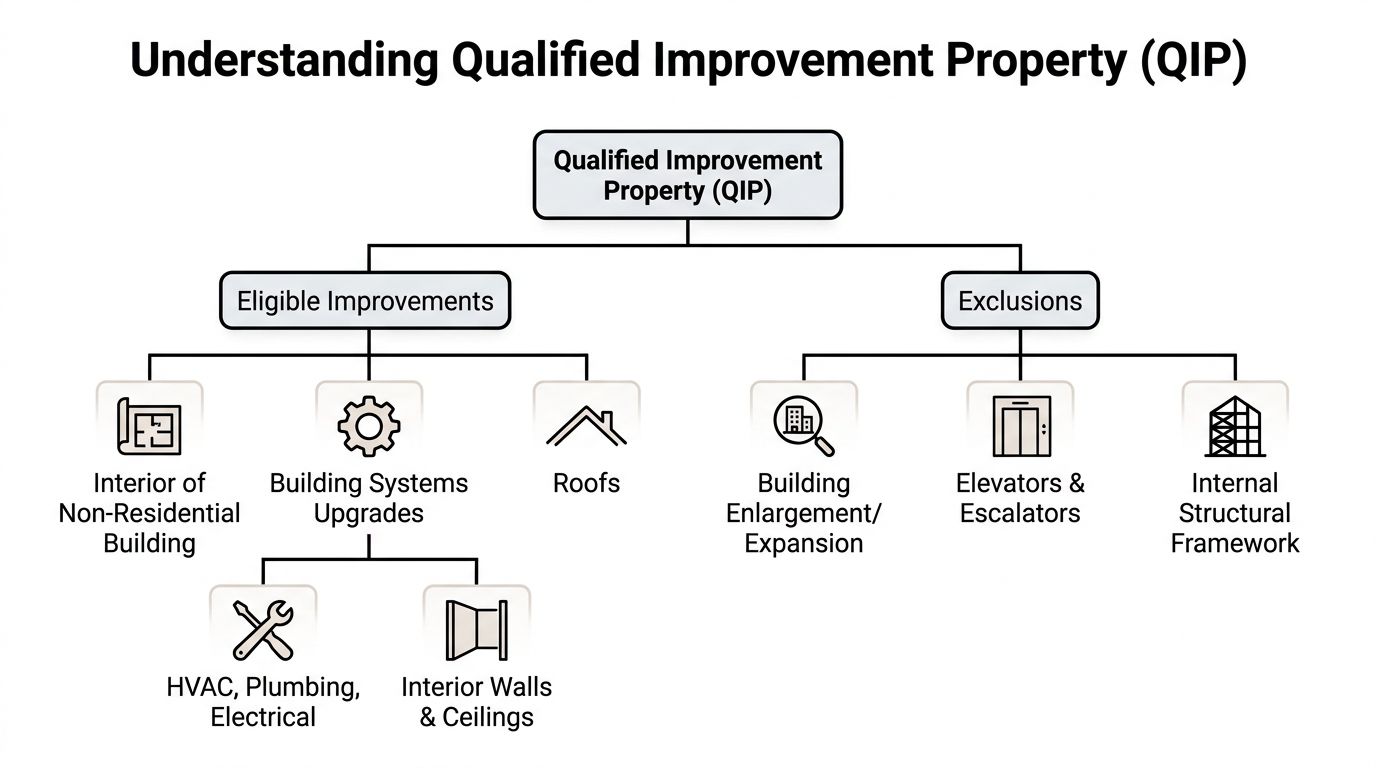
Think interior upgrades, not structural work
If you lease or own office, retail, industrial, or hospitality space, think of QIP as the bucket for interior improvements made after the building already existed and was already in service. It's often part of a tenant improvement project or a remodel done to refresh operations.
That's why QIP comes up so often with restaurants, dental offices, salons, professional suites, warehouses with finished office areas, and multi-tenant commercial properties. Owners spend real money making interiors usable, attractive, and code-compliant. The tax law treats some of that work better than many expect.
What usually qualifies and what does not
Here's the practical screen I use first.
- Interior walls and partitions: Nonstructural interior buildout work often belongs in the QIP discussion.
- Lighting and ceilings: New fixtures, drop ceilings, and related interior finish upgrades are commonly part of qualifying costs.
- Flooring and interior finishes: Replacing worn-out commercial interiors is exactly the kind of project that often triggers QIP analysis.
- Interior plumbing and electrical tied to the remodel: If the work supports the interior improvement, it may belong in the QIP bucket.
Now the exclusions. These are where owners and contractors blur the lines.
- Building expansion: If you enlarged the building, that part is out.
- Elevators and escalators: The statute excludes them directly.
- Internal structural framework: If you changed load-bearing or core structural elements, don't call it QIP.
- Work done before the building was originally in service: Initial construction is not QIP.
Owners get into trouble when one invoice mixes qualifying interior work with nonqualifying structural or expansion work and nobody separates the costs.
That's why project accounting matters. A clean contractor breakdown can preserve a strong deduction. A messy lump-sum invoice can weaken it.
The Legislative Rollercoaster Why QIP Is a Hot Topic Now
QIP is a hot topic because Congress made a mess of it, then fixed it, and that fix created a look-back opportunity that many taxpayers still haven't used.
The key fact is this: the CARES Act in 2020 retroactively corrected a drafting error in the 2017 TCJA, reclassifying QIP from a 39-year to a 15-year recovery period for assets placed in service after December 31, 2017, which restored eligibility for 100% bonus depreciation for 2018 and 2019 returns, as explained in this EisnerAmper summary.
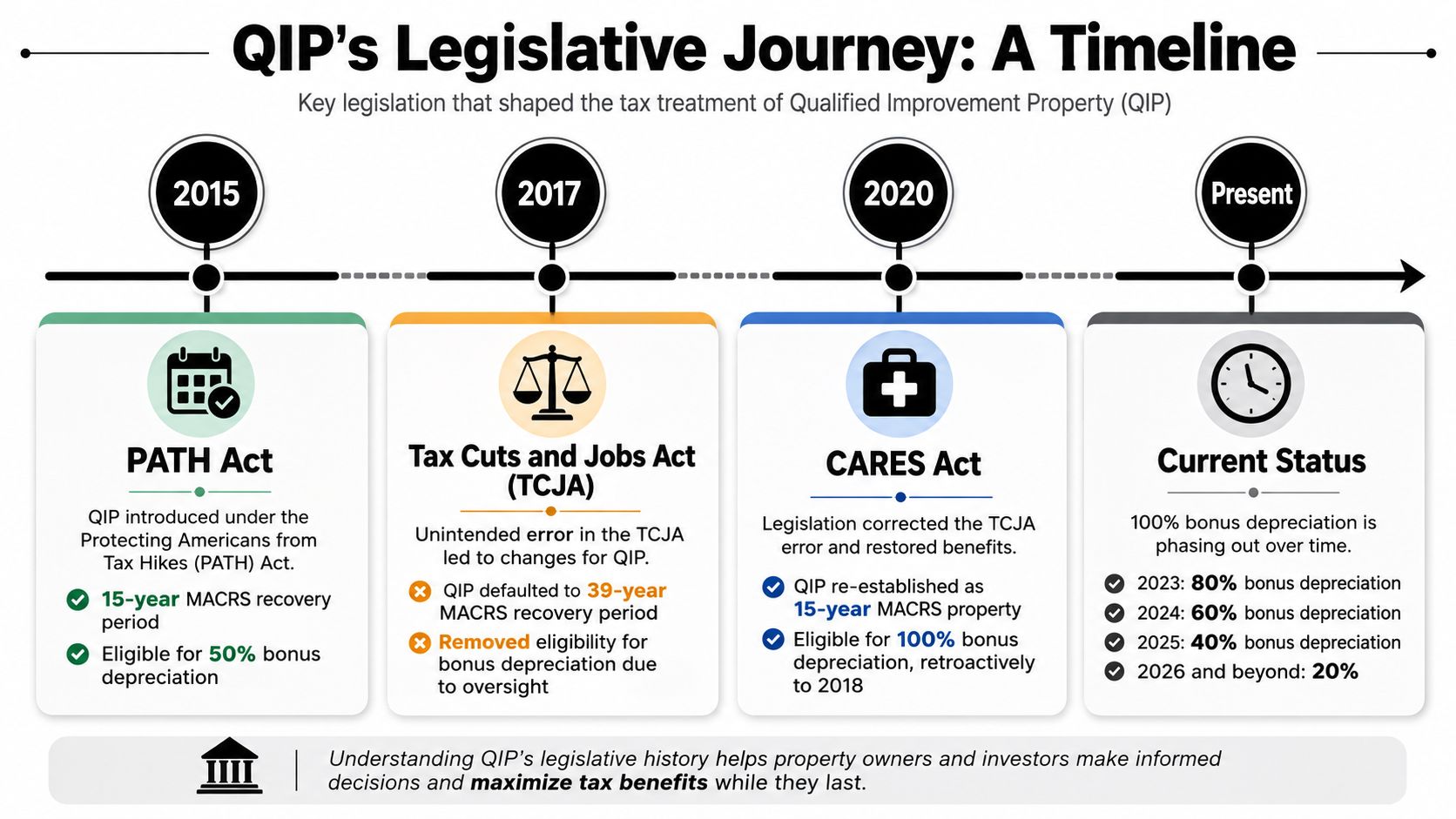
The mistake that created the opportunity
The original intent behind tax reform was favorable treatment for these kinds of improvements. But the drafting error knocked QIP into a long-life category, which blocked the accelerated benefit many owners expected. So businesses renovated interiors, filed returns, and often depreciated those assets far too slowly.
Then the CARES Act fixed the classification retroactively.
That retroactive fix is the whole story. It means the issue isn't limited to current-year planning. It reaches back to assets placed in service after the end of 2017. If your return treated interior improvements as long-life building property because of that error, you may still be able to recover the missed deduction.
Why this still matters today
A lot of business owners assume old returns are untouchable unless they amend everything. That assumption stops people from pursuing money they should have claimed years ago.
The better approach is to review renovation schedules from prior years, identify interior improvement costs that belong in the QIP category, and determine whether there's a procedural path to catch up the missed deduction. For many owners, there is.
As of January 20, 2025, QIP placed in service qualifies for 100% bonus depreciation with no scheduled expiration under the One Big Beautiful Bill Act, and the previous phase-down schedule no longer applies, according to Bloomberg Tax's QIP analysis. That gives current projects more certainty than businesses had during the phase-down years.
The legislative history matters because it explains why so many perfectly ordinary remodels were reported the wrong way.
If you renovated from 2018 forward and nobody revisited those fixed asset schedules, this topic deserves attention.
Maximizing Your Deduction Federal Tax Treatments of QIP
Once you've identified qualified improvement property, the next question is how you want it deducted for federal tax purposes. There are three main treatments to evaluate, and they are not equal.
For the 2026 tax year, QIP qualifies for 100% bonus depreciation under federal rules for assets placed in service after January 19, 2025. If you don't elect bonus depreciation or Section 179, QIP must be depreciated over 15 years using the straight-line method. The Section 179 expensing limit for 2026 is $1,220,000 and applies across all Section 179 property combined, including QIP, as summarized in this QIP deduction guide.
Three ways QIP gets deducted
Bonus depreciation is usually the most aggressive option. If the property qualifies and you don't elect out, this approach can allow a full first-year deduction for the depreciable basis.
Section 179 can also accelerate deduction, but it's a different tool. It has its own limitations, it applies across a broader bucket of eligible assets, and you don't get a separate cap just because the spend was QIP.
Standard 15-year depreciation is the fallback. If you don't use bonus and don't use Section 179, you recover the cost over time instead of immediately.
There's also an important ownership rule buried in the details. A prior tenant's improvements generally don't become your bonus depreciation or Section 179 opportunity just because you bought the building. The current taxpayer must have made the improvement after that taxpayer's own placed-in-service date to claim the accelerated treatment.
A simple comparison
Below is the cleanest way to think about it.
| Method | Year 1 Deduction | Key Considerations |
|---|---|---|
| Bonus depreciation | $100,000 | Best when the goal is immediate federal write-off and the property qualifies |
| Section 179 | Up to $100,000, subject to overall limits | Shares the $1,220,000 2026 cap with other Section 179 property and needs coordination across all purchases |
| 15-year straight-line depreciation | Spread over time | Default method if bonus and Section 179 are not elected |
If you want a broader primer on timing and elections, review how bonus depreciation works before making the call.
My recommendation in most cases
Most clients care about one thing first. Cash flow. On the federal side, immediate deduction is usually the strongest answer when the business can use it and the property clearly qualifies.
That doesn't mean bonus depreciation is automatic in every file. You still need clean classification, accurate placed-in-service dates, and good records. You also need to think about the owner-level effect if the business is a pass-through entity.
Use Section 179 when it fits a larger equipment and improvement strategy. Don't use it by habit. The shared annual limit means you can waste planning flexibility if you burn that capacity carelessly on one category of property.
Decision test: If the improvement qualifies for full federal expensing and you want the deduction now, bonus depreciation is usually the first option to evaluate, not the last.
The default 15-year method is fine when there's a reason to slow deductions, but that should be a deliberate tax planning choice. It shouldn't happen because nobody looked closely at the asset schedule.
From Plan to Paperwork How to Claim QIP Deductions
The tax benefit only matters if the paperwork matches the facts. That's where many projects fail. The contractor did the work, the owner paid the bill, but the final accounting posted everything into one vague “leasehold improvements” account and nobody sorted out what qualifies.
For current-year projects, the compliance path is straightforward. For older projects, the opportunity is often bigger because you may be fixing a costly mistake.
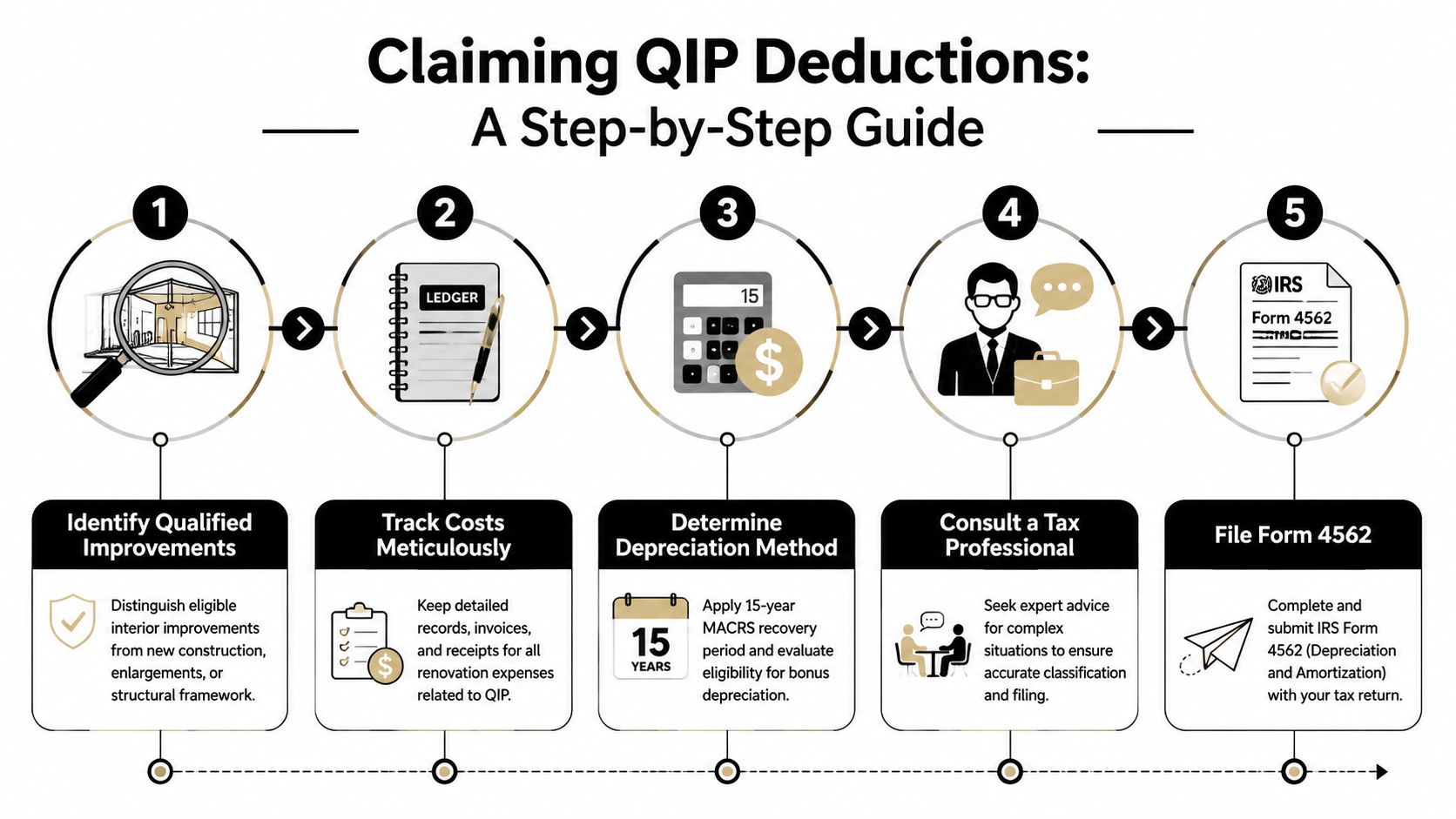
Start with the cost breakdown
Before you touch any tax form, separate the project into categories.
- Identify interior improvements clearly. Flooring, ceilings, interior walls, lighting, and similar items should not be buried with expansion or structural work.
- Pull contracts, change orders, and invoices. You need support for what was done and when it was placed in service.
- Split qualifying from nonqualifying costs. If a remodel included both interior buildout and building enlargement, those should not sit in one undifferentiated total.
- Review permits and design fees. The federal depreciable basis can include labor, materials, permits, and design fees when the costs belong to the qualifying improvement.
- Consider whether a cost segregation study helps. On larger or more complex projects, that extra layer of analysis can improve classification and support.
If the books are messy, fix that first. Tax reporting gets easier when the accounting reflects the actual scope of work.
How the forms usually work
For new improvements placed in service in the current year, the deduction is commonly reported through Form 4562, the depreciation and amortization form attached to the return. That's where the chosen treatment gets reflected.
If you need a basic refresher on mechanics, this guide on how to calculate depreciation is a useful starting point.
For many businesses, the hard part is not the form itself. It's deciding what belongs on it, how assets should be grouped, and whether the project was placed in service on the date management assumes.
Why Form 3115 is the missed opportunity
Here's the part many San Diego owners have never been told. If QIP was incorrectly depreciated as 39-year property from 2018 through 2024, many taxpayers can file Form 3115, Application for Change in Accounting Method, to claim missed 100% bonus depreciation retroactively to January 1, 2018, without amending prior returns, as explained in this Form 3115 QIP discussion.
That's a major planning opportunity.
You do not want to guess your way through Form 3115. The procedural rules matter, the asset history matters, and the support for the change matters. But owners who assume “old return means lost deduction” are often wrong.
Review every interior remodel placed in service from 2018 forward before you file another return. That review can uncover deductions your business already paid for but never claimed correctly.
If you own commercial property, operate from leased space, or manage tenant improvements, this is one of the first fixed-asset reviews worth doing.
QIP Planning and Pitfalls for San Diego Businesses
Federal QIP planning can be excellent. California can still ruin the simplicity.
That's the first trap. Business owners hear “full federal write-off” and assume the state follows along. It often doesn't. So if you're running a San Diego business or holding local rental property, you need to expect separate treatment and separate tracking. If your books don't support that, your return prep becomes sloppy fast.
California does not follow the federal playbook
For California filers, the practical issue is state non-conformity. You may have a strong federal result and a very different California depreciation schedule for the same renovation. That means your fixed asset detail needs to be clean enough to support both.
Don't let your bookkeeper dump everything into one generic depreciation account and call it good. That shortcut creates confusion later when the state return needs a different answer.
A targeted cost segregation study for tax savings can also help clarify which costs belong in which category, especially when a project mixes interior improvements with other building work.
Short-term rentals can lose QIP treatment fast
Short-term rental owners in beach markets like Pacific Beach and Mission Beach need to be especially careful. A critical nuance is that the property must be established as nonresidential by having actual guest occupancy before major renovations begin. Taking the property offline for upgrades before establishing that use can disqualify the project from QIP treatment, as discussed in this short-term rental QIP overview.
That's a brutal result because many owners assume “rental equals commercial enough.” It doesn't work that way.
If you bought a property, planned a renovation, and never established the rental's qualifying use first, stop and review the facts before claiming QIP treatment. This is one of the easiest ways for local investors to overstate deductions.
Entity issues owners overlook
S corporation and LLC owners have another layer to manage. The deduction may flow through to the owners, but that doesn't mean the cash tax effect is automatic. Basis, passive activity limits, and the owner's overall return still matter.
That's why entity-level bookkeeping and owner-level planning need to line up. If they don't, you can have a valid depreciation deduction in the business and still fail to get the result you expected on the personal return.
Putting Your QIP Strategy into Action
Qualified improvement property is one of the better tax opportunities available to businesses and commercial property owners who spend money improving interiors. It's also one of the most mishandled.
If you renovated interior commercial space, review the asset schedule. If you filed returns after interior improvements were placed in service, check whether those costs were trapped in the wrong recovery period. If you're a landlord with a short-term rental angle or a California filing requirement, verify the classification before claiming anything.
Most of all, don't ignore the retroactive angle. A current-year return is not the only place tax savings show up. Older renovation costs may still produce meaningful deductions if they were handled the wrong way the first time.
If you want a second look at prior renovations, current fixed-asset schedules, or California-federal differences, talk with Allied Tax Advisors. We help San Diego business owners and landlords sort out qualified improvement property, Form 3115 opportunities, rental-property classification issues, and the recordkeeping needed to claim deductions correctly.