
You invoice a client, the payment hits your account, and then it dawns on you: nobody withheld taxes from that money. That's the moment quarterly estimates stop feeling like abstract tax jargon and start feeling very real.
Most new self-employed clients don't struggle because the rules are impossible. They struggle because most explanations stop at “divide by four” and ignore what real income looks like. Freelancers have slow months and big launch months. Rental owners have repairs, vacancies, and seasonal spikes. Crypto investors may have little taxable activity for most of the year and then one major gain late in the year. A quarterly tax payment calculator is useful, but only if you understand what it's calculating and when the simple version stops working.
Table of Contents
- Who Needs to Pay Quarterly Estimated Taxes
- Gathering Your Financial Data for the Calculation
- How to Calculate Your Estimated Tax Payment
- Avoiding Penalties with IRS Safe Harbor Rules
- Estimating Taxes for Variable and Seasonal Income
- How to Make Payments and When to Call an Expert
- Frequently Asked Questions About Estimated Taxes
Who Needs to Pay Quarterly Estimated Taxes
The people who usually need estimated tax payments are the ones earning money without enough withholding built in. That includes self-employed professionals, independent contractors, business owners, investors, and anyone getting income from sources that don't automatically send tax money to the IRS along the way.
The pay as you go rule in plain English
The federal system is built on a pay as you go model. If tax isn't being withheld from your income during the year, you may need to send it in yourself rather than waiting until you file.
A clean starting point is the IRS threshold. If you expect to owe at least $1,000 for the year, the estimated tax system may apply, and quarterly tax payment calculators are built around that framework. The IRS uses four payment periods, with due dates generally falling on the 15th day of the 4th, 6th, 9th, and 12th months of the tax year. For calendar-year taxpayers in 2026, that means April 15, June 16, September 15, and January 15 of the following year. The IRS also says that if a due date lands on a weekend or legal holiday, payment is timely on the next business day, as explained on the IRS estimated taxes guidance.
If you're unsure whether your income triggers this system, a practical primer on estimated tax payments helps frame the issue before you start running numbers.
Practical rule: If money comes in without withholding, assume you need to check estimated taxes before you spend it.
The 2026 due dates that matter
These dates matter because the IRS doesn't treat estimated tax as one annual bill. It treats it as a series of required payments across the year. Missing one period can create an underpayment issue even if you catch up later.
Keep these situations in mind:
- Self-employment income: Client payments, contract work, consulting revenue, and sole proprietor profit often fall here.
- Investment or side income: Dividends, interest, gains, and other non-wage income can create a tax bill without withholding.
- Business pass-through income: Owners of certain small businesses may owe during the year even if cash flow is uneven.
- Mixed-income households: A spouse's withholding may cover some of the liability, but not always enough.
The biggest mistake I see is waiting until tax filing season to discover there was no system in place. By then, the tax itself is only part of the problem. Timing becomes the problem too.
Gathering Your Financial Data for the Calculation
A quarterly tax payment calculator is only as good as the information you feed it. If the inputs are rough guesses, the result will be rough too. Good tax planning starts with collecting the right records before you try to estimate anything.
Start with income you expect to receive
You need a working projection of the year's income, not just what has already landed in your account. For a sole proprietor, that usually means expected gross receipts from clients or customers. For investors or property owners, it may include rental income, dividends, interest, or anticipated asset sales.
Use records that show actual cash movement and recurring patterns. If your bookkeeping is behind, your bank activity is often the fastest way to rebuild the story. A practical resource for cleaning that up is Koru's guide to reading bank statements, especially if you're sorting personal and business deposits or trying to identify missed transactions.
Here's the prep list I'd want in front of a new client before touching any calculator:
- Income records: invoices, payment processor summaries, bank deposits, prior year return, and year-to-date profit reports.
- Other taxable income: brokerage activity, rental receipts, retirement distributions, or side-hustle income.
- Withholding already happening: recent pay stubs if you also have a W-2 job, plus any tax already withheld elsewhere.
Then collect deduction and credit inputs
The second half of the estimate is what reduces taxable income or tax due. If these items are incomplete, many taxpayers overpay early in the year.
Focus on records for:
- Business deductions: software, supplies, professional fees, home office costs, mileage logs, and similar ordinary expenses.
- Personal adjustment items: anything that may affect adjusted gross income or taxable income on your return.
- Tax credits: credits don't work like deductions, so they should be tracked separately rather than lumped into expenses.
- Prior payments: if you've already made estimated payments, those need to be included so you don't pay the same quarter twice.
Organized books don't just make tax season easier. They make quarterly decisions more accurate.
QuickBooks or a comparable bookkeeping system helps because it gives you a current profit picture instead of forcing you to estimate from memory. That matters most when income changes midyear and you need to update the number instead of repeating an old assumption.
How to Calculate Your Estimated Tax Payment
Some taxpayers want a calculator and nothing else. I get that. But if you understand the moving pieces first, you'll know when the calculator is helping and when it's misleading you.
The manual way to think through the math
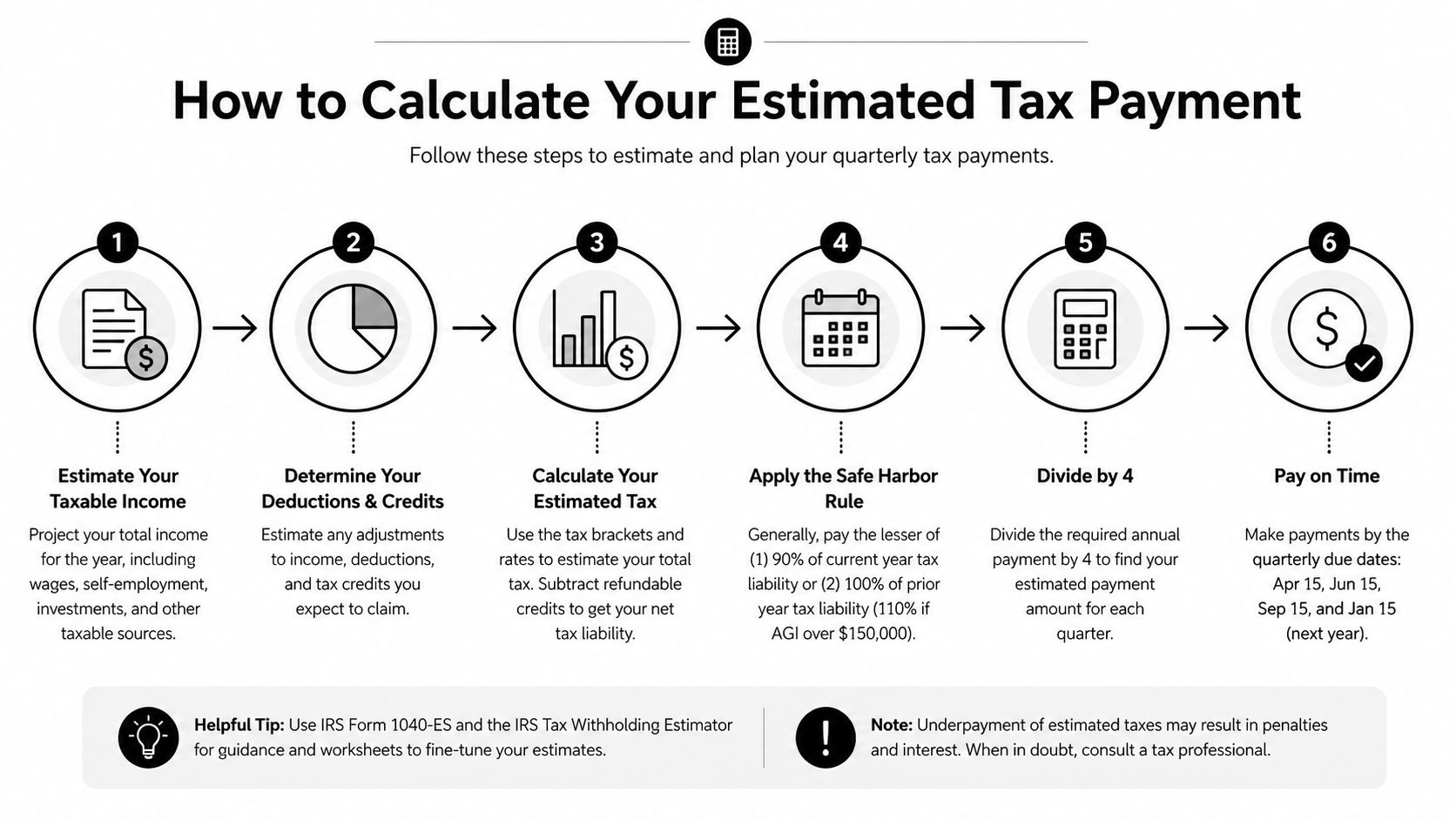
Start with projected income for the full year. Then subtract projected business expenses if you're self-employed. That gives you an estimate of net business income rather than gross receipts, which is the figure that matters more for tax planning.
From there, build the estimate in layers:
- Project annual net earnings. This is the baseline for many self-employed taxpayers.
- Add other expected income. Rental activity, investments, retirement income, and side work can change the result materially.
- Factor in deductions and adjustments. These reduce what ultimately becomes taxable.
- Apply credits where appropriate. Credits affect tax differently than expenses do, so treat them separately.
- Subtract withholding and payments already made. This tells you what still needs to be covered.
A lot of online tools compress those steps into one screen, which is convenient but dangerous if you don't know what was omitted. If your year includes more than one income stream, check the assumptions carefully.
When the divide by four method works
The most common benchmark is still the simple division method. Estimate your full-year tax, then divide it by four. That approach is widely used for self-employed individuals and businesses, and one sample calculation cited by Paychex shows $19,658.49 of annual estimated taxes split into $4,914.62 quarterly installments on its quarterly taxes guide.
This method works best when income is relatively steady. Think of a consultant with consistent monthly billing or a business owner with fairly predictable margins. In those situations, equal payments are usually close enough to reality to be efficient and manageable.
A manual walkthrough is helpful, but many taxpayers prefer a worksheet or tool that handles the sequencing. For that, a guide on how to calculate quarterly estimated taxes can be a practical next step.
| Situation | Divide by four works well | Divide by four works poorly |
|---|---|---|
| Consistent freelance income | Yes | |
| Seasonal business revenue | Yes | |
| One-time capital gain late in year | Yes | |
| Stable consulting retainer work | Yes |
What a quarterly tax payment calculator actually saves you
A good quarterly tax payment calculator saves more than time. It reduces preventable errors.
It helps by:
- Pulling the estimate into one place: income, deductions, credits, and prior payments can be viewed together.
- Forcing an update cadence: when income rises or falls, the number can be recalculated rather than guessed.
- Reducing mental shortcuts: many taxpayers round too aggressively or forget a category entirely when they calculate by hand.
If your income is smooth, a simple calculator is often enough. If your income is irregular, the calculator needs a strategy behind it.
That's the dividing line. The math itself isn't usually the hard part. Matching the method to your income pattern is.
Avoiding Penalties with IRS Safe Harbor Rules
A quarterly tax payment calculator tells you what you might owe. Safe harbor rules address a different question: how much you need to pay during the year to reduce the risk of underpayment penalties.

The two safe harbor paths
The first path is based on your current year tax. If your withholding and estimated payments cover enough of what you owe for the current year, you may avoid penalties.
The second path uses your prior year tax as the benchmark. Many taxpayers with unpredictable income prefer this because it gives them a fixed target instead of a moving one.
That distinction matters in practice:
- Current-year method: better when this year's income is lower and you want payments to reflect that lower result.
- Prior-year method: better when this year's income is volatile and you want a more predictable target.
- Blended planning: sometimes withholding from wages can support the estimate strategy without requiring every dollar to be paid through separate quarterly vouchers.
High earners need to be more careful with the prior-year route. According to the TurboTax estimated taxes article, taxpayers with adjusted gross income over $150,000 or $75,000 if married filing separately may need to increase the prior-year safe-harbor amount by 10% before dividing by four.
Why prior year safe harbor is often the calmer choice
For clients with uneven income, I usually prefer a predictable rule over a hopeful projection. If your year could change quickly, a prior-year safe harbor approach often creates fewer surprises because you aren't rebuilding the estimate from scratch every time revenue jumps.
That doesn't mean it's always the cheapest cash-flow option. In a down year, it may cause you to send in more than necessary during the year. But many people accept that trade-off because they want certainty and cleaner penalty protection.
A safe harbor plan is a risk-management decision, not just a math exercise.
The mistake is assuming every calculator handles these nuances automatically. Some tools estimate payment amounts well enough but don't force you to think about penalty protection, especially when income is rising, prior-year tax was high, or withholding is being used as part of the strategy.
Estimating Taxes for Variable and Seasonal Income
The basic advice that many taxpayers find online often breaks down. Equal payments can be perfectly reasonable for steady earners, but they can be clumsy for taxpayers whose income arrives in bursts.
The IRS allows an annualized income method for taxpayers with lumpy cash flow. That approach lets you calculate installments based on year-to-date income, which can help avoid overpaying in lean periods while still staying aligned with safe-harbor rules, as noted in this discussion of the annualized income method for estimated payments.
A freelancer with one big quarter
Take a freelance designer who has modest revenue early in the year and then lands a large contract in the second quarter. If that person uses a simple annual estimate too early, the first payment may be inflated based on income that hasn't happened yet. That ties up cash at the exact moment the business may still be covering software costs, subcontractors, and basic operating expenses.
With an annualized method, the designer can base each installment more closely on what has been earned so far. That doesn't erase tax. It changes the timing so the payments better match reality.
The trade-off is administrative effort. The calculation has to be updated with current numbers instead of repeating the same payment four times.
A rental owner with seasonal cash flow
A rental owner might collect strong income in peak season and have weaker occupancy in other periods. Repairs can also distort the picture. One expensive maintenance issue can turn what looked like a profitable quarter into a much thinner one.
In that setting, the annualized method often works better than a flat estimate because it recognizes that income and expenses don't occur in smooth monthly increments.
A practical way to approach it is:
- Track year-to-date net activity: not just rent collected, but actual expenses paid.
- Recalculate after major events: vacancy, repair costs, or a sudden occupancy jump can change the estimate.
- Coordinate state payments separately: rental property often creates state-specific issues that a generic federal-only calculator won't catch.
A crypto investor with a late year gain
Crypto creates a different timing problem. A taxpayer may have little to report through most of the year and then realize a large gain near the end. If earlier quarters were quiet, equal installment planning may not fit what occurred.
Annualizing can be more defensible than pretending the gain existed all year. But crypto adds a recordkeeping burden. Wallet activity, exchange statements, basis tracking, and transaction classification need to be cleaned up before any estimate is trustworthy.
The annualized income method is often the right answer when your income pattern is irregular. It is not the easy answer.
For freelancers, investors, and owners with seasonal revenue, the best method is the one that reflects the way money arrives. That's the piece many simple quarterly tax payment calculator pages miss.
How to Make Payments and When to Call an Expert
Once the estimate is set, execution matters. A correct calculation does no good if the payment is late, applied to the wrong year, or sent without records you can verify later.

Practical ways to submit payments
Most taxpayers use one of three practical routes:
- IRS Direct Pay: simple for one-off payments from a bank account.
- EFTPS: useful if you want a more structured payment history and scheduling workflow.
- Mailing Form 1040-ES with payment: still available for taxpayers who prefer paper or need a backup method.
Whatever method you use, keep the confirmation or proof of mailing. If a payment later goes missing in the IRS system, your records become the first line of defense.
Also check your state requirements separately. Federal estimates and state estimates don't always follow the same rules, and multi-state taxpayers need to be especially careful about sourcing and residency issues.
For taxpayers who can't pay in full, understanding IRS payment plan options can help you decide what to do next instead of freezing and missing deadlines entirely.
Situations where a calculator is no longer enough
A calculator is great for straightforward facts. It stops being enough when the issue is classification, allocation, or strategy.
That usually shows up in situations like these:
- Multi-state income: you moved, worked remotely across state lines, or own property in another state.
- Crypto activity: the challenge isn't just estimating tax. It's cleaning the transaction history first.
- Entity changes: if you're forming an S corporation or changing how you pay yourself, the estimate process changes too.
- IRS notices or old balances: at that point, compliance and resolution start to overlap.
In more complex cases, one option is to work with a firm that handles estimated tax calculation based on current income and deductions as part of broader planning. Allied Tax Advisors provides that type of support alongside tax preparation, bookkeeping, crypto tax work, rental property compliance, and IRS resolution.
Frequently Asked Questions About Estimated Taxes
What happens if I miss a quarterly deadline
Usually, the first step is to pay as soon as possible rather than waiting for the next due date or the annual return. Delays can create underpayment issues and interest-related consequences, and the timing matters even if you expect to catch up later.
If you missed one quarter because income arrived unexpectedly, don't guess your way out of it. Recalculate the year with current numbers, document what changed, and make the next payment based on a real estimate.
Can I just pay everything at once
Not if the reason you owe estimates is that tax should have been paid across the year. The system is built around paying as income is earned, not waiting until the end and sending one large check.
There are situations where payment amounts become uneven, especially when income spikes later or when planning starts after the first due date. But that is different from intentionally treating estimated tax as a single year-end bill.
What if I have a W-2 job and side income
You generally have two workable paths. You can make separate estimated tax payments for the side income, or you can increase withholding from your W-2 wages to cover more of the combined liability.
That second option is often underused. For many taxpayers, extra withholding through payroll is administratively easier than tracking separate estimated payments, especially if side income is modest or irregular.
A simple decision guide looks like this:
| Situation | Often the cleaner option |
|---|---|
| Stable side business with no payroll income | Estimated payments |
| W-2 wages plus moderate side income | Increase withholding |
| Highly irregular side income | Recalculate during the year |
| Multi-state or crypto complexity | Get tailored advice |
The right method depends less on ideology and more on what you can maintain accurately. A tax plan that is slightly less elegant but gets done on time is usually better than a perfect plan that never gets implemented.
If your income is uneven, your estimates don't have to be guesswork. Allied Tax Advisors helps individuals, self-employed professionals, rental property owners, and crypto investors calculate estimated payments, coordinate tax planning, and handle more complex issues when a basic quarterly tax payment calculator isn't enough.