
Ever wondered if you could use your retirement savings to buy that rental property down the street? It’s not just a thought experiment; it’s a strategy made possible by a real estate IRA.
This is a special type of retirement plan, formally known as a Self-Directed IRA (SDIRA), designed for investors who want to go beyond the typical menu of stocks, bonds, and mutual funds. It gives you the power to invest your retirement funds directly into tangible assets, like property, and have all the profits grow with the same tax advantages you're used to.
What Is a Real Estate IRA and How Does It Work
Most people are familiar with standard IRAs, where your investment choices are limited to what a brokerage firm offers. Think of it like a restaurant with a set menu—the options are solid, but you can’t order off-menu.
A Self-Directed IRA, on the other hand, throws the whole cookbook open. You gain the freedom to choose from a much wider universe of investments, with physical real estate being one of the most popular choices. It puts you in the driver's seat of your retirement portfolio.
Unlocking Tangible Assets for Retirement
The core idea of a real estate IRA is to allow you to purchase property with your retirement funds. We're not talking about REITs or real estate stocks, but direct ownership of assets like:
- Single-family rental homes
- Apartment buildings and multifamily units
- Commercial properties, from office space to warehouses
- Undeveloped land
When your SDIRA owns the property, it functions like a little business inside your retirement account. All income, like monthly rent checks, gets deposited directly into the IRA. Likewise, all expenses, from a leaky faucet to property taxes, are paid straight from the IRA funds. The best part? Any rental profits or gains from an eventual sale grow tax-deferred—or completely tax-free if you’re using a Roth SDIRA.
This isn't a niche strategy anymore. We've seen a 22% year-over-year increase in real estate professionals opening SDIRAs since 2021. With U.S. home prices climbing 40% since 2020, many are looking for a direct path to capture that growth, and SDIRAs provide exactly that. You can learn more about how real estate pros are using SDIRAs from industry leaders like the National Association of REALTORS®.
Standard IRA vs Real Estate SDIRA at a Glance
To really see the difference, it helps to put the two account types side-by-side. While both are retirement accounts, how they operate and what they allow you to do are worlds apart.
Here’s a quick breakdown of the key distinctions:
| Feature | Standard IRA | Real Estate SDIRA |
|---|---|---|
| Investment Options | Stocks, bonds, mutual funds, ETFs | Real estate, private equity, precious metals, and more |
| Asset Type | Paper assets (digital) | Tangible assets (physical property) |
| Control Level | Limited to custodian's offerings | High degree of investor control over assets |
| Management | Managed by a brokerage firm | Requires a specialized SDIRA custodian and active investor involvement |
Ultimately, the choice comes down to your goals and comfort level. A standard IRA is a passive, hands-off approach, while a real estate SDIRA is for the hands-on investor who wants direct control over tangible assets.
Getting to Know the IRS Rulebook
When you decide to use a real estate IRA, you’re essentially agreeing to play by a special set of IRS rules. It’s not complicated, but you absolutely have to know the rulebook inside and out. Getting it wrong can have devastating consequences for your retirement savings.
The single most important concept to grasp is avoiding what the IRS calls prohibited transactions. The entire framework is built on a simple idea: your IRA is its own legal and financial entity, completely separate from you. You can't personally benefit from its assets until you hit retirement age. This is what's known as an "arm's length" relationship.
What Exactly Is a Prohibited Transaction?
Think of it this way: your IRA can’t do business with you or anyone the IRS considers a "disqualified person." This isn't just a small group; it includes you, your spouse, your parents and grandparents, and your children and their spouses. It also covers any business you have a major ownership stake in.
Here are a few classic mistakes that will get you in hot water:
- Personal Use: You can't crash for a weekend at your IRA-owned vacation home, even if you offer to pay rent. The property is an investment for the IRA, not a personal perk for you.
- Hiring Family: Thinking of hiring your son, a skilled contractor, to fix up the kitchen in your IRA's rental? Don't. All work must be done by independent, third-party professionals who have no relation to you.
- Improper Loans: You are strictly forbidden from lending yourself money from the IRA. You also can't personally guarantee a loan that the IRA takes on to buy a property.
Let me be clear: the penalties for this are severe. One wrong move—just one prohibited transaction—can trigger the disqualification of your entire IRA. This means all the money inside becomes immediately taxable and hit with early withdrawal penalties. It’s the ultimate financial own-goal.
This diagram helps visualize the fundamental difference. A standard IRA keeps you in the world of stocks and bonds, while a self-directed IRA opens the door to real estate, but with its own distinct path and rules.
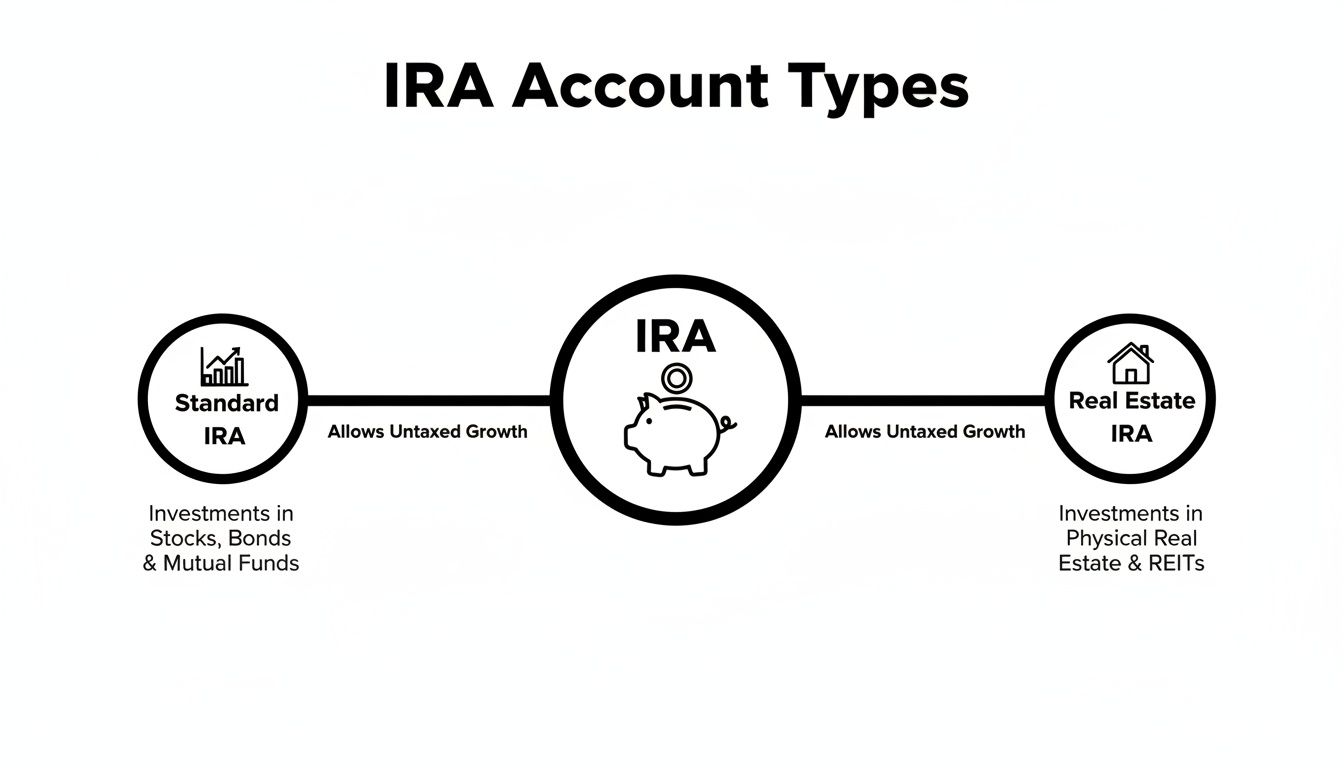
As you can see, choosing the real estate IRA route requires a more hands-on approach and a deeper understanding of the unique regulations that come with it.
The Two Surprise Taxes: UBIT and UDFI
Beyond prohibited transactions, there are a couple of lesser-known taxes that often catch new real estate IRA investors off guard: the Unrelated Business Income Tax (UBIT) and Unrelated Debt-Financed Income (UDFI) tax. These can pop up if your IRA starts acting like an active business or uses debt to buy an asset.
For real estate investors, UDFI is the one to watch. If your IRA takes out a non-recourse loan (a type of mortgage specific to IRAs) to purchase a property, a portion of the income generated by that property is no longer tax-deferred. It becomes taxable right then and there.
Key Takeaway: Using leverage in your IRA isn't forbidden, but it does trigger a tax on the profits attributable to the borrowed money. This tax is paid directly from the IRA's funds, not out of your personal pocket.
Here’s a practical example. Let's say your IRA finances 50% of a rental property with a non-recourse loan. That means 50% of the net rental income is now subject to UDFI. With a tax rate that can climb as high as 37%, this can take a serious bite out of your returns if you haven't planned for it.
Staying compliant with the IRS is non-negotiable for success. With so many potential pitfalls, it’s no wonder many investors work with specialists. Our team at Allied Tax Advisors, for instance, focuses on helping investors navigate these complexities, from managing rental property tax issues to planning for capital gains. To get ahead of the curve, it's worth reviewing how upcoming IRA rules and other potential tax traps could impact your strategy.
Proven Investment Strategies for Your Real Estate IRA

Alright, so you understand the rules of a real estate IRA. Now, how do you actually use it to win? A Self-Directed IRA (SDIRA) lets you break free from the usual Wall Street menu of stocks and bonds. Let’s dive into the most common and effective strategies that savvy investors use to build real wealth inside their retirement accounts.
The real key is to pick a lane that fits you—your financial goals, how much risk you're comfortable with, and how hands-on you want to be. Whether you're aiming for steady rental checks or want to be a private lender, your real estate IRA can be an incredibly powerful tool.
Classic Buy and Hold Rental Properties
This is the bread and butter of real estate investing, and for good reason. The strategy is simple: your IRA buys a property, like a single-family home or a duplex, with the goal of holding it for the long haul and renting it out.
Every dollar of rent collected goes straight into your IRA, where it can grow tax-deferred or even tax-free. Likewise, all the bills—from property taxes and insurance to a new water heater—are paid directly out of the IRA. This creates a predictable stream of cash flow that constantly fuels your retirement savings.
Here’s why it’s so popular:
- Consistent Cash Flow: Those monthly rent payments provide a reliable source of income for your IRA.
- Property Appreciation: While you collect rent, the property itself is hopefully gaining value over time, giving your nest egg a second engine for growth.
- Inflation Hedge: As the cost of living goes up, so do property values and rents, which helps protect the long-term buying power of your retirement funds.
Property Flipping for Tax-Sheltered Profits
If you have a higher tolerance for risk and a good feel for your local market, flipping properties inside an IRA can be a game-changer. The concept is straightforward: your IRA buys a property that needs work, pays for the renovations, and then sells it for a profit.
The real magic is what happens to that profit. If you flipped a house personally, you'd owe capital gains tax right away. But when the flip happens inside your IRA, 100% of the profit goes directly back into your retirement account. This allows your gains to compound without a tax bill slowing you down, dramatically accelerating your portfolio's growth.
Important Note: Every single cost associated with the flip has to be paid from the IRA. That includes the purchase price, building materials, and contractor invoices. You absolutely cannot contribute your own "sweat equity" or personal cash.
Acting as the Bank with Real Estate Notes
Maybe you like the idea of real estate returns but not the reality of leaky faucets and tenant calls. In that case, investing in real estate notes could be a perfect fit. This is where your IRA lends money to another real estate investor, and the loan is secured by the property itself.
Essentially, your IRA becomes the bank. You just sit back and collect a steady stream of interest payments. It's a fantastic way to generate passive income inside your retirement account without the headaches of being a landlord. You can explore a variety of our real estate investment tax strategies to see how this approach can fit into your larger financial picture.
Diversifying with REITs and Private Funds
For those who want ultimate diversification and a completely hands-off experience, your SDIRA can also invest in Real Estate Investment Trusts (REITs) or private real estate funds. These investment vehicles pool money from hundreds of investors to buy large-scale properties, like big apartment communities, shopping centers, or office buildings.
An SDIRA also allows you to move beyond the limitations of Wall Street by investing directly in private partnerships or funding non-recourse loans. This gives you the flexibility to team up with other investors, pool your IRA funds, and acquire much larger assets than you could on your own—from competitive markets like San Diego to opportunities across the globe. This opens the door to institutional-quality deals that were previously out of reach for individual retirement investors.
Ready to turn your real estate IRA from an idea into an actual investment? Getting it set up is a straightforward process. While it’s certainly more hands-on than opening a standard brokerage account, you can get it done right by following a few key steps.

It all begins with finding the right partner. You can’t just use a typical brokerage like Fidelity or Vanguard to hold physical real estate. For that, you need a specialized financial institution—an IRS-approved custodian—that handles Self-Directed IRAs and the alternative assets that go in them.
Step 1: Find a Qualified SDIRA Custodian
Think of your custodian as the official record-keeper for your real estate IRA account. They won’t offer you investment advice, but they are absolutely essential. They’re the ones who hold the funds, process the transactions, and make sure all the IRS reporting is handled correctly.
When you're vetting potential custodians, treat it like you’re hiring for a critical role. This is a long-term partnership, so you need to be sure they can support your specific investment strategy. Make sure you ask them some pointed questions:
- Experience: How many real estate deals do you handle each year? Do you have specific experience with the kinds of properties I'm looking at, like rentals or flips?
- Fees: Can you walk me through your fee schedule? Is it a flat annual fee, or is it based on my account's value or the number of properties I hold?
- Record-Keeping: How do you process rent payments and property expenses? Do you have an online portal where I can easily track everything?
Picking the wrong custodian can bog you down with administrative headaches, delays, and surprise fees. A good one, on the other hand, makes the whole experience feel seamless.
Step 2: Open and Fund Your Account
Once you've picked your custodian, you'll fill out their application to open your Self-Directed IRA. It’s a lot like opening any other retirement account. You’ll just need to decide if you want a Traditional SDIRA for tax-deferred growth or a Roth SDIRA for tax-free growth.
With the account officially open, you need to fund it. You generally have three ways to get money into your new real estate IRA account:
- Rollover: You can move funds from a 401(k) or 403(b) from a previous employer.
- Transfer: This involves moving money directly from another IRA (like one at a brokerage) to your new SDIRA custodian.
- Contribution: You can make new annual contributions, up to the IRS limits for the year.
The most common method is a direct IRA-to-IRA transfer, as it’s a non-taxable event that simply moves your existing retirement savings from one custodian to another.
Step 3: Find the Property and Direct the Purchase
Now for the fun part. With cash in your account, you can start shopping for properties. It’s up to you to do all the legwork—finding the deal, negotiating the price, hiring inspectors, and lining up any financing (which must be a non-recourse loan).
When you have a property under contract, you don’t sign the purchase agreement yourself. Your IRA is the buyer. You will formally instruct your custodian to execute the purchase on behalf of your IRA. Because of this, the property title will be recorded in the IRA’s name, something like "ABC Custodian FBO [Your Name] IRA."
From that moment on, all income and expenses flow through the IRA. Rent checks are sent to the custodian, and they pay for things like property taxes, insurance, and repairs using the funds in your account. You act as the manager, directing the custodian on every decision for your investment.
Weighing the Pros and Cons of a Real Estate IRA
The idea of buying a rental property or flipping a house with your retirement funds is exciting, but a real estate IRA account isn't for everyone. Before you dive in, it’s crucial to look at this strategy from all angles. Investing in physical property is a world away from stocks and bonds, and it comes with its own unique rewards and headaches.
Let's be honest, the appeal is easy to see. A real estate IRA gives you the chance to add a tangible asset to your retirement portfolio—something you can actually see and touch. This provides a layer of diversification that doesn’t automatically sink when the stock market has a bad day, which can be a huge relief during volatile times.
What's to Love About a Real Estate IRA?
For many, the draw of a real estate IRA is all about having more control and seeing real-world growth. You're the one picking the properties, which means you have a direct say in how your investment performs.
Here are the key advantages:
- Real Diversification: Owning physical property means you aren't putting all your retirement eggs in the stock market basket. It adds a welcome dose of stability.
- A Hedge Against Inflation: As the cost of living goes up, so do property values and rental income. This is a classic way to protect the future buying power of your savings.
- Powerful Tax-Advantaged Growth: Every dollar of rental income and appreciation grows inside the IRA’s tax shelter. This lets your profits compound year after year without you having to send a cut to the IRS.
A real estate IRA can turn retirement saving from a passive waiting game into an active wealth-building machine. The goal is to create a steady stream of cash flow from rents—tax-deferred in a Traditional IRA or completely tax-free in a Roth—all while your property value (hopefully) climbs. As you can learn from industry experts, it’s a strategy that puts your retirement account to work in a very dynamic way.
The Trade-Offs and Potential Pitfalls
Now for the reality check. This strategy is far from a "set it and forget it" investment. The hands-on nature of a real estate IRA account demands your attention and brings some serious risks to the table.
The main downsides boil down to complexity and inflexibility. Unlike a mutual fund, you can't just ignore it and hope for the best.
Consider This: Imagine your IRA-owned rental property needs a new roof. You must direct your custodian to pay the contractor from your IRA funds. You can’t simply pay for it yourself or perform the labor, which underscores the strict separation required.
Keep these significant challenges in mind:
- Lack of Liquidity: You can't sell a house with the click of a button. Your money is tied up, which can be a problem if you need to access your cash in a hurry.
- Active Management: You're the one ultimately responsible for the property. That means finding tenants, handling repairs, and dealing with late-night emergencies. Even with a property manager, the buck stops with you.
- Higher Fees: SDIRA custodians charge more for administration than your typical IRA provider. The complexity of holding alternative assets simply costs more to manage.
- Strict IRS Rules: We've already touched on this, but it bears repeating. Breaking the prohibited transaction rules can get your entire IRA disqualified. That’s a financial disaster you have to avoid at all costs.
A real estate IRA is best for disciplined investors who understand what they’re getting into and are ready for the hands-on work it requires.
Don't Let Taxes Derail Your Success: Why Expert Guidance Matters
A real estate IRA account is an incredible vehicle for building wealth, but let’s be frank: the tax rules are a minefield. Diving in without knowing the landscape is one of the fastest ways to turn a great investment into a costly mistake. One wrong move, and you could face steep penalties that threaten your retirement funds.
This is why teaming up with a tax advisor who lives and breathes real estate and IRS regulations isn't just a good idea—it's essential. Think of them as your strategic partner, not just a tax filer. Their job is to get ahead of problems and make sure your investments are structured for maximum growth from the very beginning.
When a Tax Pro Is Non-Negotiable
A seasoned tax professional is your best defense against the common pitfalls of real estate IRA investing. They'll help you structure your deals to sidestep future tax headaches.
This becomes absolutely critical when you start dealing with the trickier rules, like UBIT and UDFI. A specialist can run the numbers and show you exactly how using a non-recourse loan will impact your tax bill, helping you keep as much of that tax-deferred growth as possible.
They also handle the crucial day-to-day compliance that often trips people up:
- Filing Form 990-T if your IRA owes any unrelated business income tax.
- Making sure every expense, from a new roof to property taxes, is paid directly from the IRA—not your personal bank account.
- Keeping airtight records that prove every transaction was done at arm's length, with no self-dealing.
If that dreaded IRS notice ever shows up in your mailbox, your tax advisor steps in as your champion. They speak the IRS's language and can handle the communications, provide the right documents to prove you've followed the rules, and work to resolve the audit quickly, protecting your nest egg from disaster.
Why Partner with Allied Tax Advisors?
At Allied Tax Advisors, we specialize in the very specific world where real estate investing and IRS tax law meet. Our team gets the unique challenges and opportunities that come with using a real estate IRA account. We’re here to help you structure your deals, manage your annual filings, and navigate the ever-changing rules.
We've seen how investors can thrive when they have the right guidance and can use this strategy with confidence. If you're wondering what to look for in a professional, our guide on how to find a good CPA is a great place to start. Our job is to manage the tax complexity so you can get back to what you do best: finding great real estate investments.
Common Questions About Real Estate IRAs
Even the most well-thought-out strategy can hit a few snags when it comes to the day-to-day reality of managing a real estate IRA account. We see the same questions pop up time and again, so let's walk through them to give you the clarity you need to invest with confidence.
Getting these details right isn't just about best practices—it's about protecting your entire retirement nest egg.
Can I Use a Mortgage to Buy Property in My IRA?
Yes, you can, but it’s a different ballgame than getting a loan for your personal home. Your IRA has to use a non-recourse loan. Think of it this way: with a regular mortgage, the bank can come after your other assets if you default. With a non-recourse loan, the property itself is the only collateral. The lender has no "recourse" to your other IRA funds or your personal finances.
Here’s the catch, though. Using debt to buy the property introduces a tax complication called the Unrelated Debt-Financed Income (UDFI) tax. A portion of the rental income or sale profit becomes taxable, even inside the IRA. This is something you absolutely need to model out with a tax advisor beforehand.
How Do I Pay for Property Expenses?
This is a bright-line rule with no exceptions: every single expense must be paid directly from the IRA's cash. We're talking about everything from property taxes and insurance down to a simple trip to Home Depot for a new faucet or paying an HOA fee.
You can never, ever pay for an expense with your personal credit card or checkbook, even if you plan to "reimburse" yourself. That's a classic prohibited transaction. Your SDIRA custodian is your gatekeeper here; you'll direct them to cut checks or send wire transfers from your IRA to cover any and all costs.
For example, if a tenant calls about a broken water heater, you'll get a quote from a plumber and then instruct your custodian to pay that invoice directly from your IRA funds. Your personal money can't touch the transaction.
What Happens If I Accidentally Perform a Prohibited Transaction?
The consequences here are brutal, and there's no way to sugarcoat it. If you accidentally slip up and engage in a prohibited transaction—like paying for that plumber yourself or staying at the property for a weekend—the IRS can deem your entire IRA disqualified.
A disqualified IRA is a financial catastrophe. The entire value of the account is treated as if you cashed it out on January 1st of that year. It all becomes taxable income, and if you're under 59½, the IRS will slap you with an additional 10% early withdrawal penalty. This is why following the rules to the letter is so incredibly important.
Can I Live In or Use the Property Myself Before I Retire?
Let's be crystal clear on this: absolutely not. This is probably the most fundamental rule of a real estate IRA account. The property is an investment owned by your IRA, which is a separate legal entity. It is not yours to use.
Any personal benefit, even for a single night, is a prohibited transaction that can blow up your entire account. This rule doesn't just apply to you; it includes all "disqualified persons" like your spouse, parents, children, and grandchildren. The property must remain a hands-off investment until you take it as a distribution in retirement.
The power of doing this right is incredible. Just look at real estate agent John Cochran, who used his Self-Directed IRA to flip houses and buy rentals. As the National Association of REALTORS® highlighted, he followed the rules meticulously and generated huge, tax-deferred profits that supercharged his retirement savings. You can explore his story for more inspiration.
Navigating the complexities of a real estate IRA requires careful planning and expert oversight. At Allied Tax Advisors, our team is dedicated to helping you structure your investments correctly, maintain compliance, and achieve your retirement goals with confidence. Visit us at Allied Tax Advisors to schedule your consultation.