
When you own a rental property, the mortgage interest you pay isn't just an expense—it's one of the most powerful tax deductions available to you. Think of it as a crucial business expense that directly cuts down your taxable rental income, which in turn lowers your tax bill and improves your return on investment.
Unlocking Your Biggest Tax Advantage

For any real estate investor, a mortgage is more than just a way to finance a property; it's a strategic financial tool. A huge chunk of your monthly payment goes toward interest, and it’s easy to see that as money down the drain. The good news is, the tax code sees it differently.
Just like a local bakery can deduct the cost of flour and sugar, you can deduct the interest you pay on the loan that finances your rental property. This deduction is a cornerstone of smart real estate investing because it tackles one of your largest and most consistent expenses head-on. By lowering your taxable income, it makes your property more profitable from day one.
Why This Deduction Matters So Much
The real magic of this deduction is how it directly impacts your bottom line. It's not a tax credit, which reduces your final tax bill dollar-for-dollar. Instead, it’s an expense deduction that lowers your taxable income. This is a key distinction. Lowering your income can sometimes even bump you into a lower tax bracket, which means your savings can really add up.
Let's say you bring in $20,000 in rent for the year and pay $7,000 in mortgage interest. You're only taxed on the remaining $13,000 (before other expenses, of course). That makes a huge difference in how much you owe the IRS.
Mortgage Interest Deduction at a Glance
To put it all into perspective, here’s a quick summary of what this deduction is all about.
| Concept | Brief Explanation |
|---|---|
| Who Qualifies? | Any real estate investor with a mortgage on a property used for rental purposes. |
| What Can Be Deducted? | Interest on loans used to buy, build, or make substantial improvements to the rental property. |
| Where Is It Claimed? | It's a business expense reported on IRS Schedule E (Supplemental Income and Loss). |
| Why Is It Important? | It directly reduces your taxable rental income, which lowers your overall tax liability. |
This isn't some obscure loophole; it’s a well-established tax benefit for property owners. For rental properties, the mortgage interest you pay is treated as a business expense. According to the rules, this interest is fully deductible as long as the loan was used to acquire or improve the property itself. You can dig into the fine print in the official IRS publications.
Getting this concept down is the first step. While the mortgage interest deduction is a big one, it's just one piece of the puzzle. To see how it fits into the bigger picture, take a look at our comprehensive guide to rental property tax deductions.
Getting on the Right Side of the IRS
Before you can even think about deducting mortgage interest, you have to prove to the IRS that your property is a legitimate rental business, not just a second home you happen to rent out sometimes. This is the first and most important hurdle. Think of it as the gatekeeper to some serious tax savings—and thankfully, the rules are pretty clear once you know what they are.
The whole game boils down to one key distinction: personal use versus business use. The IRS needs to see that the property is primarily an income-generating asset, not a personal getaway that occasionally brings in a little cash.
The Make-or-Break 14-Day Rule
The number one rule you absolutely have to know is what I call the "14-day rule." It’s what the IRS uses to classify your property as either a rental business or a personal residence that you also rent out (often called a "vacation home"). The difference in tax treatment is huge.
Here's the deal: to qualify as a rental property, your personal use of the home can't be more than the greater of two things:
- 14 days a year.
- 10% of the total days it was rented out to others at a fair market price.
Stay under that limit, and you're in business. You can generally deduct your rental expenses, including the mortgage interest that applies to the rental period. But if you cross that line, your property is reclassified as a personal residence, and the rules for deducting expenses get much, much tighter.
The Bottom Line: Watch your calendar. Going over the 14-day/10% limit is the quickest way to lose your best deductions. It fundamentally changes how the IRS sees your property.
Let's walk through an example. Say you have a lake cabin that you rented out for 200 days this year. The 10% rule gives you 20 days for personal use (10% of 200). Since 20 is greater than 14, you can use the cabin for up to 20 days without jeopardizing its status. But if you only managed to rent it for 100 days, your personal use is capped at just 14 days, because 14 is greater than 10% of 100 (which is 10 days).
What Counts as "Personal Use"?
So, what exactly is a "personal use" day? It's not just when you're there on vacation. The IRS has a broad definition. A day counts as personal use if the property is used by:
- You or anyone else who has an ownership stake.
- Your family members (or the family of another owner), unless they're paying you fair market rent just like any other tenant.
- Anyone you've done a "house swap" with, letting them use your place while you use theirs.
- Anyone who isn't paying a fair rental price.
That's right—letting your brother use the condo for a free ski weekend counts against your personal day limit. It directly impacts your ability to claim the rental property mortgage interest deduction.
Making Sure Your Loan Interest Qualifies
Once you've cleared the personal use hurdle, you need to make sure the loan itself qualifies. The IRS won't let you deduct interest from just any loan; it has to be directly tied to the property in a specific way.
First, the loan must be secured by the rental property. More importantly, the money from that loan must have been used to buy, build, or substantially improve the property. You can't take out a loan on your rental, use the cash to buy a boat, and then try to deduct the interest. The IRS follows the money.
The interest on these types of loans is almost always deductible:
- First Mortgages: The main loan you took out to buy the place.
- Second Mortgages: Another loan taken out later, also secured by the property.
- Home Equity Loans (HELOCs): As long as you used the funds for the rental property. For example, you might use a HELOC to add a new deck or renovate the kitchen—that interest is deductible.
Here's a clever strategy I see investors use all the time: They take out a HELOC on their primary home and use that money to make the down payment on a new rental property. Because the funds were used to acquire an income-producing asset, the interest on that HELOC becomes a deductible rental expense. It all comes back to tracing where the money went.
Calculating Your Deductible Interest Amount
Alright, let's get into the nitty-gritty. Pinpointing the exact amount of mortgage interest you can deduct is where being meticulous really pays off. If your property is 100% a rental, the math is refreshingly simple. But the second you start using part of the property yourself, things require a bit more precision.
Think of it like splitting a utility bill with a roommate. You wouldn't pay the whole bill if you only used half the electricity, right? The same logic applies here. You can only deduct the portion of the mortgage interest that corresponds to the rental's business use.
To get a good handle on your numbers before tax time, a mortgage payment calculator can be a huge help. It breaks down your payments, showing you exactly what’s going toward interest versus what’s paying down the principal—a critical distinction for accurate tax reporting.
Handling 100 Percent Rental Properties
When a property is exclusively used for rental purposes, the process is as straightforward as it gets. Each year, your lender sends you Form 1098, the Mortgage Interest Statement. Just look at Box 1.
That number is the total mortgage interest you paid for the year, and that’s your deductible amount. No complicated math or allocations needed. You can claim that full figure directly on your Schedule E. Easy.
Mixed-Use Properties: The Allocation Method
Now, for the more common scenario: the mixed-use property. Maybe you rent out a room in your primary residence, or you live in one unit of a duplex and rent out the other. In these cases, you have to divide—or allocate—the interest between your personal use and the rental business.
The IRS gives us a pretty clear method for this. You need to base the split on a "reasonable" standard, and the most common and defensible one by far is square footage.
- Calculate Total Square Footage: Start with the total livable area of the entire building.
- Calculate Rental Square Footage: Next, measure the space that is used exclusively by your tenant.
- Find the Rental Use Percentage: Simply divide the rental area by the total area.
This percentage is the magic number. You'll multiply the total mortgage interest from your Form 1098 by this percentage to figure out your deduction.
This infographic breaks down the key checkpoints for figuring out if you're eligible in the first place.
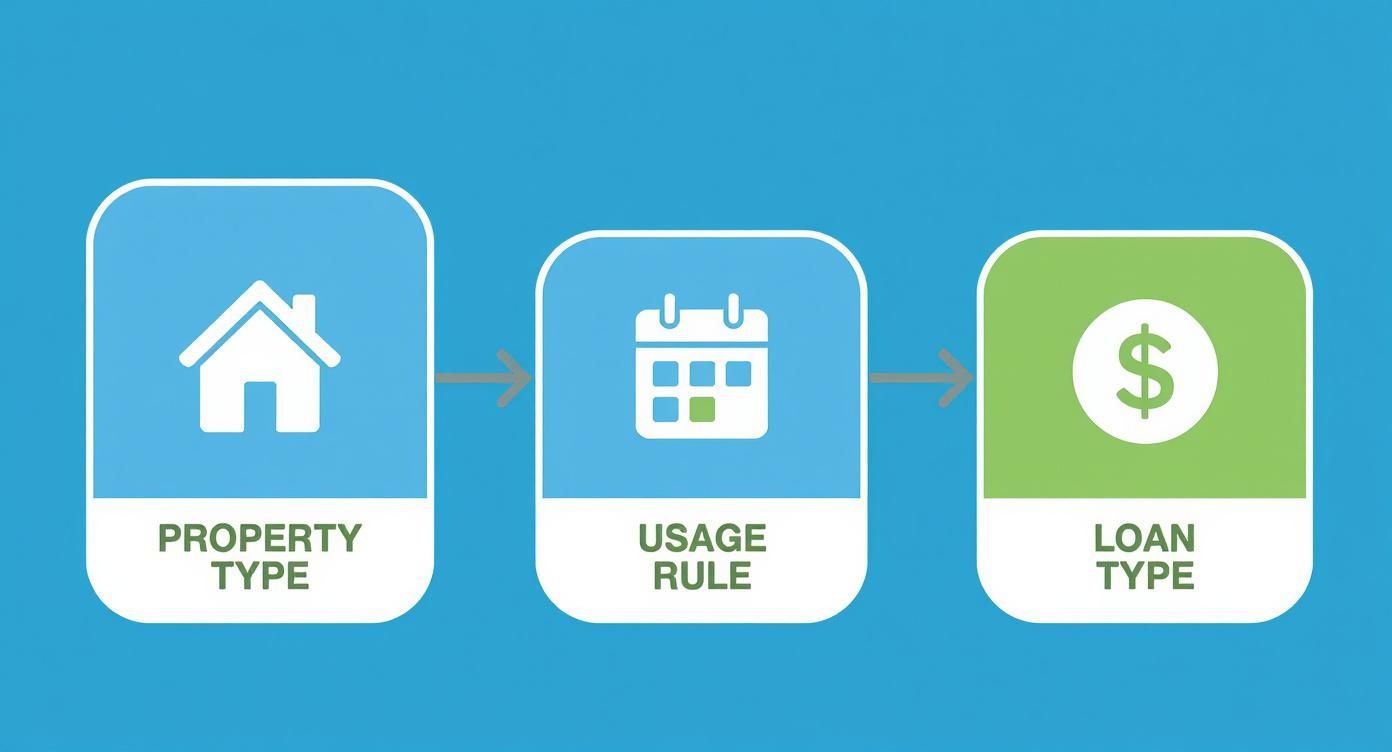
As you can see, everything hinges on your property type, how it's used, and the kind of loan you have. Getting these fundamentals right is the first step.
Beyond Standard Interest Payments
Your deduction isn't always just the interest listed on your monthly statements. A few other related costs can often be included, as long as you account for them correctly.
It’s crucial to remember that the Tax Cuts and Jobs Act (TCJA) of 2017 changed the landscape a bit. It capped the mortgage debt eligible for interest deduction at $750,000 for loans taken out after December 15, 2017. This limit applies to rental properties too, so it's a key factor for anyone with a higher-value investment.
Here are a few other costs you shouldn’t overlook:
- Mortgage Points: If you paid points to get your loan, you can't deduct them all in one go. The IRS requires you to spread this deduction out over the life of the loan. For a 30-year mortgage, you’d deduct 1/30th of the cost of the points each year.
- Prepaid Interest: Any interest you paid upfront at closing is typically deductible in the year it actually applies, not necessarily the year you paid it.
- Refinancing: Interest on a refinanced loan is deductible up to the balance of the original mortgage. If you did a cash-out refinance, the interest on the extra money is only deductible if you used those funds to substantially improve the rental property itself.
Key Insight: The IRS always wants to know one thing: how was the money used? If the loan proceeds went into your rental business—buying it, improving it—the interest is almost always deductible. If you used it for personal expenses, it's not.
Let's put this all together with a practical example for a mixed-use property.
Sample Calculation for a Mixed-Use Property
This table shows exactly how a landlord would calculate their deduction for a property where 40% of the space is used for rental purposes.
| Expense Item | Total Annual Amount | Rental Use Percentage (e.g., 50%) | Deductible Amount |
|---|---|---|---|
| Total Mortgage Interest Paid | $12,000 | 40% | $4,800 |
| Mortgage Insurance (PMI) | $900 | 40% | $360 |
| Points (Annual Portion) | $100 | 40% | $40 |
| Total Deduction for Schedule E | $13,000 | 40% | $5,200 |
By applying that 40% rental-use figure to each eligible expense, the landlord arrives at a total deductible amount of $5,200. This is the final number they would report on their tax return for these specific costs.
Claiming Your Deduction on Schedule E
Running the numbers for your rental property mortgage interest deduction is one thing, but actually claiming it is what puts money back in your pocket. This is where all your hard work pays off, and it all happens on a single tax form: IRS Schedule E, Supplemental Income and Loss.
Think of Schedule E as the official P&L statement for your rental property. It’s where you tell the government the story of your rental's financial year. This is the moment your meticulous calculations and organized records come together to create a clear, accurate, and defensible picture of your investment. Get this right, and you’ll secure the full tax benefit you’re entitled to without raising any red flags.
Gathering Your Essential Documents
Before you even think about opening Schedule E, you need to get your paperwork in order. Filing without your documents ready is like trying to bake a cake without the ingredients—you're just setting yourself up for a mess and a lot of frustration. Good documentation isn't just for filing; it’s your number one defense if the IRS ever comes knocking.
For mortgage interest, there are a few non-negotiables you'll need:
- Form 1098, Mortgage Interest Statement: This is the big one. Your lender sends this out every January, and it officially states how much interest you paid for the year.
- Closing Statements (HUD-1 or Closing Disclosure): If you bought or refinanced the property this year, these documents are gold. They show any prepaid interest or points you paid at closing.
- Loan Amortization Schedules: While not always essential, these are incredibly helpful for cross-referencing interest amounts and seeing exactly how your payments break down between principal and interest.
- Proof of Payments: Keep your bank statements or canceled checks handy. They serve as a backup to confirm your payments, especially if you spot a discrepancy on your Form 1098.
Crucial Tip: The IRS generally wants you to keep tax records for at least three years after you file. But for real estate, smart investors and tax pros will tell you to hang onto records related to the property's cost basis for as long as you own it, plus another three years after you sell.
Navigating the Schedule E Form
With your documents assembled, it's time to tackle Schedule E. This form is where you'll list all your rental income and then subtract all your operating expenses to determine your net profit or loss. Thankfully, the IRS gives mortgage interest its very own line item, making it hard to miss.
As you can see in the screenshot, Schedule E has a straightforward layout with specific lines for each expense category.
You’ll report your mortgage interest deduction on Line 12, "Mortgage interest paid to banks, etc." This is where you enter the final, deductible interest amount you calculated. If the property is 100% rental, this number should match your Form 1098. If it's a mixed-use property, this is where you'll enter the carefully allocated rental portion. For a deeper look, our guide on understanding Schedule E for rental income breaks down the entire form in more detail.
Bringing It All Together
Let's walk through one last example to see how it all connects.
Say you own a duplex. You live in one half and rent out the other, and both units are identical in size (a clean 50/50 split). At the end of the year, your Form 1098 from the bank shows you paid a total of $14,000 in mortgage interest.
- Allocation: First, you calculate the rental portion. $14,000 (total interest) x 50% (rental use) = $7,000.
- Documentation: You file away your Form 1098 along with a note detailing your 50/50 square footage calculation.
- Reporting: You confidently enter $7,000 on Line 12 of your Schedule E for the duplex.
It really is that systematic. By following this process—gather, calculate, and report—you can claim your rental property mortgage interest deduction correctly and without stress. You’ve just turned a complex tax rule into a simple, powerful step toward lowering your tax bill.
Sidestepping Common Pitfalls and Tackling Advanced Scenarios
Getting the hang of the rental property mortgage interest deduction is one thing, but even seasoned investors can get tripped up by common errors or run into complex situations that aren't so black and white. Nailing these details is the key to maximizing your tax savings while keeping your books clean and avoiding any unwanted letters from the IRS.
Think of it like being a pilot. Learning to take off and land is fundamental, but knowing how to handle turbulence, navigate through a storm, or execute a tricky maneuver is what separates the novices from the pros. Let's walk through some of those tougher aspects so you can sidestep costly mistakes and handle nuanced financial situations with confidence.
Costly Errors You Must Avoid
The mistakes that trip people up are often small but can pack a big financial punch. They usually pop up from a simple misunderstanding of the rules or from not allocating expenses with precision. Just knowing what to watch for is your first line of defense.
-
Incorrectly Deducting HELOC Interest: This is a classic. It’s easy to assume that any interest you pay on a Home Equity Line of Credit (HELOC) is fair game, but that's not how the IRS sees it. The rule is crystal clear: you can only deduct the interest on funds you actually use to buy, build, or substantially improve the rental property itself. If you tap that HELOC to buy a new car or take a vacation, the interest tied to that portion of the cash is a personal expense, not a deductible rental one.
-
Fumbling Mixed-Use Deductions: Do you live in one unit of a duplex and rent out the other? When a property is part rental, part personal home, landlords sometimes just guess at the allocation percentage. You have to use a reasonable, consistent method—like square footage—to divide all shared expenses, not just the mortgage interest.
-
Improperly Handling Points: Many investors mistakenly write off the entire cost of mortgage points in the year they paid them. The IRS actually requires you to amortize this cost, which is just a fancy way of saying you have to spread the deduction out over the life of the loan. On a 30-year mortgage, that means you can only deduct 1/30th of the points' cost each year.
Expert Takeaway: When in doubt, follow the money. The deductibility of interest almost always hinges on how you used the loan funds. Meticulous records aren't just good practice; they're your best defense.
Navigating More Complex Scenarios
As your real estate portfolio expands, you'll inevitably face situations that don't fit into a neat little box. Understanding the tax implications of these more advanced scenarios is what will empower you to make smarter financial decisions down the road.
Tax policies are always in flux, and changes can have a ripple effect on investor strategies globally. New Zealand, for example, initially scrapped the ability for landlords to deduct mortgage interest—a massive shift that cooled the market. Now, they're in the process of phasing the deduction back in, with a full restoration planned by April 2025. You can dive deeper into these kinds of international policy shifts with Wolters Kluwer's expert analysis.
Seller-Financed Mortgages
What happens when you buy a property directly from the owner and they play the role of the bank? In a seller-financed deal, your mortgage payments go straight to the seller instead of a traditional lender. The good news? The interest you pay is still completely deductible.
The catch is that you won't get a Form 1098 from the seller. To claim the deduction, you'll need the seller's name, address, and their Social Security Number or Taxpayer Identification Number. You'll report all this information right on your Schedule E.
The Tax Impact of Refinancing
Refinancing can be a fantastic financial move, but you need to know the tax rules. If you refinance for an amount that's equal to or less than your outstanding mortgage balance, it’s simple: all the interest on the new loan is still deductible.
Things get interesting with a "cash-out" refinance. If you borrow more than your old balance and pull cash out, the interest on that extra money is only deductible if you use the funds to make substantial improvements to the rental property. Use it for anything else, and the interest tied to that cash is no longer a business expense.
Passive Activity Loss Rules
Finally, you have to understand how your rental property mortgage interest deduction plays with the Passive Activity Loss (PAL) rules. For most investors, rental real estate is considered a "passive" activity. If your total rental expenses (interest included) are more than your rental income for the year, you have a passive loss.
Generally, you can only use passive losses to offset passive income. However, there's a special allowance that might let you deduct up to $25,000 in rental losses against your non-passive income (like the salary from your day job). Be aware, though, this benefit begins to phase out as your income climbs.
The Bigger Picture for Real Estate Investors
Getting a handle on the rental property mortgage interest deduction is about more than just trimming your tax bill. It's about understanding the powerful economic engine that drives your investments and the real estate market as a whole. Think of this deduction as a major incentive from the government that encourages property investment, impacting everything from home values to the supply of rental units.
When you grasp this bigger picture, you stop being just a taxpayer filling out forms and start thinking like a strategic investor. You'll begin to see how whispers of tax policy changes in Washington could signal new risks—or create incredible opportunities—for your portfolio. This kind of forward-thinking is what separates successful long-term investors from the rest.
A Powerful Economic Driver
Make no mistake, the mortgage interest deduction is one of the biggest tax breaks on the books. For the 2025 fiscal year alone, it’s expected to cost the federal government around $26 billion in revenue.
Digging into the numbers reveals that roughly 64% of tax returns claiming this deduction belong to households earning over $150,000. This same group reaps about 84% of the total financial benefit.
By making it cheaper to borrow money for real estate, the deduction fuels demand and helps prop up property values. Keeping meticulous records for this and other deductions is non-negotiable, and modern tools can make it a breeze. Checking out reviews of the best property management apps is a great way to find software that can simplify your life.
When you see this deduction as one piece of a giant economic puzzle, you can position your business to not just survive, but thrive through market shifts and new laws.
Mastering this one tax break is a fantastic first step, but it’s just one tool in your financial toolkit. A truly effective strategy means knowing every single write-off you’re entitled to. To expand your expertise, dive into our complete guide on tax deductions for real estate investors.
Frequently Asked Questions
The tax code can feel like a maze, especially when you're trying to make sure you get every deduction right. Let's tackle some of the most common questions landlords ask about deducting mortgage interest. Think of this as your cheat sheet for those tricky "what if" scenarios.
Can I Deduct Mortgage Interest on a Vacant Rental Property?
Absolutely. The key here is intent. As long as your property is genuinely available for rent and you're actively trying to find a tenant, you can continue to deduct the mortgage interest. The IRS sees it as an ongoing business activity, even during a vacancy.
The trick is proving it. Keep a paper trail of everything you do to get it rented—screenshots of your Zillow or Craigslist ads, emails with your property manager, and receipts for that pre-tenant deep clean or fresh coat of paint. This documentation shows the property is still very much a business asset, not just sitting empty.
How Is This Different from My Home Mortgage Deduction?
This is a fantastic question because the difference is huge. Think of it this way: your home mortgage interest is a personal deduction, while your rental's is a business expense.
For your primary home, the interest goes on Schedule A as an itemized deduction. This means you only get the tax break if your total itemized deductions are more than the standard deduction. Many people just take the standard deduction and miss out.
But for your rental property, the mortgage interest is a direct business expense reported on Schedule E. It reduces your rental income right off the bat, before you even get to your personal deductions. You can claim this business expense and still take the standard deduction on your personal return. It’s a win-win.
How Does Refinancing Affect the Interest Deduction?
Refinancing can muddy the waters a bit, but there’s a simple principle to follow: follow the money.
If you refinance for an amount up to your old mortgage balance, nothing really changes. The interest on that new loan is still fully deductible as a rental expense.
Things get interesting with a "cash-out" refinance, where you borrow more than you previously owed. The deductibility of the interest on that extra cash depends entirely on what you do with it.
Follow the Money: If you use the cash-out funds to put a new roof on that same rental property, the interest on that portion is a deductible business expense. But if you use that cash to pay off your personal credit card or buy a boat, that portion of the interest is considered personal and is not deductible on your Schedule E.
Are Mortgage Insurance Premiums Deductible?
Yes, they are, and it’s a deduction many people overlook! Private Mortgage Insurance (PMI) on a rental property loan is treated the same as mortgage interest. It’s a necessary cost of your business financing, making it fully deductible.
Your lender makes this easy for you. They’ll report the total PMI you paid for the year in Box 5 of your Form 1098. Just grab that number and add it to your total mortgage interest when you're filling out Schedule E.
At Allied Tax Advisors, we live and breathe this stuff. We help real estate investors untangle complex tax rules just like these every day. Let our team of experts make sure you’re not leaving any money on the table. Visit us at https://alliedtax.com to see how we can help you build a stronger financial future.