
You’ve probably hit the point where your business is making real money, and someone has said, “You should elect S corp status. It’ll save you on taxes.”
That advice isn’t wrong. It’s just incomplete.
Most new owners don’t struggle with the big idea. They struggle with the practical questions. Do I need payroll? What’s a distribution? Why did I get a K-1 if I already took money out of the business? What does “reasonable salary” mean in real life?
This guide is written in plain English for that exact stage. If you’ve been searching for s corp taxes for dummies, you likely don’t need tax jargon. You need a simple way to understand how the rules work, where the savings come from, and what can get you in trouble if you guess.
What Is an S Corp and Why Does It Matter for Taxes
You form an LLC, the business starts turning a profit, and your bookkeeper says, “It may be time to elect S corp status.” That moment trips up a lot of owners because “S corp” sounds like a business type, when it is really a tax choice layered on top of a legal entity.
An S corporation is a tax election. In practice, that usually means you already have an LLC or corporation, and you choose to have it taxed under S corporation rules. The legal shell and the tax treatment are two separate decisions, which is why owners often get confused when comparing entity options.
A simple way to sort this out is to use a vehicle comparison.
A sole proprietorship works like a bicycle. It is easy to get going, but the owner has very little protection. A C corporation works more like a bus. It has its own tax system and more formality. An S corp works like a car using a different toll lane. The vehicle may still be an LLC or corporation, but the tax rules change the route your profit takes.
Why does that matter? Because taxes are often the whole reason owners consider the election in the first place.
The main appeal is that S corp status can reduce how much of the owner’s business income gets hit with self-employment taxes, but only if the business is set up and run correctly. That is the practical side many guides skip. The theory sounds simple. The practical questions are harder. Do you need payroll? How much should your salary be? When is it okay to take distributions?
Those questions matter because the IRS expects owner-employees of an S corp to pay themselves a reasonable salary before taking profit out in other ways. That rule is where tax savings and audit risk often meet. A good S corp plan is not just “pay less tax.” It is “pay yourself in a way you can defend with facts.” At Allied Tax Advisors, that usually means looking at your role, your industry, local pay data, and what the business can support.
Why owners choose S corp taxation
Small business owners usually do not elect S corp status because it sounds fancy. They do it because they want a tax setup that can be more efficient than staying a sole proprietor or default LLC tax treatment.
Here are the core ideas to keep straight:
- It is a tax election, not a new business type. Your LLC can often choose S corp taxation.
- Business profit usually passes to the owners’ personal returns. The company still files its own return, but the income is generally taxed at the owner level.
- Owners who work in the business usually need payroll. You cannot treat every dollar as a casual owner draw.
- Recordkeeping matters more. Payroll, distributions, and corporate formalities need to be handled cleanly.
That last point is where theory meets practice. If your business makes only a small profit, the added payroll and filing work may not be worth it. If profit is growing, the election can make more sense. The answer depends on real numbers, not internet hype.
The decision is often really LLC vs. S corp taxation
Many owners ask whether they should be an LLC or an S corp. That question mixes legal structure with tax treatment.
An LLC is a legal entity. An S corp is a tax status. An LLC can often elect to be taxed as an S corporation, which is why the better comparison is usually S corp vs LLC for small business, not one versus the other as if they are direct opposites.
If you are still earlier in the process of choosing the right business structure, separate the choice into two steps. First, pick the legal entity. Second, pick how that entity should be taxed.
That one distinction clears up a surprising amount of confusion.
A practical gut check
Here is a simple test.
If your business is producing steady profit after paying ordinary expenses, and you actively work in the business, S corp status may be worth a closer look. If your income is inconsistent, very low, or still in the early side-hustle stage, the extra compliance may outweigh the benefit for now.
The goal is not to chase a label. The goal is to choose a tax setup that fits how your business operates.
The Magic of Pass-Through Taxation Explained
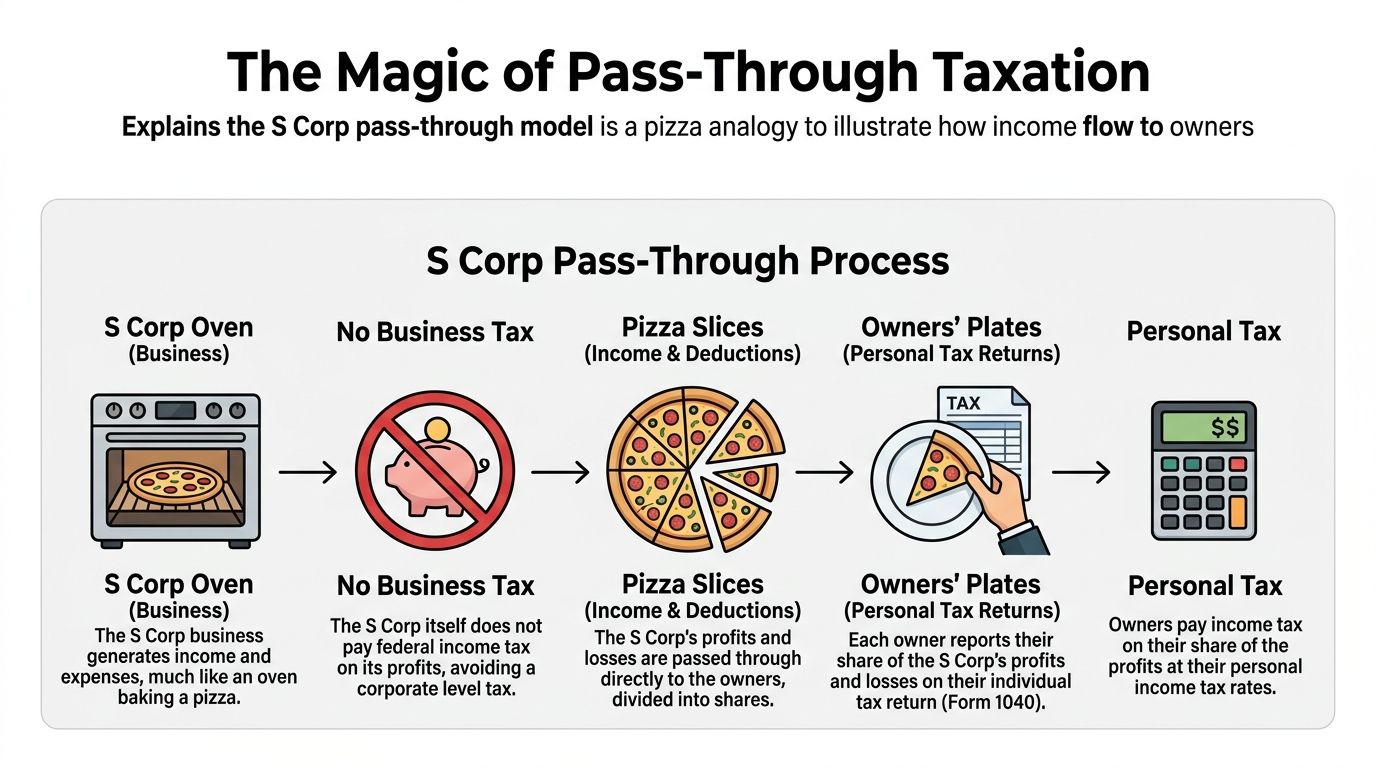
Pass-through taxation is the part that confuses many new S corp owners at first. The business files its own tax return, but the federal income tax on profit usually shows up on the owners’ personal returns.
A quick real-world example helps. Say your S corp earns a profit for the year, but you leave most of the cash in the business account to cover rent, software, and future payroll. You may still owe tax on your share of that profit even though you did not transfer that same amount to your personal account. That is the practical side of pass-through taxation, and it surprises owners all the time.
How the profit gets reported
The S corp reports income and deductions on Form 1120-S. Then each shareholder receives a Schedule K-1 showing that owner’s share of the tax items. The owner usually reports those amounts on their personal return.
Here is the simplest way to picture it. The business bakes the pizza. The K-1 shows how many slices belong to each owner for tax purposes.
If two owners each own half of the company, each generally reports half of the profit. If ownership is split differently, the tax items usually follow those ownership percentages.
The important part is this: tax reporting and cash withdrawals are two different things.
Your K-1 reports your share of the business results. It does not simply track how much money you moved from the business account to your personal account.
That distinction matters in practice. Many owners assume, "I only took $20,000 out, so I only pay tax on $20,000." That is often wrong. If your K-1 shows more taxable income than the cash you received, you may owe tax on the larger amount.
Why owners get tripped up
S corps are often described as avoiding double taxation, and that part is helpful. But it can also make the system sound simpler than it feels in real life.
Here is where owners usually get confused:
- Profit can be taxable before cash is distributed.
- Your ownership percentage usually drives your share of income.
- Bookkeeping errors can flow straight onto your personal return through the K-1.
- Owner pay decisions affect the final tax picture, especially if salary is too low or distributions are too high.
That last point is a big one. Pass-through taxation does not mean you can skip the owner-pay rules. If you actively work in the business, salary still needs to be handled correctly. A good starting point is this guide on reasonable salary for an S corp owner, because the right split between wages and profit affects both compliance and tax savings.
Losses pass through too
Losses can pass through to the owners as well, which sounds great until basis enters the conversation.
Basis is your tax investment in the company. In plain English, it is the running measure of how much tax benefit and distribution room you have. It usually starts with what you put into the business, then changes over time as the business earns income, passes through losses, and makes distributions.
A simple example makes this easier. Suppose you put money into the company and your tax basis is $30,000. If your share of the S corp loss is $20,000, you may be able to deduct that amount. If your share of the loss is $40,000, part of it may be suspended until you have enough basis.
The plate analogy works well here. Basis is the size of your plate. If your plate only holds so much pizza, you cannot pile on more loss deductions than the plate can carry.
Why basis matters in real life
Basis problems usually do not start with fraud or aggressive tax planning. They start with ordinary habits. An owner puts money in without recording it clearly. Another takes distributions during the year and never updates the books. By tax time, nobody is sure how much loss is deductible or whether a distribution created a tax issue.
A few habits make this much easier:
- Keep a basis worksheet. Update it when you contribute money, lend money to the business, take distributions, or use losses.
- Review basis before year end. Waiting until return prep often leads to missed deductions or unpleasant surprises.
- Match tax reporting to legal ownership. Your books, shareholder records, and tax return should all tell the same story.
For many small business owners, this is the moment the theory clicks. The S corp itself generally does not pay federal income tax on its profit the way a C corp does. The owners report that profit, whether or not all the cash was distributed.
That is the power of pass-through taxation. The tax bill passes to the owners, so good records and smart owner-pay decisions matter just as much as profit.
Paying Yourself The Smart Way Payroll vs Distributions
You finish a strong month, look at the S corp bank balance, and wonder, “Can I just transfer money to myself?” That is where many new owners get into trouble.
With an S corp, owner pay usually has two lanes. One lane is payroll, which pays you as an employee for the work you do. The other is distributions, which move profit to you as an owner. Both put cash in your pocket, but they do not follow the same tax rules.
Why the split matters
Payroll is your paycheck for actual work. It runs through payroll tax filings and is subject to Social Security and Medicare taxes. Distributions are different. They are a return of profit to the shareholder and do not get that same payroll tax treatment, based on the owner-pay example summarized by Desi Tax Service.
A pizza works well here. Salary is the slice you earn for working in the shop, making dough, taking orders, and managing the staff. Distribution is your share of whatever pizza is left because you own the shop. The IRS expects you to take the work slice first if you are actively working in the business.
That rule creates tax planning room, but only if you do it in the right order. Pay yourself a salary the IRS can defend. Then take additional profit as distributions if the business has enough earnings and cash.
Salary and distributions side by side
| Feature | Reasonable Salary (W-2 Wages) | Profit Distribution |
|---|---|---|
| What it is | Pay for the work you perform in the business | Share of business profit after salary |
| How it gets paid | Through payroll, with withholdings and payroll filings | By owner draw or transfer, recorded as a distribution |
| Payroll taxes | Applies | Does not apply in the same way |
| IRS concern | Whether your pay matches your role and duties | Whether you took distributions before paying proper wages |
| Best use | Compensate actual labor | Take remaining profit in a tax-efficient way |
What “reasonable salary” actually means
This is the part many articles gloss over, and it is usually the biggest audit risk.
“Reasonable” does not mean “as low as possible.” It means your pay should make sense for the job you perform. If you bring in clients, manage workers, oversee operations, and deliver the service yourself, your salary should reflect that reality. If you are mostly passive and someone else runs the company day to day, the answer may be different.
In practice, we tell owners to build a small file that answers one question: what would you have to pay someone else to do your job? That file can include wage data, your job duties, hours worked, industry pay ranges, and the company’s revenue. If you want help building that file, this guide on reasonable salary for an S corp owner walks through the process in more detail.
The same source noted that the IRS can reclassify distributions as wages if owner compensation is too low. That can mean back payroll taxes, penalties, and interest.
A practical example
Say your S corp earns a healthy profit and you work in it full time. You handle sales, client work, and management. In that case, treating every dollar you take out as a distribution is risky because it ignores the value of the work you perform.
Now change the facts. You own the company, but a hired manager runs daily operations and you spend very little time on it. Your salary analysis may come out lower because your services to the business are limited.
Same entity type. Different facts. Different answer.
That is why owner pay should be based on records, not gut feel.
A short checklist before you pay yourself
Use this before you set payroll or take large distributions:
- Write down your real duties. Sales, production, management, bookkeeping, hiring, and strategy all count.
- Check market pay for similar work. Use actual job matches, not a flattering title.
- Match pay to time spent. A part-time owner and a full-time operator should not look the same on paper.
- Run payroll on a normal schedule. Monthly, semi-monthly, or biweekly is easier to defend than random checks.
- Record distributions clearly. Do not mix them with wages in the books.
- Review compensation each year. Growth, new staff, or a changing role can justify a different salary.
- Keep your support in one folder. Many owners use the best software for tax professionals to organize payroll records, reports, and supporting documents.
A simple rule helps here. If the payment is for your labor, treat it like payroll. If the payment is a share of profit after reasonable wages have been handled, treat it like a distribution.
That approach keeps the tax savings legitimate and gives you a cleaner story if the IRS ever asks how you picked your pay.
A Step-by-Step Checklist for Filing S Corp Taxes
It is March. You finally sit down to file, and one question turns into six. Are the books final? Did payroll match the W-2s? Were those owner transfers distributions, loan repayments, or reimbursements?
That is why S corp filing works better as a checklist than a once-a-year scramble. You are not just filling out a return. You are making sure the numbers on that return match what happened in the business.
A simple way to view it is this. Your tax return is the finished pizza. If the dough, sauce, and toppings were thrown together carelessly, the final slice will show it. Clean records first. Tax forms second.
Start by cleaning up the books
Before you touch the return, make the accounting reliable. Unreliable accounting causes many first-time owners to lose hours they did not expect to lose.
Review these areas first:
- Reconcile bank and credit card accounts. Every balance in the books should match a real statement.
- Pull out personal expenses. If an owner ran personal spending through the business, reclassify it before filing.
- Match payroll to the books. Wages, payroll tax filings, and year-end forms should agree.
- Label owner transactions correctly. Separate contributions, distributions, loans, and reimbursements.
If your team is tightening up its tax workflow, this guide to the best software for tax professionals can help you compare tools for organizing records, payroll support, and filings.
Know the few forms that drive the process
You do not need to memorize every IRS form. You do need to know the forms that matter so nothing sneaks up on you.
Form 1120-S
This is the federal tax return for the S corporation. It reports the company’s income, deductions, gains, losses, and other tax items. For calendar-year S corps, it is generally due March 15. If you need more time, you can usually request an extension to September 15.
Schedule K-1
Each shareholder gets a K-1. It shows that owner’s share of the S corp’s tax items so those amounts can be reported on the owner’s personal return.
Form 7004
This is the extension form for the entity return. It gives you more time to file the return itself. It does not fix late payroll filings or sloppy bookkeeping.
Payroll forms
If you work in the business and take wages, payroll reporting matters all year, not just at tax time. That usually means quarterly payroll filings and year-end wage reporting need to tie back to the return.
Follow this filing order
Owners who stay organized usually follow the same sequence.
Close the year in the books
Finalize income, expenses, payroll, and balance sheet items. Do not build a return from rough guesses or memory.Confirm the S election is in place
If you are unsure whether the company properly elected S status, review this guide explaining how Form 2553 establishes S corporation tax treatment.Tie out owner pay
Make sure payroll records support the salary paid to any owner-employee. This is also the point to compare wages to your role, hours, and local market pay so the file tells a reasonable story if anyone asks later.Prepare Form 1120-S
This is the main entity return. Everything else flows from it.Create and review each K-1
Every shareholder needs an accurate K-1 before finishing a personal return.File an extension on time if needed
More time is fine. Missing the deadline is what creates trouble.
One missed item can slow down the whole chain. A late or inaccurate entity return means delayed K-1s, and delayed K-1s usually mean extended personal returns, amended returns, or both.
A practical filing checklist you can save
Use this list each year:
- Books reconciled through year-end
- Personal expenses removed or reclassified
- Owner salary and payroll records reviewed
- Shareholder distributions and loans labeled correctly
- Form 1120-S prepared
- K-1s issued to every shareholder
- Extension filed, if needed
- Personal returns updated using the K-1s
Where first-time filers usually get stuck
The forms are rarely the actual problem. The missing support is.
A common example is an owner who took money out of the business all year without clear labels. In January, those transfers all look the same in the bank feed. In tax prep, they are very different. One may be wages. Another may be a distribution. Another may be repayment of money the owner previously put into the company. If they are grouped carelessly, the return gets harder to prepare and easier to challenge.
The practical fix is boring, but it works. Keep records current. Review owner transactions monthly. Check payroll before year-end, not after W-2 season. That is the part many simple guides skip, and it is usually the difference between a smooth filing and a stressful one.
Common S Corp Mistakes That Trigger IRS Audits
The mistake that causes the most trouble is also the one owners are most tempted to make. They pay themselves little or nothing in wages, then take the rest as distributions.
That strategy looks tax-efficient on the surface. It also puts a spotlight on the return.
Unreasonably low salary
A major IRS audit risk is unreasonable salary. The verified data states that IRS audits increasingly target this area, with over 1,000 S-corp cases in 2024-2025 challenging salaries, and notes potential penalties of 20-40% underpayment plus interest, along with a reported 30% increase in IRS small-business audits after post-2022 funding changes, according to UpCounsel’s summary of the issue.
The point isn’t to scare you. It’s to show that salary isn’t a paperwork technicality. It’s one of the first places the IRS looks when an S corp owner tries to push tax savings too far.
Sloppy records around owner money
The second common problem is poor classification of cash moving in and out of the business.
Owners mix these up all the time:
- Payroll wages
- Shareholder distributions
- Loan repayments
- Owner contributions
- Expense reimbursements
If your bookkeeping labels all owner withdrawals the same way, your return can become internally inconsistent. That’s how small errors become expensive questions.
If you can’t explain a transfer from the business account in one sentence, fix the books before filing the return.
Basis mistakes
Basis problems usually show up after the owner has already taken money out or claimed losses. Then the CPA has to work backward.
This often happens when:
- The owner deducts losses without enough basis
- Distributions are taken without tracking prior activity
- Shareholder loans are recorded casually with no support
- Books and tax records don’t agree on capital activity
The fix is simple in concept, even if it takes work. Keep a running basis schedule and update it regularly.
Ignoring corporate formalities
Many small S corps act like sole proprietorships with a fancier tax return. That’s risky.
Even owner-run corporations should keep clean records of shareholder actions, major decisions, and basic corporate documents. You don’t need a boardroom drama scene. You do need evidence that the corporation is being run like a separate entity.
A practical prevention list
- Run real payroll for working owners
- Benchmark salary using actual duties
- Keep personal and business spending separate
- Track basis before losses or distributions become an issue
- Maintain corporate records and minutes
- Review the books before year end instead of after the deadline
Audit risk often grows from repeated shortcuts, not one dramatic mistake. Small-business owners usually stay out of trouble by being boring, consistent, and well documented.
Real-World S Corp Tax Scenarios
A lot of S corp confusion clears up once you put real numbers on a real business year.
The tricky part is that real life rarely follows a neat twelve-month script. Profit can swing. Owners add cash midyear. Payroll has to keep making sense even when the business has one strong quarter and one weak one. That is where theory either holds up or falls apart.
Scenario one consultant with an uneven year
A solo consultant runs an S corp and expects a solid year, but the timing is messy. The first half is strong. Then one major client pauses work for a quarter.
By year end, the business still shows healthy profit. The owner works full time the whole year, so payroll still matters. But the practical question is not just, "Can I take distributions?" The better question is, "What salary would make sense if an IRS examiner looked at my actual duties, hours, and market pay?"
Here is a simple way to frame it. Salary is the slice of the pizza you pay yourself for doing the work. Distributions are the slices you take as an owner after that. If you skip the salary slice or make it unrealistically tiny, the whole pizza starts looking mislabeled.
A careful owner in this situation would usually check:
- What similar consultants in the same market earn for comparable work
- How much time the owner spent on revenue-producing work versus admin work
- Whether payroll stayed consistent with the owner's role, even during the slow quarter
- Whether year-end distributions were much larger than wages
The lesson is practical. A slow quarter does not automatically justify a very low salary if the owner still ran the business full time. Reasonable compensation should match the job, not just the month with the weakest cash flow.
Scenario two startup loss with a midyear cash contribution
Now switch to a newer S corp with two equal owners and an early loss. The company spends heavily on setup, marketing, and software before revenue catches up.
Midyear, one owner puts more personal money into the business to keep it going. That changes the tax picture. Losses may pass through, but each owner can deduct only the amount supported by that owner's basis. In plain English, basis is your tax investment in the company. It works like the running balance on your personal scoreboard.
Here is why this matters. If the business loses money and one owner adds cash while the other does not, the two owners may not have the same ability to use their share of the loss right away. The loss allocation might still be split by ownership percentage, but the deduction can be limited at the individual level.
That catches many owners off guard because they assume "50-50 ownership" means "same tax result this year." Sometimes it does. Sometimes it does not.
What these scenarios show in practice
S corp taxes get easier once you separate the three buckets.
First, money paid as salary is compensation for work. Second, distributions are owner withdrawals. Third, pass-through income or loss is the tax result reported to the owner whether or not cash moved.
Those buckets can line up neatly. They often do not.
A consultant can have uneven cash flow and still need defensible payroll. A startup can have a real loss and still find that one owner cannot currently deduct the full amount. That is why strong S corp planning is less about memorizing rules and more about matching the books, payroll, and owner activity to what happened.
A simple year-end review helps:
- Compare owner salary to actual duties and market pay
- Review distributions after confirming payroll is reasonable
- Update each shareholder's basis before claiming losses
- Check whether cash contributions or shareholder loans were recorded correctly
- Make sure the tax return matches the books, not a rough estimate from memory
That checklist is where good S corp tax advice pays off. It turns abstract rules into decisions you can defend.
Frequently Asked Questions on S Corp Taxation
Can my LLC be taxed as an S corp
Yes, if your LLC meets the IRS rules and files the S election on time.
A lot of new owners mix up legal structure and tax treatment. It helps to separate them. Your LLC is the box the business operates in. The S corp election is the tax label on that box. You are not creating a new type of company. You are choosing a different way for the IRS to tax the same business.
Do S corps pay federal income tax
Usually, no. In most cases, the S corp files an informational return, and the income flows through to the shareholders' personal tax returns.
A simple way to picture it is a pizza. The S corp calculates the whole pizza first. Then each owner gets their slice reported on a K-1. The business usually does not pay federal income tax on the whole pizza itself. The owners pay tax on their slices. A few special exceptions exist, but most small business owners deal with pass-through treatment, not corporate income tax.
What state taxes should I watch for
State rules are where theory and practice often split apart.
Federal S corp treatment does not mean your state will follow the same playbook. Some states tax S corps differently, charge franchise fees, require separate elections, or impose minimum business taxes even when federal tax is pass-through. California is a common example because it applies a franchise tax to S corporations.
This is one of the first places owners get surprised, especially after hearing that an S corp "doesn't pay tax." Sometimes that is broadly true at the federal level and incomplete at the state level. Check your home state and any state where you do business.
What’s the biggest area of confusion for new owners
The biggest trouble spot is usually owner pay.
New owners often blend together salary, distributions, and K-1 income as if they are the same dollar three different ways. They are three separate buckets. Salary is what the company pays you for your work through payroll. Distributions are money you take out as an owner. K-1 income is your share of the company's taxable profit, whether or not cash was distributed.
The reasonable salary question causes the most risk. Owners hear that S corps can reduce self-employment tax, then jump straight to taking distributions. The safer approach is to start with your actual job duties, time involved, and market pay for similar work. Then document how you arrived at that salary before taking extra profits out as distributions. That is the practical step many guides skip.
When should I stop trying to do this myself
Get help once the return stops being a basic one-owner, one-state setup.
Payroll is usually the first line in the sand. Add a second shareholder, uneven distributions, business losses, shareholder loans, or operations in more than one state, and the room for mistakes grows fast. At that point, the cost of fixing payroll errors, basis problems, or late elections can be higher than the cost of getting good advice up front.
A simple checklist helps you decide:
- You pay yourself or plan to start payroll
- You are unsure what a reasonable salary should be
- You took distributions during the year
- The business had a loss
- There is more than one owner
- You loaned money to the business or took money back
- You file in more than one state
If your business is growing and you want help setting up payroll, filing an S election, preparing Form 1120-S, or reviewing owner compensation, Allied Tax Advisors can help you handle the details without the guesswork.