
You're sitting at the kitchen table with an Airbnb statement on one screen, a VRBO payout report on another, and a mortgage statement you're not sure how to allocate. Your San Diego coastal condo earned respectable booking revenue, but you and your spouse also used it personally, paid cleaners, replaced supplies, and covered HOA dues. The question isn't, “What can we deduct?” It's whether the property belongs on Schedule E, Schedule C, or nowhere on the federal rental return at all.
Short term rental tax deductions reward accurate classification, not aggressive guessing. The IRS 14-day rule, average-stay treatment, material participation, personal-use allocation, depreciation, and local occupancy-tax compliance all affect the answer. A useful short term rental definition guide can help clarify the operational meaning of a short-term rental, but tax treatment requires a separate review of your facts.
Table of Contents
- Where You Stand With Short Term Rental Tax Deductions
- The Three IRS Tests That Decide Your Tax Treatment
- Deductions That Move the Needle
- How Depreciation Works on a Furnished Rental
- Schedule E Versus Schedule C for a Host
- State and Local Occupancy Tax Compliance
- Year-Round Recordkeeping and Tax Planning Moves
- Host Questions Worth Answering Before You File
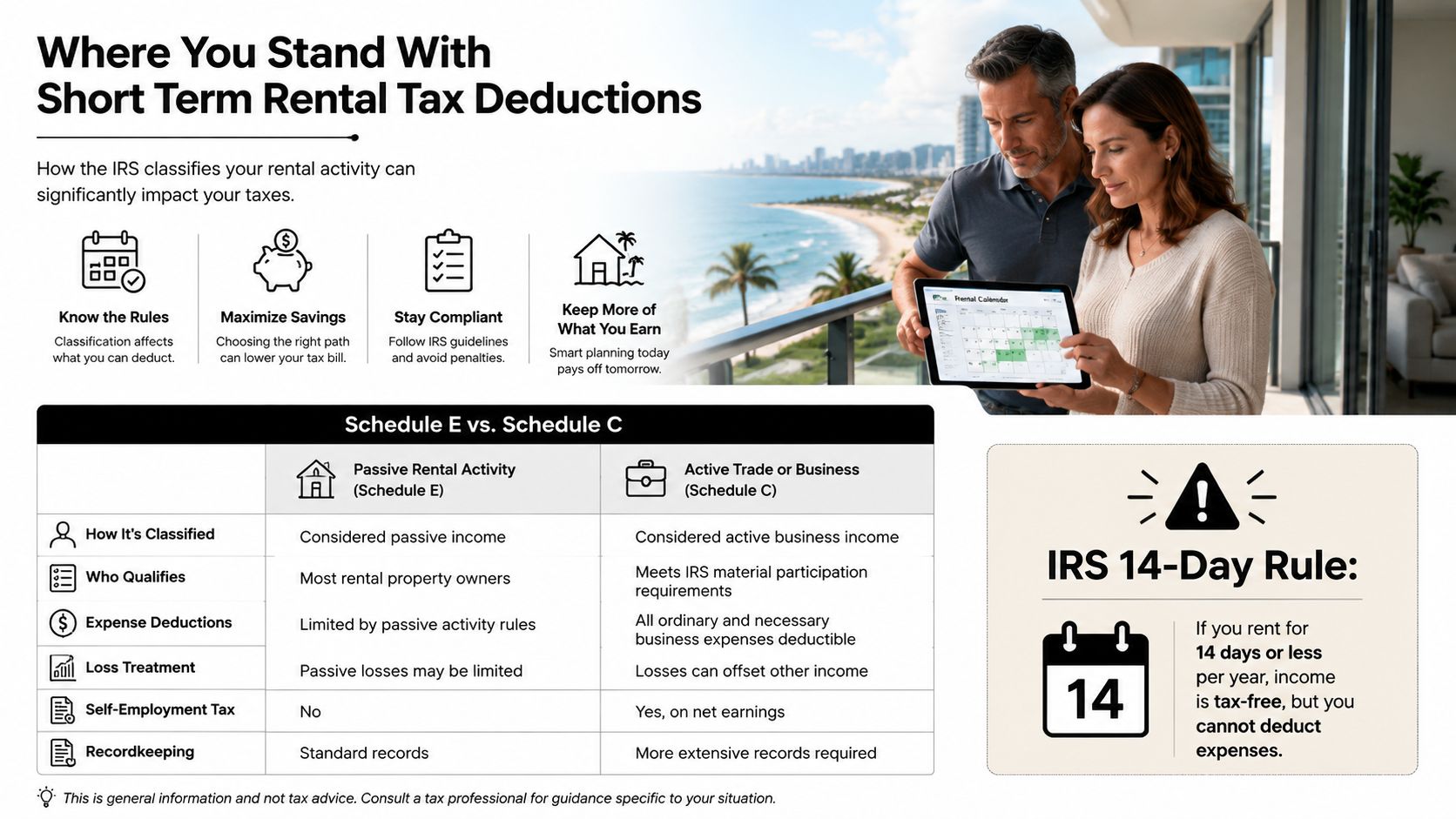
Where You Stand With Short Term Rental Tax Deductions
Start with the decision that controls every later deduction: how many days did you rent the property, how long did guests stay, what services did you provide, and how much did you personally use it? A host who answers those questions before sorting receipts avoids the common mistake of building a deduction schedule for an activity that should not be reported as rental income.
This playbook takes you through the classification rules, operating expenses, depreciation, filing-form trade-offs, occupancy taxes, and recordkeeping. You'll finish with a practical framework for deciding whether to report rental activity, which deductions deserve the most attention, and when a CPA should review the return before filing.
Begin with the reporting gate
If a residence is rented for fewer than 15 days in a year, the IRS says the owner doesn't report the rental income and can't deduct rental expenses for that activity, as explained in IRS Topic 415. That's the foundational rule. It can produce the cleanest result, but only if the host qualifies and keeps records supporting the rental days.
If the property is rented longer, the analysis changes. You'll need to separate rental use from personal use, determine whether the activity is generally passive or operated as a trade or business, and allocate shared costs rather than claiming every property expense in full.
Four mistakes that create avoidable trouble
Allied Tax Advisors commonly sees hosts make four errors on short-term rental returns:
- Choosing Schedule C because the listing feels like a business, without analyzing services, average stay, and participation.
- Claiming the full mortgage interest, property tax, insurance, or utility bill despite personal use.
- Treating furniture, remodeling, and repairs as interchangeable, even though improvements generally require capitalization and depreciation.
- Ignoring local permits and occupancy-tax filings, assuming the platform's collection practices cover every obligation.
Practical rule: Decide whether you're required to report rental activity before you calculate deductions. The deduction list comes second.
The Three IRS Tests That Decide Your Tax Treatment
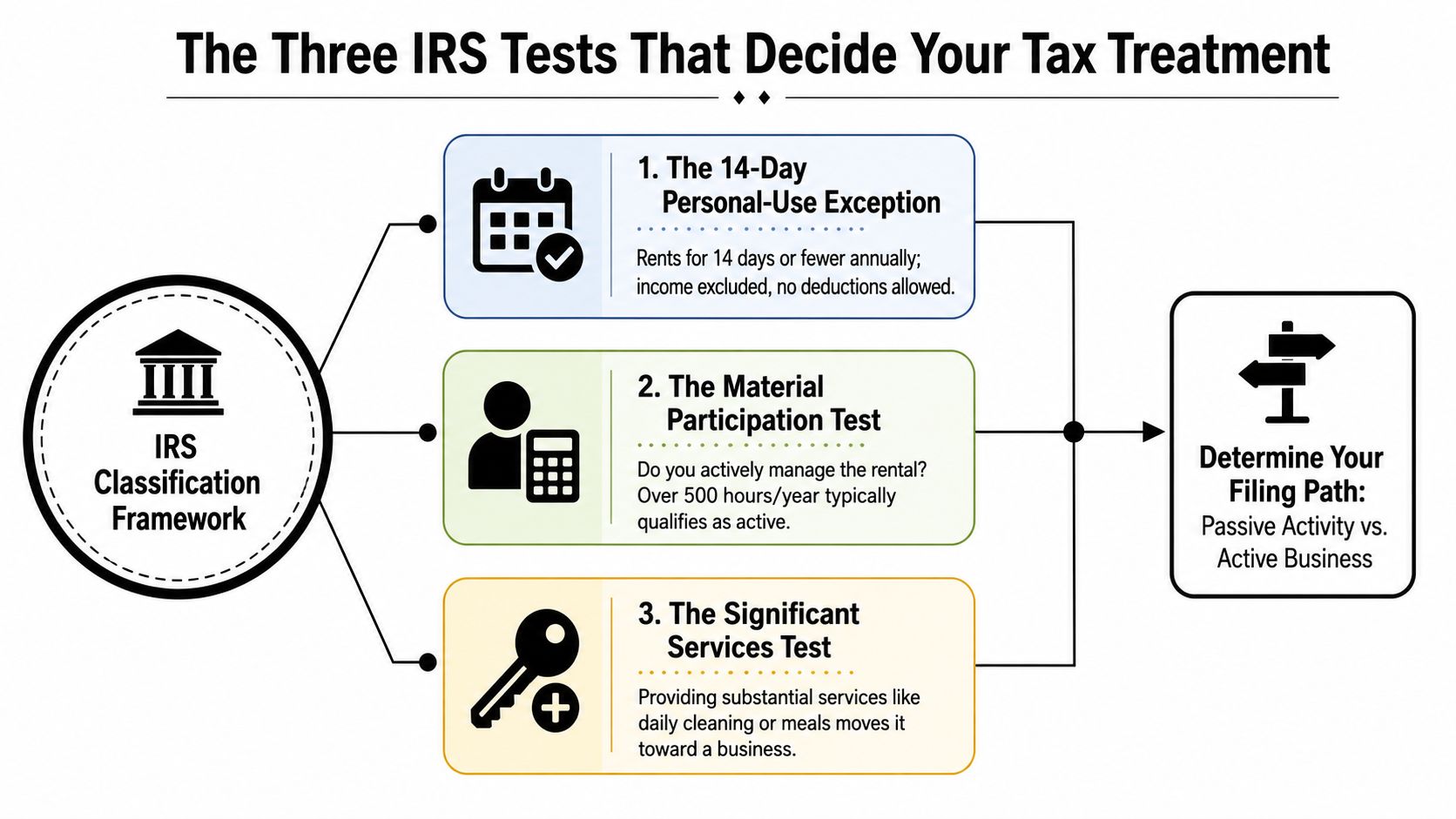
Your two-bedroom coastal rental runs for 110 nights, with guests staying an average of 3.5 nights. Those figures shape the tax analysis, but they do not answer every question. Apply the three IRS tests in order before deciding how the activity should be reported.
Test one is the 14-day threshold
If a dwelling unit used as a residence is rented for 14 days or fewer, the owner generally excludes the rental income and claims no rental-expense deduction, according to IRS Topic 415. The example property was rented for 110 nights, so it does not qualify for that income exclusion for the year.
This threshold resets annually. Recalculate rental days every year and preserve the booking calendar that supports the result. A property rented for 14 days in one year and 110 nights the next can receive different treatment.
Test two examines the average stay and services
An average stay of less than seven days can move the activity outside the standard passive-rental framework, as summarized by the University of Illinois Tax School. With an average stay of 3.5 nights, the example property requires short-term-rental analysis under the average-stay rules.
That classification does not automatically make losses deductible against wages. It identifies the framework you must examine. Substantial guest services can also support business treatment, particularly when the host provides services during the stay instead of only arranging cleaning between reservations.
Test three asks whether you materially participate
Material participation determines whether a qualifying short-term-rental loss remains passive or may offset active income. The host needs records showing meaningful involvement, such as guest communications, pricing, booking administration, inspections, supply purchases, cleaner coordination, and maintenance oversight.
The example passes the average-stay test, yet the owner still needs a credible participation record. A property manager's role, the owner's work, and the nature of contractor duties all affect the analysis. Keep a dated log identifying the task, time spent, and property involved. The material participation test guide provides a focused reference for organizing that review.
For operating context, consult the short-term rental insights blog when comparing guest-service models and property operations. Keep that business context separate from the tax records that prove your filing position.
Before opening an expense spreadsheet, answer three questions:
- Did I rent the property for 14 days or fewer?
- What was the actual average guest stay, and did I provide substantial services?
- Can my records prove material participation?
Clear answers establish the likely filing pathway before you sort deductions. A host who skips these tests can claim otherwise reasonable expenses under the wrong tax treatment.
Deductions That Move the Needle
Single-property hosts typically miss three deduction categories that account for many recoverable costs: recurring operating expenses, shared property costs, and activity-dependent expenses. Rank those categories before sorting receipts. Capture costs that support bookings first, then review mixed-use and capital items with stronger documentation.
For tax years 2018 through 2025, the IRS standard allows expenses incurred in carrying on a trade or business, producing income, or managing, conserving, or maintaining property held for income production, as summarized by the University of Illinois Tax School. Business purpose and a defensible allocation determine whether an expense belongs on the return.
| Deduction Tier | Common Examples | Typical Relative Size |
|---|---|---|
| Tier one, recurring operations | Platform service fees, third-party cleaning, guest supplies, utilities, insurance, HOA dues, management fees, marketing | Usually the most dependable recurring costs |
| Tier two, allocation-sensitive items | Mortgage interest, property taxes, repairs, specialized insurance, larger maintenance work | Often significant, but requires allocation and classification |
| Tier three, activity-dependent items | Home office costs, vehicle mileage, accounting, legal, tax preparation, software | Valuable when the host actively operates the rental |
Tier one deserves monthly attention
Platform fees, cleaning payments, toiletries, paper products, replacement batteries, utilities, guest-only subscriptions, insurance, HOA dues, and management fees form the practical core of short term rental tax deductions. Save invoices, payout reports, and payment records. A bank description such as “supplies” does not establish what you purchased or how it served the rental.
Marketing costs belong here when they support the activity. Retain receipts for listing photography, advertising, booking software, pricing tools, and website costs.
Tier two is where hosts overclaim
Mortgage interest and property taxes may be deductible to the rental extent, but personal use and loss limitations can restrict the result. Repairs generally receive different treatment from improvements. Fixing a broken appliance or patching damage may be an operating expense. A remodel, new roof, or significant upgrade usually becomes part of the property's depreciable basis.
Insurance needs the same review. Coverage for the rental activity can support a rental deduction, while a personal homeowner policy or mixed-use premium requires a defensible allocation.
Tier three follows your operating model
A host who manages the property from a dedicated workspace should analyze potential home-office costs. A host who drives to inspect the condo, collect supplies, or meet contractors needs mileage records showing the date, destination, business purpose, and property. Separate professional fees for rental work from fees for personal tax services.
Pull three months of statements now. Sort each transaction into the three tiers, mark personal or mixed-use charges, and flag capital purchases for CPA review. Do not force a capital cost into an immediate deduction just because the receipt is convenient.
How Depreciation Works on a Furnished Rental
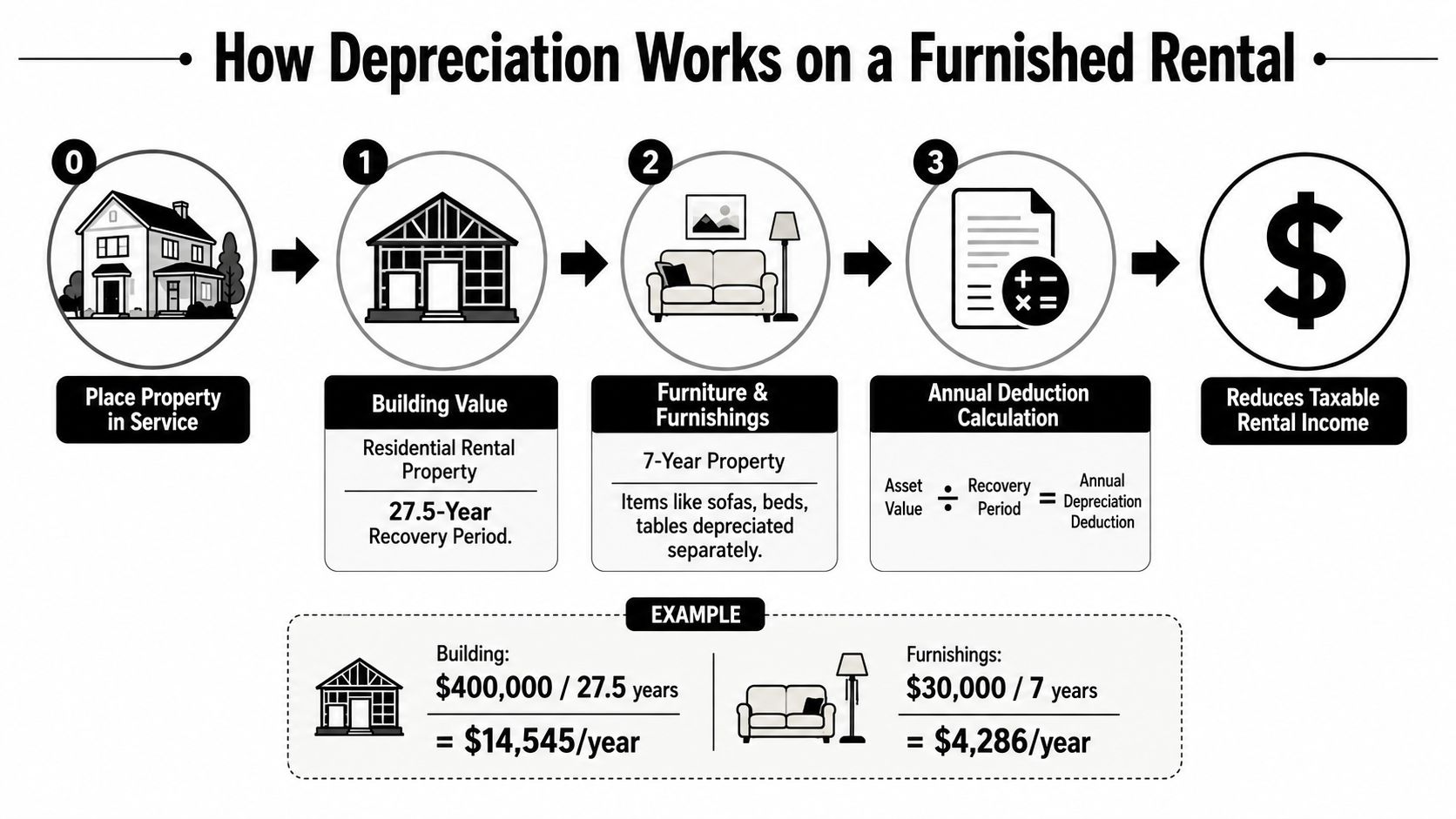
Depreciation converts the cost of income-producing property into deductions over its recovery period. It isn't a cash payment, but it can reduce taxable rental income while the property remains in service.
For a furnished residential rental, the building is generally depreciated over a 27.5-year recovery period, while furniture and furnishings are listed separately. Furniture may fall into five-year or seven-year property, depending on the asset and applicable classification. Appliances, décor, beds, tables, and other equipment shouldn't disappear into one vague “furniture” line.
Place assets in service correctly
The placed-in-service date is the date the property or item is ready and available for rental use, not necessarily the date you paid for it. Keep closing documents, settlement statements, furniture invoices, delivery records, and the first date the listing was available.
Bonus depreciation has changed under current law, and the applicable percentage depends on the asset's acquisition and placed-in-service timing. Don't use an old spreadsheet assumption. Give your preparer the dates and invoices so the correct rule can be applied.
A cost segregation study can identify components that belong in shorter recovery periods, such as certain appliances, flooring, or site improvements. For a single-property operator, the study fee must be weighed against the expected acceleration and the property's classification. It's a technical exercise, not an automatic win.
A concrete calculation
Suppose the condo costs $475,000 and the host purchases $60,000 of furnishings. A rough first-year depreciation estimate of about $25,000 before cost segregation may be possible, depending on land allocation, placed-in-service timing, asset classification, personal use, and applicable depreciation rules. That figure isn't a filing result. It's a prompt to build a proper depreciation schedule.
Depreciation also has a future cost. When you sell, previously claimed depreciation can create recapture income taxed at up to 25 percent, as described in Allied Tax Advisors' rental-property depreciation guidance. If you convert the unit to a long-term rental, update the records and preserve the original basis and depreciation history. Don't treat conversion as a reset.
Schedule E Versus Schedule C for a Host
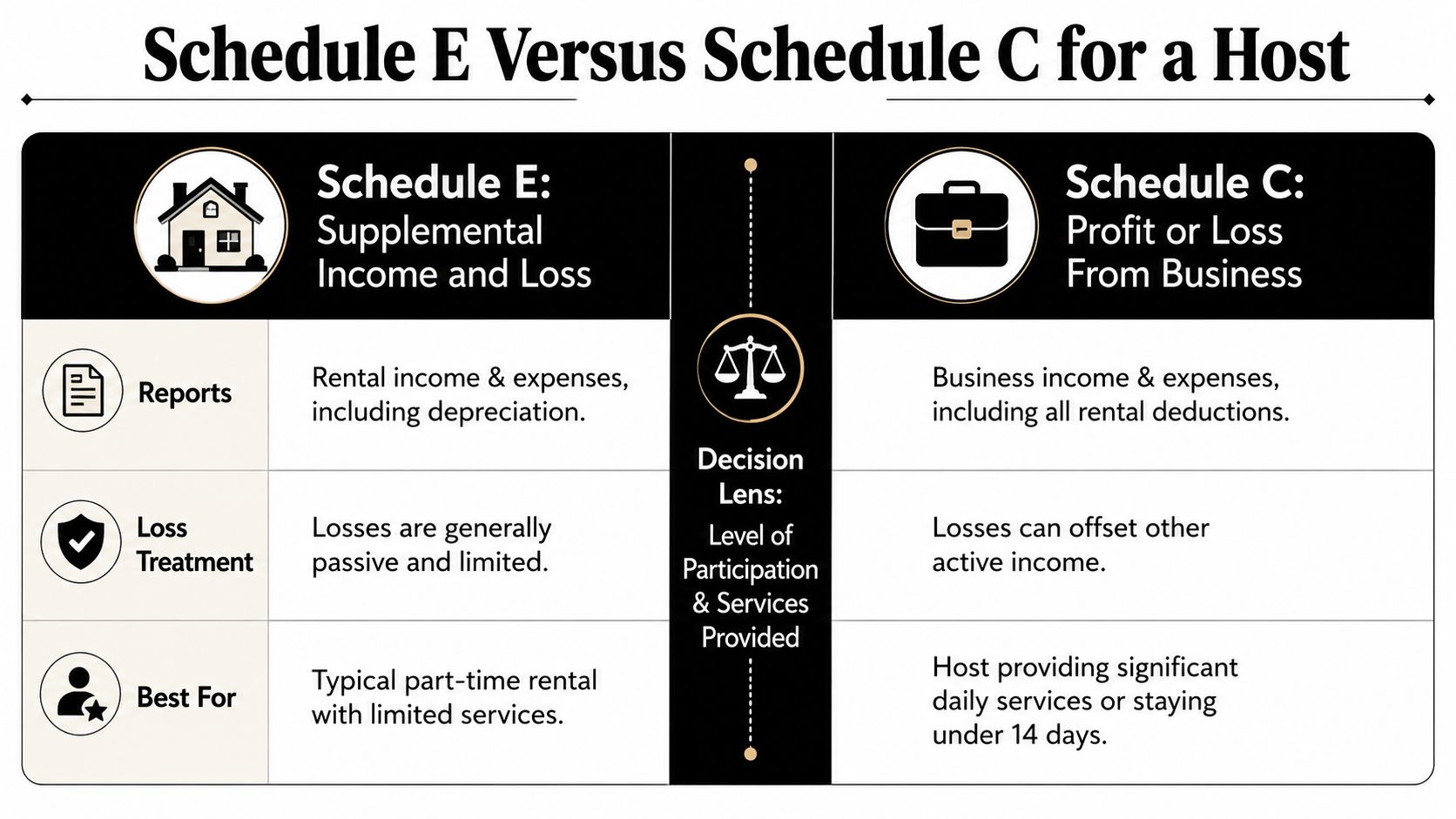
Schedule E generally fits a host operating a rental as an investment with limited services. Schedule C becomes more plausible when the activity operates as a trade or business, particularly when the host provides substantial services or the rental's average stay is short.
The forms carry different consequences. Schedule E commonly reports rental income, expenses, and depreciation, while losses are generally passive and aren't subject to self-employment tax. Schedule C reports business profit and loss, which can support non-passive treatment when the host materially participates, but net income may be subject to self-employment tax.
Use the form as a consequence, not a preference
Consider a single-property host who rents for 90 nights and produces a small profit. Under the planning example, Schedule C could create about $200 of self-employment tax, while Schedule E would create $0 of self-employment tax, subject to the facts and final tax treatment. That comparison shows why a host shouldn't choose Schedule C merely because the property feels active.
Now change the facts. The same host produces a $4,000 loss, materially participates, and satisfies the applicable short-term-rental framework. Schedule C treatment may allow that loss to reduce W-2 wages, while a passive Schedule E loss generally can't do so immediately.
The trade-off is clear. Schedule C can open a path to non-passive loss treatment and business retirement-planning opportunities such as QBI analysis or SEP-IRA contributions, but it can also bring self-employment tax and more operational scrutiny.
Schedule E is usually the sensible starting point for one or two passive rentals. Consider Schedule C when hosting is your primary income-producing activity, services are substantial, or the loss-treatment benefit is real and documented.
For filing mechanics, review Allied Tax Advisors' Schedule E resource with your preparer rather than selecting a form based on an Airbnb label.
State and Local Occupancy Tax Compliance
Federal income tax is only one layer. Cities, counties, and states may impose transient occupancy, hotel, or lodging taxes on short stays. Those taxes can apply even when your federal return reports the activity correctly.
Platforms such as Airbnb and VRBO may collect and remit occupancy taxes in some jurisdictions. That doesn't guarantee complete coverage. A platform might collect one jurisdiction's tax while leaving another registration, permit, filing, or remittance obligation with the host.
Separate platform collection from host responsibility
A host-collected model means you may need to register, file returns, and remit tax yourself. A platform-issued tax form can still report gross booking proceeds, and platform collection doesn't eliminate the need to reconcile those proceeds with your books.
Delaware, for example, has a 4.5 percent tax on stays of 31 nights or less, according to the jurisdictional discussion in this 2026 short-term rental deduction guide. The point isn't to memorize one state rule. It's to recognize that local tax treatment remains a moving target.
Check these items every January:
- Platform coverage: Confirm whether Airbnb, VRBO, and direct-booking channels collect and remit for each location.
- Outstanding filings: Search for missing registrations, returns, notices, and unpaid balances.
- Permit status: Verify business licenses, short-term rental permits, zoning approvals, and renewal dates.
- Revenue reconciliation: Match booking calendars, platform statements, bank deposits, and tax remittances.
- Rule changes: Review the city, county, and state rules before opening the calendar for the new year.
Canada denies income-tax deductions tied to non-compliant short-term rentals for tax years after 2023, while the UK changed holiday-let treatment in 2025, according to the same jurisdictional guide. Hosts with properties outside the United States need local advice, not a U.S.-only deduction checklist.
Noncompliance on the local side can expose inconsistencies between booking revenue, tax forms, permits, and occupancy-tax records. Fix missing filings before an agency asks why the numbers don't match.
Year-Round Recordkeeping and Tax Planning Moves
A short-term rental return becomes easier when the host treats bookkeeping as an operating process rather than a March project. Open a dedicated business bank account and credit card, then reconcile them monthly. A focused 30-minute monthly review can identify missing receipts, personal charges, duplicate platform entries, and unexplained deposits.
Keep a quarterly projection of booking income, operating costs, estimated depreciation, owner use, and major planned purchases. That forecast helps you decide whether to accelerate a legitimate expense, defer a nonessential purchase, or reserve cash for tax.
Keep the records that support the return
Retain:
- Booking calendars: Rental dates, guest stays, cancellations, and personal-use days.
- Platform statements: Gross receipts, fees, refunds, and occupancy-tax collections.
- Expense evidence: Invoices, receipts, payment confirmations, and business purpose.
- Participation logs: Dated entries describing management tasks and time spent.
- Basis records: Closing documents, improvements, furniture invoices, and depreciation schedules.
- Compliance records: Permits, registrations, returns, remittances, and agency correspondence.
Maintain federal tax records for at least three years, and keep capital-improvement and basis records longer because they support future depreciation and sale calculations.
Before year-end, ask whether repairs should be deducted or capitalized, and discuss the de minimis safe harbor election with your preparer. Revisit the entity choice, including a single-member LLC or possible S-Corporation election, only after the activity produces meaningful income and the payroll, compliance, and administrative costs make sense.
For hosts renting 14 days or fewer, the cleanest result may be zero reporting and zero deductions. Chasing write-offs can create unnecessary filings when the law already provides an income exclusion.
Host Questions Worth Answering Before You File
Can a rental loss offset wages from my day job?
Sometimes, but the answer depends on classification and participation. A short-term rental with an average stay under seven days may fall outside the standard rental-activity treatment, but the host still needs to materially participate before losses can potentially offset active income. The loss also has to survive basis, at-risk, and other applicable limitations.
Your next step is simple. Reconcile the booking calendar, calculate the average stay, and prepare a contemporaneous participation log. Bring the file to a CPA if your planned deduction depends on reducing W-2 wages.
What changes if I live in the property?
Personal-use days affect both income allocation and deductions. Owner use, family use, and below-market stays can change how you allocate mortgage interest, property taxes, utilities, insurance, depreciation, and operating expenses.
Create a calendar that distinguishes fair-market rental days, personal days, maintenance days, and unavailable days. Don't claim the full cost of a mixed-use property without a written allocation method and supporting records.
What happens to depreciation when I sell or convert the property?
A sale can trigger depreciation recapture on prior deductions, potentially at up to 25 percent, as explained in IRS Publication 527. Converting a short-term rental to a long-term rental doesn't erase the existing basis or depreciation history. Preserve every depreciation schedule and improvement record.
If you're upgrading into another investment property, ask a CPA about whether a Section 1031 exchange is available and whether the transaction satisfies the property and timing requirements. Don't assume a 1031 exchange automatically eliminates every tax consequence.
What records might an auditor request?
Expect questions about the booking calendar, platform payout statements, bank deposits, receipts, personal-use days, cleaning and management invoices, mortgage and property-tax records, depreciation schedules, permits, occupancy-tax filings, and participation logs. The auditor's concern is usually whether the return matches the underlying activity.
Build one digital folder for each property. Save monthly statements, export calendars, label receipts by category, and record business purpose when the transaction occurs. Reconstructing a year of participation or personal-use records at filing time is a weak defense.
Allied Tax Advisors can review rental classification, expense allocation, depreciation, and federal, state, and local compliance for hosts who want a defensible filing position. Visit Allied Tax Advisors to discuss your property records and build a short term rental tax deductions plan before the next return is due.