
You bought the rental, handled the repairs, and filed what looked like a clean return. Then the losses came back limited, and the question hit fast: did the IRS see you as an owner who worked in the business, or as a passive investor who mostly watched from the sidelines? That answer often turns on the material participation test, one of the most important rules in rental, LLC, and closely held business tax reporting.
At the kitchen table version, this rule is simpler than the IRS language makes it sound. The government is asking a basic question, did you really work in the activity, or did you just own it? The answer can change whether a loss sits on the sidelines for later or lands on your return now, which is why this topic matters so much for landlords, partners, and real estate investors.
Table of Contents
- What Material Participation Actually Means
- The Seven IRS Tests Explained Clearly
- Two Rental Scenarios That Change Everything
- The Real Estate Professional Shortcut
- Building Records That Survive an IRS Review
- How This Test Connects to Your Tax Return
- Common Mistakes That Cost Real Money
- A Practical Checklist and When to Call a Pro
What Material Participation Actually Means
Many landlords only discover this rule once their tax return is already prepared. The property showed a profit on paper, the expenses were genuine, and the loss seemed valid. Then the passive activity rules applied, requiring the taxpayer to demonstrate material participation in the activity, not merely that the property was listed on a Schedule E.
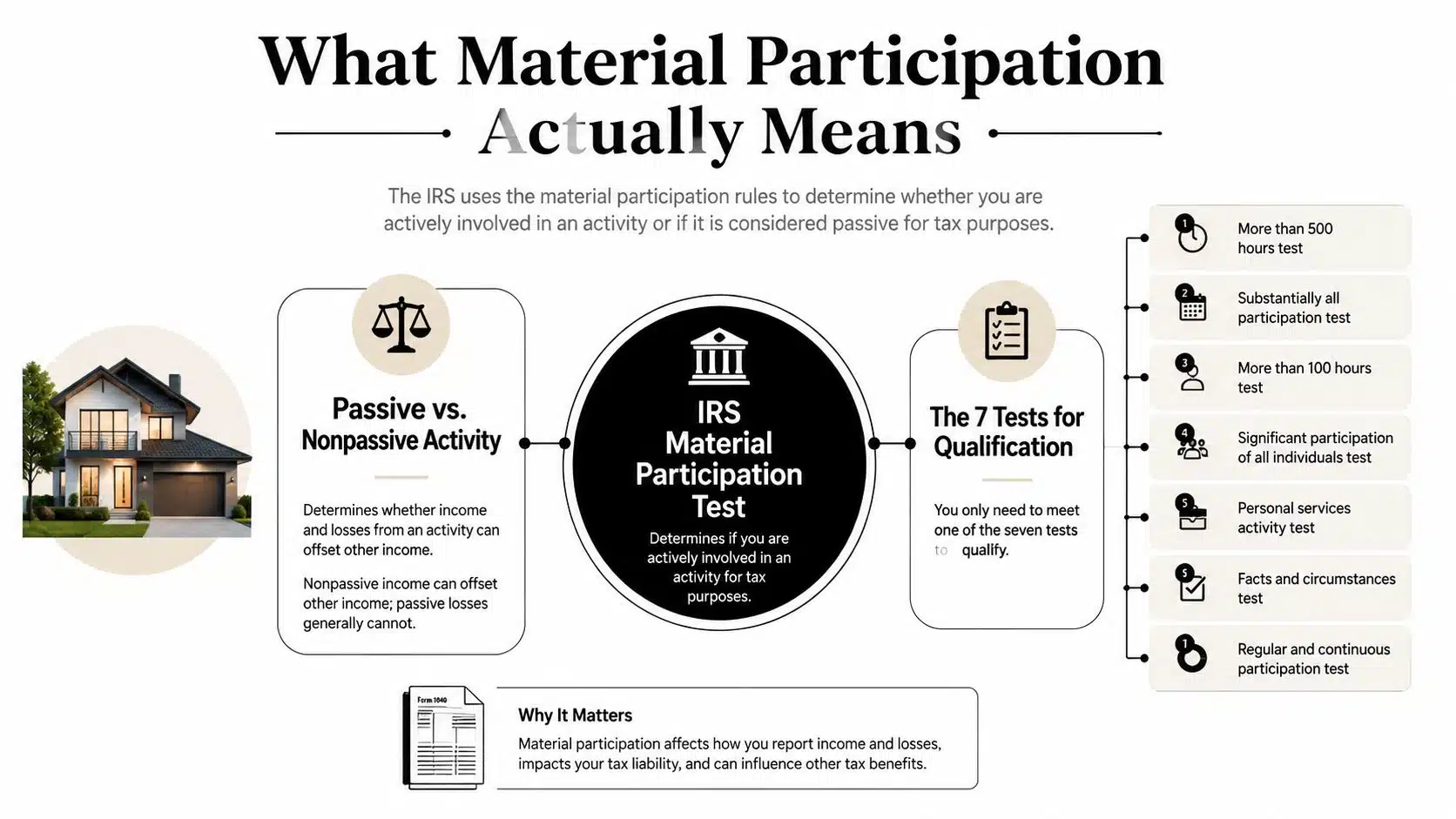
The IRS uses seven separate material participation tests to decide whether an activity is passive or nonpassive, and a taxpayer needs to satisfy any one of them for the tax year. That structure matters because the IRS is not looking for a vague sense of involvement. It is looking for a documented level of work that shows the taxpayer was engaged in the business, not just collecting statements and signing checks. The rules are especially important in real estate, LLCs, and closely held businesses, where owners often do some work but not enough to know where they stand.
Why the IRS cares about hours
The whole point is to separate active involvement from passive ownership. Under the passive activity loss rules, a passive loss generally can't offset nonpassive income the way an active business loss can. That's why a single number, especially a credible hour count, can make a real difference on a tax return.
Practical rule: if the work is real enough to claim, it should be real enough to document.
The historical shift here is important. The IRS moved the conversation away from loose descriptions like “I stayed involved” and toward a quantified framework based on time. For investors, that means the safest mindset is simple, track the work as you do it. If you can't show the hours later, the IRS may treat your estimate as unsupported. For a plain-English overview of the passive activity framework, this guide to passive activity loss rules is a useful companion.
The Seven IRS Tests Explained Clearly
The seven tests are not seven different jobs. They are seven ways to show the IRS that your involvement was real enough to count. For many taxpayers, the easiest ones to understand and document are the 500-hour test and the 100-hour test. The IRS also looks at longer patterns of involvement, such as participation in 5 of the previous 10 tax years, and a separate 3 prior years lookback for personal service activities. Those are the landmarks to keep in mind, because they show two things at once, how much you did and how steadily you did it.
The main tests in plain English
1. More than 500 hours.
This is the clearest path. If you spent more than 500 hours on the activity during the year, you may meet material participation. Best fit for: landlords, operators, and hands-on owners who stay close to the work.
2. Substantially all participation.
You did most of the work, and no one else shared the load in any meaningful way. Best fit for: smaller businesses where the owner is the main worker and decision-maker.
3. More than 100 hours and nobody else did more.
You do not have to be the only person involved, but your hours must exceed anyone else's. Best fit for: owners who stay active without carrying the entire operation alone.
4. Significant participation activities.
You take part in several qualifying activities, and the total time reaches the level the rules require. Best fit for: taxpayers who split their time across multiple business interests.
5. 5 of the previous 10 tax years.
You materially participated in the same activity for five of the prior ten years. Best fit for: long-running operators and repeat owners who have a clear history of involvement.
6. Personal service activity rule.
For certain service businesses, the lookback period is 3 prior years instead of ten. Best fit for: service-oriented taxpayers with recurring involvement over time.
7. Facts and circumstances.
Your participation is regular, continuous, and substantial when you look at the whole picture. Best fit for: unusual situations where the hour tests do not fully capture what you did.
| Test | Threshold | Best Fit |
|---|---|---|
| 500-hour test | More than 500 hours | Hands-on owners with steady involvement |
| 100-hour test | More than 100 hours, no one else does more | Active owners with limited but concentrated time |
| 5-of-10-years test | Material participation in 5 of the previous 10 years | Long-term operators |
| Substantially all test | Taxpayer does nearly all the work | Small operations with one primary worker |
| Significant participation activities | Multiple activities counted together | Multi-activity taxpayers |
| Personal service activity rule | 3 prior years for personal service activities | Service businesses |
| Facts and circumstances test | Regular, continuous, substantial involvement | Edge cases |
That table works like a quick screening tool. If your facts do not fit one of the easier tests, the return is harder to defend, and the IRS has more room to question your position. For a broader technical overview of the passive activity framework, this analysis of rental loss limits can help connect the dots.
Two Rental Scenarios That Change Everything
Two investors can own nearly identical properties and land in different tax buckets. The difference is often not the building. It's the record of what each owner did during the year.
The owner who stayed hands-off
One San Diego landlord uses a property manager for nearly everything. Rent collection, tenant communication, repairs, and most decisions run through that manager, and the owner's own time is close to zero. On the return, that usually looks like a passive activity, so the losses don't freely offset other income. They may stay suspended and carried forward under the passive activity rules.
The owner who stayed in the weeds
Another owner self-manages a duplex, answers tenant calls, coordinates vendors, reviews repairs, and keeps a running log of every task. That person may have a very different result if the hours support one of the IRS tests. The activity is still a rental, but the tax treatment can change depending on whether the participation rises to the level the IRS cares about.
Practical rule: the same property can produce a passive loss for one owner and a nonpassive loss for another, because the IRS judges the person's involvement, not the address.
That difference matters on Schedule E. A passive loss that doesn't clear the rules can be held back for later years, while a qualifying nonpassive loss can be usable now. The mechanics are less about real estate glamour and more about whether the owner can prove actual work, not just ownership.
The best way to think about it is this, the property is only half the story. The other half is your calendar, your emails, and your calls with vendors. If you've ever wondered why one client's return seemed to absorb the loss while another's didn't, this is usually where the fork in the road begins.
The Real Estate Professional Shortcut
Material participation alone does not solve every rental tax problem. For many owners, the bigger question is whether they qualify as a real estate professional, because that status can move rental activities out of the passive bucket when the other requirements are met.
The two big hurdles
The first hurdle is the time test, more than 750 hours in real property trades or businesses during the year. The second is the service test, more than half of the taxpayer's personal services must be in real property trades or businesses. Those two checks work together, and both matter.
A lot of taxpayers get tripped up by the spouse issue. In many cases, the test is not a household-wide averaging exercise. The spouses need to be analyzed separately unless they make the appropriate election to treat activities as one. That catches people off guard because one spouse may be heavily involved in real estate while the other has a different career entirely.
The rule is often the difference between a rental loss sitting on the sidelines and a rental loss reaching the return. A part-time agent can sometimes qualify if the time and service mix are right. A full-time engineer with a few weekend property tasks usually does not.
For a detailed overview of the status itself, see this real estate professional tax status guide. The practical lesson is simple, don't guess based on title, license, or general busyness. Count the work, compare it against the two hurdles, and then look at the rental participation rules on top of that.
Building Records That Survive an IRS Review
The IRS does not care how reasonable your estimate feels. It cares whether you can show the hours with records that hold up under review. That means your best defense is not a memory from tax season, it's a routine you can keep all year.
What to save and how to save it
Start with time logs, calendar entries, emails, texts, and short narrative summaries of what you did. Add vendor invoices and any notes that show why you made the call or approved the repair. Those records work together, because one line item on its own can look thin, while a cluster of consistent records tells a more believable story.
A simple setup is enough. Use a notes app or shared calendar, then spend ten minutes every Friday cleaning up the week's entries while the details are still fresh.
Keep the log boring. Boring is defendable.
A spouse-by-spouse review matters too. If both spouses work in the activity, their hours may need to be tracked separately so you can prove each person's participation correctly. A merged household memory is not the same thing as separate support in an audit.
A strong log entry looks like, “Reviewed tenant repair request, called plumber, approved estimate, and coordinated access for Tuesday.” A weak one looks like, “Worked on property stuff.” One shows a task and a time stamp. The other is too vague to carry much weight.
For document habits that support the rest of your file, this document retention policy resource is a useful reference point.
How This Test Connects to Your Tax Return
The material participation result doesn't live in a vacuum. It feeds into the return through Schedule E and Form 8582, which is where passive losses and credits are tracked. If an activity is passive, the loss may be limited and carried forward. If the activity becomes nonpassive, the result can be very different.
Here's the basic math. If you have a $20,000 current-year loss, $8,000 of passive income, and $12,000 of released suspended losses, the return has to sort out how those amounts interact under the passive activity rules. The exact treatment depends on the activity classification, but the point is clear, one classification change can allow losses that were previously parked to be used.
Where the release usually happens
Suspended losses often stay in the background until something changes, such as the taxpayer becoming nonpassive or a qualifying disposition triggering the rules. That's why investors need to think beyond the current year. The classification this year can affect what becomes usable later.
If you want a practical overview of how this connects to partnership and syndication reporting, the Homebase syndication tax guide is a helpful read. It sits in the same universe of loss treatment, activity classification, and return mechanics.
The main point for taxpayers is simple, the test and the return are linked. You don't just “qualify” in the abstract. You either clear the hours and evidence needed to change the tax treatment, or you don't.
Common Mistakes That Cost Real Money
Most audit problems around this topic start with overconfidence. Someone rounds up hours to hit a threshold, assumes a spouse's time counts automatically, or treats a title like general partner as if it guarantees the result. None of those shortcuts replace actual proof.

The traps I see most often
- Inflated hour estimates. The IRS can reject unsupported estimates, especially when there's no contemporaneous log.
- Ignoring spouse participation. If both spouses worked, the time needs to be handled carefully, not guessed at as a household total.
- Assuming status from title alone. Being a partner or owner doesn't automatically satisfy the test.
- Double-counting the same time. One hour can't usually be counted twice just because it helped two activities.
A taxpayer may feel qualified on paper and still lose the deduction after audit if the records aren't there. That's the uncomfortable part of this rule, the facts can be true in a general sense and still fail in tax form because the proof is too thin. The fix is usually boring, but effective, keep the log contemporaneous and specific.
A Practical Checklist and When to Call a Pro
Before you sit down with a tax advisor, gather hours by activity, spouse hours, your real estate professional calculation, any currently suspended losses, and the two most recent tax returns. If the move could shift taxable income by a meaningful amount, or you're dealing with an IRS notice, that's not a DIY moment.
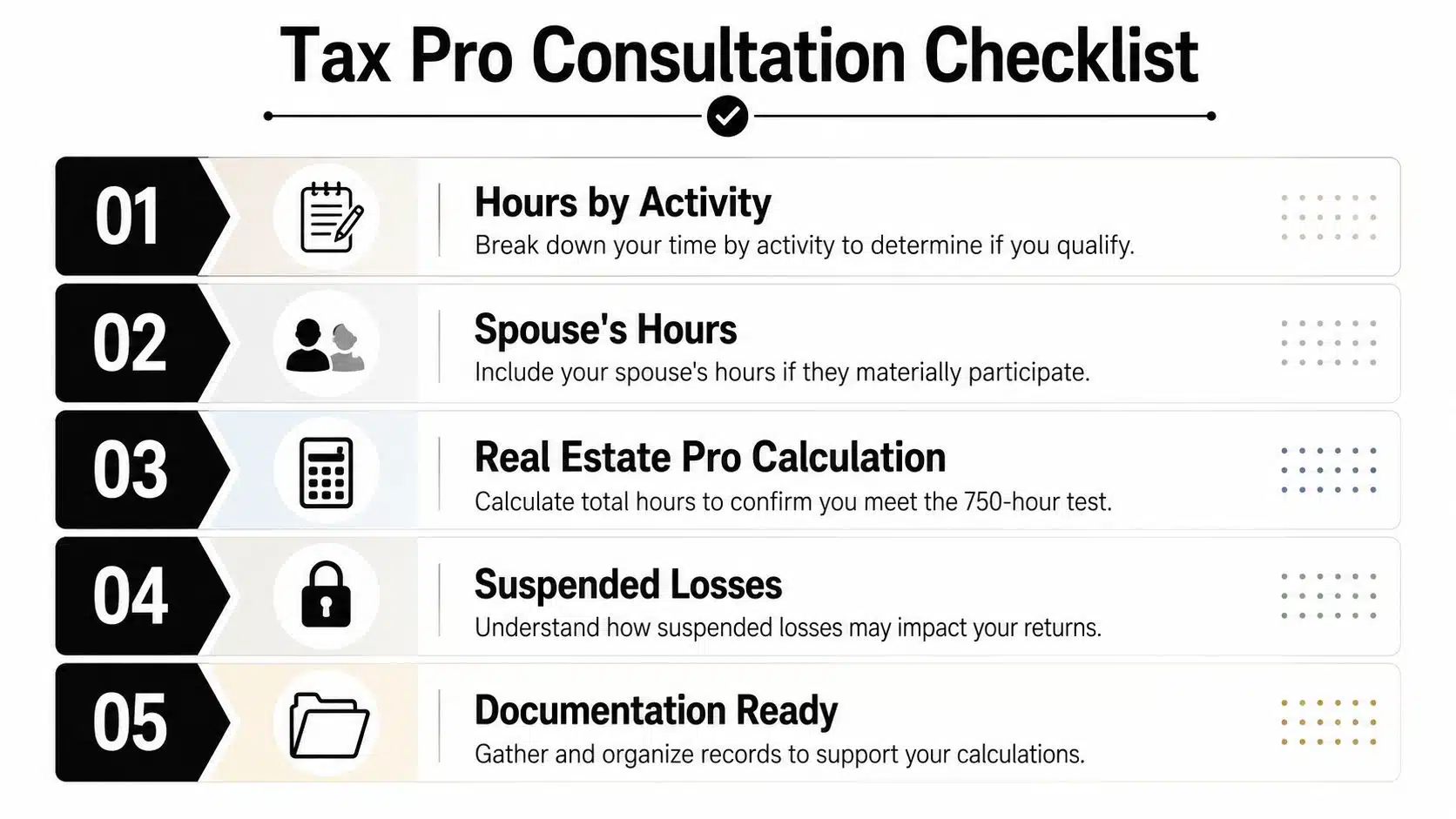
A review is especially worth it when you're near the real estate professional line, trying to defend a material participation position, or sorting through losses that were suspended in prior years. The cleanest outcomes usually come from good records and a calm second look, not a last-minute scramble.
If you want a hands-on review of your rental hours, suspended losses, or real estate professional position, Allied Tax Advisors can walk through the facts with you and help you make sense of the return before it's filed. If you're in Clairemont or anywhere in San Diego and this rule might change your taxable income, it's worth getting a CPA involved before the IRS does.