
You open your W-2, see a large California withholding number, then glance at your property tax bill and ask the same question many high earners ask every year. “Do I get any real federal relief for this, or am I still stuck at the old SALT cap?”
That question is more important in 2026 than it was a few years ago. A lot of articles still talk about the state income tax deduction as if the answer is simple. It isn't. The rules changed, the cap changed, and for some taxpayers the planning opportunity is real. For others, the benefit still disappears because they won't itemize or because their income pushes them into the phase-down.
If you live in California, own a business, receive K-1 income, or pay substantial estimated taxes, this is where careful planning matters. The state income tax deduction is no longer just a line item you notice in April. It's something you should model before year-end.
Table of Contents
- Your Guide to the State Income Tax Deduction in 2026
- What Is the State and Local Tax SALT Deduction
- The 2026 SALT Deduction Cap and Phase Down Rules
- Should You Itemize or Take the Standard Deduction
- Advanced Planning Strategies to Maximize Savings
- Implications for Business Owners and Investors
- Next Steps and When to Consult a CPA
Your Guide to the State Income Tax Deduction in 2026
A common California scenario looks like this. You earn good income, your paycheck shows heavy state withholding, maybe you also make quarterly estimates, and you own a home with meaningful property taxes. You assume that all of that should help on your federal return. Then you remember years of hearing about the $10,000 SALT cap, and you conclude there's probably no point in planning.
That assumption can cost you.
For 2026, the state income tax deduction sits inside a revised SALT framework. The deduction may be more valuable than many taxpayers expect, but only if they understand three moving parts at the same time: whether they itemize, how the temporary higher cap works, and whether income triggers a phase-down.
Practical rule: Don't treat SALT as an April issue. For many taxpayers, the right time to manage it is before the tax year closes.
This matters most for taxpayers with uneven income. A bonus, stock sale, large K-1, business profit spike, or Roth conversion can change whether the higher SALT cap helps at all. It can also change whether accelerating or deferring income makes sense.
The planning conversation is different now. Instead of asking only “Can I deduct state taxes?” the better questions are these:
- Will I itemize this year
- Will my adjusted gross income reduce the available SALT deduction
- Should I use a pass-through entity tax election if I own a business
- Should I change the timing of estimated taxes, property taxes, or charitable gifts
Those are the questions that drive actual savings. The answer is rarely found in a generic online calculator.
What Is the State and Local Tax SALT Deduction
The state and local tax deduction, usually called the SALT deduction, lets taxpayers who itemize deduct certain taxes paid to state and local governments on their federal return. Think of it as a partial federal offset for taxes you already paid elsewhere.
It isn't one deduction with one source. It's a bucket made up of several categories, and the details matter because taxpayers often assume every local tax bill belongs in that bucket. It doesn't.
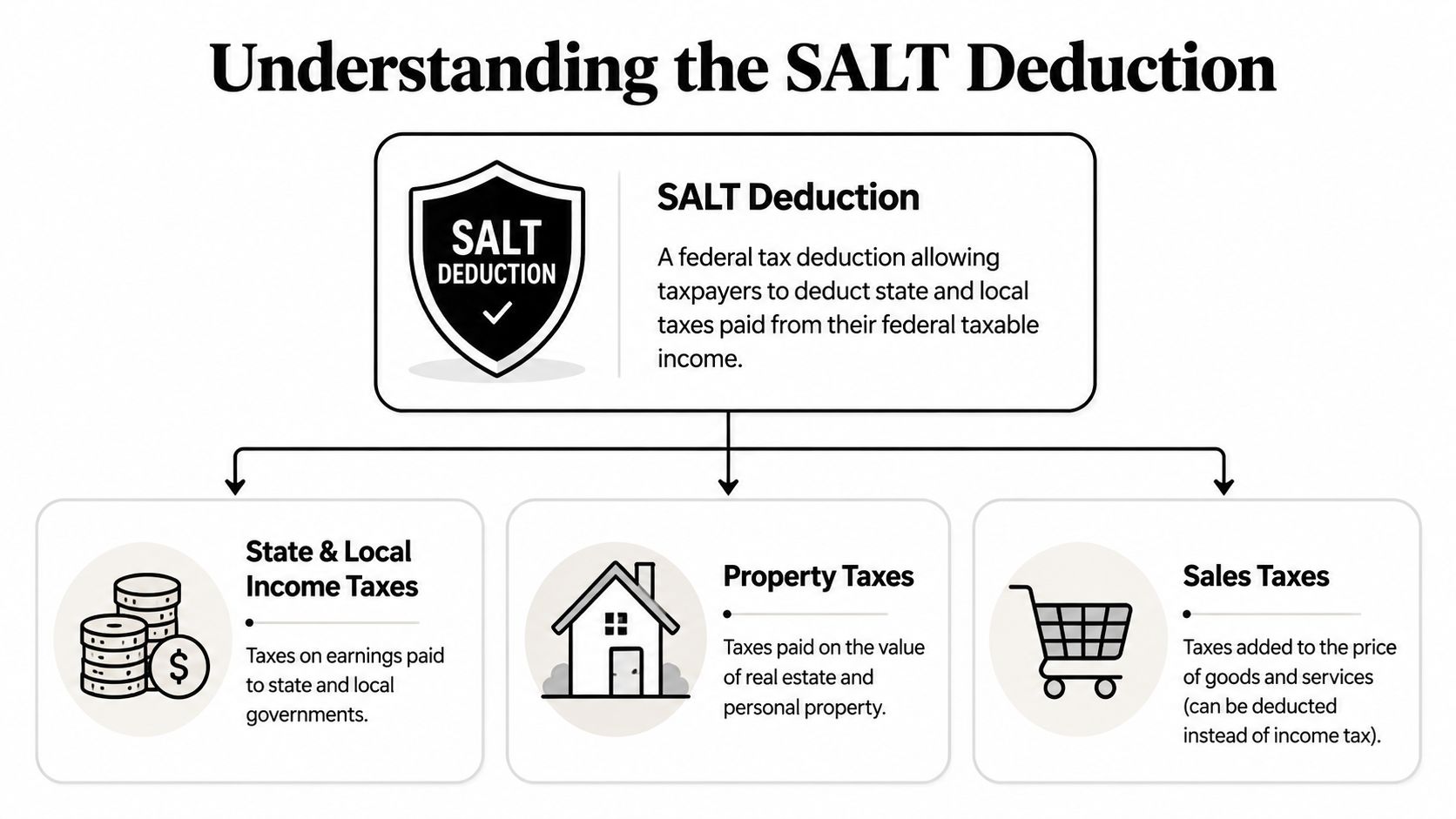
What counts toward SALT
Three categories matter most:
- State and local income taxes paid through withholding or estimated payments
- Real property taxes on personal residences and other qualifying property
- State and local sales taxes if you choose sales tax instead of income tax
You can't deduct both state income tax and sales tax in the same year. You choose the more favorable option. For most California wage earners, that usually means income tax. For taxpayers in no-income-tax states, or for people with unusually large taxable purchases, sales tax may be the better path.
The deduction is claimed on Schedule A with Form 1040. If you don't itemize, you don't get the SALT benefit.
Why older SALT advice often misses the mark
The SALT deduction has been part of the federal income tax system since 1913, and Congress narrowed the deductible tax categories in 1964. The modern turning point came with the Tax Cuts and Jobs Act, which imposed the $10,000 cap starting in tax year 2018. Before that change, about 30% of taxpayers claimed SALT in 2017 at an estimated federal revenue cost of $104 billion. By 2020, after the cap and larger standard deduction reduced itemizing, the share fell to 9% and the estimated revenue cost dropped to $13.5 billion, according to the Tax Policy Center's SALT deduction overview.
That's why many taxpayers still think of SALT as a broad deduction everyone gets. It used to be much more common. Today it's much more selective.
If you're also weighing how property taxes affect a future sale decision, especially in a changing market, a practical read is Evaluating Florida home selling options. It's useful because property tax planning often overlaps with broader housing decisions, even when the federal deduction rules don't fully offset the cost.
The 2026 SALT Deduction Cap and Phase Down Rules
A California couple with strong W-2 income, stock compensation, and a large property tax bill can see very different federal results in 2026 depending on one variable. Adjusted gross income. At one income level, the higher SALT cap creates real Schedule A value. At a higher level, the phase-down starts giving part of that benefit back.
The new cap for 2026
For 2026, the SALT deduction cap is scheduled to increase to $40,000 for most filers and $20,000 for married filing separately, based on the Congressional Research Service summary of the SALT deduction changes.
That change matters most for taxpayers who have spent years capped at $10,000 with no practical way to deduct the rest of their state income and property taxes. In high-tax states, especially California, New York, and New Jersey, the larger cap can materially improve the value of itemizing.
The catch is that the headline cap is not the planning answer by itself.
Two rules control whether the higher limit helps:
- You still need enough itemized deductions to benefit from Schedule A.
- The deduction begins to phase down once income crosses the threshold.
For readers who want a broader foundation before running projections, our guide on whether state taxes are deductible covers the mechanics behind the SALT rules.
How the phase-down changes planning
The higher cap does not apply evenly across income levels. For higher-income taxpayers, the allowed SALT deduction is reduced by 30% of income above $500,000 for most filers, with a floor of $10,000. For married filing separately, the threshold is $250,000, as described in the statutory summary from the Congressional Research Service linked above.
That creates a real planning trade-off. Extra income can increase tax in two ways at once. It raises taxable income and can also shrink the SALT deduction you expected to claim.
Here is the practical implication I would flag for a client at Allied Tax Advisors. A taxpayer who assumes the full $40,000 cap is available may overestimate the federal benefit of paying or accelerating state taxes. Once income moves into the phase-down range, the deduction compresses until it reaches the floor. At that point, the result starts looking much closer to the old capped environment.
This is why 2026 planning should be done with a projection, not a rule of thumb. Timing matters. A year-end bonus, a Roth conversion, a large capital gain, or a late pass-through distribution can reduce the value of the higher cap faster than many taxpayers expect.
For high earners and business owners, the most useful review points usually include:
- Income timing, especially bonuses, equity compensation, and capital gain recognition
- Deduction timing for itemized deductions outside the SALT bucket
- PTET elections for pass-through businesses, which may still offer a better federal result than relying on an individual SALT deduction alone
- Estimated tax payment timing, so cash goes out in the year that produces the strongest tax benefit
For many households, the 2026 change is favorable. For high earners near or above the phase-down thresholds, the larger cap is still helpful, but only if the rest of the return is planned around it.
Should You Itemize or Take the Standard Deduction
The SALT deduction only matters if itemizing beats the standard deduction. That sounds basic, but many planning conversations should begin with this consideration and frequently do not.
The reason is simple. A taxpayer can spend a lot of energy trying to maximize the state income tax deduction and still end up taking the standard deduction because the full itemized total doesn't exceed it.
A practical comparison
The IRS notes that the TCJA-era expansion of the standard deduction changed filing behavior dramatically. The share of filers claiming the SALT deduction dropped from 30% in 2017 to 9% in 2020, as described in IRS Topic No. 503 on deductible taxes. That tells you something important. Even when SALT is available, most returns still won't benefit from it.
Use this comparison as a first-pass decision tool.
| Consideration | Take the Standard Deduction If… | Itemize Your Deductions If… |
|---|---|---|
| SALT taxes paid | Your usable SALT amount doesn't move the total enough to matter | Your allowed SALT deduction is substantial and usable |
| Mortgage interest | You have little or no deductible mortgage interest | Mortgage interest adds meaningful value to Schedule A |
| Charitable giving | Your annual giving is modest or spread evenly | You made larger gifts or concentrated giving in one year |
| Medical and other itemized deductions | You don't have enough eligible deductions to create a gap | Several deduction categories together push you above the standard deduction |
| Return complexity | Simplicity matters more than a small tax difference | The tax savings from itemizing clearly outweigh the added tracking and planning |
How to make the call on your own return
Start with a draft Schedule A mindset. Add up:
- Allowed SALT amount
- Mortgage interest
- Charitable contributions
- Other itemized deductions that apply to you
Then compare that total against your standard deduction amount for the year.
If the numbers are close, timing becomes important. One year may favor itemizing if you bunch deductible payments together. The next year may favor the standard deduction. This alternating pattern is often more effective than trying to force itemization every year.
A related issue many taxpayers overlook is how state refunds behave later. If you itemize and deduct state taxes in one year, a later refund can create a federal tax question. This guide on whether state income tax refunds are taxable helps clarify that follow-on issue.
The mistake isn't failing to itemize. The mistake is paying attention to SALT without first testing whether itemizing wins at all.
If you're a California homeowner with high withholding and modest mortgage interest, the answer may still be the standard deduction. If you also have large charitable gifts, investment-related planning, or a temporary spike in property tax and state tax payments, itemizing may become worthwhile again.
Advanced Planning Strategies to Maximize Savings
Once you know itemizing is on the table, the next step is strategy. Through careful planning, taxpayers can still create meaningful savings even though the SALT rules are tighter than they used to be.

PTET for pass-through owners
For S corporation owners, partnership owners, and some LLC members, the pass-through entity tax, or PTET, can be one of the most important SALT workarounds. The basic idea is that the entity pays qualifying state tax at the business level instead of leaving the full burden on the individual return.
Why does that matter? Because the personal SALT cap applies on the individual side. When state tax is properly shifted to the entity level under a valid state regime, that can produce a federal business deduction rather than a capped personal itemized deduction.
This isn't automatic. The election rules, deadlines, owner eligibility, and credit mechanics vary by state. California business owners should review PTET every year, not once and forget it.
For broader strategy work, tax reduction strategies is a useful reference because PTET usually works best as part of a bigger planning picture, not as a standalone move.
Bunching deductions into the right year
Some taxpayers benefit from bunching. Instead of paying deductible amounts in a smooth annual pattern, they concentrate them into one year so itemized deductions exceed the standard deduction by a wider margin.
That can work with a mix of:
- Property tax timing, if payment deadlines and assessment rules allow
- State estimated taxes, when acceleration makes tax sense and is deductible in that year
- Charitable gifts, especially when a donor wants to separate the tax deduction year from the eventual grant year
The trap is paying early without confirming deductibility. Not every prepaid amount creates a current-year federal deduction. Timing only works when the tax is imposed and paid under the applicable rules.
Charitable planning when SALT is limited
When SALT is capped or partially phased down, charitable planning can carry more weight on Schedule A. Donor-advised funds are often useful because they let taxpayers bunch giving into one year while spreading grants to charities over time.
That can help in years with business income spikes, major liquidity events, or unusually high itemized deductions. It can also pair well with appreciated assets, depending on the taxpayer's situation.
If you're also dealing with wealth transfers, trust distributions, or family asset transitions, understanding related inheritance tax implications can help you avoid planning one tax issue in isolation from another.
One practical note. Professional modeling often pays for itself. A firm such as Allied Tax Advisors can project whether PTET, bunching, or charitable planning improves the return before you commit to the move.
Implications for Business Owners and Investors
The state income tax deduction doesn't land the same way for every taxpayer. Business owners, landlords, and crypto investors each run into different friction points.

Business owners
If you receive pass-through income, PTET deserves direct review. For many owners, this is the cleanest way to reduce the personal SALT bottleneck. But the election only works when the entity type, state rules, ownership structure, and timing all line up.
Owners should also review how compensation, distributions, and year-end income recognition interact with the SALT phase-down. A bigger profit number can affect more than the tax due. It can also reduce deduction value elsewhere on the return.
Real estate investors
Landlords often confuse personal property taxes with rental property taxes. The taxes tied to your personal residence generally flow into the itemized SALT rules. Taxes tied to rental activity are usually part of the rental expense picture and belong in the business analysis for that property.
That distinction matters because the federal treatment is not the same. Mixing the two leads to bad assumptions about how much of a real estate tax payment is limited.
For landlords reviewing the broader context, this roundup of essential 2025 rental tax deductions is a practical companion resource. It's especially helpful if you're sorting out which expenses belong on the rental side versus your personal return.
Crypto investors
Crypto gains often create state tax surprises. If you realize gains and owe state income tax on them, those state taxes generally feed into the same SALT framework as other state income taxes on your individual return.
The mistake I see most is assuming that because crypto is a newer asset class, the state tax payment gets special treatment. It doesn't. The state tax may be very real, but the federal deduction for that tax still runs through the same itemized rules and limitations.
That means crypto investors need timing discipline. Large gain years are often the same years when estimated taxes, charitable planning, and income management deserve closer attention.
Next Steps and When to Consult a CPA
A high earner in California can do everything right on the state side, write large estimated tax checks, and still leave federal savings on the table if the SALT plan is not coordinated before year-end. That problem gets more complicated in 2026, when the higher cap, the phase-down rules, and PTET planning can change the answer from one client to the next.
The SALT deduction is a planning issue, not just a line item on Schedule A. The right approach depends on which taxes qualify, whether itemizing still beats the standard deduction, whether income pushes you into the phase-down range, and whether an entity-level election changes the federal result.
There is also a broader policy debate behind the deduction. The Mercatus Center at George Mason University argues that SALT acts as an indirect federal subsidy to state and local governments, as discussed in Mercatus on the deduction for state and local taxes. For taxpayers, the practical takeaway is simpler. Federal rules do not just affect your return. They also shape how costly state taxes feel after federal offsets.
Documents to gather first
Start with the records that drive the calculation and the planning options:
- W-2s and 1099s showing state withholding
- Proof of estimated state tax payments
- Property tax bills and payment confirmations
- Prior-year return, especially if you need to review state refund treatment
- K-1s and entity records if a PTET election is on the table
For many clients, the individual deduction ends up on Schedule A with Form 1040. The harder part is deciding whether the payment belongs on the individual return at all, or whether it is better handled through entity-level planning.
When DIY stops making sense
A CPA review usually makes sense if any of these apply:
- You have income in more than one state
- You own an S corporation, partnership interest, or multi-member LLC
- Your income may trigger the 2026 SALT phase-down
- You want to compare PTET, bunching, or charitable timing
- You had a major gain event, such as a business income spike, stock sale, or crypto liquidation
Those situations create trade-offs. Paying state tax earlier can help in one scenario and do very little in another. A PTET election can produce real federal savings for one business owner and add complexity without much benefit for another. The difference usually comes down to income level, entity structure, state rules, and timing.
If your situation involves any of those moving parts, Allied Tax Advisors can model the outcome of different strategies, including PTET elections, itemizing, multi-state allocations, and estimated payment timing, so you can choose the approach that cuts tax cost before year-end.