
If you're staring at a tax organizer, a stack of mail, and a calendar that says April while your business books still say February, you're not alone. Most deadline confusion doesn't come from one date. It comes from trying to line up federal rules, state rules, entity rules, extension rules, and life events that don't always move together.
That confusion gets worse when a basic online chart gives you one date and leaves out the practical question you need answered. Does your state follow the IRS date? Does your S corporation file before your personal return? If you're in California, does disaster relief change the answer? If you're due a refund, is filing late still worth it?
This guide is built for that real-world mess. It covers state tax filing deadlines, but it doesn't stop at a state-by-state list. It ties state deadlines back to the federal framework, separates individual and business filing issues, addresses extensions and missed deadlines, and includes guidance that matters to San Diego residents, California business owners, landlords, and closely held companies. One habit that helps every filer is keeping prior returns, notices, and source documents easy to retrieve. If your records are scattered, this practical resource on secure document keeping advice is worth reviewing before tax season gets crowded.
Table of Contents
- Navigating the Maze of Tax Filing Deadlines
- The Federal Tax Deadline Framework for 2026
- State by State Tax Filing Deadline Reference for 2026
- Key Deadlines for Business Entities
- Understanding Filing Extensions and Penalties
- Special Circumstances That Change Your Deadline
- A Closer Look at California and San Diego Deadlines
- What to Do If You Missed a Tax Deadline
Navigating the Maze of Tax Filing Deadlines
Tax deadlines feel simple until your facts stop being simple. A W-2 employee in one state, a married couple with rental income in California, and an LLC taxed as a partnership all face different timing issues, even when they look at the same calendar.
The first practical rule is this. Your filing deadline depends on what you are, where you file, and whether anything unusual applies to your year. That's why state tax filing deadlines create so much frustration. People assume every return is due on one day, then discover that their state, entity type, or extension status changes the answer.
Why people miss the right date
In practice, most missed deadlines come from a few repeat problems:
- One return controls another: A business owner waits on a K-1, which delays the individual return.
- Federal assumptions spill into state filings: Someone files the IRS extension and assumes the state works the same way.
- A move changes everything: Part-year residents often have more than one filing obligation.
- The taxpayer has no balance due: That person delays filing because there seems to be no urgency, then forgets about the refund or credit claim.
Practical rule: Don't ask, "When are taxes due?" Ask, "Which return is due, for which entity, in which jurisdiction, and under what filing status?"
What actually helps
A useful deadline system is rarely complicated. It usually includes a short filing calendar, a list of expected tax documents, and one place where notices and prior returns are stored. For business owners, it also means knowing whether the company return must be completed before the owner's personal return can be filed accurately.
That steady, methodical approach reduces errors better than last-minute scrambling. It also makes extensions less chaotic when you need one.
The Federal Tax Deadline Framework for 2026
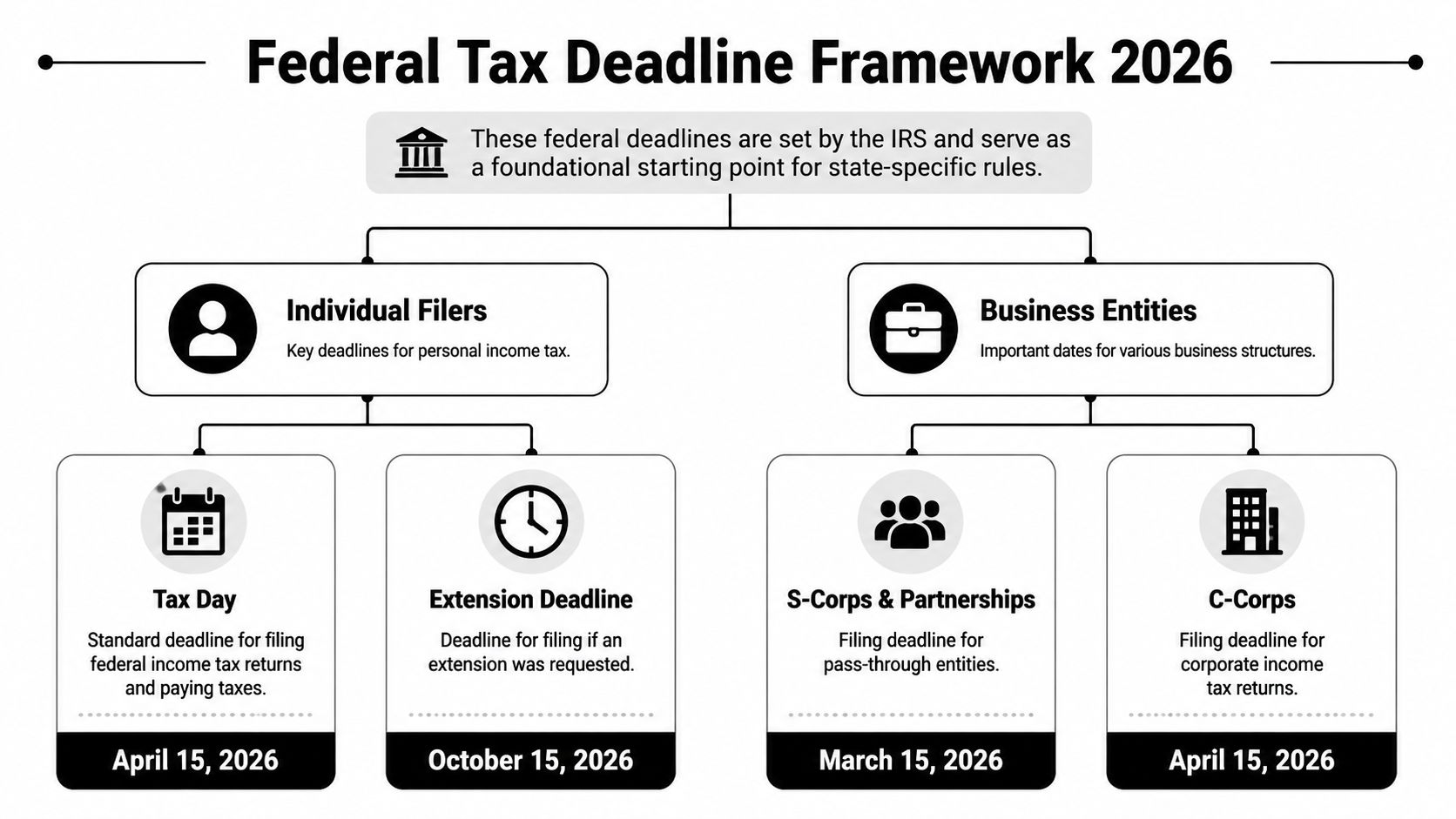
Before you can make sense of state tax filing deadlines, you need the federal framework that most states use as a starting point.
Why federal dates come first
For individual calendar-year filers, the IRS says the filing deadline is April 15, 2026, and fiscal-year filers are due on the 15th day of the fourth month after year-end. Taxpayers can also request an automatic 6-month extension under the federal rules described by the IRS in its guidance on when individuals must file.
Business returns follow a different logic. Partnerships and S corporations are generally due March 15, while C corporations are generally due April 15, according to the same verified federal framework and supporting tax guidance summarized in the IRS-based filing overview above.
The dates that drive most filing calendars
Those federal dates matter because they shape how work flows through a tax year.
- Individuals: Most wage earners, retirees, and sole proprietors using a calendar year think in terms of April.
- Pass-through entities: Partnerships and S corporations file earlier because owners need K-1 information before their individual returns can be finalized.
- C corporations: Their filing date usually sits later than pass-through entity deadlines under the standard federal framework.
- Fiscal-year filers: They don't live on the April and March schedule. Their deadlines move according to year-end.
A lot of state systems mirror those federal patterns, but they don't always copy them exactly. Some states line up neatly. Others shift for local law, weekends, holidays, or entity-specific rules.
Federal timing is the backbone. State timing is the overlay. Confusion starts when taxpayers assume the overlay always matches the backbone.
If you're trying to sort out whether payment timing also differs from filing timing, this overview of when taxes are due if you owe is a useful companion because the cash-flow question often matters as much as the paperwork deadline.
State by State Tax Filing Deadline Reference for 2026
A national chart is useful only if you read it carefully. State tax filing deadlines are not uniform. Some states follow the federal April schedule. Others set a later date. Some don't impose a state individual income tax at all. Verified 2026 examples include many states due April 15, Delaware due April 30, Virginia due May 1, and states such as Florida, Texas, Washington, Alaska, Nevada, South Dakota, Tennessee, New Hampshire, and Wyoming with no state income tax, as reflected in TaxAct's 2026 state due-date chart at state return due dates.
That means a quick glance isn't enough. You need to know whether you're looking at an individual return, a pass-through business return, or a C corporation return, and whether your state has a separate extension process.
How to use this reference
Use the table below as a planning tool, not a substitute for reading the state instructions that apply to your filing type.
- Start with your state of residence or registration: Individuals should begin with residency. Businesses should begin with formation state and every filing state.
- Match the entity to the right column: An LLC taxed as a partnership doesn't follow the same timetable as a C corporation.
- Treat agency links as the final checkpoint: States change forms, portal procedures, and extension rules more often than people expect.
2026 State Tax Filing Deadlines at a Glance
| State | Individual Deadline | S-Corp / Partnership Deadline | C-Corp Deadline | State Tax Agency Link |
|---|---|---|---|---|
| Alabama | April 15 | Check state agency guidance | Check state agency guidance | Alabama Department of Revenue |
| Alaska | No state income tax | Check state agency guidance | Check state agency guidance | Alaska Department of Revenue |
| Arizona | April 15 | Check state agency guidance | Check state agency guidance | Arizona Department of Revenue |
| Arkansas | April 15 | Check state agency guidance | Check state agency guidance | Arkansas Department of Finance and Administration |
| California | April 15 | Check state agency guidance | Check state agency guidance | California Franchise Tax Board |
| Colorado | April 15 | Check state agency guidance | Check state agency guidance | Colorado Department of Revenue |
| Connecticut | April 15 | Check state agency guidance | Check state agency guidance | Connecticut Department of Revenue Services |
| Delaware | April 30 | Check state agency guidance | Check state agency guidance | Delaware Division of Revenue |
| Florida | No state income tax | Check state agency guidance | Check state agency guidance | Florida Department of Revenue |
| Georgia | April 15 | Check state agency guidance | Check state agency guidance | Georgia Department of Revenue |
| Hawaii | April 15 | Check state agency guidance | Check state agency guidance | Hawaii Department of Taxation |
| Idaho | April 15 | Check state agency guidance | Check state agency guidance | Idaho State Tax Commission |
| Illinois | April 15 | Check state agency guidance | Check state agency guidance | Illinois Department of Revenue |
| Indiana | April 15 | Check state agency guidance | Check state agency guidance | Indiana Department of Revenue |
| Iowa | April 30 | Check state agency guidance | Check state agency guidance | Iowa Department of Revenue |
| Kansas | April 15 | Check state agency guidance | Check state agency guidance | Kansas Department of Revenue |
| Kentucky | April 15 | Check state agency guidance | Check state agency guidance | Kentucky Department of Revenue |
| Louisiana | May 15 | Check state agency guidance | Check state agency guidance | Louisiana Department of Revenue |
| Maine | April 15 | Check state agency guidance | Check state agency guidance | Maine Revenue Services |
| Maryland | April 15 | Check state agency guidance | Check state agency guidance | Comptroller of Maryland |
| Massachusetts | April 15 | Check state agency guidance | Check state agency guidance | Massachusetts Department of Revenue |
| Michigan | April 15 | Check state agency guidance | Check state agency guidance | Michigan Department of Treasury |
| Minnesota | April 15 | Check state agency guidance | Check state agency guidance | Minnesota Department of Revenue |
| Mississippi | April 15 | Check state agency guidance | Check state agency guidance | Mississippi Department of Revenue |
| Missouri | April 15 | Check state agency guidance | Check state agency guidance | Missouri Department of Revenue |
| Montana | April 15 | Check state agency guidance | Check state agency guidance | Montana Department of Revenue |
| Nebraska | April 15 | Check state agency guidance | Check state agency guidance | Nebraska Department of Revenue |
| Nevada | No state income tax | Check state agency guidance | Check state agency guidance | Nevada Department of Taxation |
| New Hampshire | No state income tax | Check state agency guidance | Check state agency guidance | New Hampshire Department of Revenue Administration |
| New Jersey | April 15 | Check state agency guidance | Check state agency guidance | New Jersey Division of Taxation |
| New Mexico | April 15 | Check state agency guidance | Check state agency guidance | New Mexico Taxation and Revenue Department |
| New York | April 15 | Check state agency guidance | Check state agency guidance | New York State Department of Taxation and Finance |
| North Carolina | April 15 | Check state agency guidance | Check state agency guidance | North Carolina Department of Revenue |
| North Dakota | April 15 | Check state agency guidance | Check state agency guidance | North Dakota Office of State Tax Commissioner |
| Ohio | April 15 | Check state agency guidance | Check state agency guidance | Ohio Department of Taxation |
| Oklahoma | April 15 | Check state agency guidance | Check state agency guidance | Oklahoma Tax Commission |
| Oregon | April 15 | Check state agency guidance | Check state agency guidance | Oregon Department of Revenue |
| Pennsylvania | April 15 | Check state agency guidance | Check state agency guidance | Pennsylvania Department of Revenue |
| Rhode Island | April 15 | Check state agency guidance | Check state agency guidance | Rhode Island Division of Taxation |
| South Carolina | April 15 | Check state agency guidance | Check state agency guidance | South Carolina Department of Revenue |
| South Dakota | No state income tax | Check state agency guidance | Check state agency guidance | South Dakota Department of Revenue |
| Tennessee | No state income tax | Check state agency guidance | Check state agency guidance | Tennessee Department of Revenue |
| Texas | No state income tax | Check state agency guidance | Check state agency guidance | Texas Comptroller |
| Utah | April 15 | Check state agency guidance | Check state agency guidance | Utah State Tax Commission |
| Vermont | April 15 | Check state agency guidance | Check state agency guidance | Vermont Department of Taxes |
| Virginia | May 1 | Check state agency guidance | Check state agency guidance | Virginia Department of Taxation |
| Washington | No state income tax | Check state agency guidance | Check state agency guidance | Washington Department of Revenue |
| West Virginia | April 15 | Check state agency guidance | Check state agency guidance | West Virginia State Tax Department |
| Wisconsin | April 15 | Check state agency guidance | Check state agency guidance | Wisconsin Department of Revenue |
| Wyoming | No state income tax | Check state agency guidance | Check state agency guidance | Wyoming Department of Revenue |
| District of Columbia | April 15 | Check state agency guidance | Check state agency guidance | Office of Tax and Revenue |
A few practical cautions matter here. No state income tax doesn't mean no filing obligations of any kind. Businesses may still face franchise, gross receipts, sales tax, payroll, or annual report requirements. Also, business deadlines in the table are intentionally marked for confirmation because business-entity due dates often depend on federal conformity, fiscal year-end, and state-specific extension mechanics.
The fastest way to create a tax mess is to rely on an individual deadline chart for a business filing problem.
Virginia is a good example of why detail matters. The state's tax agency says that taxpayers must file by May 1, and fiscal-year filers are due on the 15th day of the 4th month after the close of the fiscal year, which is materially different from a generic April chart.
Key Deadlines for Business Entities
Business owners usually don't struggle because they forgot taxes exist. They struggle because the entity calendar doesn't line up neatly with the owner calendar.

Why pass-through entities file earlier
Under the standard federal framework for business returns, a calendar-year C corporation is due on the 15th day of the fourth month after year-end, while partnerships and S corporations generally file on the 15th day of the third month. That distinction, along with the way states often key their own rules to federal timing, is summarized in Wolters Kluwer's analysis of state corporate income tax return deadline changes.
The earlier timing for partnerships and S corporations makes practical sense. Those entities usually produce information that flows through to owners. If the entity return is late, the owner's individual return often becomes inaccurate, delayed, or both.
Where businesses get tripped up
The trouble starts when owners assume state conformity is automatic.
- Extensions vary by jurisdiction: Federal Form 7004 generally gives six months, but some states have their own forms or offset rules.
- State rules can be longer or shifted: The verified examples include Arizona allowing a seven-month automatic extension for tax years after 2020.
- Some states disconnect from the federal original due date: New Jersey may require returns 30 days after the federal original due date for certain periods.
- Others add time differently: Pennsylvania ties the state deadline to the federal due date plus one month.
Those aren't minor drafting details. They affect bookkeeping close schedules, K-1 delivery timing, shareholder communication, and cash planning.
A business doesn't have one tax deadline. It has a chain of deadlines, and the first missed date usually causes the rest of the chain to slip.
For LLCs, the answer depends on tax classification, not just legal name. An LLC taxed as a partnership usually follows the partnership framework. An LLC that elected corporate treatment follows the corporate framework. That's one reason entity setup should be reviewed before filing season rather than during it.
If you're checking how far an entity extension can carry you and what paperwork is required, this guide to the business tax extension deadline helps frame the filing side of that decision.
Understanding Filing Extensions and Penalties
An extension is useful. It's also one of the most misunderstood parts of tax compliance.
People often treat an extension like a full postponement. It isn't. In real practice, an extension is a way to buy filing time when your return can't be completed accurately by the original due date. It doesn't erase the need to estimate what you owe and address payment exposure.
An extension gives time to file, not time to ignore the balance
For individuals, the federal system allows an automatic 6-month extension when requested properly by the original deadline, as covered earlier in the federal framework. Businesses also generally need the correct extension filing in place by the original due date if they want the extra time recognized.
The key trade-off is simple:
| Situation | Filing status | Payment consequence |
|---|---|---|
| You file on time and pay on time | Compliant | Cleanest outcome |
| You extend on time but underpay | Filing time protected | Balance issues remain |
| You miss both filing and payment | Exposure increases | Penalties and interest become harder to manage |
One industry source cited in the verified data states that failure-to-file penalties are about 5% per month, up to 25%, with interest accruing from the original due date. That is why filing, even when payment is difficult, usually works better than silence.
What works when you're behind
The strongest moves are usually procedural, not dramatic.
- File the extension before the original due date if the return won't be ready. Late extension requests don't solve much.
- Estimate the balance accurately. Perfect precision isn't always possible, but a serious estimate is better than wishful thinking.
- Pay what you can by the original due date. That reduces the amount exposed to ongoing charges.
- Don't assume the state follows the federal extension automatically. Some states do. Others require separate action.
- Keep proof of submission and payment. Confirmation records matter when notices arrive.
A lot of taxpayers waste time hunting for the perfect answer when a good procedural answer is available immediately. File what needs to be filed. Pay what can be paid. Then fix the remaining issues from a position of compliance instead of delay.
Special Circumstances That Change Your Deadline
A standard deadline chart breaks down the moment your year stops being standard.
One of the clearest examples came when California granted relief for taxpayers affected by winter storms. The state extended both filing and payment deadlines to October 16, 2023 for affected taxpayers, and that relief covered individual and business returns as well as multiple estimated-tax deadlines that normally fell between January and September, as described in the Governor's announcement on more time to file state taxes for Californians impacted by winter storms.
Disaster relief can override the normal calendar
That kind of relief changes the practical answer to, "When is my return due?"
For an affected taxpayer, the normal due date may no longer control the filing decision, the payment decision, or even estimated tax timing. If you rely on a generic annual chart during a disaster year, you can easily file too late or pay too late because you never checked whether county-based or area-based relief applied.
Nonstandard filing situations
There are other situations where the obvious date isn't the actual date.
- Expatriates: Colorado guidance, referenced in the verified data, shows that expatriates can have a June 15 filing date with additional rules.
- Automatic state extensions with payment still due: Some states offer an automatic 6-month filing extension but still expect most of the balance due by April 15.
- Fiscal-year filers: Their deadlines move with year-end, not with the public's April habits.
The right deadline is sometimes geographic. Sometimes it is entity-based. Sometimes it turns on residency or fiscal year. That's why broad charts help less than people expect.
A taxpayer with a wildfire address issue, a recent move, or foreign residence usually needs to verify facts before assuming the standard deadline applies. That's especially true in California, where emergency relief has materially changed filing calendars in recent years.
A Closer Look at California and San Diego Deadlines
California taxpayers often assume the state directly follows the IRS. Sometimes it does. Sometimes the practical answer is more complicated.

What California filers need to watch
Verified state deadline data shows California among the states due April 15 in the standard 2026 schedule referenced earlier. But California taxpayers should pay close attention to issues that don't show up in a simple due-date list.
A few examples come up repeatedly in San Diego:
- Residents with side income: A W-2 return becomes more complex when 1099 income, rental activity, or stock sales are added.
- LLC owners: The legal entity label doesn't answer the filing deadline by itself. The tax classification does.
- Real estate investors: Closing statements, depreciation schedules, and passive activity issues can delay complete filing if records aren't organized early.
- Multi-state workers and business owners: California residency and source-income rules often create overlap with another state's filing obligations.
San Diego practical guidance
San Diego taxpayers usually benefit from one thing more than any planning slogan. They need an integrated filing calendar that accounts for federal filings, California filings, business returns, estimated tax obligations, and owner-level reporting.
That matters for closely held businesses in particular. If the company books aren't closed, the owner return often shouldn't be rushed. Filing a return that later needs correction is rarely efficient.
One option for local taxpayers dealing with these issues is San Diego tax deadlines and penalties guidance with professional help, which focuses on practical filing mistakes and local compliance pressure points. For taxpayers who need hands-on preparation, planning, bookkeeping coordination, or notice response, Allied Tax Advisors handles those services in San Diego for both individuals and businesses.
What to Do If You Missed a Tax Deadline
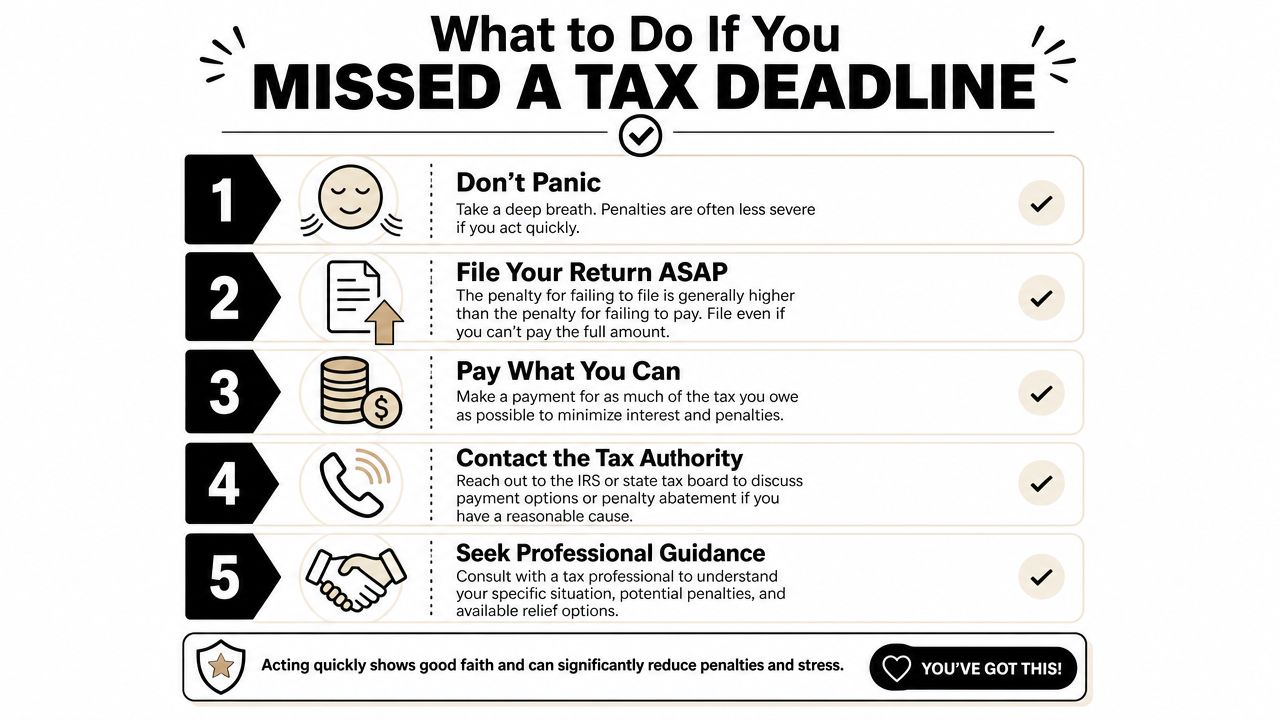
Missing a tax deadline feels bigger than it is. The damage usually comes from delay after the miss, not from the missed date alone.
First steps that reduce damage
The best response is calm and immediate.
- File the return as soon as possible: If you owe, waiting usually makes the situation worse.
- Pay what you can: Partial payment is usually better than no payment.
- Read every notice carefully: Many taxpayers react to the headline and miss the actual response options.
- Separate filing from resolution: You can file first, then work on payment arrangements or account corrections.
If records are incomplete, gather the core documents first and move. Perfect reconstruction can come later if needed. The IRS and states usually respond better when they can see the taxpayer has re-entered compliance.
If you're owed a refund, filing late may still matter
This is the part many people miss. Oregon's state guidance says that if you do not owe taxes, you have three years to file and still receive your refund, as explained in its newsroom post on having more time to file if you don't owe and want your refund.
That point matters for students, part-year residents, low-income households, and people eligible for refundable credits. A late return may still be worth filing because the practical question isn't only whether the return was late. It's whether money is still recoverable.
If you're due a refund, "I missed the deadline" is not always the end of the story.
If you missed a deadline and also can't pay in full, don't freeze. File the return, preserve your compliance position, and then evaluate payment options, notice response strategy, and any state-specific relief that may apply.
If your filing calendar has gotten tangled across federal, California, and business deadlines, Allied Tax Advisors can help you sort out what is due, what can still be fixed, and what should happen next so you can move forward with a clear plan.