
Ever found yourself in that gray area of work where you’re not quite a full-blown employee, but you’re definitely not an independent contractor either? The IRS has a special category for that exact situation: the statutory employee.
Think of it as a hybrid classification. It’s a unique middle ground carved out for four specific types of jobs, giving those workers some of the security of an employee with the tax flexibility of a business owner.
So, What Exactly Is a Statutory Employee?

Let's break it down. Imagine a Venn diagram where one circle is "Employee" and the other is "Independent Contractor." The statutory employee sits right in that overlapping sweet spot, pulling key traits from both sides. This isn't a status you can just choose; it's a specific designation based on strict IRS rules designed for roles that don't fit neatly into the usual boxes.
This classification has been around for a while, evolving in the tax code since the mid-20th century to address these unique working relationships. You can dive deeper into the history of this classification on aihr.com.
The Best of Both Worlds: Key Tax Traits
What really sets a statutory employee apart is how their taxes are handled. Like a business owner, they report income and deduct expenses on a Schedule C. But here's the kicker: their employer still handles their Social Security and Medicare (FICA) taxes, just like a regular employee.
This hybrid approach brings some serious perks:
- Employer-Paid FICA: Your employer pays their half (7.65%) of your Social Security and Medicare taxes. Independent contractors have to pay the full amount themselves, so this is a huge savings.
- Deduct Business Expenses: You can write off all your ordinary and necessary business costs—think vehicle mileage, home office expenses, tools, and supplies. This directly lowers your taxable income.
- Unique W-2 Reporting: You’ll still get a Form W-2, not a 1099. The dead giveaway is that Box 13, "Statutory employee," will be checked. The W-2 can get complicated, so if you need a refresher, check out our guide to Box 12 codes.
This unique tax treatment provides a significant financial advantage, allowing certain workers to reduce their overall tax burden while still benefiting from employer FICA contributions.
To get a clearer picture, it helps to see the classifications side-by-side.
At-a-Glance Worker Classification Quick Comparison
This table offers a quick snapshot of how statutory employees stack up against the other two common worker types when it comes to taxes.
| Classification | Tax Form | Income Tax Withholding | FICA / SE Tax |
|---|---|---|---|
| Statutory Employee | W-2 (Box 13 Checked) & Schedule C | No | Employer & Employee Split |
| Regular Employee | W-2 | Yes | Employer & Employee Split |
| Independent Contractor | 1099-NEC & Schedule C | No | Paid Entirely by Contractor |
As you can see, the statutory employee holds a truly unique position, blending elements from both columns to create a distinct tax situation.
The Four Types of Statutory Employees
The IRS is incredibly specific when it comes to who qualifies as a statutory employee. This isn't a vague category you can opt into; it's a short, exclusive list of just four types of workers. If your job doesn't fit neatly into one of these boxes, this classification likely doesn't apply to you.
Let's break down exactly who these four workers are, moving from the tax code jargon to real-world examples you can actually picture.
1. Certain Delivery Drivers
This category covers drivers who are essentially the lifeblood for businesses dealing in specific goods. We're talking about drivers distributing beverages (but not milk), or delivering meat, fruit, vegetable, or bakery products. It also extends to drivers who pick up and drop off laundry or dry cleaning.
A great example is a bread delivery driver. Imagine someone who spends their entire week driving a route for a single large bakery, dropping off fresh loaves and pastries to grocery stores and cafes. The bakery is their principal, and the core of their job is distribution—a perfect fit for this category.
2. Full-Time Life Insurance Sales Agents
An agent can be considered a statutory employee if selling life insurance or annuity contracts is their main gig, and they do it almost exclusively for one company. This isn't for the independent agent juggling policies from a dozen different providers.
Think about an agent who works solely for a big-name insurance carrier. While they might place a rare, specialized policy elsewhere, 95% of their business and income stream comes from that one primary company. It's this deep, full-time commitment to a single firm that triggers the statutory employee status.
3. At-Home Workers
This one feels a bit old-school, but it's still very relevant. It applies to people working from home on materials or goods that a company provides and that must be returned to that same company (or someone they name). Crucially, the company has to give them the blueprint—the specifications for how the work gets done.
A classic case is someone who assembles circuit boards at their kitchen table. The tech company ships them all the components and a detailed set of instructions. The worker’s job is simply to follow the plan and send the finished boards back.
The defining feature here is the dependency. The worker relies entirely on one company for the raw materials, the instructions, and the final destination of the product. That's the kind of relationship the IRS is looking at.
4. Traveling or City Salespeople
The final category is for the road warriors—the salespeople who are out there full-time drumming up orders for a single company. They are typically soliciting orders from wholesalers, retailers, contractors, or businesses like hotels and restaurants. The key is that the orders are for merchandise the customer will resell or supplies they'll use in their own business operations.
Picture a salesperson who travels a specific territory visiting restaurant owners. Their entire job is to take orders for a particular food distributor. They aren't selling to the public; they're taking wholesale orders, working full-time, and turning them over to their principal for fulfillment.
The IRS lays all this out in Publication 15-A, Employer's Supplemental Tax Guide.
This table from the IRS itself really drives the point home: the list is short and specific. By looking at these four distinct roles, you can get a much clearer picture of how these rules work in the real world and figure out if they might apply to your own situation.
Passing the Three Crucial IRS Tests
It’s not enough to just fit into one of those four job categories we talked about. To officially be classified as a statutory employee, the IRS requires you to pass three more specific tests. Think of it as a final checklist—if you fail even one, you don't qualify.
Let’s dig into what these tests actually mean in the real world.
The Personal Service Requirement
First, your agreement with the company has to state that you will personally perform the work. This is key. The company is hiring you for your specific skills, not just contracting out a task that anyone could do. You can't turn around and delegate your core duties to someone else.
For instance, a life insurance agent is hired to be the one meeting clients and closing deals. They can't just send another agent in their place to handle appointments. This personal commitment creates a direct link between you and the company, which is fundamental to the statutory employee relationship.
This test is all about distinguishing a personal service relationship from a standard business-to-business deal where subcontracting the work would be perfectly normal.
This flowchart gives you a quick visual of the four main types of workers who start on the path to becoming a statutory employee.
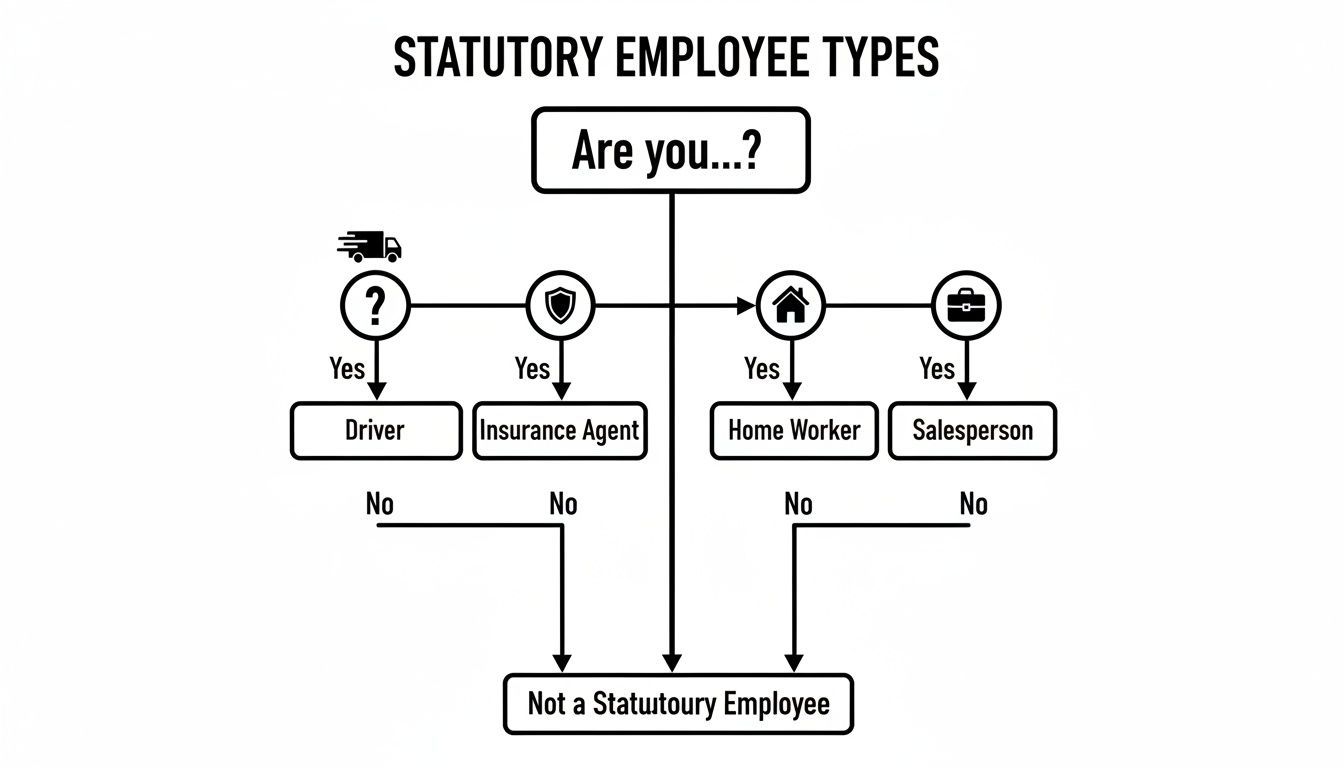
As the chart shows, whether you're a driver or an agent, getting through the next two IRS hurdles is what really seals the deal on your classification.
The Substantial Investment Test
Second, you can't have a substantial investment in the equipment and property you use to do your job. The IRS is basically asking, "Who's footing the bill for the major tools of the trade?" Owning your own laptop or using your personal car for some trips is usually fine. But you can't have significant capital tied up in the assets needed to run the business.
Think about it this way: A freelance photographer who owns $30,000 worth of cameras, lenses, and studio lights clearly has a substantial investment. On the other hand, a traveling salesperson who is given a company car, all their product samples, and a tablet for placing orders has very little personal investment. That salesperson is a much better fit for the statutory employee model.
The Continuing Basis Rule
Finally, the relationship has to be ongoing. The IRS requires that the work is performed on a continuing basis for the same payer. They're looking for a stable, consistent working relationship, not just a series of disconnected, one-off projects. This isn't about a temporary gig.
This doesn't mean you have to work 9-to-5 every single day. It's more about a regular, predictable pattern. An at-home worker assembling parts for the same company every week for the past year? That's a continuing basis. A graphic designer hired for a single three-month branding project? That’s not.
You have to pass all three of these tests, no exceptions. It's the combination of your job type and meeting these three specific conditions that officially cements your status as a statutory employee in the eyes of the IRS.
How Statutory Employee Taxes Actually Work

This is where things get interesting—and potentially very rewarding for your wallet. The real power of being a statutory employee comes to life during tax season. It’s a unique mix of an employee’s simplicity and an independent contractor's flexibility, creating a "best-of-both-worlds" scenario that can seriously lower your tax bill.
It all starts with the paperwork. You won’t get a 1099-NEC like a freelancer. Instead, you'll receive a Form W-2, just like any other employee. But there's one tiny, crucial detail to look for: Box 13, where the "Statutory employee" box will be checked.
That little checkmark is everything. It’s your green light from the IRS, signaling that a special set of rules applies to you and unlocking a powerful suite of tax deductions.
FICA Taxes and Your W-2
When you scan your W-2, you’ll see that your employer has already handled your Social Security and Medicare (FICA) taxes. This is a major plus. They’ve paid their half, and your half has been withheld from your paychecks throughout the year. You don't have to worry about setting that money aside.
But you'll notice something is missing: federal income tax withholding. This isn't a mistake. The IRS views you as self-employed for income tax purposes, which means you're responsible for paying your own income taxes. This responsibility is directly tied to the biggest perk of being a statutory employee: writing off your business expenses.
Filing Schedule C: Where the Magic Happens
That checked box on your W-2 is your ticket to filing a Schedule C (Form 1040), Profit or Loss from Business. This is the exact same form used by consultants, freelancers, and small business owners to report their earnings and expenses.
You’ll start by reporting the total income from your W-2 as your gross business revenue. Then comes the game-changer: you get to subtract all your "ordinary and necessary" business expenses from that income. This is a massive advantage over regular W-2 employees, who lost the ability to deduct most unreimbursed work expenses years ago.
By writing off these costs, you directly lower your adjusted gross income (AGI). A lower AGI means a smaller taxable income, which translates directly into a smaller tax bill. It’s the most powerful tool in your tax-saving arsenal.
Common Business Deductions You Can Take
So, what exactly can you deduct? The list is long, giving you plenty of opportunities to reduce your taxable income.
- Vehicle Expenses: Whether you track the actual costs of using your car (gas, insurance, repairs) or take the standard mileage rate—which was 67 cents per mile for 2024—it’s a major deduction.
- Home Office Deduction: If you have a dedicated space in your home used exclusively for your work, you can write off a portion of your rent, utilities, mortgage interest, and insurance.
- Supplies and Tools: From office supplies and software subscriptions to product samples and specialized equipment, anything you buy to do your job is fair game.
- Travel and Meals: Hitting the road for work? You can deduct the cost of flights, hotels, and 50% of your business meal expenses.
- Professional Development: Subscriptions to trade journals, professional association dues, and courses to sharpen your skills are all deductible.
To help clarify how these responsibilities are divided, here's a quick breakdown of how taxes are handled for each worker type.
Tax Responsibility Breakdown Employee vs Contractor vs Statutory
| Tax Type | Regular Employee (W-2) | Independent Contractor (1099) | Statutory Employee (W-2) |
|---|---|---|---|
| Federal Income Tax | Withheld by Employer | Paid by Individual | Paid by Individual |
| Social Security (Employee) | Withheld by Employer (6.2%) | Paid by Individual (6.2%) | Withheld by Employer (6.2%) |
| Social Security (Employer) | Paid by Employer (6.2%) | Paid by Individual (6.2%) | Paid by Employer (6.2%) |
| Medicare (Employee) | Withheld by Employer (1.45%) | Paid by Individual (1.45%) | Withheld by Employer (1.45%) |
| Medicare (Employer) | Paid by Employer (1.45%) | Paid by Individual (1.45%) | Paid by Employer (1.45%) |
As you can see, the statutory employee gets the benefit of the employer covering half of the FICA taxes, just like a regular employee. But for income tax, they operate like an independent contractor, which is what allows them to take all those valuable business deductions on Schedule C. This differs starkly from contractors, who have to pay the full FICA amount themselves.
For a deeper dive into the self-employment tax obligations that contractors face, check out our guide on how much self-employment tax you might have to pay.
Navigating Employer Responsibilities and Risks

For business owners, getting worker classification right isn't just about paperwork—it's a massive compliance issue. When it comes to statutory employees, misunderstanding the rules can land you in serious financial and legal hot water. The responsibilities are clear, and they aren't optional.
If you bring someone on board who fits the very specific definition of a statutory employee, you've got a unique set of duties. Your main job is to withhold and pay their share of FICA taxes (that's Social Security and Medicare), exactly like you would for a standard W-2 employee. This means you have to get the calculations right and send those funds to the IRS on time.
A Quick Compliance Checklist for Employers
To keep your business out of trouble, you need to follow a precise process. One wrong move can trigger an audit and a cascade of penalties, so paying close attention here is non-negotiable.
Here’s what you absolutely have to do:
- Proper Identification: Before anything else, make sure the worker actually fits one of the four job categories and passes all three of the IRS tests. No guessing allowed.
- Issue the Right Tax Form: They get a Form W-2, not a 1099-NEC. And here's the critical part: you must check Box 13 to officially mark them as a "Statutory employee."
- Withhold FICA Taxes: You're on the hook for withholding the employee's 7.65% share of Social Security and Medicare taxes. You also have to pay the matching employer portion out of your own pocket. For a deeper dive, our guide on how to calculate payroll taxes breaks it all down.
One key difference? You are not required to withhold federal income tax for a statutory employee. That’s their responsibility, as they are treated like a self-employed individual for income tax purposes.
The High Cost of Getting It Wrong
Worker misclassification is easily one of the most expensive mistakes you can make as a business owner. If the IRS finds that you've treated a statutory employee as a plain old 1099 contractor, the fallout can be severe. You could be on the hook for all the back FICA taxes you failed to withhold and pay on their behalf.
Penalties for misclassification can snowball in a hurry. You’re often looking at interest charges and other fines that can genuinely threaten a small business’s survival. A rock-solid written contract that clearly defines the working relationship is your best defense.
When handled correctly, statutory employees can actually be a smart move. HR teams sometimes find they can lower certain compliance costs, but this only works with carefully written contracts that spell out the unique terms of the job. You can find more on this from the experts at ADP.com.
Ultimately, a firm grasp of general employment law and compliance is the only way to classify workers correctly, meet your legal obligations, and steer clear of the risks that come with getting it wrong.
Understanding Statutory Nonemployees
Just when you think you have a handle on statutory employees, the IRS throws a curveball: the statutory nonemployee. The names sound almost identical, but their tax treatment couldn't be more different. Mixing them up is a recipe for a major tax headache.
This special classification is incredibly specific and really only applies to two roles:
- Direct sellers
- Licensed real estate agents
Unlike the hybrid status of a statutory employee, these individuals are treated as independent contractors for all tax purposes. There's no gray area here—they are fully self-employed in the eyes of the law.
The All-Important Tax Difference
The biggest distinction comes down to who pays the payroll taxes. Statutory nonemployees are on their own. They don't get a W-2 form at the end of the year.
Instead, they receive a Form 1099-NEC and are responsible for paying the entire 15.3% self-employment tax. That covers both the employee and employer shares of Social Security and Medicare taxes.
Simply put, a statutory nonemployee is an independent contractor by law. They don’t get the FICA tax split that a statutory employee enjoys, which places the full tax burden squarely on their shoulders.
This classification isn't arbitrary; it was cemented into law by the Revenue Act of 1978. The goal was to provide clear, final guidance on the status of these specific roles and cut down on misclassification disputes. You can read more about the history of this ruling on ADP.com.
To truly understand what makes a statutory employee unique, it helps to see how they stack up against independent contractors, who are often statutory nonemployees. These contractors have a completely different set of needs and responsibilities, which is covered in this detailed guide to insurance for independent contractors. For anyone working in direct sales or real estate, getting this right is non-negotiable for accurate tax filing and preventing a surprise bill from the IRS.
Tying Up Loose Ends: Common Questions About Statutory Employees
Even with a solid grasp of the basics, a few tricky scenarios often pop up when dealing with statutory employees. Let's tackle some of the most common questions to make sure you're on the right track.
Can I Be a Statutory Employee if I Juggle Work for Multiple Companies?
This is a great question, and the answer usually comes down to where the bulk of your work lies. The IRS really focuses on the idea of a “continuing relationship” with one primary company.
So, if you’re a life insurance agent and 95% of your business is with a single firm, you’re likely in the clear. But if you spread your work evenly across three or four different companies, the IRS will almost certainly see you as a standard independent contractor. It's all about having one principal you work for.
Does My State See Me as a Statutory Employee, Too?
Here’s where things can get complicated. It’s crucial to remember that "statutory employee" is a federal tax term, created by the IRS for federal income and FICA taxes.
Your state likely plays by a completely different set of rules. Many states use their own tests (like the "ABC test") to decide if you're an employee or contractor for state income tax, unemployment, and workers' comp. This means you could be a statutory employee in the eyes of the IRS but a regular employee according to your state. Always check your state's specific guidelines.
What Happens if My Employer Forgets to Check Box 13 on My W-2?
Don't panic—this happens more often than you'd think. If you meet all the criteria for being a statutory employee but that little box on your W-2 is unchecked, your first move should be to simply ask your employer for a corrected form, a W-2c. It’s often just an honest mistake.
If for some reason they refuse, you aren't out of options. You can still file your taxes as a statutory employee. You'll just need to attach Form SS-8, Determination of Worker Status, to your return. This tells the IRS your side of the story, but be ready to back it up with records proving you meet the qualifications.
Getting worker classification right is one of the trickiest parts of the tax code. If you're still sorting through the details, the team at Allied Tax Advisors can help you get clarity and make sure you're taking full advantage of your tax situation. Get the expert guidance you need by visiting us at https://alliedtax.com.