
Effective tax planning isn't just a once-a-year scramble to meet the April deadline. It’s a year-round discipline, a way of looking at every financial decision through a tax lens to legally minimize what you owe. Think of it less as a chore and more as a strategy to keep more of your hard-earned money in your business, fueling growth and improving your cash flow.
Why Smart Tax Planning Is Your Secret Weapon
Let’s be honest: for most entrepreneurs, "tax planning" sounds about as fun as a root canal. It feels complex, frustrating, and like something you'd rather put off. But shifting your mindset on this is a game-changer. Proactive tax planning is a massive competitive advantage that directly boosts your cash flow and sharpens your business acumen. We're here to pull back the curtain on the core pillars of a solid strategy, turning it from a puzzle you fear into a tool that empowers you.
If you feel overwhelmed by your tax obligations, you're in good company. Research shows that only 26% of small business owners and freelancers feel completely confident about their taxes. What's causing all this uncertainty? The usual suspects: organizing receipts (35%), decoding complex tax laws (33%), and figuring out which deductions you can actually claim (32%). As you can see from these small business tax trends, these challenges are incredibly common.
The First and Most Crucial Decision
Before you even think about deductions or credits, your first major decision is choosing the right business structure. This is the bedrock of your entire financial strategy. It dictates not just how your profits are taxed, but also how protected your personal assets are from business liabilities.
The IRS lays out the most common business structures pretty clearly.
This graphic from the IRS website shows the main paths you can take: Sole Proprietorship, Partnership, Corporation (like an S-Corp or C-Corp), and the ever-popular Limited Liability Company (LLC). Each one comes with its own set of tax rules that will absolutely impact your bottom line.
A Quick Glance at Your Options
Choosing the right structure can feel daunting, but seeing the key differences side-by-side makes it much clearer. The best choice for you hinges entirely on your goals, whether you're prioritizing liability protection, planning to attract investors, or simply aiming for the most straightforward tax situation.
The table below breaks down the essentials of each entity type, giving you a starting point for a conversation with your tax advisor.
Business Structure Tax Implications at a Glance
| Business Structure | Taxation Method | Liability Protection | Best For |
|---|---|---|---|
| Sole Proprietorship | Pass-through; reported on owner's personal return (Schedule C) | None; personal assets are at risk | Freelancers, consultants, and single-owner businesses just starting out |
| Partnership | Pass-through; profits/losses passed to partners' personal returns | Generally none, but varies by partnership type | Businesses with two or more owners who want simplicity |
| S Corporation | Pass-through; owners paid a "reasonable salary" + distributions | Yes; protects personal assets from business debts | Profitable businesses looking to reduce self-employment tax liability |
| C Corporation | Separate entity; taxed at the corporate level, then again on dividends | Yes; offers the strongest liability protection | Startups seeking venture capital and businesses planning to go public |
| LLC | Flexible; can be taxed as a sole prop, partnership, S-Corp, or C-Corp | Yes; separates personal and business liability | Owners who want liability protection with administrative simplicity and tax flexibility |
This comparison highlights why this initial choice is so foundational. Getting it right from the start can save you a world of trouble later on.
Your business entity is not just a legal formality; it's a strategic tax tool. Choosing correctly at the outset can save you thousands in taxes and headaches down the road. An LLC might offer flexibility, while an S-Corp election could slash your self-employment tax bill once your profits grow.
Understanding these distinctions early is key. For instance, a sole proprietor pays self-employment tax on every single dollar of profit. An S-Corp owner, on the other hand, only pays that tax on their designated salary, not on the additional profit distributions they take. As your business grows, that single difference can lead to massive tax savings. Nail this decision, and you've set the stage for a much healthier financial future.
Choosing Your Business Structure for Tax Efficiency
Picking your business structure is probably the biggest tax decision you’ll make. This isn't just about legal paperwork; it's the bedrock of your entire tax strategy. Let's skip the textbook definitions and get right into how this choice actually affects your bank account.
Many consultants and freelancers I've worked with start out as a Limited Liability Company (LLC). It’s straightforward, offers good liability protection, and is easy to manage. But as their income climbs, there's often a smart pivot: electing to be taxed as an S Corporation. This move is all about cutting down on the hefty self-employment tax bill.
Pass-Through Entities and Avoiding Double Taxation
The magic here lies in what we call "pass-through" entities. Structures like LLCs and S-Corps get this name because the business profits aren't taxed at the company level. Instead, the profits "pass through" directly to the owners' personal tax returns. This simple concept is how you sidestep the dreaded double taxation that C Corporations can get hit with—where the business pays corporate tax, and then shareholders get taxed again on their dividends.
Choosing a pass-through entity like an S-Corp or LLC is a core strategy for most small businesses to keep their profits from being taxed twice. It’s a foundational move that keeps more cash in your business and simplifies your life at tax time.
Practical Scenarios S-Corp vs C-Corp
Let's say you run a growing e-commerce shop. A C-Corp might look tempting because it's the structure venture capitalists and other big investors often prefer. But you have to balance that future possibility against the immediate tax savings of an S-Corp.
As an S-Corp, you can pay yourself a reasonable salary (which is subject to payroll taxes) and take the rest of the profits as distributions, which aren't hit with self-employment taxes. For a business clearing $150,000 in profit, that simple strategy can easily save you over $10,000 a year.
This decision tree infographic can help you visualize the key questions to consider.
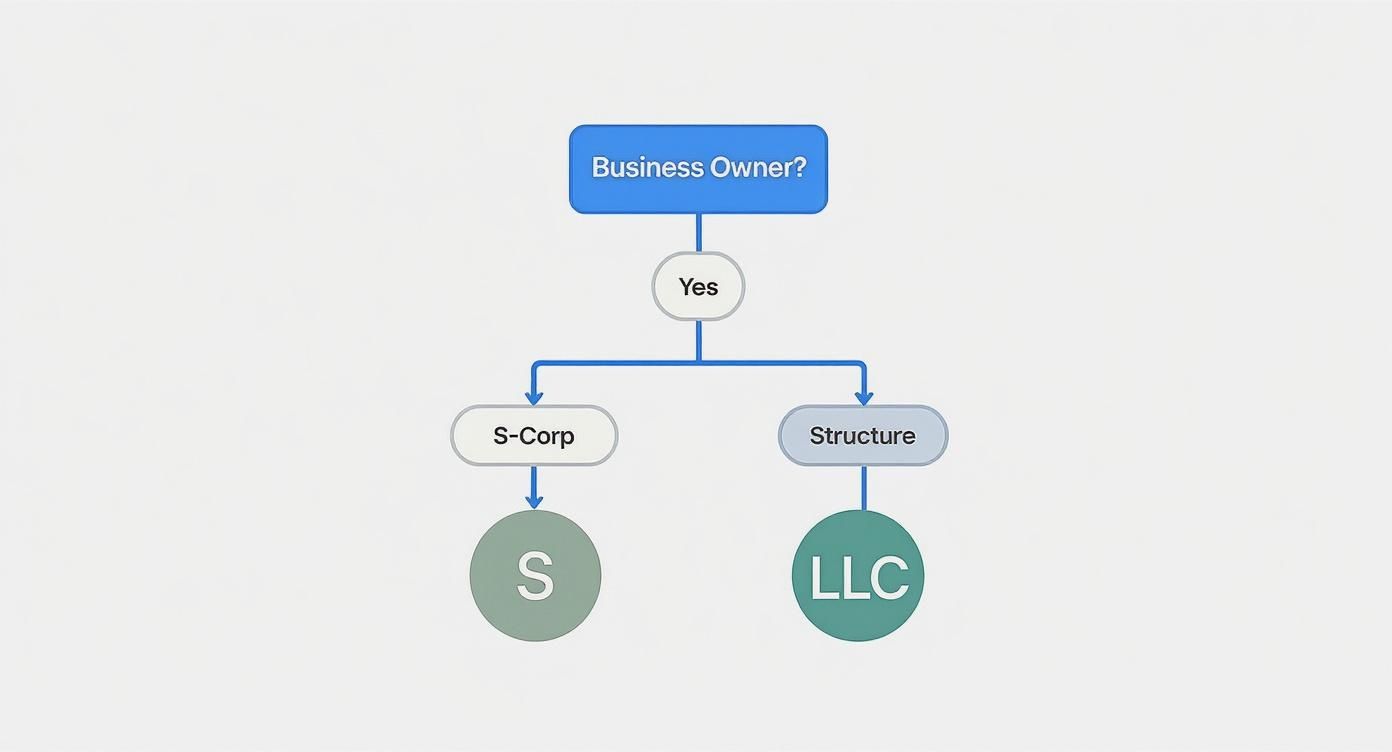
As you can see, the right path really depends on whether your priority is immediate tax savings or long-term growth fueled by outside investment.
Connecting Your Entity to Major Tax Breaks
Your business structure is also your ticket to some of the most powerful tax deductions out there. The Qualified Business Income (QBI) deduction, or Section 199A, is a perfect example. It allows owners of most pass-through businesses to deduct up to 20% of their qualified business income—a huge break.
- S-Corps, LLCs, and Sole Proprietorships are typically eligible for the QBI deduction.
- C-Corporations are completely shut out from this benefit.
That one difference can dramatically change your tax bill. Your entity choice isn’t just a box you check on a form; it's about strategically setting up your business to unlock the best tax breaks. For a closer look at the pros and cons of each, our guide on business structure types goes into much greater detail. Getting this right from the start lays the groundwork for a more profitable future.
Uncovering Every Deduction You Deserve

Smart tax planning isn’t about some secret bag of tricks. It's about being methodical and claiming every single legitimate deduction and credit your business has earned. This is, without a doubt, the most direct path to lowering what you owe, freeing up cash flow, and keeping more of your hard-earned capital in the business.
This stuff really matters. For a lot of small business owners, the federal tax system feels like a constant uphill climb. A recent survey from Goldman Sachs found that a staggering 73% of small business owners believe the system is stacked against them. Their top concerns? Big-ticket items like Section 179 expensing and the R&D credit.
This just drives home how crucial it is to take control of what you can—and that starts with mastering your deductions.
Mastering Common (But Powerful) Deductions
Let’s get the basics right first, because these are the write-offs I see business owners miss or underutilize all the time. Nailing these can make a huge dent in your tax bill.
-
Home Office Deduction: If you have a space in your home used exclusively and regularly for your business, you can claim this. You can take the easy route with the simplified method (a flat rate per square foot) or go with the actual expense method. The actual method—deducting a percentage of your mortgage interest, utilities, and repairs—usually gives you a bigger deduction, but it demands meticulous records.
-
Vehicle Expenses: Just like the home office, you’ve got two choices here. You can either track every single vehicle expense (gas, insurance, maintenance, the works) or use the IRS's standard mileage rate. If you're on the road a lot for business, the standard mileage rate is often a no-brainer—it’s simple and can be surprisingly generous.
-
Business Meals and Travel: The IRS has specific rules here, so pay attention. For a meal to be deductible, it has to be a necessary business expense. Travel costs, like flights and hotels, are deductible when you're away from your business's "tax home" for work.
One of the biggest wins for many entrepreneurs is the self-employed health insurance deduction. If you qualify, you can deduct 100% of the premiums you pay for medical, dental, and even long-term care insurance for you, your spouse, and your dependents. That’s a game-changer.
Advanced Strategies: Depreciation and Asset Expensing
Now, let's talk about big purchases. How you handle buying equipment, vehicles, or software is a massive opportunity for strategic tax planning. While depreciation lets you write off an asset's cost over its lifespan, a couple of tax code provisions let you speed things up dramatically.
Section 179 Expensing is a powerhouse. It lets you deduct the entire purchase price of qualifying equipment in the year you put it to use. This is your go-to move for immediately slashing your taxable income.
Bonus Depreciation is another way to accelerate your write-offs. For 2024, it lets you deduct 60% of an asset's cost in the first year. Heads up, though: this percentage is set to drop in the coming years, so timing your purchases is key.
The strategic use of Section 179 and bonus depreciation can turn a high-profit year into a much more manageable tax situation. Timing a necessary equipment purchase before year-end can directly reduce the income you’ll be taxed on.
The Critical Difference: Deductions vs. Credits
It’s easy to lump these together, but they’re completely different. Deductions lower the amount of your income that gets taxed. Credits, on the other hand, are pure gold—they reduce your final tax bill, dollar-for-dollar.
Here's the math: a $1,000 deduction in a 24% tax bracket saves you $240. But a $1,000 tax credit saves you the full $1,000. See the difference?
Too many business owners wrongly assume they won't qualify for some of the most valuable credits out there. Two you should absolutely look into are:
- Research & Development (R&D) Tax Credit: This isn’t just for scientists in lab coats. If your business developed a new product, improved a process, or even created new software for internal use, you might qualify.
- Work Opportunity Tax Credit (WOTC): This is a federal credit that rewards businesses for hiring people from certain groups who have historically faced barriers to getting a job.
Making sure you’ve found every last deduction is a year-round job. For a more exhaustive list, dive into our complete guide to small business tax deductions and stop leaving money on the table.
Building Your Year-Round Financial System
Smart tax planning isn’t some mad scramble you do in March or April. It’s the natural outcome of a strong financial system that you maintain all year long. Think of it this way: clean, organized financials are the bedrock of your business. Without them, you’re essentially flying blind, unable to make informed decisions and almost certainly leaving money on the table.
The system doesn’t have to be overly complex, but consistency is key.
Your first move, before anything else, is to draw a hard line between your business and personal finances. This is non-negotiable. Open a dedicated business bank account and get a business credit card. Mingling funds—paying for groceries from the business account or buying inventory on your personal card—is a recipe for chaos. It makes bookkeeping a nightmare and can even pierce the corporate veil, putting your personal assets at risk if you're an LLC or corporation.
Think of your business finances as a self-contained ecosystem. Every dollar that comes in and every dollar that goes out—from client payments to software subscriptions—needs to live within that ecosystem. This separation is fundamental to accurate reporting and a stress-free tax season.
Choosing Your Bookkeeping Software
With your accounts separated, you need a reliable way to track every transaction. Let's be honest, manual spreadsheets are a relic of the past and a breeding ground for costly errors. Modern accounting software is an absolute must-have for any serious business owner.
Platforms like QuickBooks or Xero are designed for this. They sync directly with your business bank and credit card accounts, automatically pulling in and categorizing your transactions. This isn't just a time-saver; it gives you a real-time pulse on your business's financial health. With just a few clicks, you can pull up a Profit & Loss (P&L) statement and see exactly where your money is coming from and where it’s going.
For a deeper dive, our guide on bookkeeping basics for small business will get you started on the right foot. Understanding your numbers is the first step toward implementing effective strategies for managing overhead and profit.
Managing Payroll Responsibilities
If you have a team, payroll quickly becomes one of your most critical—and complicated—financial tasks. The IRS doesn't mess around with payroll taxes, and the penalties for getting it wrong can be severe.
Here's what's on your plate:
- Withholding Taxes: From each employee's paycheck, you're required to withhold federal and state income taxes, plus their share of Social Security and Medicare (FICA) taxes.
- Paying Employer Taxes: You also have to pay the employer's portion of FICA taxes, along with federal (FUTA) and state (SUTA) unemployment taxes.
- Filing Payroll Reports: These collected taxes need to be deposited with the IRS on a strict schedule. You'll also file quarterly reports, like Form 941, to square everything up.
At the end of the year, you’re responsible for issuing a Form W-2 to every employee and a Form 1099-NEC to any independent contractor you paid $600 or more. Meticulous payroll records are crucial, as wages and payroll taxes are significant business deductions.
Using a dedicated payroll service like IRIS or the built-in payroll features in QuickBooks can automate these calculations, payments, and filings. It's a smart move that ensures you stay compliant and accurate, which is a cornerstone of intelligent tax planning.
Taking Your Tax Strategy to the Next Level
Once your business has a steady pulse and you've got the basics of bookkeeping and deductions down, it's time to get more strategic. We're moving beyond the everyday write-offs and into tactics that build long-term wealth and help you navigate the complexities that come with real growth.
One of the most powerful moves you can make is opening a small business retirement plan. Think of a SEP IRA or a Solo 401(k). Every dollar you contribute is generally a dollar you can deduct from your business income.
It's a simple but profound shift in mindset. Instead of writing a check to the IRS, you're investing in your own future. For a profitable business, this isn't just a good idea—it's a no-brainer. You get to slash your current tax bill while aggressively building a nest egg.
Supercharge Your Savings with the Right Retirement Plan
The real magic of these plans lies in their high contribution limits, which blow traditional IRAs out of the water.
- SEP IRA (Simplified Employee Pension): This is a fantastic, low-admin option for sole proprietors and small businesses. You can sock away up to 25% of your compensation, up to the annual limit. It's beautifully straightforward.
- Solo 401(k): If you're self-employed with no employees (besides a spouse), this is a true powerhouse. It lets you contribute as both the "employee" and the "employer," effectively doubling up your savings potential.
Let’s put that into perspective. A consultant pulling in $120,000 in net self-employment income could potentially stash over $20,000 into a SEP IRA. That contribution comes right off the top, reducing their taxable income by that full amount and saving them thousands in taxes today.
Your retirement plan isn't just a savings account; it's one of the most potent tax-reduction tools you have. Maxing out your contributions is a direct lever you can pull to lower your Adjusted Gross Income (AGI) and keep more money working for you.
Tackling the Maze of State and Local Taxes
As your business footprint expands—especially if you're selling online—your tax world gets a lot bigger. Suddenly, you're not just dealing with the IRS. You’ve got a whole new world of State and Local Taxes (SALT) to worry about, each with its own rulebook.
The biggest headache for most online businesses is figuring out sales tax nexus. Put simply, nexus is a connection between your business and a state that legally requires you to collect and pay their sales tax. This used to mean having a physical presence, like an office or warehouse. But now, you can trigger "economic nexus" just by hitting a certain amount of sales or number of transactions in a state.
Juggling dozens of different tax rates and nexus rules is a huge administrative drain. It’s no wonder the global tax management market is exploding. Projections show it will climb from $24.52 billion in 2025 to $33.21 billion by 2030. That’s a clear signal that businesses are wisely investing in experts and software to stay compliant. You can discover more insights about this growing market and what it means for businesses like yours.
Modern Assets and Staying Out of the IRS Spotlight
Many businesses today hold assets that were barely on the radar a decade ago. If your company is holding cryptocurrency or owns rental property, you need a specific game plan. Every crypto transaction is a taxable event, and you have to track your cost basis religiously to report gains and losses correctly. The same goes for rental income—it has its own specific rules for reporting what you earn and deducting expenses like depreciation and repairs.
Finally, let's talk about audits. While the odds are low for most small businesses, certain patterns can definitely get the IRS’s attention. Red flags include:
- Reporting big business losses for several years in a row.
- Claiming unusually high deductions for things like meals and travel relative to your income.
- Misclassifying workers as independent contractors when they really function like employees.
The best defense isn't to be timid with your deductions; it's to keep immaculate records. Save every receipt, log every business mile, and document every major transaction. When your books are clean and organized, you can face any IRS letter with confidence and stay focused on what really matters—running your business.
Common Questions About Small Business Taxes
Diving into the world of small business tax planning can feel like learning a whole new language. You've got the big-picture strategy down, but specific questions and real-world scenarios inevitably pop up. Here are some straightforward, practical answers to the questions we hear most often from entrepreneurs.
When Should I Switch from Sole Proprietor to an LLC or S-Corp?
This is one of the most important questions an entrepreneur will face, and the answer isn't a simple one-size-fits-all. It really comes down to two separate issues: legal protection and tax savings. You should think of it as a two-step decision.
First, think about becoming an LLC the moment you want a legal wall between your business and your personal life. An LLC establishes a separate legal entity. That means if the business gets sued or takes on debt, your personal assets—your home, car, and savings—are generally off-limits. This is purely a risk management move.
The second part, electing S-Corp status, is all about tax strategy. The perfect time to make this move is when your business’s net profits start to consistently outpace what you’d pay yourself as a "reasonable salary." For most business owners, that tipping point is somewhere in the $50,000 to $60,000 net profit range.
Here's why: As a sole proprietor or a standard LLC, every single dollar of profit gets hit with self-employment taxes (currently 15.3%). But with an S-Corp, you only pay those taxes on your formal salary. The rest of the profit is taken as a distribution, which is not subject to self-employment tax. That's where you see the real savings.
What Is the Difference Between Tax Planning and Tax Preparation?
It's easy to get these two mixed up, but they represent opposite ends of the financial calendar. I like to explain it this way: tax preparation is looking in the rearview mirror, while tax planning is looking ahead through the windshield.
Tax preparation is the act of documenting what already happened. You gather your financial data from the last year, fill out the right forms, and file your return. It's a necessary task focused on compliance and reporting on past events.
Tax planning, on the other hand, is a forward-looking strategy. It’s all about making smart, deliberate decisions today to legally reduce the amount of tax you'll owe tomorrow.
- Preparation: Simply listing the new work truck you bought in July on your tax forms next April.
- Planning: Intentionally buying that truck in December to take advantage of Section 179 depreciation and lower your taxable income for the current year.
Good planning makes tax prep a whole lot less painful—and a lot more profitable.
How Can I Legally Lower My Quarterly Estimated Tax Payments?
Your estimated tax payments are tied directly to your projected net income. So, to legally lower the payments, you have to legally lower your projected income. This isn't about pulling a number out of thin air; it’s about taking strategic action.
Here are the most effective ways to do just that:
- Get Serious About Deductions: Meticulous, year-round expense tracking is your best friend. Every legitimate business expense you capture, from software subscriptions to coffee with a client, directly reduces your net income and, by extension, the tax you'll owe.
- Fund a Retirement Account: This is a win-win. Contributions to a plan like a SEP IRA or Solo 401(k) are a powerful way to slash your taxable income. The money you put in comes right off the top, giving you an immediate tax break while you build for the future.
- Time Your Big Purchases: If you know you need to buy significant equipment or a vehicle, think strategically about when you do it. Using tools like Section 179 or bonus depreciation can create a huge, immediate deduction that dramatically lowers your income for that quarter and the year.
If your income tends to swing up and down, look into the annualized income method for your calculations. It lets you adjust your payments each quarter based on what you’ve actually earned, so you’re not overpaying during the lean times.
What Are the Biggest Audit Red Flags for a Small Business?
The IRS uses powerful software to flag returns that look statistically out of whack compared to similar businesses. While getting audited is never a guarantee, certain things are more likely to get you a second look.
Here are some of the most common triggers we see:
- Reporting big losses year after year. If you're always in the red, the IRS might start to wonder if your business is actually a hobby, where losses aren't deductible against other income.
- Claiming unusually high deductions. If your expenses for things like meals, entertainment, or travel seem way out of proportion to your revenue, it can raise an eyebrow.
- Deducting 100% of a vehicle's use. It’s pretty rare for a vehicle to be used only for business with absolutely no personal trips. This claim often invites a closer look.
- Misclassifying employees as independent contractors. This is a huge area of focus for the IRS. Getting this wrong can lead to steep penalties for unpaid payroll taxes.
At the end of the day, your single greatest defense against an audit—and the best way to breeze through one if it happens—is rock-solid record-keeping. When you can confidently back up every number on your return with a receipt, invoice, or mileage log, you have nothing to worry about. It turns a potential threat into a simple review of your well-organized files.
Feeling like this is a lot to handle? You don't have to go it alone. The team at Allied Tax Advisors has spent decades helping small business owners in San Diego and beyond turn tax complexity into financial clarity. From picking the right business structure to managing payroll and finding every last deduction, we're here to build a proactive strategy that lets you get back to growing your business.
Ready to build a smarter tax plan? Visit us at https://alliedtax.com to schedule your consultation today.