
You moved money into a high-yield savings account, saw interest finally showing up again, and felt like you made a smart move. Then tax season rolled around and you had the obvious follow-up question: how much of that interest do you keep?
That question matters more than many realize. A savings account feels safe and simple, but the tax side isn't optional and it isn't always intuitive. If you live in San Diego and you're stacking cash for emergencies, a home purchase, quarterly taxes, or business reserves, the interest you earn can increase your tax bill.
I'll give you the straightforward CPA answer. Yes, savings account interest is taxable. You also need to know when it becomes taxable, how to report it correctly, how to estimate the after-tax return, and when it makes sense to move part of your cash into a more tax-efficient account.
Table of Contents
- Your Savings Are Growing But So Is Your Tax Bill
- How Savings Account Interest Is Taxed
- Reporting Your Interest Income to the IRS
- Calculating Your Tax on Savings Interest
- Strategies to Lower Your Taxable Interest
- When to Talk to a San Diego Tax Advisor
Your Savings Are Growing But So Is Your Tax Bill
A lot of new clients come in with the same situation. They moved cash from a checking account paying almost nothing into a savings account that earns interest. A few months later, they notice the balance growing and assume that's pure upside.
It isn't.
That interest is income, and once it starts showing up consistently, it needs to be part of your tax planning. If you're a W-2 employee, the extra tax might be modest. If you're self-employed, already in a higher bracket, or holding large cash reserves for a business or real estate purchase, the tax impact gets harder to ignore.
Practical rule: Don't treat savings interest as “free money.” Treat it like any other taxable income stream and plan for it before year-end.
I'm opinionated on this point because I see the same mistake every year. People focus on the posted APY and never calculate the after-tax result. That's fine if the account is purely for liquidity and safety. It's not fine if you've parked long-term money there without asking whether a different account type would serve you better.
For most households, a savings account is still useful. You need liquid cash. You need an emergency fund. You may need reserves for property taxes, tuition, or uneven income. But if your balances are large enough to produce meaningful interest, tax savings account interest should stop being an afterthought.
How Savings Account Interest Is Taxed
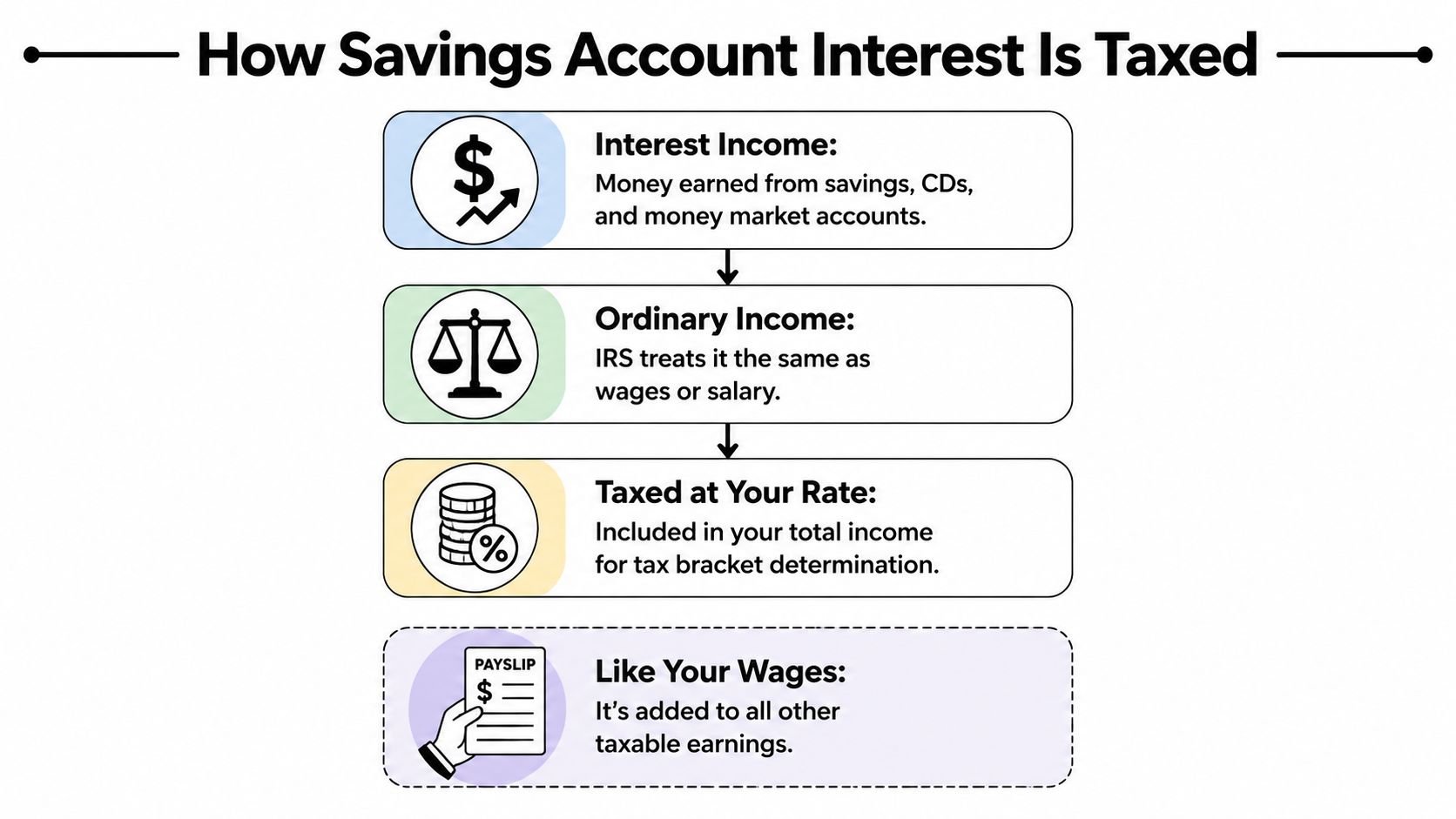
The IRS doesn't give savings account interest any special break. It's taxed as ordinary income, and it gets added to your adjusted gross income in the year it becomes available to you. Under current federal brackets, that tax can range from 10% to 37%, which is why the after-tax yield is lower than the headline APY, as explained in Experian's overview of savings account interest taxes.
Why the IRS treats interest like regular income
The simplest way to think about it is this. If wages are money you earn by working, interest is money your cash earns by sitting in the bank. Different source, same general tax treatment.
That's why I often describe interest as a tiny side job your money is doing for you. The IRS still wants its share. It doesn't matter that you didn't clock in somewhere to earn it.
If you want a broader grounding in how this category fits into the tax code, take a look at Allied Tax's explanation of unearned income and how it's taxed. Savings interest falls into that general bucket, but the key takeaway here is simpler: it lands on your return as taxable income and stacks on top of everything else you earned.
When the tax hits
The timing trips people up. You don't pay tax when you spend the interest. You pay tax when the interest is credited and available to you.
That means year-end timing matters. If your bank posts interest at the end of December and you can access it then, it generally belongs on that year's return. If it posts in the next tax year, it generally shifts with it. That sounds minor, but for clients who are close to a bracket threshold or managing multiple accounts, timing can affect planning decisions.
Here's the practical consequence:
- Check December statements: The posting date matters more than the statement period.
- Don't rely on memory: Use the tax forms and account records, not rough estimates.
- Watch multiple banks: Online banks, credit unions, brokered cash accounts, and joint accounts can all generate taxable interest.
Your bank's advertised yield tells you what the account earns. Your marginal rate tells you what you keep.
That's the core issue with tax savings account interest. The account may be excellent for liquidity. It may be mediocre for long-term after-tax growth.
Reporting Your Interest Income to the IRS
People often get sloppy. They assume that if the bank doesn't send a tax form, the IRS doesn't care. That's wrong.
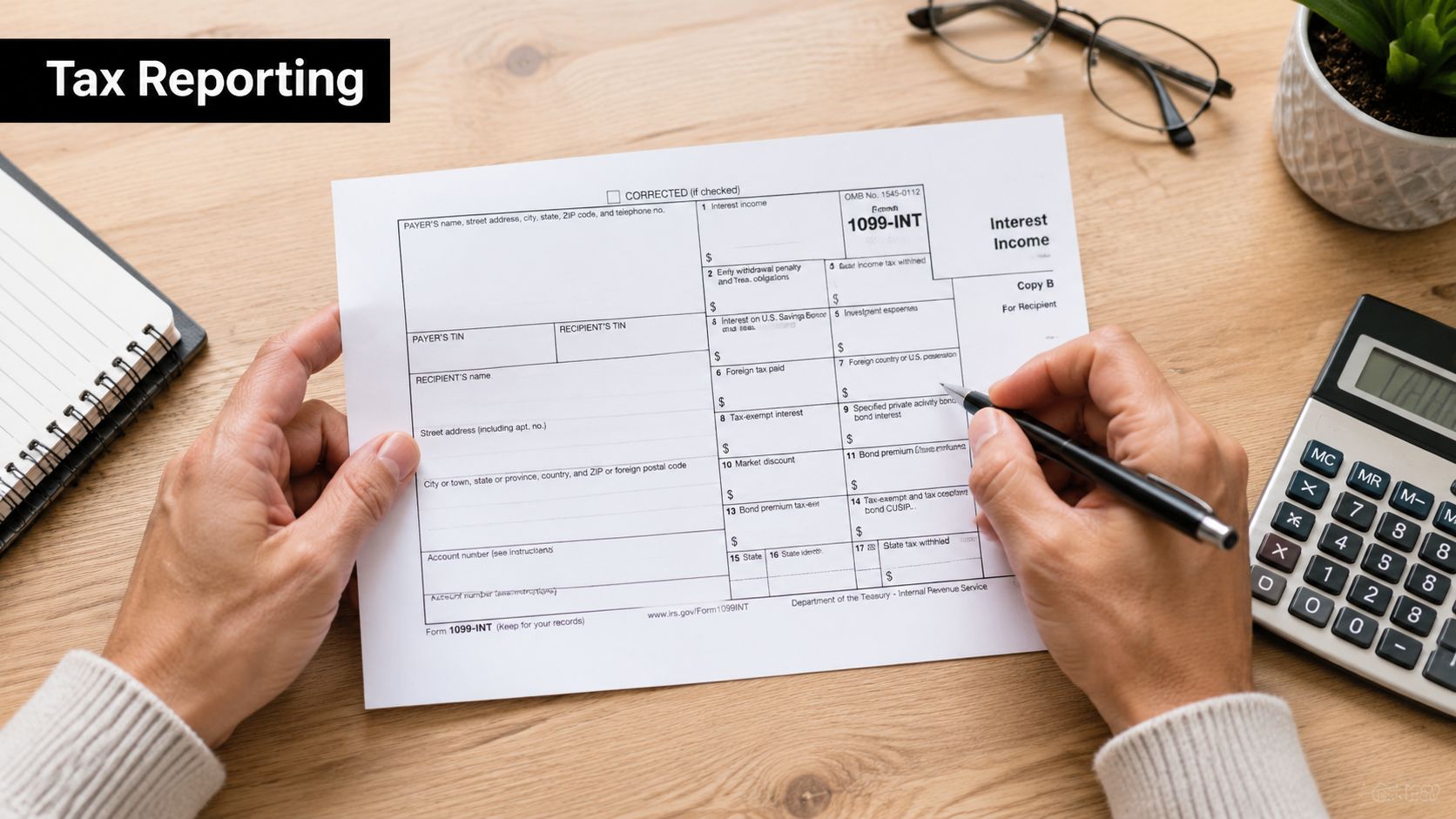
Savings-account interest is generally taxed at your marginal rate, and banks typically issue Form 1099-INT when annual interest from that institution is at least $10. If your total taxable interest reaches $1,500 or more, you'll generally need Schedule B rather than reporting only on Form 1040 line 2b, as outlined in Fidelity's summary of interest income reporting.
What to expect from Form 1099-INT
If a bank pays you enough interest to trigger reporting, it will generally send Form 1099-INT. You'll usually get one from each institution that crossed the reporting threshold.
That form is useful, but it doesn't define your legal obligation. If a bank doesn't issue one because the amount was under the reporting threshold, the interest can still be taxable. You're still supposed to report it.
I tell clients to stop thinking in terms of “Did I get the form?” and start thinking in terms of “Did I earn taxable interest?”
A good process looks like this:
- Gather every year-end tax packet from your banks, credit unions, and brokerage cash accounts.
- Review account statements for any small amounts that may not have generated a form.
- Match account ownership carefully, especially for joint accounts or custodial accounts.
- Keep your totals organized before filing, rather than scrambling in April.
When Schedule B enters the picture
Schedule B isn't scary. It's just more detailed reporting. If your total taxable interest is high enough to require it, the form lists payers and amounts in a more structured way.
If you've never dealt with it before, this breakdown of Form 1040 Schedule B and when it applies is a useful reference. It helps if you have several accounts, old accounts you forgot to close, or a mix of bank and brokerage interest.
Compliance point: The reporting threshold for a form and the taxability of the income are not the same thing.
That distinction matters. It's one of the easiest ways taxpayers create avoidable notices.
Don't ignore California
If you live in San Diego, don't make this a federal-only conversation. California generally taxes interest income too. So even if the federal tax on your savings interest looks manageable, the state side can still reduce what you keep.
I'm blunt about this because California taxpayers often underestimate the combined effect. You're not just asking whether the account earns a decent rate. You're asking whether the after-tax result still makes sense for the purpose of that money.
For a true emergency fund, simplicity wins. For money you won't need for a while, tax efficiency starts to matter more.
Calculating Your Tax on Savings Interest
The issue's practical impact takes hold. The tax on savings account interest isn't some abstract rule. It's math, and once you run the numbers, you can decide whether the account is still the right place for your money.

Three simple examples
These examples show the basic federal effect using the scenarios provided.
| Profile | Annual Income | Interest Earned | Marginal Tax Rate | Estimated Federal Tax on Interest |
|---|---|---|---|---|
| College student | $15,000 | $200 | 10% | $20 |
| Single professional | $60,000 | $500 | 22% | $110 |
| High-income earner | $200,000 | $1,500 | 32% | $480 |
Here's how that works in plain English.
For the college student, the interest is small and the tax hit is small too. Earning $200 of interest and paying 10% federal tax means about $20 goes to federal tax, leaving about $180 before any state tax.
For the single professional, the savings account still works fine for short-term goals, but the drag becomes more visible. On $500 of interest taxed at 22%, about $110 goes to federal tax.
For the high-income earner, the issue is no longer trivial. $1,500 of interest taxed at 32% creates about $480 of federal tax before you even think about California tax or any other layered taxes.
Small interest amounts feel harmless. Larger cash balances can turn ordinary savings into a recurring tax drag.
When higher earners pay more than their bracket
There's another layer for some taxpayers. The 3.8% Net Investment Income Tax applies once modified adjusted gross income exceeds $250,000 for married filing jointly or $200,000 for single filers, and it can apply to interest income alongside dividends, capital gains, and rental income, as noted in Thrivent's NIIT explanation.
That matters because your savings interest may not stop at your regular marginal bracket. If you're near those thresholds, additional interest can contribute to a higher effective tax cost.
A few judgment calls I make with clients:
- If you're below the NIIT thresholds, savings interest is simpler to evaluate.
- If you're near the thresholds, year-end planning gets more valuable.
- If you're above the thresholds, holding large long-term balances in fully taxable savings often becomes a strategy problem, not just a compliance issue.
The point isn't that savings accounts are bad. The point is that once your income and balances rise, you should stop using them by default for money that has a different purpose.
Strategies to Lower Your Taxable Interest
A standard savings account is a cash tool, not a tax strategy. That's been true for a long time. Historically, interest has been taxed less favorably than some other forms of investment return, which is one reason savings accounts remain more tax-inefficient for higher-bracket households, as discussed by the Bradford Tax Institute in its historical federal rate overview.

Use the right account for the right goal
This is my main recommendation. Don't ask one account to do everything.
If the money is your emergency fund, a regular savings account still makes sense because access matters more than tax efficiency.
If the money is for retirement, health expenses, or education, using a taxable savings account by default is usually lazy planning. You may be giving up better tax treatment for no good reason.
Some alternatives to consider:
- Roth IRA: Best for long-term retirement money if you qualify and can leave the funds invested for that purpose.
- HSA: Powerful if you're eligible and want to save for qualified medical expenses with favorable tax treatment.
- 529 plan: Useful when the goal is future education costs.
- U.S. savings bonds: Worth reviewing for certain goals because they can offer different tax treatment than a bank savings account.
- Traditional retirement accounts: Often a better place for long-term savings than leaving excess cash fully taxable year after year.
If you want a broader perspective on how tax-efficient structures vary across jurisdictions and asset choices, World Property Investor's tax efficiency guide is an interesting outside reference. It's not a substitute for U.S. tax advice, but it does help frame the larger idea that where income sits can matter almost as much as how much it earns.
Compare taxable savings with tax-advantaged options
Here's the practical comparison I use with clients.
| Account Type | Primary Goal | Federal Tax on Growth | California Tax on Growth |
|---|---|---|---|
| Taxable savings account | Emergency fund, short-term reserves, operating cash | Taxable | Generally taxable |
| Roth IRA | Retirement | Tax-free growth if qualified rules are met | California generally follows federal qualified treatment principles for retirement distributions, but account use should be reviewed case by case |
| HSA | Qualified medical expenses | Tax-advantaged treatment for eligible contributions and qualified medical use | California tax treatment differs from federal treatment, so separate review is important |
| 529 plan | Education savings | Tax-free for qualified education expenses | State treatment depends on account use and rules |
| Traditional IRA or similar tax-deferred retirement account | Retirement | Tax-deferred until withdrawal | State taxation depends on distribution timing and type |
That table is intentionally simple. The right choice depends on the goal, time horizon, and access needs. The mistake is keeping medium-term or long-term money in a taxable savings account just because it feels familiar.
Practical moves I recommend
Start with account purpose. Label each pool of money by job.
- Emergency cash: Keep it liquid. Don't over-optimize this.
- Known spending within the near term: Savings or money market options are fine if access matters.
- Longer-term money: Review whether a tax-advantaged account fits better.
- Large idle balances: Revisit them before year-end. They often sit in taxable accounts out of habit.
If you want help evaluating where cash should live, tax reduction strategies for lowering taxable income can give you a solid framework. One planning option some San Diego taxpayers use is working with Allied Tax Advisors for tax advisory services that map savings, investments, and account structure to the actual goal of the money.
Good tax planning isn't about chasing every break. It's about stopping avoidable leakage on money that was never meant to sit in a fully taxable account forever.
That's the heart of tax savings account interest planning. Keep liquid cash liquid. Move purpose-driven money into a structure that matches the purpose.
When to Talk to a San Diego Tax Advisor
Some returns stay simple even with savings interest. Many don't.
The IRS taxes savings interest in the year it's credited and available for withdrawal, not when you spend it, which makes timing important for year-end planning. Even small posting differences can shift income between tax years, according to the IRS topic on taxable and nontaxable interest.
You should talk to a tax advisor if any of these apply:
You're near higher-income thresholds
If your income is high enough that extra interest can affect other tax calculations, DIY software often gives you an answer without giving you a strategy. That's not the same thing.
You have multiple account types
Bank savings, brokerage sweep accounts, CDs, joint accounts, and trust or custodial accounts create more room for reporting mistakes and missed planning opportunities.
You own a business or rental property
In San Diego, a lot of clients hold large cash reserves for payroll, repairs, tax payments, or acquisitions. Once those balances grow, the tax cost of leaving everything in ordinary taxable cash becomes worth reviewing.
You want a year-round plan, not just a filed return
The best time to deal with tax savings account interest isn't after January forms arrive. It's before year-end, while you still have choices.
If you want someone to review your interest income, account structure, and California tax exposure before filing season gets messy, Allied Tax Advisors can help you build a clean reporting process and a practical tax plan that fits your savings goals.