
You're staring at a paycheck, a property tax bill, or a sales report, and one question keeps coming up, why is some money taxed while other money isn't? That's where what is a tax base stops being an abstract classroom term and becomes a practical question about your own cash flow. For a homeowner, landlord, or small business owner, the tax base decides what portion of income, property value, or sales is exposed to tax.
A cleaner way to think about it is this, the tax base is the pile of economic activity the government has chosen to tax. If that pile is broader, rates can often be lower for the same revenue, which is why base design matters as much as the headline rate. If you want a simple starting point on the income side, the definition of adjusted gross income is a useful companion to this topic, because it helps show how tax systems narrow a gross amount into something taxable through specific rules and adjustments, and a good plain-English overview is available in this guide to adjusted gross income.
If you're also dealing with property, the question gets even more concrete. A vacant lot, for example, may face different treatment than a rental house or operating business asset, and a practical local overview like vacant land property taxes helps show how the taxable base can change depending on use, location, and assessment rules. By the end, you'll be able to define the term, compare common types, see how the base is calculated, and understand how legal planning can shrink or reshape it.
Table of Contents
- Understanding the Key Concepts
- Differentiating Common Tax Bases
- Calculating Tax Base Examples
- Implications for Tax Planning and Compliance
- Strategies to Optimize Your Tax Base Legally
Understanding the Key Concepts
Tax base means the total amount of income, property, assets, consumption, transactions, or other economic activity that's subject to tax. That sounds simple, but the practical meaning is bigger than the dictionary version. If lawmakers tax more of the underlying activity, they can often use lower rates to raise the same revenue, which is why tax base design sits at the center of tax policy, not on the sidelines.
A historical U.S. example makes the idea easier to see. After the Tax Reform Act of 1986, the National Bureau of Economic Research describes the taxable portion of income as rising sharply, and in its sample the mean average tax base went from 0.880 in 1985 to 0.927 in 1988, while the mean marginal tax rate fell from 0.212 to 0.184 (Tax Foundation summary). The lesson is straightforward, changing what counts in the base can matter just as much as changing the rate itself.
How base, rate, and revenue fit together
A tax system works like a recipe. The base is the ingredients list, the rate is the proportion applied, and the revenue is the result. If you widen the ingredients list, you may not need as much of the rate to produce the same outcome.
Practical rule: when people argue only about rates, they're often missing the more important debate about what the tax system actually reaches.
The same logic shows up in everyday planning. A founder comparing a tax offset vs tax deduction needs to know whether a rule reduces taxable income, reduces the tax bill directly, or changes the size of the base in the first place. A clear overview from ClaimKit's explanation of tax offsets and deductions can help readers separate those ideas without mixing them up.
Differentiating Common Tax Bases
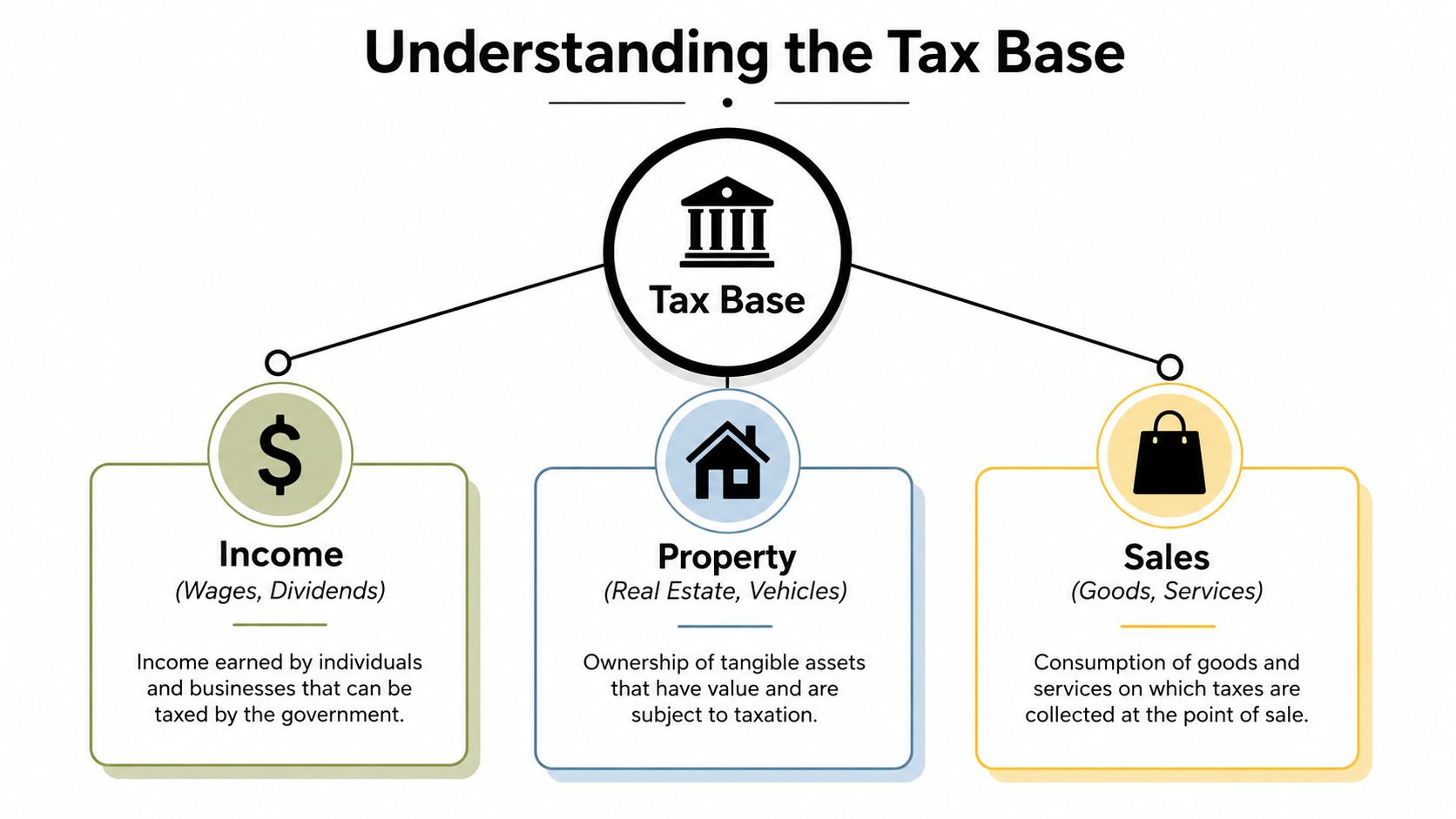
The phrase tax base gets used in a few different ways, and that's where many people get lost. Income tax, property tax, and sales tax each have their own base, which means each one counts different things. A paycheck, a county assessment, and a retail receipt can all be part of the tax conversation, but they are not taxed under the same rule set.
Three bases, three different scopes
Income tax bases usually start with wages, business income, interest, and other taxable receipts, then subtract items the law excludes or deducts. Property tax bases focus on assessed value, which is why the bill on a home, commercial building, or land parcel can differ from the price you paid. Sales tax bases usually cover the taxable price of goods, and in some places selected services, but the exact scope depends on state law.
| Base Type | Scope | Example |
|---|---|---|
| Income | Money received or earned that the tax law treats as taxable after exclusions and deductions | Wages from a job, self-employment income, rental income |
| Property | Assessed value of land, buildings, or other taxable property | A home assessment, a warehouse parcel, a vacant lot |
| Sales | Taxable purchases of goods, and sometimes services, under state or local rules | A supermarket receipt, a software sale, a taxable service charge |
Why the same transaction can be taxed differently
California is a useful example because the state's sales tax base doesn't reach every transaction the same way. Its treatment of software shows how delivery method and product category can change whether a sale falls inside the base, which is why a business owner can't assume every purchase is treated alike. For a focused explanation of basis issues that matter when property changes hands, the distinction between purchase price, basis, and later tax treatment is worth reviewing in this cost basis guide.
A good tax question isn't just “what's the rate?” It's “what's included before the rate even gets applied?”
That's the dividing line. Once you understand scope, you can tell whether a tax is broad or narrow, and whether your paycheck, your building, or your point-of-sale system is the item that matters.
Calculating Tax Base Examples
The fastest way to understand the tax base is to work through it the way a taxpayer would. The rules look different depending on whether you're an employee, a landlord, or a small retailer, but the same logic applies each time, start with the gross amount, then remove the items the law says don't belong in the base.

Individual income
For an individual, the tax base often begins with income earned during the year and then gets narrowed by deductions, exclusions, and other adjustments allowed under the law. That's why two people with the same paycheck can end up with different taxable amounts. A freelancer, for example, may have business expenses that reduce taxable income, while a W-2 employee may rely on a different set of rules.
The main point is not the exact form of every deduction. It's that the base is the amount left after the tax law finishes its filtering process. If you treat gross pay and taxable pay as the same thing, you'll misread your return.
Landlord property
A landlord's tax base can be even more intuitive. Rental property starts with the asset's tax basis, then the owner adjusts for depreciation and expenses over time. Under IAS 12, the tax base of an asset equals the amount deductible when recovering its carrying amount, and a higher tax basis lowers taxable gain on disposal (CPDbox explanation).
That matters because book value and tax base aren't always the same number. Book value is an accounting measure, while tax basis is what the tax system recognizes for gain, loss, and deductions. When those differ, financial statements can show temporary differences that create deferred tax effects.
Small-business sales
For a small retailer, the sales tax base is usually the amount of taxable sales, not every dollar that comes through the register. Taxable goods are often included, while exempt products, non-taxable services, or sales outside the jurisdiction may be excluded. A store owner needs the point-of-sale system to separate those categories correctly, because a messy sales base creates filing problems fast.
Practical rule: if your software, rent roll, or accounting file can't separate taxable from non-taxable items, your tax base is probably being measured too loosely.
That's why the same transaction can be treated differently in accounting and tax. A company may record one number for books and another for tax, and that gap is normal when the law uses a different base than the financial statements do.
Implications for Tax Planning and Compliance
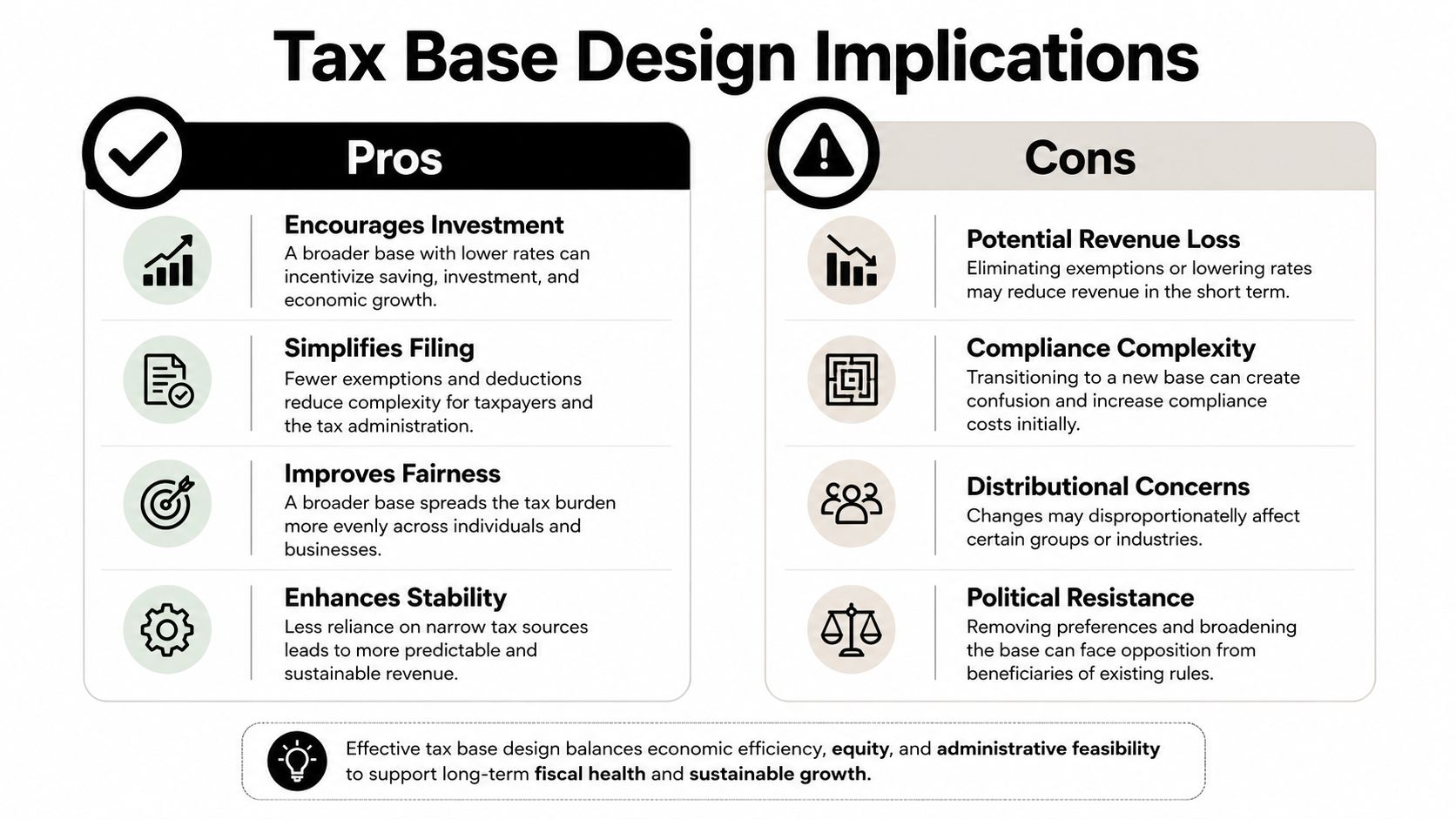
Once you understand the base, planning gets more precise. Taxpayers don't usually change the rate, but they do influence the base through timing, classification, documentation, and lawful elections. That's where good compliance work starts, because a rule that looks like a deduction, exclusion, or exemption can end up shrinking the base in a way that changes your real tax bill.
What base design does to incentives
Policy choices around tax base shape who pays, how much they pay, and how much complexity they face. Recent policy research finds that major tax expenditures and preferential rates disproportionately benefit White families per capita, which shows that base design affects distribution as well as revenue (Tax Policy Center briefing). That matters for families, landlords, and business owners because a rule that narrows the base can shift the burden elsewhere even when the headline rate stays unchanged.
For California taxpayers, the practical question is often whether a deduction, exemption, or sourcing rule exists under state law even when federal treatment looks different. IRS rules don't automatically carry over to California, and that gap is where many filing errors start. The safest approach is to treat each system as its own map, not as one merged code.
Planning without stepping over the line
A business owner maximizing allowable expenses has to support every item with records, not assumptions. The same is true for rental owners who claim repairs, interest, or depreciation, and for retailers who track taxable and exempt sales. One helpful read for small businesses comparing deduction strategies is maximising allowable expenses in Ireland, because it shows how professional expense tracking works as a compliance habit, not a loophole.
The California side of sales tax can be especially tricky when digital goods, software, or mixed transactions are involved. A service that feels similar to another service can fall on the other side of the taxable line depending on state rules, contract language, and delivery method. That's why compliance teams spend so much time on classification before they ever get to filing.
The most expensive tax mistake is often not a wrong rate. It's putting the wrong transaction into the wrong base.
Strategies to Optimize Your Tax Base Legally
Legal tax planning usually means managing what enters the base, when it enters, and how it's documented. Timing income near year-end, tracking depreciation carefully, and separating taxable from exempt sales can all change the amount ultimately exposed to tax. If you want a broader roadmap for income-side tactics, this guide on how to reduce taxable income is a useful companion.
For landlords, keep repair records distinct from improvements, because those categories are treated differently and can affect basis over time. For small businesses, make sure your point-of-sale setup flags taxable items correctly, especially if you sell a mix of goods and services. For California filers, review state-specific credits and exclusions separately from federal rules, since the two systems don't always line up.
A simple checklist helps:
- Time income carefully: Use legitimate timing rules so income lands in the right tax year.
- Document basis changes: Keep purchase records, depreciation schedules, and improvement invoices together.
- Separate taxable sales: Configure your accounting system so exempt items don't get swept into the base.
- Review state differences: Check California treatment on items that may be taxed differently federally.
- Ask before you classify: When a transaction is borderline, get advice before filing.
Allied Tax Advisors works with individuals, landlords, and business owners on planning, compliance, and IRS or state resolution, so it's a practical option when you need help sorting out what belongs in the base and what doesn't.
If you want a clear review of your income, rental property, or sales-tax exposure, Allied Tax Advisors can help you map the rules to your situation. Their team works on tax planning, business compliance, and resolution matters, which makes them a strong fit when the key question is not just what you earned, but what part of it the tax system ultimately reaches.