
In the world of accounting, depreciation is simply a way to spread the cost of a physical asset—like a delivery truck, a piece of machinery, or a building—over its useful lifespan. Think of it as a methodical way to account for the asset's value dropping over time, whether from normal wear and tear or just becoming outdated. It matches the cost of the asset to the revenue it helps you earn each year.
Unpacking the Concept of Depreciation

Let's make this real. Imagine your business buys a brand-new delivery van for $40,000. The second you drive it off the lot, it starts losing value. That’s depreciation in a nutshell.
But here’s a common misconception: depreciation isn't about tracking the van's daily resale value. You're not checking Kelley Blue Book every month. Instead, it's a structured accounting process. You're taking that big $40,000 hit and spreading it out as a smaller, predictable expense over all the years you expect to use the van.
This clever process transforms a huge one-time cash outlay into a series of manageable annual expenses on your financial statements.
Why It's a Non-Cash Expense
You'll often hear accountants call depreciation a non-cash expense. This sounds a bit technical, but the idea is simple. When you record a depreciation expense for the year, no money actually leaves your bank account. The cash already went out the door when you first bought the van.
Recording depreciation is purely an on-paper adjustment. It shows that the asset's value on your books is gradually decreasing. This is a fundamental part of accrual accounting, which gives a much more accurate picture of your company's real profitability. It affects your income statement by lowering net income (and thus, your tax bill) and your balance sheet by reducing the asset's book value.
This is especially critical for certain types of assets, like investment properties. Getting the rules right is non-negotiable, and you can learn more about the specifics in our detailed guide on depreciation on rental property.
The Core Idea: Depreciation is the accounting practice of spreading a tangible asset's cost over its useful life. It's not about cash flow, but about matching expenses to the periods in which the asset helps generate revenue.
It's also interesting to see how this plays out on a global scale. The rates at which assets are depreciated can differ significantly between economies. Research has shown that annual depreciation rates for public capital in high-income countries hovered around 4.59%, while in low-income nations, they were closer to 2.50%. This reflects vast differences in economic conditions, asset quality, and how long things are expected to last. You can dive deeper into these global economic indicators to see the full picture.
Key Depreciation Terms at a Glance
To really get a handle on depreciation, you need to know the lingo. These are the building blocks for any calculation you'll do.
Here’s a quick-reference table to make these core concepts easy to digest.
| Term | Simple Definition | Example |
|---|---|---|
| Asset Cost | The total amount you paid for the asset, including any shipping, installation, or setup fees. | The $40,000 price tag of the van, plus any extra fees to get it ready for the road. |
| Useful Life | The estimated number of years you expect the asset to be productive and generate revenue for your business. | You estimate your new delivery van will be in service for 5 years. |
| Salvage Value | The estimated resale value of an asset at the very end of its useful life. What you think you can sell it for. | After 5 years, you believe you can sell the used van for parts for $5,000. |
| Book Value | The asset's cost minus all the depreciation that has been recorded against it so far (accumulated depreciation). | After one year of depreciation, the van's book value is no longer $40,000; it's lower. |
Understanding these four terms is the foundation. Once you have them down, calculating depreciation becomes a straightforward process of plugging the right numbers into the right formula.
Why Depreciation Is a Critical Financial Tool
Depreciation is so much more than a routine entry in your books. Think of it as a powerful financial tool that brings a dose of reality and strategic thinking to your business finances. Its entire purpose is to honor one of the most fundamental rules in accounting: the matching principle.
Simply put, this principle says you need to record expenses in the same period as the revenue they helped create. Let's go back to that delivery van. You wouldn't expense the entire $30,000 cost on day one. Instead, depreciation lets you spread that cost over the years the van is actually generating income for you. This approach paints a far more accurate picture of your profitability year after year.
How It Shows Up on Your Financial Statements
Depreciation leaves its fingerprints on your two most important financial reports: the income statement and the balance sheet. Getting a feel for how it affects both is the key to understanding its practical role.
- On the Income Statement: Depreciation appears as an operating expense. This lowers your company's net income, which is the number your taxes are based on.
- On the Balance Sheet: The value of your assets on paper goes down over time. Each year's depreciation expense gets added to a running total called accumulated depreciation. We then subtract this total from the asset's original price to get its current "book value."
By systematically reducing an asset's book value while recognizing a corresponding expense, depreciation gives you a realistic view of your company's financial health and the true cost of doing business. It's what turns a simple purchase into a calculated, long-term investment.
The Strategic Tax Advantage
Here’s where it gets really interesting. The most immediate benefit of depreciation is its impact on your tax bill. Because depreciation is a non-cash expense—you aren't actually writing a check for it each year—it reduces your taxable income without affecting your cash flow for that period.
That's a huge deal. By lowering your profit on paper, you directly reduce how much you owe in income taxes. This frees up real cash that you can put back into the business to fuel growth, pay down debt, or just keep on hand for a rainy day. It's this strategic angle that makes depreciation an essential part of smart tax planning for any company.
This isn’t just a small-business tactic, either. Depreciation is a core component of national economic calculations that influence metrics like a country's GDP. Methodologies can differ from one country to another; for instance, some prefer a straight-line method while others use accelerated schedules, which can affect how economies are compared. In large economies, corporate depreciation charges add up to billions of dollars every year, showing just how massive its scale is in the world of finance.
To really get the most out of depreciation for planning, many businesses are now exploring modern approaches like using AI for financial analysis to pull deeper meaning from their financial data. This shifts depreciation from a simple accounting chore to a powerful tool for improving financial health.
Choosing the Right Depreciation Method
Picking the right way to calculate depreciation isn't just a box-ticking exercise for your accountant. It’s a strategic decision. The best method should reflect how your asset actually loses value in the real world, because not everything wears out at a nice, even pace.
Getting this right ensures your financial statements tell an accurate story and helps you build a smarter tax strategy. Let's walk through the three most common approaches: straight-line, declining balance, and units of production. Each one tells a different story about an asset's journey.
The Straight-Line Method
The straight-line method is the old faithful of depreciation—simple, predictable, and the most common method you'll see. Think of it as the "slow and steady" approach. It takes the total cost of an asset and spreads it evenly across each year of its useful life.
This means you record the exact same depreciation expense, year in and year out. It’s perfect for assets that lose value consistently over time, without any big drops in the beginning.
- Office Furniture: Your trusty desk or office chair provides roughly the same value year after year until it’s time for a replacement.
- Fixtures: Things like shelving or basic building improvements tend to have a long, stable lifespan.
Its simplicity is its biggest strength, making it a go-to for straightforward financial reporting.
The Declining Balance Method
On the flip side, the declining balance method is an accelerated approach. It’s all about front-loading the expense, so you record a much larger depreciation hit in the early years of an asset's life and a smaller one as it gets older.
This method lines up perfectly with the reality of how many assets work. They are often most productive—and lose the most value—right when they're brand new.
It's the ideal choice for assets like:
- Technology: A new server or computer is at its peak on day one, but its value drops quickly as technology advances.
- Vehicles: Everyone knows a new company car loses a big chunk of its value the second you drive it off the lot.
- Heavy Machinery: New equipment is typically at its most efficient and powerful when it first comes off the production line.
Accelerated methods became popular for a reason—they're a powerful tax strategy. Back in 1962, the U.S. IRS gave its official nod to methods like the double-declining-balance approach, which gave businesses a major incentive to invest in new equipment. As you can read in historical documents like Revenue Procedure 62-21, this allowed companies to get bigger tax deductions sooner.
This chart shows just how dramatic the difference is for a $10,000 asset in its first year.
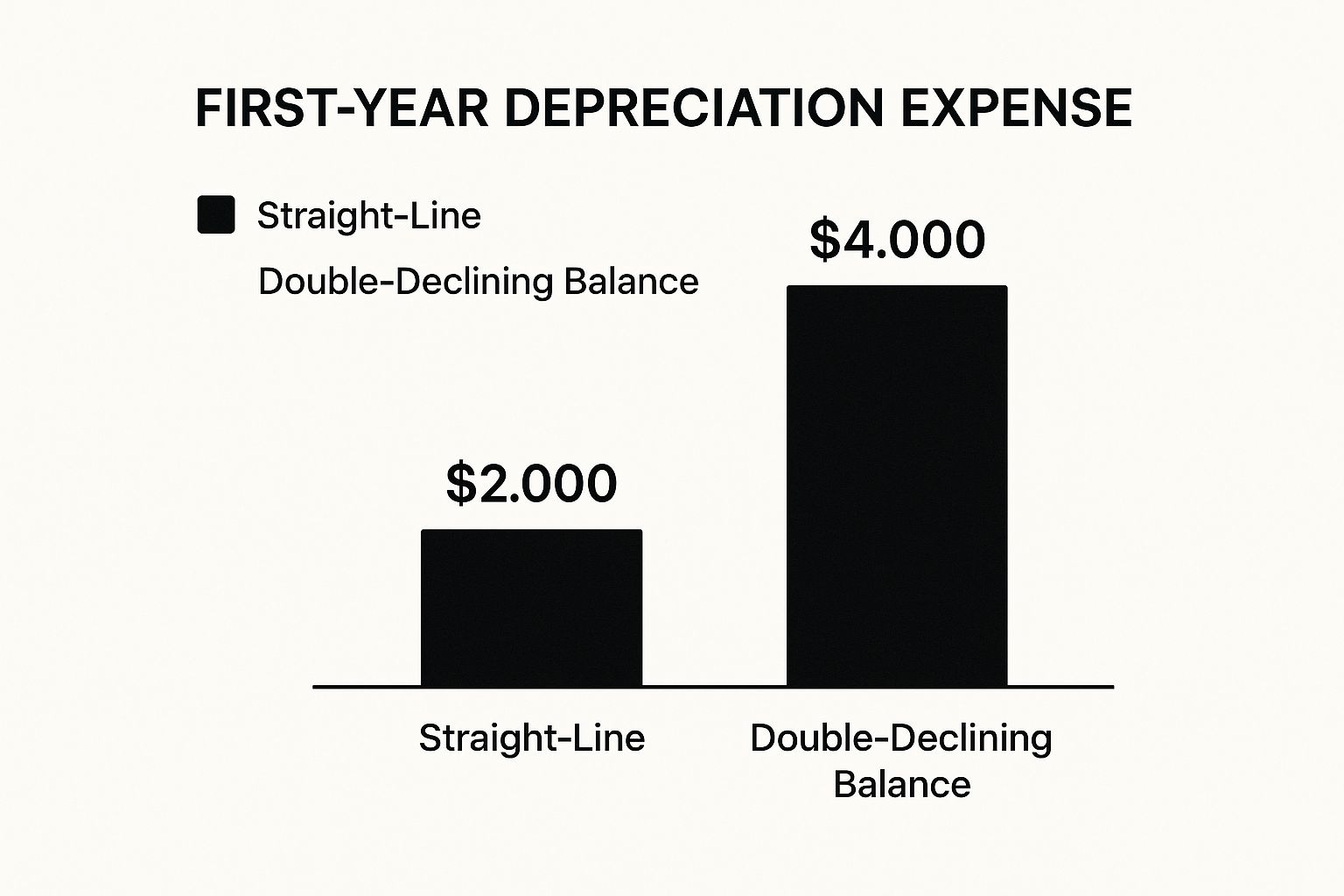
As you can see, the accelerated method gives you double the depreciation expense in year one, which means a much larger tax deduction right away.
The Units of Production Method
Finally, we have the units of production method. This one throws the calendar out the window and ties depreciation directly to usage. An asset's value goes down based on how much work it actually does—whether you measure that in miles driven, hours operated, or widgets produced.
With this method, an asset that sits idle in a warehouse for a year incurs zero depreciation. The cost is perfectly matched to its actual productivity.
This is by far the most accurate method for assets where wear and tear is the biggest factor. Think of a factory machine rated to produce a million units in its lifetime, or a delivery truck whose value is tied more to its mileage than its model year.
Comparing Depreciation Methods
Feeling a bit lost in the options? This table offers a quick side-by-side comparison to help you match the right method to your assets and financial goals.
| Method | Best For | Depreciation Pattern | Complexity |
|---|---|---|---|
| Straight-Line | Assets that lose value evenly (e.g., office furniture, fixtures). | Consistent and predictable expense each year. | Low |
| Declining Balance | Assets that lose value quickly (e.g., tech, vehicles, machinery). | High expense in early years, lower in later years. | Medium |
| Units of Production | Assets whose lifespan is based on usage (e.g., manufacturing equipment). | Varies directly with asset use; no use, no expense. | High |
Ultimately, the goal is to choose the method that gives the truest financial picture of your business operations.
Calculating Depreciation: Putting the Methods to the Test
Theory is great, but let's get our hands dirty. The best way to really grasp these concepts is to run the numbers on a real-world asset. We'll take one common business purchase and apply all three methods so you can see firsthand how the results differ.
Imagine a local bakery buys a new delivery van. Here are the core numbers we’ll be working with:
- Asset Cost: $35,000
- Salvage Value: $5,000 (what they expect to sell it for after its useful life)
- Useful Life: 5 years
- Total Production Capacity: 100,000 miles (for the units of production method)
Example 1: The Straight-Line Method
This is the bread and butter of depreciation—simple, predictable, and easy to calculate. It spreads the cost of the van evenly across its five-year lifespan. Think of it as paying the same "wear and tear" expense every single year.
The formula couldn't be simpler:
Annual Depreciation = (Asset Cost – Salvage Value) / Useful Life
Let's plug in the van's details:
($35,000 – $5,000) / 5 years = $6,000 per year
For the next five years, the bakery will record a $6,000 depreciation expense. This steady approach is why it's so popular for assets that provide consistent value over time, like office furniture or basic machinery.
Here’s a look at how the van's value decreases on the company's books:
| Year | Depreciation Expense | Accumulated Depreciation | Book Value (End of Year) |
|---|---|---|---|
| 1 | $6,000 | $6,000 | $29,000 |
| 2 | $6,000 | $12,000 | $23,000 |
| 3 | $6,000 | $18,000 | $17,000 |
| 4 | $6,000 | $24,000 | $11,000 |
| 5 | $6,000 | $30,000 | $5,000 |
See how at the end of year five, the book value lands exactly on the $5,000 salvage value? That’s the goal.
Example 2: The Double-Declining Balance Method
Now for a more aggressive, front-loaded approach. The double-declining balance method is designed for assets that lose a huge chunk of their value right away—and a new vehicle is a perfect example.
First, we find the straight-line rate. For an asset with a 5-year life, the rate is 1/5, or 20% per year. As the name implies, we just double that to get 40%.
The formula for this method is:
Annual Depreciation = Book Value at Beginning of Year * Double-Declining Rate
A key difference here: we ignore the salvage value in our annual calculations. We just have to make sure we stop depreciating once the book value hits that $5,000 floor.
- Year 1: $35,000 * 40% = $14,000
- Year 2: ($35,000 – $14,000) * 40% = $8,400
- Year 3: ($21,000 – $8,400) * 40% = $5,040
- Year 4: ($12,600 – $5,040) * 40% = $3,024
- Year 5: This is where we adjust. The remaining book value is $4,536. To hit our $5,000 salvage target, we can only claim $536 in depreciation this year.
Notice the massive first-year tax deduction: $14,000 with this method versus just $6,000 with straight-line. That's a huge benefit for managing cash flow.
Example 3: The Units of Production Method
What if you want depreciation to mirror actual usage? That's where the units of production method shines. For our van, wear and tear is directly tied to mileage, making it a perfect fit.
We start by calculating a depreciation rate per unit—in this case, per mile.
(Asset Cost – Salvage Value) / Total Estimated Miles
($35,000 – $5,000) / 100,000 miles = $0.30 per mile
From here, the annual expense is just that rate multiplied by the miles driven each year.
- Year 1: Driven 25,000 miles -> 25,000 * $0.30 = $7,500
- Year 2: Driven 30,000 miles -> 30,000 * $0.30 = $9,000
- Year 3: Driven 15,000 miles -> 15,000 * $0.30 = $4,500
This is the purest application of the matching principle. The expense recorded is directly tied to the revenue-generating work the van did. If the van has a slow year, the depreciation expense is low. If it's running nonstop, the expense is high.
These examples make it clear: the method you choose can drastically change your financial statements and tax planning from one year to the next.
For a more detailed breakdown of the formulas and a look at more complex situations, take a look at our complete guide on how to calculate depreciation.
Navigating Book Versus Tax Depreciation

It often comes as a surprise to learn that businesses keep two separate sets of depreciation records. This isn't some shady accounting trick—it's a perfectly legal and standard strategy that savvy companies use all the time.
Essentially, you have one depreciation schedule for your financial reports (book depreciation) and a completely different one for filing your taxes (tax depreciation).
Why the split? It all comes down to different goals. When you're creating financial statements for investors or lenders, your aim is to paint the most accurate, realistic picture of your company's financial health. But when you're preparing your tax return, the goal is to legally minimize what you owe the government. These two objectives call for different playbooks.
The Purpose of Each Method
For book depreciation, the version shared publicly, a business typically uses the straight-line method. This approach shows a slow, predictable, and steady decline in an asset's value, which honestly reflects how things like office buildings or heavy machinery wear out over their lifetime. The priority here is consistency and truthful financial reporting.
On the other hand, for tax depreciation, companies almost always opt for an accelerated method. The IRS actually has its own system called the Modified Accelerated Cost Recovery System (MACRS). MACRS is designed to let businesses claim larger depreciation deductions in the first few years they own an asset.
This doesn't change the total amount you can depreciate, but it dramatically shifts the timing. By front-loading the deductions, a business can significantly lower its taxable income right away. This means a smaller tax bill in the short term and, crucially, better cash flow. For an even more aggressive approach, businesses can look into how bonus depreciation works.
Understanding Deferred Tax Liabilities
So, what happens when you have two different expense amounts for the same asset? You create a temporary gap. In the early years, your "book income" (using smaller straight-line deductions) will look higher than your "taxable income" (using larger accelerated deductions).
This mismatch creates something called a deferred tax liability. Think of it as an IOU to the tax authorities on your balance sheet. You're acknowledging that while you're enjoying tax savings now, you'll eventually pay more in taxes later when the accelerated depreciation benefits start to taper off.
Juggling these two sets of books is a core part of smart financial management. It’s how a company stays transparent with its stakeholders while legally and strategically optimizing its tax position year after year.
Frequently Asked Questions About Depreciation
Even with the methods laid out, a few common questions always seem to pop up when we talk about depreciation. Let's clear up some of the most frequent points of confusion to make sure you have a rock-solid understanding of these concepts.
Think of this as the final check-in to make sure everything clicks.
Can You Depreciate Land?
The short answer is no. Land is unique in the world of assets because it’s considered to have an infinite useful life. It doesn't wear out, get used up, or become obsolete like a delivery truck or a laptop.
While its market value can go up or down, depreciation isn't about tracking market value—it's about spreading out an asset's cost. Since land doesn't have a finite lifespan, you can't depreciate it.
But here’s a crucial distinction: you can and should depreciate any improvements you make to the land. Things like paving a parking lot, putting up a fence, or significant landscaping projects all have limited useful lives and should be depreciated separately.
What Is the Difference Between Depreciation and Amortization?
This one is simple. Depreciation and amortization are practically twins; they both spread an asset's cost over its useful life. The only real difference is the type of asset they apply to.
- Depreciation: This is for tangible assets—the physical things you can see and touch. Think vehicles, machinery, buildings, and office furniture.
- Amortization: This is for intangible assets, which don't have a physical form but still have value. This includes things like patents, copyrights, trademarks, and software licenses.
Both show up as expenses on your income statement and help reduce your taxable income.
The Bottom Line: Just remember, depreciation is for physical stuff, and amortization is for non-physical stuff. The core idea of expensing an asset over time is exactly the same for both.
What Happens When You Sell a Fully Depreciated Asset?
When an asset is "fully depreciated," its value on your books (its book value) has been reduced all the way down to its salvage value, which is often zero.
So, what happens if you sell it? If you get any cash for it, that money is considered a gain on the sale.
Let’s say you sell an old piece of equipment for $1,000. If its book value is $0, you now have a $1,000 taxable gain. Be aware that this gain falls under what’s known as "depreciation recapture" rules, which can get a bit complex but essentially mean that gain could be taxed as ordinary income.
Getting depreciation right—from picking the best method to understanding how it affects your taxes—is a cornerstone of good financial management. The team at Allied Tax Advisors provides expert guidance to help your business stay compliant and make smart financial decisions. To see how personalized accounting solutions can benefit you, visit https://alliedtax.com.