
Ever heard of IRS Form 8832? Officially, it’s called the Entity Classification Election, and it’s a powerful tool for certain businesses. It essentially lets an eligible business tell the IRS how it wants to be treated for tax purposes, rather than just accepting the default classification.
Think of it this way: when you form a business, especially an LLC, the IRS automatically puts you in a box. With Form 8832, you get to choose a different box that might fit your financial situation much better.
Choosing Your Business's Tax Identity
When you set up a Limited Liability Company (LLC), the IRS has a standard plan for you. If you're a solo operation (single-member LLC), they see you as a "disregarded entity," which is a fancy way of saying you're taxed just like a sole proprietor. If you have partners (multi-member LLC), the default is to be taxed as a partnership.
These defaults are fine for many, but they might not be the most tax-savvy option for your specific goals. That's exactly why Form 8832 exists—it gives you the power to change things up.
The "Check-the-Box" Regulations Explained
The whole system works because of something called the "check-the-box" regulations. This was a game-changer when it was introduced, as it gave businesses a much simpler way to control their federal tax status without having to go through a complicated legal restructuring. You can dive deeper into how this works for LLCs at https://alliedtax.com/what-is-tax-classification-for-llc/.
Instead of being locked in, you can file Form 8832 and elect to have your LLC taxed as a corporation. This is a huge decision. It affects your tax rates, how you pay yourself, and how you handle profits. If you're not used to dealing with this kind of paperwork, it can be helpful to get a primer on understanding legal documents like Form 8832.
Key Takeaway: Filing Form 8832 doesn't change your business's legal structure—your LLC is still an LLC. It only changes how the IRS sees you for federal tax purposes.
Making this election can unlock different tax strategies. For instance, if your business plans to retain a lot of its earnings to fuel growth, being taxed as a corporation might offer significant advantages over the default partnership or sole proprietorship treatment.
Form 8832 At a Glance
Here’s a quick rundown of what Form 8832 is all about.
| Attribute | Description |
|---|---|
| Form Name | Entity Classification Election |
| Purpose | To allow eligible entities to choose their federal tax classification. |
| Primary Users | LLCs, partnerships, and certain other business entities. |
| Common Elections | An LLC choosing to be taxed as a C Corporation or an S Corporation. |
This table provides a snapshot, but the real power of the form lies in how it can be applied to your business's unique financial situation.
When Should You Consider Filing Form 8832?

Knowing what Form 8832 does is one thing, but knowing if you should file it is where the real strategy comes in. The most common trigger? A Limited Liability Company (LLC) deciding it wants to be taxed differently than how the IRS automatically classifies it.
Out of the box, the IRS treats a single-member LLC as a sole proprietorship. If your LLC has multiple owners, it’s automatically taxed as a partnership. These default settings are beautifully simple, but they aren't always the best fit for a business with big plans.
This is where Form 8832 becomes your financial Swiss Army knife. It lets an eligible business—most often an LLC—choose to be taxed as a corporation. This doesn't change your legal structure as an LLC, but it completely changes how you're treated at tax time.
Strategic Reasons to Change Your Tax Status
So, why would an LLC want to rock the boat? It almost always boils down to savvy tax planning and aligning your finances with your long-term vision. Filing Form 8832 is about actively choosing a tax structure that supports your goals, rather than just accepting the default.
Here are a few scenarios where making the switch makes a lot of sense:
- You're Reinvesting Heavily: If your plan is to pour most of your profits right back into the business, electing to be taxed as a C Corporation can be a smart move. This structure can sometimes result in a lower tax bill on those retained earnings compared to having them pass through directly to your personal return.
- You Want to Reduce Self-Employment Taxes: Once an LLC becomes consistently profitable, the owners might look to an S Corporation election. This lets you pay yourself a "reasonable salary" (which is subject to self-employment taxes), but any profits beyond that can be taken as distributions, which are not. This can lead to significant tax savings.
- You're Chasing Big Investors: Planning to court venture capitalists or other major investors? They almost universally prefer—and often require—a C Corp structure. Filing Form 8832 to be taxed as a corporation is a critical first step to get your company investor-ready.
The decision to file Form 8832 is more than just paperwork; it’s a strategic business decision. You're molding your tax structure to fit your operational reality and growth ambitions.
And this isn't just a tool for domestic companies. The flexibility of Form 8832 is also used by certain foreign businesses operating in the U.S. A foreign entity might elect to be treated as a U.S. corporation to simplify its tax obligations and become more appealing to American investors who understand that specific structure. You can find more details about how foreign entities use Form 8832 on corpnet.com.
Choosing Your Tax Status: A Strategic Comparison
Filing Form 8832 isn't just about checking a box on some government paperwork. It’s a major strategic decision. Think of it as choosing the financial operating system for your business—the choice you make will directly impact how your company is taxed, your personal liability, and even your ability to attract investors down the road.
Getting this right from the start, or making a change at the right time, can set your business up for long-term success. It’s about aligning your tax structure with your real-world business goals.
Comparing Your Options
For an LLC, the main decision often boils down to being taxed as a C Corporation or an S Corporation. Each has its own distinct playbook. The C Corp is often the default for startups with big ambitions, especially those looking to woo venture capitalists. On the other hand, a profitable small business might find significant payroll tax savings by becoming an S Corp. You can dive deeper into this comparison in our guide here: https://alliedtax.com/s-corp-vs-llc-for-small-business/.
One of the most common reasons business owners use Form 8832 is to make this exact switch. Learning how to convert an LLC to an S-Corp can be a game-changer for a growing company. This move allows owners to draw a "reasonable salary" while taking any additional profits as distributions, which aren't subject to hefty self-employment taxes.
The choice has real financial consequences. Businesses that elect C corporation status, for instance, sometimes face what's known as "double taxation"—the company pays tax on its profits, and then shareholders pay tax again on the dividends they receive. But it's not all bad; this structure is essential for raising capital by issuing stock.
This image breaks down the key steps in the process.
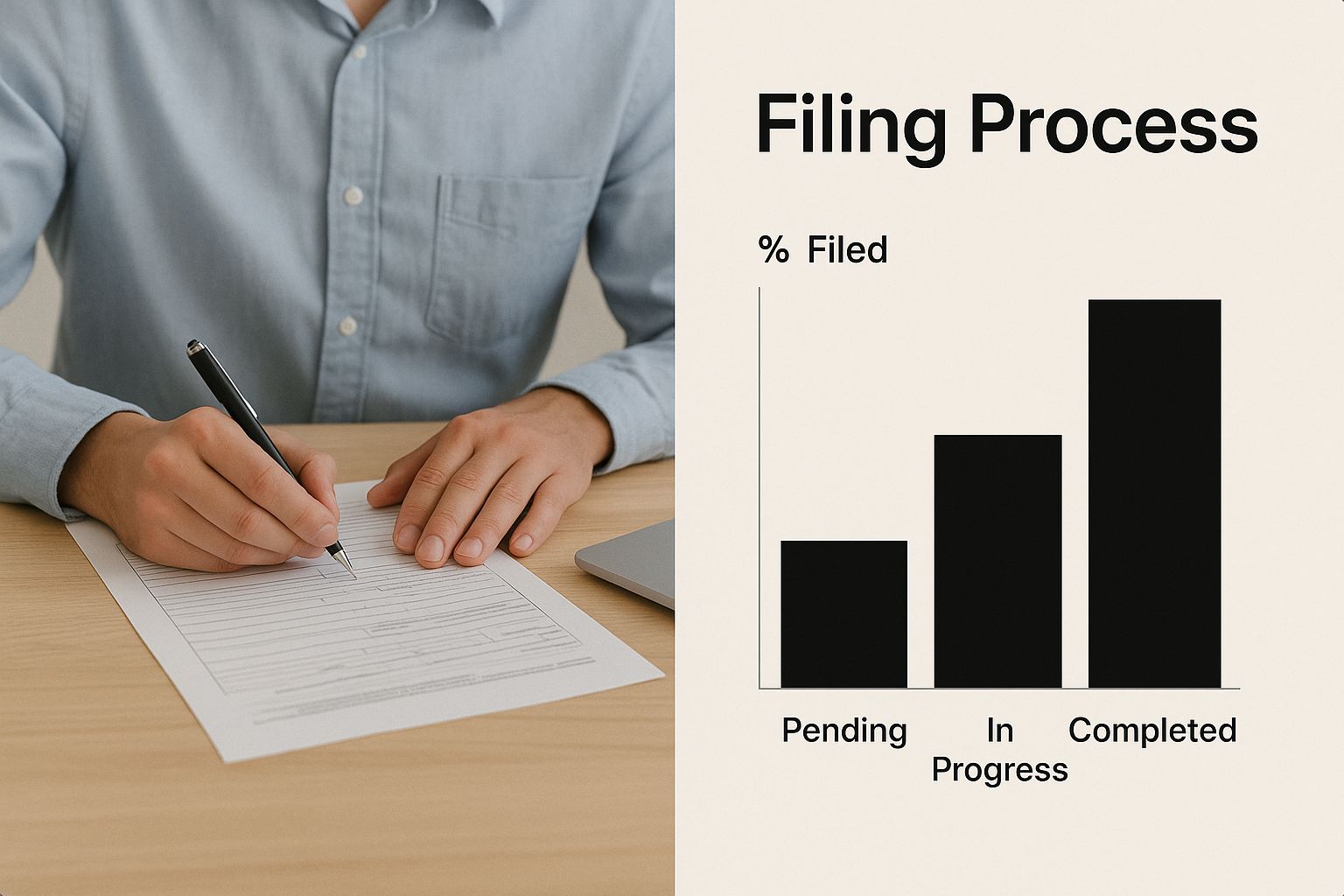
As you can see, a successful election really comes down to paying close attention to the details, from filling out the form accurately to hitting your filing deadlines.
Comparing Tax Classifications for Your Business
To make this clearer, let's break down how an LLC is treated under each possible tax classification you can choose with Form 8832.
| Feature | Disregarded Entity | Partnership | S Corporation | C Corporation |
|---|---|---|---|---|
| Number of Owners | One | Two or more | Up to 100 shareholders | Unlimited |
| Taxation Level | Pass-through (owner's personal return) | Pass-through (partners' personal returns) | Pass-through (shareholders' personal returns) | Corporate level, then shareholder level (dividends) |
| Liability Protection | Provided by LLC structure | Provided by LLC structure | Provided by LLC structure | Provided by corporate structure |
| Self-Employment Tax | On all net business income | On all net business income | Only on owner's salary, not distributions | Not applicable; owners are employees |
| Raising Capital | Difficult | Difficult | Limited (one class of stock) | Easiest (can issue multiple stock classes) |
This table highlights the fundamental trade-offs you'll need to consider based on your business's specific needs and future plans.
Real-World Scenarios
Sometimes, the best way to understand these concepts is to see them in action. Let's look at a couple of common examples.
-
The Tech Startup: A new software company, launched by three founders, has a solid plan but needs cash to build its product. They decide to file Form 8832 and elect to be taxed as a C Corporation. Why? Because this structure is what venture capitalists know and trust, making it much easier for the founders to sell stock and raise the capital they need to grow.
-
The Consulting Firm: A two-person marketing consultancy is doing very well, bringing in consistent profits. By electing S Corporation status, the partners can pay themselves a fair market salary. Any profit left over can be taken as a distribution, which isn't subject to self-employment taxes. This single move could save them thousands of dollars every year.
Getting Form 8832 Filed Right the First Time
Successfully filing Form 8832 isn't about being a tax whiz; it's about being meticulous. Think of it as a two-part checklist. Nail both parts, and you can be confident the IRS will process your election smoothly.
First up is Part I, which is all about your business's basic identity. You’ll enter your company's name, address, and Employer Identification Number (EIN). It’s absolutely critical that this information matches exactly what the IRS has on file for your EIN. Any mismatch can cause an immediate rejection.
The Nitty-Gritty of the Election
Part II is the main event—this is where you officially tell the IRS what you want to be. You'll declare your new desired tax classification and, most importantly, the date you want it to start.
This effective date is a common trip-up spot for business owners.
The IRS gives you a specific window: the effective date cannot be more than 75 days before you file the form. On the flip side, it cannot be more than 12 months after you file. Pick a date outside these goalposts, and the IRS will almost certainly send it back.
Crucial Tip: Let’s make this real. Say you file Form 8832 on April 15, 2024. The absolute earliest effective date you could request would be January 31, 2024 (which is 75 days prior). Don't guess—count the days and double-check your calendar.
Once you've picked your date, someone with the proper authority needs to sign the form. The right person depends on your structure:
- For LLCs or Partnerships: This could be any member, manager, or owner authorized to make decisions for the business.
- For Corporations: The signature must come from the president, vice president, treasurer, or a similarly authorized corporate officer.
That signature is your company’s official seal of approval on the change.
Keep in mind, Form 8832 gets you to C Corp status. If your ultimate goal is to be an S Corp, there’s another step involved. Our guide explains how to file as an S Corp after this election is complete.
After a final review, mail the signed form to the IRS service center listed in the instructions. And always, always make a copy for your own records before you send it off.
When to File: Timing Your Election and the 60-Month Rule
When it comes to filing Form 8832, timing is everything. Get it wrong, and you could find your election denied or taking effect on a date that messes up your tax planning. The IRS gives you a specific window, so let's break it down.
Essentially, you have a "look-back" and a "look-forward" period for choosing your effective date.
You can't pick a date that's more than 75 days before you actually file the form. Think of it this way: if you file on March 15th, you can't backdate your new tax status any earlier than January 1st of that year.
You can also plan ahead. The effective date you select can be up to 12 months after the date you file, giving you plenty of runway to align your new tax status with your business goals.
The 60-Month Rule: This is a Long-Term Commitment
Before you mail that form, take a deep breath. Changing your entity’s tax classification isn't something you can easily undo. The IRS enforces what's known as the 60-month limitation rule, and it's a big deal.
Once you change your classification with Form 8832, you're generally stuck with that choice for the next five years. You can't just file another Form 8832 to switch back if things don't go as planned.
This five-year lock-in period is why careful consideration is so important. It's a significant strategic decision, not just a box to check.
There is, however, a key exception to this rule. The IRS understands that businesses change. If your entity experiences a massive ownership shift—specifically, if more than 50% of the ownership interests have changed hands since your last election—you may be able to request another classification change before the 60 months are up. This makes sense, as a new ownership group might have entirely different financial needs and tax strategies.
Common Questions About Filing Form 8832
Working through the specifics of a tax election like this always brings up a few practical questions. Let's tackle some of the most common ones that business owners have when they're figuring out what Form 8832 is and where it fits into their big-picture tax plan.
Form 8832 vs. Form 2553
This is probably the biggest point of confusion for new entrepreneurs: What's the difference between Form 8832 and Form 2553?
Think of it like a two-step process. An LLC starts by filing Form 8832 to change its default tax status. This is the form that tells the IRS, "Hey, I'd like to be treated as a corporation from now on."
Once that election is accepted, and only then, can the business file Form 2553. This second form makes a more specific request: "Now that I'm a corporation, I'd like to be taxed as an S Corp." You can't just jump straight to S Corp status from being a default LLC; you have to become a corporation first.
Key Takeaway: Form 8832 gets your LLC to the "corporation" starting line. Form 2553 is the next step you take if you want to be an S Corporation instead of a C Corporation.
Can I Change My Mind Later?
A lot of business owners worry about getting locked into a decision. And for good reason. Once you make an election with Form 8832, you generally can't change it for 60 months. That’s five full years.
This lock-in period, known as the 60-month limitation rule, makes your initial choice a pretty significant one. The main way out of this is if the business has a major ownership shake-up, specifically where more than 50% of the ownership interests are sold or change hands.
What Happens if I Miss the Deadline?
So, you missed the filing deadline. Don't panic. The IRS offers relief for late elections, but you need to have a good reason for the delay.
To request this relief, you'll file the completed Form 8832 along with your tax return for the year the election was supposed to take effect. Be sure to write "FILED PURSUANT TO REV. PROC. 2009-41" right at the top of the form. You also have to attach a separate statement explaining, in detail, why you couldn't get it filed on time.
Making the right entity classification election is a critical decision that impacts your business for years. The team at Allied Tax Advisors can help you understand your options and ensure your tax strategy aligns with your long-term goals. To explore our business tax and advisory services, visit us online.