
You're probably in one of two spots right now. You're either forming a business and trying to decide between an LLC, S corp, or C corp, or you already run a corporation and someone just warned you about c corp double taxation. Either way, the same question lands on my desk all the time: “Am I setting myself up to pay tax twice?”
That concern is valid. But the primary problem usually isn't the dividend tax explanation you see in generic articles. The bigger issue is that owners make an entity choice based on this year's tax return, then get blindsided later when they sell assets, distribute profits, or try to exit the business. That's where expensive mistakes happen.
The rules changed when the Tax Cuts and Jobs Act cut the federal corporate rate from 35% to 21% effective January 1, 2018, which made the C corp conversation more nuanced than it used to be, as outlined by 1800Accountant's discussion of TCJA and C corp taxation. If you want a plain-English refresher on the broader law change, the Helpside guide on federal tax changes is a useful starting point.
Table of Contents
- Choosing Your Business Structure and Facing the Tax Puzzle
- What Is C Corp Double Taxation Really
- The Math of Double Taxation in Action
- C Corp vs Pass-Through Entities A Head-to-Head Comparison
- Actionable Strategies to Reduce the Tax Bite
- When a C Corporation Is the Smart Choice
- Making the Right Entity Choice for Your Business
Choosing Your Business Structure and Facing the Tax Puzzle
A founder sits down with incorporation papers, a QuickBooks file, and three tabs open. One says LLC. One says S corp. One says C corp. Every option claims to save taxes. Every article sounds certain. Most of them ignore what happens when the business grows up.
That's the tax puzzle. Your entity choice affects how you file every year, how you pay yourself, how investors view the company, and how much you keep if you ever sell. If you choose based only on startup convenience, you can trap yourself later.
The wrong question owners ask
Most owners ask, “Which entity has the lowest tax right now?” That's too narrow.
A better set of questions looks like this:
- How will I take money out? Salary, distributions, or retained earnings each create different tax outcomes.
- Will I reinvest profits? A growth company and a cash-flow business shouldn't default to the same structure.
- What am I likely to sell later? Stock sales and asset sales are not taxed the same way.
- Will I need flexible ownership? Investors, foreign owners, and multiple classes of equity can change the answer fast.
Pick an entity for the business you're building, not the business you had last year.
Why the C corp decision isn't simple anymore
The old blanket advice was easy. Avoid the C corp because of double taxation. That advice got weaker after the federal corporate rate dropped to 21% under the TCJA, as noted earlier. That lower corporate rate made C corps more competitive for some owners, especially if they planned to leave money inside the company instead of distributing it.
But lower doesn't mean harmless. It means you need to understand the trade-off clearly. A C corp can work well for the right fact pattern. It can also punish the wrong one.
What Is C Corp Double Taxation Really
Many business owners hear the term “double taxation” and assume it only means that dividends are taxed twice. That is only part of the problem. The core issue is that a C corporation can generate two separate tax bills on the same economic profit, and that trap becomes even more painful when the company sells appreciated assets instead of just paying out annual earnings.

The two tax layers
A C corporation pays its own tax first. If the corporation later sends the remaining cash to the owner, the owner may owe a second tax at the individual level. That is the basic structure.
For federal purposes, the corporation pays tax on its taxable income at a flat corporate rate. After that, money coming out to shareholders as dividends is generally taxed again on the owner's personal return. The second tax does not apply only because profit exists on paper. It usually shows up when cash or value is distributed to the shareholder.
That distinction matters.
If the company keeps earnings inside the business, you may defer the second layer for a while. If the company distributes profits, redeems shares, or liquidates after selling assets, the second layer can hit fast and hard.
Why owners get blindsided
Small business owners usually focus on annual income. They ask what happens if the company earns a profit and pays a dividend. Fair question, but it is not the expensive question.
The expensive question is what happens when the corporation owns appreciated property, goodwill, equipment, or real estate and sells those assets.
In a C corporation, the company can owe tax on the gain from the asset sale. Then, if the after-tax sale proceeds are distributed to the owner, the owner can owe tax again. That is the hidden double-taxation trap many generic articles gloss over. It matters a lot for businesses that expect an eventual asset sale, a wind-down, or a real estate exit.
The biggest C corp tax surprise often shows up at sale time, not during the years you are operating.
Why dividends and salary are treated differently
Owners also need to separate compensation from distributions. They are not taxed the same way.
Dividends come out of after-tax corporate profit. The corporation does not get a deduction for them. Salary paid for actual work is generally deductible to the corporation, which means it can reduce or eliminate corporate taxable income. That is why payment structure matters so much in a closely held C corp.
Treating a C corp like a personal bank account is a costly mistake. Paying no attention to salary, retained earnings, and exit planning is another one. If you choose C corporation status, you need a plan for how money comes out during operations and how value comes out when the business or its assets are sold.
The Math of Double Taxation in Action
A lot of owners focus on annual profit and miss the bigger hit. Significant pain often shows up when the corporation sells a valuable asset and you try to get the cash out.

The asset sale trap in plain numbers
Say your C corporation owns a building bought years ago for $300,000. It sells that building for $800,000. The corporation has a $500,000 gain.
At the federal level, a 21% corporate tax on that gain is $105,000. That leaves $695,000 inside the corporation before any state tax, selling costs, or other adjustments.
If you want that remaining cash personally, the problem is not over. A distribution can trigger a second layer of tax at the shareholder level. You started with a $500,000 economic gain, but by the time the money clears both tax layers, your net can be far lower than expected.
That is the blind spot. Owners see one sale. The tax law can see two taxable events.
Why this hits harder than owners expect
Operating profit can often be managed. Compensation, benefits, retirement plan contributions, and timing decisions give you planning room. Appreciated assets are less forgiving.
Real estate is the classic example, but it is not the only one. The same issue can show up with equipment, intangible assets, and business goodwill in an asset sale. If your long-term plan involves selling assets instead of stock, C corporation status deserves a harder look.
That is why entity choice should start with the exit plan, not just this year's tax return. If you are still weighing structure options, compare the tax trade-offs in this guide on choosing between a C corp and an LLC.
What owners should take from the math
- Asset sales inside a C corporation can produce the worst version of double taxation.
- The larger the built-in gain, the more expensive the mistake becomes.
- Real estate held in a C corporation is often a long-term tax problem, not a convenience.
- Exit planning should happen before the asset appreciates, not right before the closing table.
A C corp can be manageable during operations and still become very expensive at sale time.
Plenty of generic articles stop at dividends. That is incomplete advice. If your business might sell property, liquidate, or unload appreciated assets later, the sale math should drive the entity decision early.
C Corp vs Pass-Through Entities A Head-to-Head Comparison
The cleanest way to evaluate c corp double taxation is to compare it directly with pass-through entities. C corps are their own taxpayers. S corps and most LLCs push income through to the owners' returns, which avoids the classic two-layer tax on distributions.
That difference becomes even more important when the business owns appreciated assets.
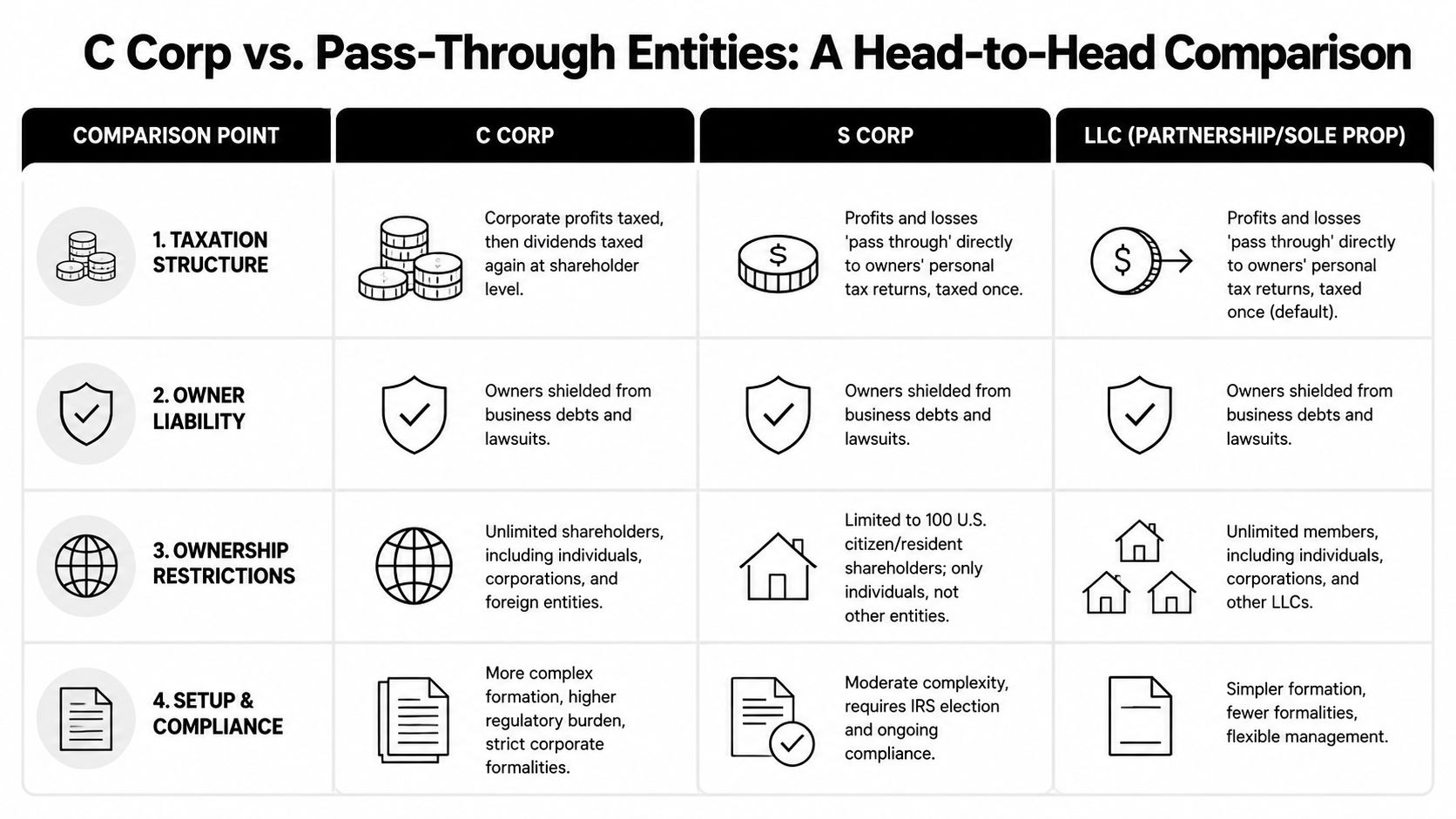
Side-by-side entity comparison
| Feature | C Corporation | S Corporation | LLC (as Partnership) |
|---|---|---|---|
| Taxation of profit | Taxed at entity level, with potential second tax on dividends | Pass-through taxation to owners | Pass-through taxation to owners |
| Profit distributions | Can trigger shareholder-level dividend tax | Generally no second entity-level tax on distributions | Generally no second entity-level tax on distributions |
| Ownership flexibility | Broad flexibility, often useful when ownership needs are complex | More restrictive ownership rules | Flexible ownership and economics |
| Compliance burden | More corporate formalities and separate tax filings | Corporate formalities plus election compliance | Usually more flexible operationally |
| Best fit | Growth companies, some investor-backed businesses, certain QSBS planning cases | Owner-operated businesses that want payroll structure with pass-through tax treatment | Closely held businesses prioritizing flexibility |
If you're weighing those options, this C corp or LLC comparison from Allied Tax Advisors is a helpful supplemental read on the legal and tax trade-offs.
The hidden asset sale trap
This is the issue too many owners miss.
If your business owns real estate, equipment, or other appreciated assets, the C corp structure can become painful at sale time. The corporation pays tax on the gain when it sells the asset. Then if the remaining cash is distributed, the shareholders can face tax again. That double-tax result is especially rough when depreciation has lowered the asset's basis.
For real estate investors, holding a $1M appreciated property in a C corp can create a combined tax burden of about 36% to 41% on the gain upon sale, versus about 20% to 37% in a pass-through entity, based on Accounting Freedom's discussion of C corporation tax outcomes for appreciated property.
That's not academic. It affects real money.
Why asset-heavy businesses should be cautious
- Real estate investors often care more about eventual property sale treatment than annual filing simplicity.
- Construction companies may accumulate equipment and depreciable assets that produce gain recapture issues later.
- Operating businesses with owned buildings can stumble into the same trap if no one modeled the exit.
The dividend issue gets attention. The asset sale issue does more damage.
If your likely exit is an asset sale, a pass-through entity often deserves serious preference. If your likely exit is a stock sale, the analysis changes. That's why entity choice has to include the end game, not just annual profit extraction.
Actionable Strategies to Reduce the Tax Bite
A lot of owners focus on the annual dividend problem and miss the bigger planning issue. By the time they sell a building, unload equipment, or sign a letter of intent for an asset deal, the tax damage is already baked in.

If you already operate as a C corp, the goal is simple. Get more value out of deductible payments, avoid unnecessary shareholder-level tax, and plan the exit before a buyer controls the structure.
Pay yourself correctly
Owner compensation is usually the first fix.
If you work in the business, paying everything out as dividends is usually a bad tax result. Salary and bonus are deductible to the corporation. Dividends are not. That difference matters immediately.
Do this:
- Set reasonable compensation based on your role, duties, hours, and market pay for someone doing the same job.
- Use payroll, not random owner draws disguised as "distributions."
- Document the compensation decision in corporate records so you can defend it if the IRS asks.
The point is not to zero out income at all costs. The point is to pull cash out in forms the corporation can deduct, while keeping the compensation supportable.
If your long-term plan points away from C corp treatment, this guide on converting a C corp to an S corp is a practical next step.
Stop defaulting to dividends
Dividends are the lazy answer. They are rarely the smart one.
A better plan usually combines compensation, retirement contributions where appropriate, accountable plan reimbursements, and legitimate fringe benefits. Those items need to be handled correctly, but they often produce a better result than pushing after-tax corporate earnings out to the owner and triggering a second layer of tax.
Retaining earnings can also make sense if the business is reinvesting for growth. That works best when the company needs working capital, hiring capacity, equipment, or expansion funds. It works poorly when the business is really a cash machine funding the owner's personal lifestyle.
Build the exit plan now, not when the buyer shows up
This is the blind spot that hurts asset-heavy businesses.
If your company owns appreciated real estate, heavily depreciated equipment, or a valuable operating asset, annual tax planning is only half the job. A significant tax bill may arrive at sale. In a C corp, an asset sale can trigger tax inside the corporation first. Then a second tax can apply when sale proceeds are distributed to the owners. That is the trap.
Ask these questions well before any deal process starts:
- Is your likely exit an asset sale or a stock sale?
- What appreciated assets are sitting inside the corporation right now?
- How much depreciation recapture or built-in gain could show up on a sale?
- Would restructuring before a sale window opens improve the result?
Owners who skip this analysis often spend years fine-tuning payroll and distributions while ignoring the event that will create the largest tax bill of their business life.
Coordinate tax planning with bookkeeping
Poor books create expensive tax decisions.
You need current visibility into compensation, retained earnings, basis in major assets, and how much cash is available to distribute. If those numbers are stale or wrong, you will make bad calls on bonuses, dividends, and exit timing.
Keep the planning practical:
- Review compensation before year-end, not after the books are closed.
- Track appreciated assets separately so you know where exit risk is building.
- Model cash needs and tax cost together before declaring distributions.
- Revisit entity choice periodically if the business model has changed.
The best strategy is not a clever year-end move. It is choosing a payment structure and exit plan that fit how you make money, hold assets, and expect to sell.
When a C Corporation Is the Smart Choice
A C corp isn't automatically the wrong answer. That's lazy advice.
There are situations where a C corporation is exactly the right tool. You just need to choose it for a reason, not because a filing service defaulted you into it or because someone told you all corporations are basically the same.
Growth and reinvestment
If the business plans to reinvest earnings instead of distributing them, the lower corporate rate can be useful. That matters most for companies trying to scale, hire aggressively, build products, or fund expansion from internal cash flow.
This structure also tends to fit businesses that expect more complex ownership over time. Some investor-backed companies prefer the C corp framework because it handles equity, classes of ownership, and institutional expectations more cleanly than many pass-through structures.
If you want a broader overview of why some businesses still prefer this model, this overview of the advantage of a corporation adds useful context.
QSBS and exit planning
The strongest case for a C corp often shows up at exit, not in annual operations. For qualifying startups, Section 1202 Qualified Small Business Stock can be a major planning opportunity. For closely held C corps, asset sales can be the worst double-tax scenario, but strategic planning around QSBS can shelter up to $10M or 10x basis in gains from tax for qualifying shareholders, based on MBE CPAs' discussion of the C corp sale double-tax problem and QSBS.
That's why I don't tell every founder to avoid the C corp. If you're building a company with a credible stock-sale path and potential QSBS eligibility, the C corp may be the right structure from day one.
Use a C corp when these facts are true:
- You expect to reinvest heavily, not distribute profits regularly.
- You may seek venture or institutional capital and need a structure that fits those expectations.
- You're planning for a stock exit, not assuming the business will sell assets.
- You can preserve eligibility for specialized exit planning, including QSBS where the facts support it.
Use something else when you're running a cash-flow business, expect regular owner distributions, or hold appreciating assets that are likely to be sold inside the entity.
Making the Right Entity Choice for Your Business
Choose your entity based on the exit you are likely to have, not the tax rate that looks good this year.
Here is the mistake that costs real money. An owner runs a profitable company for years inside a C corporation, buys a building or other appreciating assets in the business, then gets an offer from a buyer who wants the assets, not the stock. That sale can trigger tax inside the corporation first, then a second tax when the cash is paid out to the owner. At that point, the entity decision you made years earlier is no longer a planning question. It is an expensive constraint.
That is the blind spot. Annual profit is only part of the analysis. The harder question is what sits on the balance sheet and how a buyer will want to acquire it.
If your business is likely to accumulate real estate, equipment with depreciation history, or goodwill that will be sold in an asset deal, treat C corp status as a high-risk choice. If your plan points to a stock sale, heavy reinvestment, and investors who expect corporate structure, a C corporation can still make sense. Those are very different paths, and they should not be taxed as if they are the same business.
My advice is simple. Pick the entity that fits your probable exit, your distribution pattern, and the assets you expect to hold. Then test that choice before it becomes expensive to change. A low corporate rate does not rescue a bad entity fit. A pass-through election does not solve every problem either. The right answer comes from modeling the likely sale, not guessing from a headline tax rule.
If you want a clear answer for your specific situation, talk with Allied Tax Advisors. We help business owners evaluate entity choice, model the actual tax cost of distributions and asset sales, and build a structure that works for both current operations and future exit plans.