
March 15, 2026 is the federal deadline for calendar-year S corporations and partnerships, and April 15, 2026 is the federal deadline for calendar-year C corporations. If you run a business and you don't know which date applies to you, you're already closer to a tax problem than you should be.
A lot of owners hit this point every year. Bookkeeping is still being cleaned up, payroll reports need review, and someone on the team assumes “we'll just extend it” solves everything. Sometimes it does for the paperwork. It does not solve the money side.
That's the trap. The corporate income tax return due date is not always the same as the tax payment deadline in the way business owners think about it. If you confuse filing with paying, the IRS won't treat that as a harmless misunderstanding. It will treat it as late payment.
Table of Contents
- Decoding the Corporate Tax Calendar Introduction
- Federal Tax Deadlines by Business Entity
- Navigating Fiscal Year vs Calendar Year Due Dates
- How to File a Corporate Tax Extension with Form 7004
- The High Cost of Missing Deadlines Penalties and Interest
- Your Action Checklist for Tax Season Success
Decoding the Corporate Tax Calendar Introduction
Tax deadlines feel confusing because business owners often lump every business return into one bucket. That's a mistake. Your filing date depends first on your entity type, and then on whether you use a calendar year or a fiscal year.
If you're a new owner, start with the basics. An S corporation generally files Form 1120-S. A C corporation files Form 1120. A partnership files Form 1065. Those forms do not all run on the same deadline, and treating them as interchangeable is how people miss dates.
The dates that drive the season
For most small businesses on a standard January through December tax year, two dates control the early part of tax season:
- March 15, 2026 for calendar-year S corporations and partnerships
- April 15, 2026 for calendar-year C corporations
That distinction matters because many owners switch entities over time. A business might begin as an LLC taxed as a partnership, then elect S corporation treatment later, or remain a C corporation because of investor structure or long-term planning goals. If you don't confirm your tax classification, you can easily work toward the wrong deadline.
Practical rule: Don't guess your deadline based on your legal name. Confirm the tax form your business actually files.
Why this catches new owners off guard
The pressure usually builds in a predictable way. January feels early. February gets consumed by W-2s, 109ics, bookkeeping cleanup, and QuickBooks reconciliation. Then March arrives, and suddenly the owner who thought “business taxes are due in April” realizes that may only be true for a C corporation.
That's why I tell clients to stop asking, “When are business taxes due?” and start asking, “Which return do I file, and what is my actual due date?” The second question gets the right answer.
A second source of confusion is extensions. Owners hear that they can file an extension and assume that means the whole obligation moves out. It doesn't. That misunderstanding creates the biggest avoidable problem in this area, which is filing on time later but paying too late now.
Federal Tax Deadlines by Business Entity
Most owners need a clean comparison, not a legal lecture. Here it is.
The dates that matter first
| Business Structure | Tax Form | Federal Due Date |
|---|---|---|
| C Corporation | Form 1120 | April 15, 2026 |
| S Corporation | Form 1120-S | March 15, 2026 |
| Partnership | Form 1065 | March 15, 2026 |
For calendar-year C corporations, the federal return is due on the 15th day of the fourth month after year-end, which puts the standard deadline on April 15. That schedule was changed by Public Law 114-41, and the IRS explains the current rule, including the June 30 exception, in its guidance on C corporation filing deadlines.
If your company files Form 1120 and you want more detail on timing, this guide to the Form 1120 due date is a useful reference.
Why the deadlines aren't all the same
S corporations and partnerships report income differently from C corporations. They are generally pass-through entities, which means owners need business tax information in time to complete their own returns. That's why those returns hit earlier in the season.
C corporations stand apart because the corporation itself pays federal income tax at the entity level. That separate structure is one reason the filing date sits later on the calendar for standard year-end filers.
Here's the practical takeaway:
- If you file Form 1120, think April 15.
- If you file Form 1120-S or Form 1065, think March 15.
- If you aren't sure which form applies, verify that before you do anything else.
Businesses don't get in trouble because tax deadlines are unknowable. They get in trouble because they assume the wrong category applies to them.
One more point matters here. The dates above are for calendar-year filers. If your books close on a different month-end, your deadline may move, and that's where many generic online guides stop being helpful.
Navigating Fiscal Year vs Calendar Year Due Dates
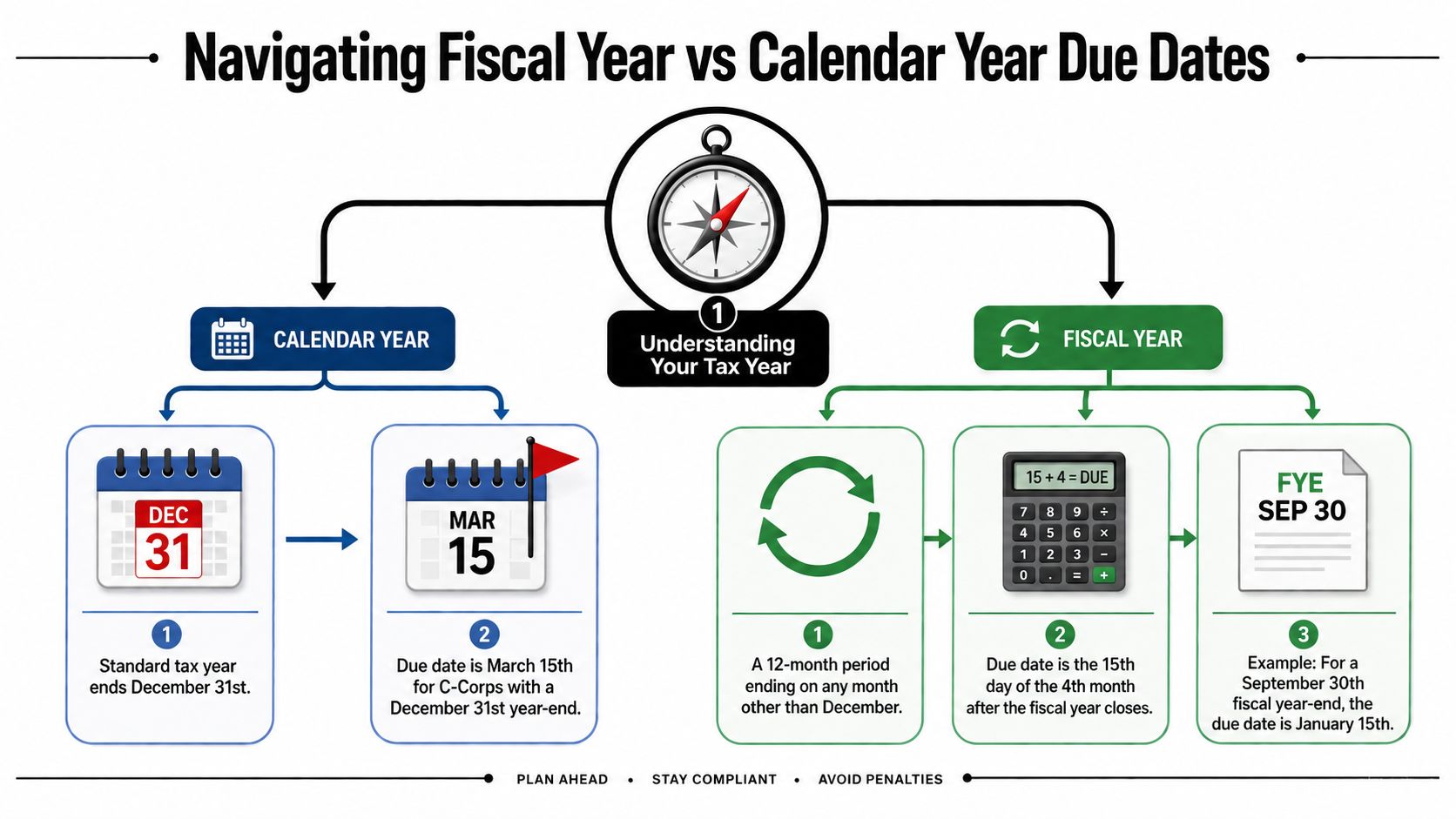
A calendar year is straightforward. A fiscal year requires you to count.
Calendar year is simple
A calendar year ends on December 31. Most small businesses use it because it aligns with payroll reporting, owner tax reporting, and basic bookkeeping cycles.
If your C corporation uses a calendar year, you don't need a custom calculation. You already know the target date from the earlier section.
Fiscal year requires a calculation
A fiscal year is any 12-month tax year that ends on a date other than December 31. This structure resembles a school year, as opposed to a calendar year. Your reporting cycle still covers twelve months, but it closes on a different month.
For U.S. C corporations filing Form 1120, the general rule is that the return is due on the 15th day of the fourth month after the end of the tax year, with a special exception for corporations with a June 30 year-end, which must file by September 15 for periods beginning before January 1, 2026, as explained in IRS Publication 509.
Here's how the general rule works in practice for a C corporation:
- Year-end September 30: due date is January 15
- Year-end October 31: due date is February 15
- Year-end November 30: due date is March 15
- Year-end December 31: due date is April 15
The June 30 exception is where people stumble. They assume the fourth-month rule always applies. It doesn't. If your corporation has that specific year-end, you need to apply the special rule, not the general one.
A clean way to handle this is to review the date shown on your prior-year return and count forward from there. Don't rely on memory. Use the actual tax year-end on file.
If your corporation doesn't close on December 31, your deadline isn't “probably April.” It's whatever the rule produces from your real year-end.
Fiscal years can be useful operationally, but they remove the safety of a familiar deadline. That means your calendar needs a deliberate process, not a rough reminder.
How to File a Corporate Tax Extension with Form 7004
An extension is a planning tool, not a rescue plan. Used correctly, it buys time to finish an accurate return. Used carelessly, it gives owners false confidence while interest and penalties start building on unpaid tax.
When an extension makes sense
You should consider an extension when the return won't be complete and accurate by the original due date. Common reasons include late bookkeeping cleanup, missing K-1 information, unresolved balance sheet items, or year-end adjustments that still need review.
An extension is smart when it helps you file correctly. It is not smart when you use it to delay facing an expected tax bill.
What Form 7004 actually does
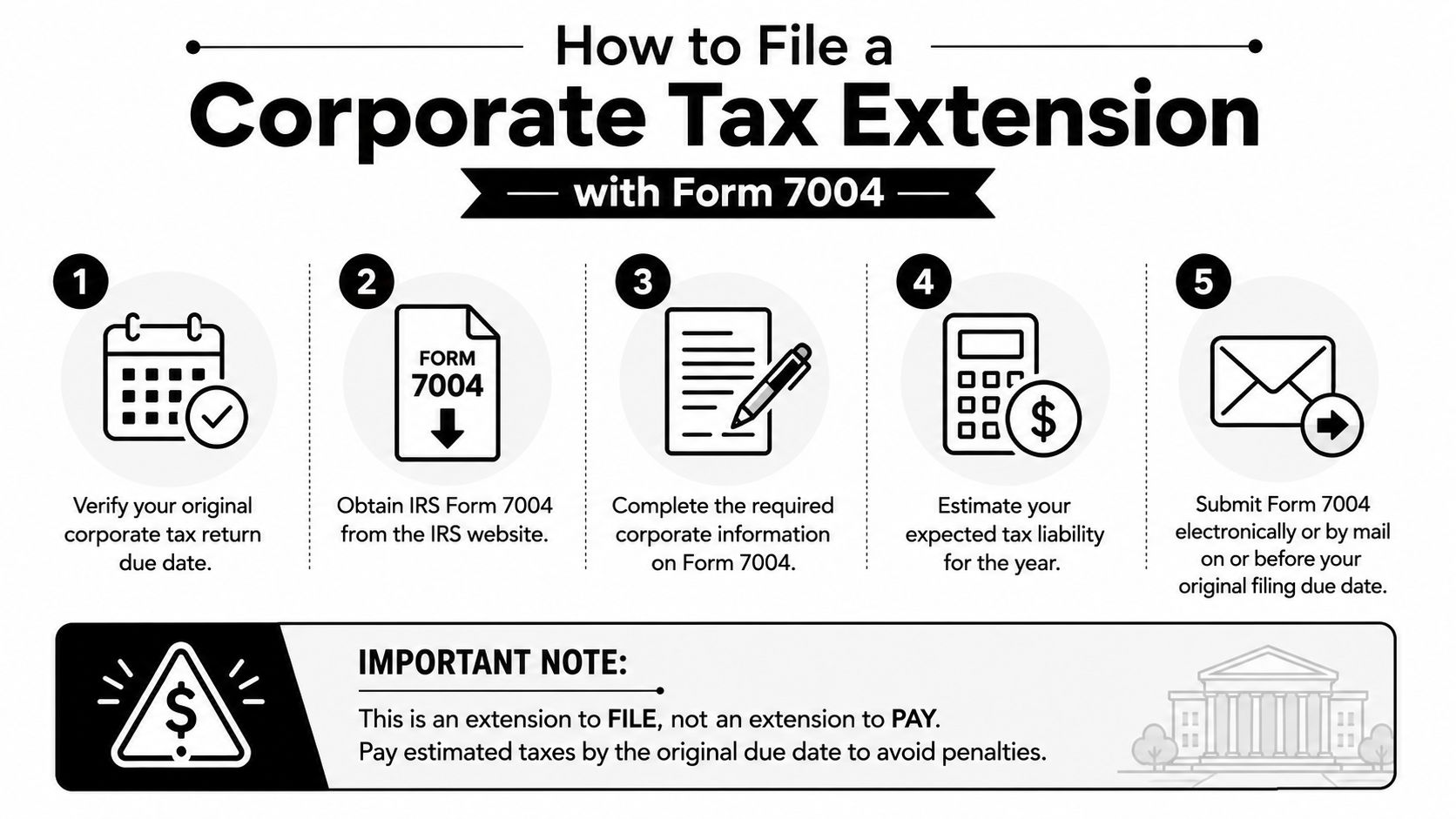
Submitting Form 7004 by the original due date gives corporations an automatic six-month extension to file. For a calendar-year C corporation, that moves the filing deadline to October 15. The same guidance also notes that S corporations operate on a different original schedule, with Form 1120-S due March 15. The key rules are summarized in PwC's overview of U.S. corporate tax administration deadlines.
That's the paperwork side. Now for the part owners miss.
Form 7004 does not extend the time to pay tax. If your C corporation owes tax, that payment is still due by the original due date. For a calendar-year C corporation, that means April 15 remains the payment deadline even if the return itself won't be filed until October.
Use this checklist before filing the extension:
- Confirm the original due date. Don't submit Form 7004 late and expect protection.
- Estimate the tax owed. A rough but reasonable calculation is better than pretending the balance is zero.
- Send the payment with the extension strategy. The extension without payment is where many problems begin.
- Document the estimate. Keep your worksheet, trial balance, and assumptions.
- Calendar the extended filing date. An extension is temporary, not indefinite.
For additional guidance, review this resource on the business tax extension deadline.
Bottom line: File Form 7004 if you need more time to prepare the return. Pay by the original deadline if you want to avoid creating a second problem.
The High Cost of Missing Deadlines Penalties and Interest
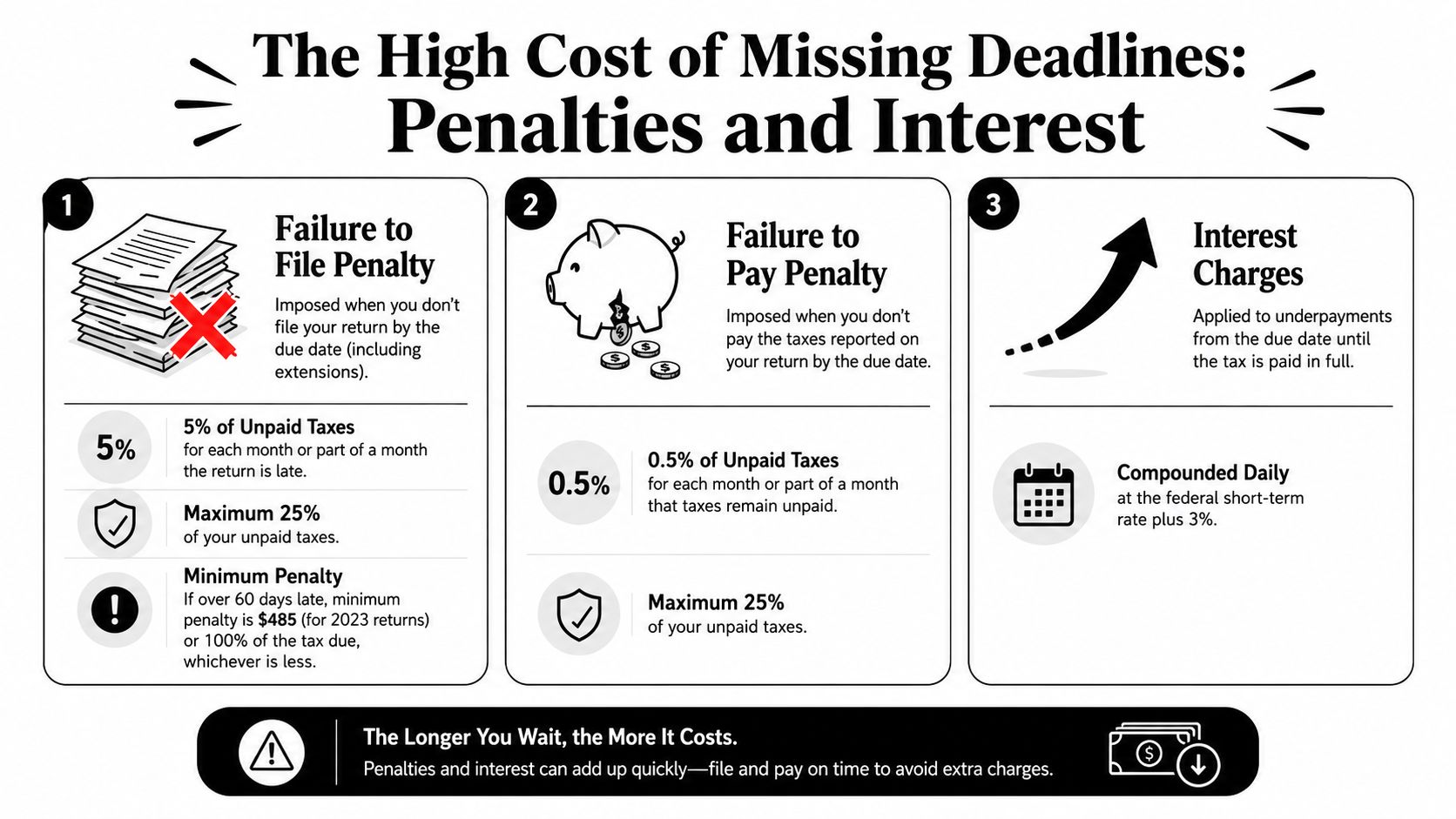
The expensive mistake isn't always failing to file. Often, it's filing the extension and assuming that bought more time to pay. It didn't.
The mistake owners make most often
Many guides mention extensions but don't clearly separate the filing deadline from the payment deadline. That gap matters. A discussion of when corporate taxes are due highlights that many C corporation filers still owe payment by April 15 even when they extend the return to October 15, and that this confusion leads to hidden interest penalties for a significant portion of filers.
That's why I push this point so hard with small business clients. The administrative task and the cash obligation are related, but they aren't the same thing. You can comply with one and still fail the other.
What late payment really causes
When tax isn't paid by the original due date, the consequences start immediately. You may face:
- Interest charges that continue until the balance is paid
- Late-payment penalties even if the extension was filed correctly
- Cash-flow pressure later in the year when the unpaid tax bill collides with current operations
- Compounded cleanup work because now the issue isn't just return preparation. It's tax resolution
This is why I tell owners to treat estimated payment analysis as part of extension prep, not as a separate task for later. If your bookkeeping isn't final, estimate conservatively and pay based on the best numbers available.
The IRS is far more forgiving of an incomplete return filed on extension than an unpaid tax bill left sitting past the due date.
There's also a management issue here. Late payment usually signals that the owner didn't have current books, didn't review year-end profit early enough, or didn't set aside tax cash during the year. The deadline problem is often a bookkeeping problem in disguise.
If you want fewer surprises, don't start with the form. Start with current financials.
Your Action Checklist for Tax Season Success
Deadlines stop being stressful when you turn them into a process. Most businesses don't need more tax theory. They need a short list of actions done at the right time.

What to do right now
Use this checklist before the filing season gets crowded:
- Confirm your entity classification. Check whether you file Form 1120, 1120-S, or 1065. Don't rely on what you “think” the business is.
- Verify your tax year-end. December 31 is common, but not universal. Your due date depends on the actual close of your tax year.
- Put the deadline on a shared calendar. Include the owner, bookkeeper, controller, and outside preparer if you use one.
- Reconcile bookkeeping early. Clean up QuickBooks, bank accounts, loan balances, payroll items, and owner distributions before the deadline gets close.
- Review taxable income before the due date. You need an estimate in hand if there's any chance of an extension.
A practical prep list can help you organize records and avoid the usual missing-document scramble. This small business tax preparation checklist is a good place to start.
What to hand off to a tax professional
Some issues shouldn't stay on your desk too long:
- Entity confusion: If your legal setup and tax election don't seem to match, get clarity before filing.
- Fiscal year complexity: If you don't use a calendar year, confirm the due date instead of calculating it from memory.
- Extension with tax due: If you know you'll extend and likely owe, have someone help estimate the payment properly.
- Owner compensation and distributions: These often affect return accuracy and planning.
- Prior-year carryovers or notices: If the IRS has already contacted you, don't treat this year like a routine filing.
The strongest habit is simple. Get your books current, know your form, know your year-end, and separate filing from paying every single time. That one distinction prevents a lot of avoidable pain.
If you want a CPA team to help you confirm your deadline, estimate tax before an extension, or clean up the bookkeeping that usually causes late filings, contact Allied Tax Advisors. They help San Diego business owners handle return preparation, planning, bookkeeping, payroll, and IRS issues before small deadline mistakes become expensive ones.