
The U.S. tax system is progressive. This just means that as your income increases, you pay a higher tax rate, but only on the portion of your income that falls into a higher bracket.
A common fear is that a pay raise will bump you into a higher tax bracket and somehow cause you to take home less money. That's a myth. Because of the way the brackets work, a raise always means more money in your pocket.
How the Current Tax Brackets Really Work
Getting a handle on the current tax brackets is the first real step to understanding your taxes. Many people think their tax bracket—say, 22%—applies to their entire income. Luckily, that's not how it works at all.
Think of it like filling a series of buckets with your income.
The first bucket is small and gets taxed at the lowest rate, just 10%. Once that one is full, your next dollars start spilling into the second bucket, which is taxed at 12%. This continues up the ladder. Only the money that lands in a specific bucket gets taxed at that bucket's rate.
Your specific tax brackets are set by two main things: your taxable income and your filing status.
There are four common filing statuses, and each one has different income thresholds for the tax brackets:
- Single: For unmarried individuals.
- Married Filing Jointly: For married couples filing one tax return together.
- Married Filing Separately: For married couples who choose to file two separate returns.
- Head of Household: For unmarried people who financially support a qualifying dependent.
Because the income ranges for each bracket are different depending on your status, a single person earning $50,000 will have a completely different tax bill than a married couple who earns a combined $50,000.
Current Federal Income Tax Brackets and Rates
Here’s a look at the actual numbers. The table below lays out the seven federal income tax rates and the corresponding taxable income ranges for each filing status.
Finding where your income falls across these tiers is the key to understanding your tax bill. To see how these numbers apply to your own situation, you can calculate federal income tax and get a solid estimate.
| Tax Rate | Single Filers | Married Filing Jointly | Married Filing Separately | Head of Household |
|---|---|---|---|---|
| 10% | $0 to $11,925 | $0 to $23,850 | $0 to $11,925 | $0 to $17,000 |
| 12% | $11,926 to $48,475 | $23,851 to $96,950 | $11,926 to $48,475 | $17,001 to $64,850 |
| 22% | $48,476 to $103,350 | $96,951 to $206,700 | $48,476 to $103,350 | $64,851 to $103,350 |
| 24% | $103,351 to $197,300 | $206,701 to $394,600 | $103,351 to $197,300 | $103,351 to $197,300 |
| 32% | $197,301 to $250,525 | $394,601 to $501,050 | $197,301 to $250,525 | $197,301 to $250,500 |
| 35% | $250,526 to $626,350 | $501,051 to $751,600 | $250,526 to $375,800 | $250,501 to $626,350 |
| 37% | $626,351 or more | $751,601 or more | $375,801 or more | $626,351 or more |
As you can see, the brackets are designed to ensure people with different life situations are taxed in a way that reflects their household's overall financial picture.
Understanding Your Marginal Tax Rate
One of the biggest hang-ups people have with the current tax brackets is wrapping their head around the marginal tax rate. It's a common misconception that if you fall into a certain tax bracket, your entire income gets taxed at that rate. Thankfully, that's not how it works at all. Our progressive tax system is much fairer.
Think of it this way: your marginal tax rate is simply the tax rate you pay on your very last dollar of earned income. It’s the rate applied to the highest "bucket" your income spills into. This is a completely different animal from your effective tax rate, which is the actual average rate you pay across all your taxable income.
Marginal Rate vs. Effective Rate
Let's break this down with a real-world example. Meet Alex, a single professional who has a taxable income of $60,000 for the year. A quick look at the single filer brackets shows Alex’s top marginal tax rate is 22%. But here's the crucial part: Alex does not pay 22% on the entire $60,000.
Instead, the IRS taxes Alex’s income in chunks, or layers, at each bracket rate:
- The first $11,925 of income is taxed at 10%.
- The next slice of income, from $11,926 up to $48,475, is taxed at 12%.
- Only the amount from $48,476 up to $60,000 is taxed at the 22% rate.
This system guarantees that a pay raise is always a good thing. If Alex gets a salary bump, only the new dollars are taxed at that higher 22% rate. The tax on the first $48,475 is already locked in at the lower rates.
You've probably heard the myth that a raise can push you into a higher tax bracket and actually lower your take-home pay. That is completely false in a progressive system. You will always have more money in your pocket after taxes when your salary increases.
This flowchart gives a great visual of how your income is whittled down before the tax brackets even come into play.
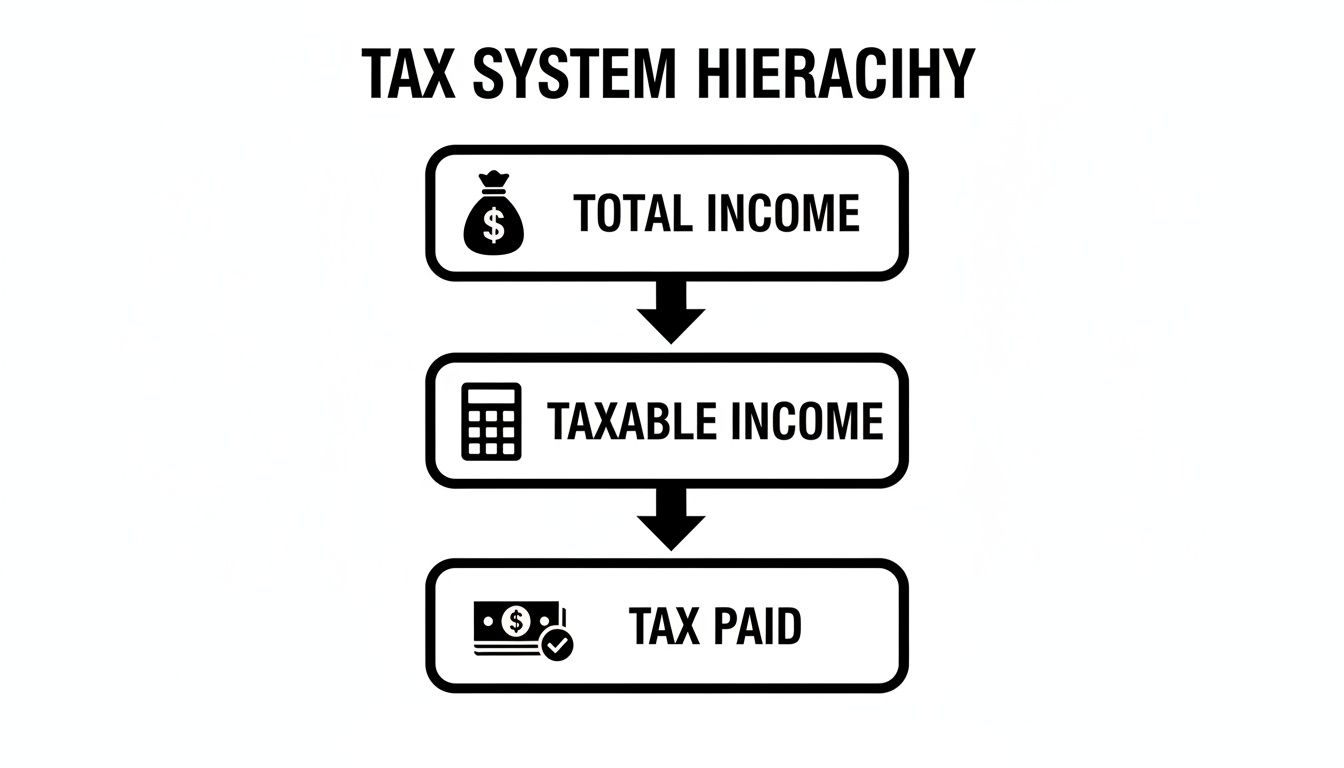
As you can see, things like deductions and credits shrink your total income down to your taxable income. That smaller number is what we use to calculate the final tax bill.
Calculating Alex's Real Tax Bill
So, let's run the numbers and see what Alex's tax bill actually looks like.
- First Bracket (10%): $11,925 x 0.10 = $1,192.50
- Second Bracket (12%): The amount in this bracket is $48,475 – $11,925, which is $36,550. So, $36,550 x 0.12 = $4,386.00
- Third Bracket (22%): The amount in this top bracket is $60,000 – $48,475, which is $11,525. So, $11,525 x 0.22 = $2,535.50
To get Alex's total tax liability, we just add those amounts together: $1,192.50 + $4,386.00 + $2,535.50 = $8,114.00.
Now, to find that all-important effective tax rate, we divide the total tax by the total taxable income: $8,114 ÷ $60,000 = 13.52%.
See the difference? Even though Alex is in the 22% marginal tax bracket, the actual average rate paid is only 13.52%. Getting this distinction right is the foundation of smart financial planning and being able to predict what you'll owe Uncle Sam.
Choosing the Right Filing Status for Your Situation

Now that you've got a handle on how marginal tax rates work, let's talk about the next critical piece of the puzzle: your filing status. This is easily one of the biggest decisions you'll make on your tax return. Why? Because it directly sets the income levels for your tax brackets and determines how big of a standard deduction you can take.
Think of your filing status as the category the IRS places you in. It tells them your story—whether you're flying solo, married, or an unmarried person running a household. Each status comes with its own set of rules and tax perks tailored to different life situations.
Breaking Down the Filing Status Options
There are four primary filing statuses, and each one has its own set of current tax brackets. This is a big deal. The exact same income can lead to a very different tax bill, all depending on the box you check.
Here are your main choices:
- Single: Pretty straightforward. This is for unmarried individuals who don't fit into any other category.
- Married Filing Jointly (MFJ): The go-to for most married couples. You combine your incomes and file one unified tax return, which often leads to a lower tax bill.
- Married Filing Separately (MFS): While less common, this allows married couples to file two separate returns. It can be a smart move in very specific scenarios, like when one spouse has a mountain of medical bills to deduct.
- Head of Household (HoH): This is for unmarried people who pay for more than half of the upkeep of a home for a qualifying person, such as a child or a dependent relative.
Picking the right status isn't just about your personal life; it's a strategic move. A small business owner, for example, has another layer to think about. The way your business is legally set up can have a huge impact, so comparing sole trader vs limited company structures is a crucial step in finding the most tax-friendly approach.
The Head of Household Advantage
The Head of Household status is a powerful tax-saver that too many people miss out on. It gives you wider tax brackets and a much larger standard deduction compared to filing as Single. In plain English, that means more of your money gets taxed at lower rates.
So, how do you qualify? Generally, you need to be unmarried, cover over 50% of the household expenses, and have a qualifying child or dependent who lived with you for more than half the year. The rules can get a little tricky, so it pays to dig in. To get a better sense of the specifics, you can learn more about filing as single or head of household and see if you're eligible for these benefits.
A classic dilemma is when a married couple weighs filing jointly versus separately. While MFJ is almost always the winner, MFS can be the smarter play if one spouse is aiming for Public Service Loan Forgiveness or has significant medical expenses, as it can lower the income threshold needed to claim certain deductions.
Ultimately, your filing status is the foundation upon which your entire tax calculation is built. Taking the time to line up your personal and financial circumstances with the IRS rules ensures you're using the status that does the most to lower your tax bill.
Let's See How This Works in Real Life
Theory is one thing, but seeing how the current tax brackets play out with actual numbers is what makes it all click. Let's walk through a few scenarios to see how this progressive system translates into a real tax bill. We'll follow three different taxpayers, each with a unique financial picture.
These examples will take you from gross income all the way to the final tax owed, showing you exactly how the system works, one layer at a time.
Example 1: The Single Remote Worker
First up is Maya. She's a single remote worker pulling in a salary of $75,000 a year. She doesn't have any dependents, so she's going to take the standard deduction for a single filer. This simple step immediately lowers her taxable income, meaning she won't be taxed on her full salary.
So, how do we figure out her tax bill using the single filer brackets? It’s like filling up a series of buckets:
- The 10% Bucket: The first chunk of her income gets taxed at this lowest rate.
- The 12% Bucket: The next portion of her income spills over into the 12% bracket.
- The 22% Bucket: Whatever is left of her taxable income gets taxed at her top marginal rate of 22%.
When you add up the tax from each of these "buckets," you get her total federal tax liability. Notice that even though her top rate is 22%, her effective tax rate—the actual slice of her income she pays in taxes—is much lower. That's the progressive system in action.
It’s a common myth that a raise can hurt you by pushing you into a higher tax bracket. That’s simply not how it works. Only the dollars you earn within that new, higher bracket are taxed at the higher rate. Everything you earned below that threshold is still taxed at the same lower rates as before.
Example 2: The Married Small Business Owners
Now, let's meet David and Sarah. They're a married couple who file their taxes jointly. Together, they run a small business that brought in a net income of $150,000 this year. After they account for their business expenses and take the standard deduction for married couples, we'll get to their taxable income.
Calculating their tax bill follows the same bucket-filling logic as Maya's, but they get to use the wider "Married Filing Jointly" brackets:
- 10% Bracket: The first slice of their combined income is taxed at 10%.
- 12% Bracket: The next, much larger slice is taxed at 12%.
- 22% Bracket: The remainder of their taxable income falls into the 22% bracket.
You'll see that the income thresholds for joint filers are almost double those for single filers. This is intentional. It allows a married couple to earn significantly more before they get bumped into higher marginal rates, which helps most couples avoid a "marriage penalty."
Example 3: The Head of Household with Rental Income
Last, we have Ben, a single dad who qualifies as a Head of Household. He earns $80,000 from his job and brings in another $20,000 from a rental property, for a gross income of $100,000. After subtracting his rental expenses and the generous Head of Household standard deduction, we arrive at his taxable income.
Ben's tax brackets are more favorable than the single filer brackets—a benefit designed to help those supporting a household. His tax is calculated through the same progressive 10%, 12%, and 22% rates, but the income limits for each tier are higher. This filing status can offer significant financial relief for single parents or anyone else supporting a dependent on their own.
It's also crucial to remember that tax laws aren't set in stone. The U.S. federal income tax brackets for 2026, for example, have already been adjusted for inflation. The seven rates remain, but the income thresholds are higher to prevent "bracket creep." You can find a complete breakdown of these future adjustments and what they mean for your planning by learning more about the 2026 federal income tax brackets on onedigital.com.
Ultimately, these examples show that your final tax bill is a unique reflection of your life—your filing status, where your money comes from, and the deductions you take all play a part.
Smart Strategies to Lower Your Taxable Income

Getting a handle on the current tax brackets is a great first step. But the real power comes from using that knowledge to legally shrink your taxable income. This isn't about hiding money—it's about making smart, strategic moves that the tax code actually encourages.
Think of it this way: your taxable income is the number the IRS uses for its final calculation. The lower you can get that number, the less tax you'll owe. The goal is to reduce how much of your hard-earned money spills over into those higher tax brackets.
This proactive mindset is what separates savvy individuals from those who just passively accept their tax bill. A few key decisions during the year can make a surprisingly big difference when April rolls around.
Maximize Tax-Advantaged Accounts
One of the most straightforward ways to lower your taxable income is to contribute to tax-deferred retirement accounts. These accounts were created to help you save for the future, and they come with some fantastic immediate tax perks.
Every single dollar you put into a traditional 401(k) or traditional IRA is subtracted directly from your gross income. For instance, if you make $80,000 a year and contribute $5,000 to your 401(k), the IRS now only sees $75,000 of your income. That simple move could be all it takes to keep a chunk of your earnings in a lower tax bracket.
Another incredible tool is the Health Savings Account (HSA), which is an option if you have a high-deductible health plan.
An HSA offers a rare triple tax advantage: your contributions are tax-deductible, the money grows tax-free, and you can withdraw it tax-free for qualified medical expenses. It’s arguably one of the best long-term savings tools out there.
Leverage Investments and Business Deductions
If you have investments, a strategy called tax-loss harvesting should be on your radar. It sounds complicated, but the idea is simple: you sell investments that have lost value to cancel out the taxes you’d owe on investments that have gained value. If your losses are greater than your gains, you can even write off up to $3,000 of those losses against your regular income annually.
For freelancers, contractors, and small business owners, there are even more opportunities to manage taxable income.
- Timing is Everything: You can deliberately make business purchases, like new equipment or software, before December 31st to boost your deductions for the current tax year.
- Deduct Every Business Expense: Keep meticulous records of everything. From your home office setup to mileage and client lunches, these deductions add up quickly. Our complete guide offers more details on how to reduce taxable income.
Keep in mind that tax planning isn't just a domestic affair. For those with international ties, it’s also wise to keep an eye on the global landscape. While this guide focuses on the U.S., exploring effective ways to reduce taxable income in Canada can offer a broader perspective on smart financial planning.
Answering Your Top Questions About Tax Brackets
Even after you get the hang of how tax brackets work, a few tricky questions always seem to pop up. Let's clear the air and tackle some of the most common points of confusion I hear from clients. We'll bust a few myths and make sure you have the clarity you need to handle your finances confidently.
"Will a Raise Push Me Into a Higher Bracket and Make Me Take Home Less Money?"
This is probably the biggest and most persistent myth in all of personal finance, and the answer is a simple, resounding no. A pay raise will never, ever result in less take-home pay.
Think of it this way: our tax system is progressive, meaning your income is taxed in layers, like a cake. When a raise pushes some of your income into a higher bracket, only the dollars in that new, top layer are taxed at the higher rate. Everything you earned below that threshold is still taxed at the exact same lower rates as before.
The bottom line is that a raise always means more money in your pocket. Period.
"How Are My Investments and Capital Gains Taxed?"
The money you earn from your job is one thing, but profits from your investments are treated a little differently. When you sell an asset like stocks or real estate for more than you paid, that profit is called a capital gain, and the IRS taxes it in a specific way.
It really comes down to how long you held the investment.
- Short-Term Capital Gains: If you sell an asset you've owned for one year or less, the profit is considered "short-term." The IRS simply adds this amount to your regular income and taxes it at your standard marginal tax rate.
- Long-Term Capital Gains: Now, if you hold that asset for more than a year before selling, you get a much better deal. Those profits are taxed at special long-term capital gains rates, which are much lower—0%, 15%, or 20%, depending on your overall taxable income.
This system is deliberately designed to reward patient, long-term investors.
"Do State Tax Brackets Work the Same Way as the Federal Ones?"
For the most part, yes, but the devil is in the details. Many states that have an income tax use a progressive bracket system that mirrors the federal model. However, the actual tax rates and the income levels for each bracket can be wildly different from state to state.
On top of that, some states have a flat tax, where they charge one single rate on every dollar of taxable income. And, of course, a lucky few states have no state income tax at all. You absolutely have to look up the rules for your specific state, as they are completely separate from the federal system.
"What's the Real Difference Between a Tax Credit and a Tax Deduction?"
Knowing the difference here is one of the most powerful things you can learn for saving money on your taxes. Both are good, but a tax credit is the undisputed champion.
A tax deduction lowers the amount of your income that is subject to tax. A tax credit, on the other hand, is a dollar-for-dollar reduction of the actual tax you owe.
Let’s make that real. A $1,000 deduction for someone in the 22% tax bracket will reduce their final tax bill by $220. But a $1,000 tax credit? That knocks a full $1,000 right off the top of what you owe the IRS.
Credits are a direct discount on your tax bill, which makes them incredibly valuable. Getting a firm grip on these core ideas doesn't just help you understand your tax return—it empowers you to make smarter financial moves all year long.
At Allied Tax Advisors, we believe that understanding your taxes is the first step toward financial control. If you need help navigating the complexities of the current tax brackets, from annual filings to strategic planning, our team is here to provide personalized guidance. Visit us at https://alliedtax.com to see how we can help you achieve your financial goals.