
You've got the tax software open, one parent is asking where the kids lived, and your name is on the mortgage. It feels obvious that you're the “head of household,” but the IRS doesn't use that term the way most families do. For tax purposes, head of household qualification is a narrow set of rules, and getting the label wrong can change your return in a very real way.
The confusion starts because the phrase means different things in different places. In housing, healthcare, and benefit programs, “head of household” can mean the main responsible adult or the person listed first on a household record. For federal tax purposes, it means something much stricter, and the IRS ties it to a marriage test, a qualifying person test, and a cost test (IRS guidance on filing status). That distinction matters because the status is widely used, with the Congressional Budget Office reporting that in 2016 about 22 million unmarried taxpayers filed as head of household, and nearly 19 million of them lived with a qualifying child (CBO budget options on head of household).
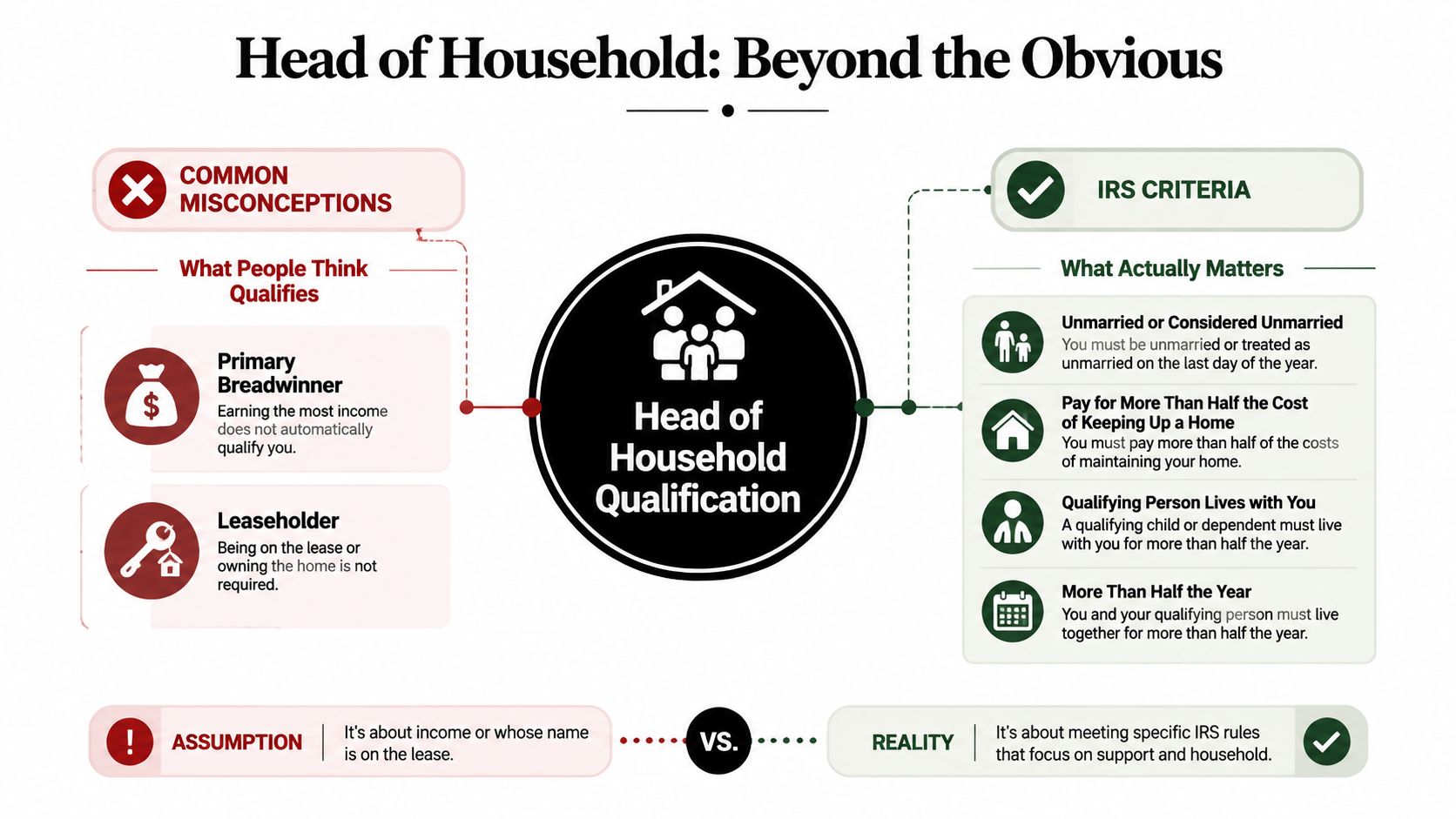
Table of Contents
- What Head of Household Actually Means for Tax Purposes
- The Three Core Tests Every Filer Must Pass
- Who Counts as a Qualifying Person
- Navigating Tricky Situations and Edge Cases
- Tax Benefits and Filing Advantages
- Documentation and Audit Preparedness
- Common Mistakes and Your Eligibility Checklist
What Head of Household Actually Means for Tax Purposes
A common point of confusion is that head of household sounds like the person who runs the home, pays the bills, or is listed first on the lease. For IRS purposes, that everyday meaning is too loose. The filing status is reserved for taxpayers who are unmarried or considered unmarried, pay more than half the cost of keeping up a home, and have a qualifying person living with them for more than half the year, with a special rule for a dependent parent who does not have to live in the home (IRS filing status rules).
That narrow definition is why the phrase creates so much confusion. A roommate who splits rent, a partner who helps with groceries, or an adult child living at home does not automatically create HOH status. The IRS is asking a specific filing-status question, whether your household meets the rule for this status, not whether you are the practical decision-maker in the family.
Why the distinction matters
For many filers, the tax version of head of household is the one that changes the return. Analysts at the Tax Foundation, using IRS figures, reported that in tax year 2021, 71% of HOH returns were filed by taxpayers with incomes under $50,000, and more than 92% reported incomes under $100,000 (Tax Foundation analysis). That concentration shows how often the status comes up for working families and caregivers, not just for people with unusually complicated tax returns.
Practical rule: if you are asking whether you are the “main adult” in the house, you are asking the wrong question. The IRS wants to know whether you satisfy the filing tests, not whether you carry the most responsibility.
The appeal is easy to understand. Taxpayers use HOH because it generally comes with a larger standard deduction than single filing status, and analysts in the cited data linked the status to refunds that are often in the several-thousand-dollar range. That is why people should sort out the definition first, before they start counting days, dollars, or dependents.
The Three Core Tests Every Filer Must Pass
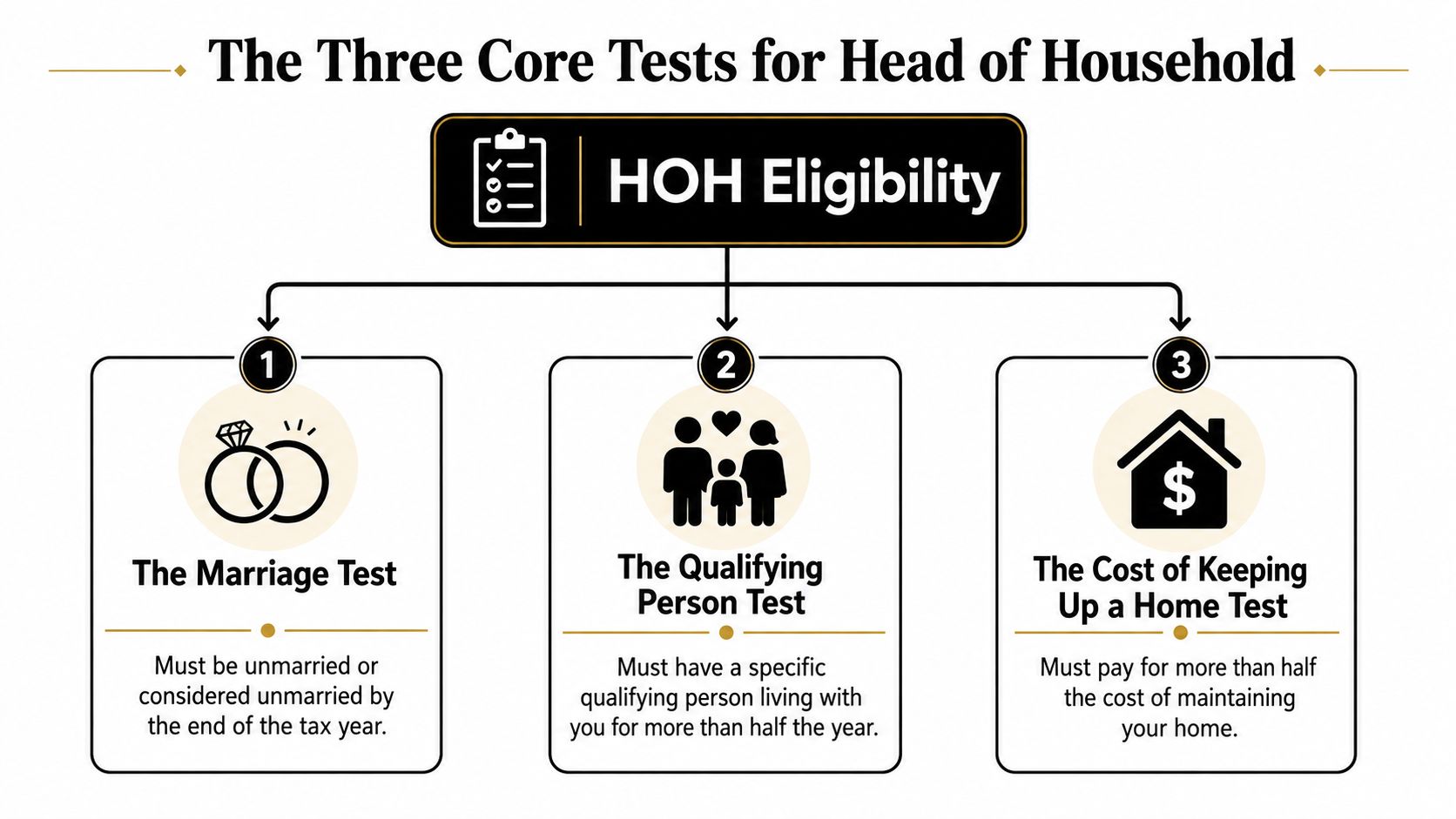
A filer can look ready for head of household qualification and still miss the mark because one IRS test breaks the chain. The rules work together like three legs of a stool, if one leg is missing, the status does not hold. That is why a situation that feels straightforward at home can become technical as soon as you apply the tax rules to it.
The marriage test
You must be unmarried or considered unmarried at the end of the tax year. “Considered unmarried” is where many people pause, because the tax meaning is narrower than the everyday one. It is not a statement about whether a couple is emotionally separated, it is a filing-status rule with its own conditions.
A spouse who lived in the home during the final part of the year can block HOH, even when the relationship has clearly broken down in practice. Temporary absences do not automatically change that result, because the IRS can still treat some separations as temporary rather than a true end to the shared household. The date that matters most is the last day of the tax year.
The qualifying person test
You also need a qualifying person. In ordinary conversation, people often stop at “dependent,” but that is too broad for this status. The IRS looks at whether the person fits one of its recognized relationships and whether the residency rules line up with your household.
A child who lives elsewhere for too much of the year, or a relative who does not fit the IRS category, can break this test even if you provide most of the support. The role the person plays in the tax rules matters as much as the role they play in family life.
The filing status does not turn on effort alone. It turns on whether the IRS-recognized person and residency tests line up.
The cost test
You must pay more than half the cost of keeping up the home for the year. The IRS looks at the actual cost of maintaining the household, not just who feels responsible for it. That is where shared-household cases often get tangled, because several people may contribute and each contribution can be easy to underestimate or overcount.
Rent or mortgage interest, property taxes, insurance, repairs, utilities, domestic help, and food consumed in the home can all matter in the calculation. The key question is whether your share exceeds the rest of the household support added together. A family can split bills in a way that feels fair and still fail this test if your payments do not cross that line.
Who Counts as a Qualifying Person
A lot of people hear “dependent” and stop there. For head of household, that label is only the starting point. The IRS looks at which dependent category fits, whether the person meets the residency rule, and, for some relatives, whether the income and support rules line up.
Children, stepchildren, and foster children
A qualifying child can be a biological child, adopted child, stepchild, or foster child. In most family setups, the main question is where the child lived for more than half the year. That is where people often get tripped up. A child who spends exactly half the year with you does not meet “more than half,” so a parent can feel like the main caregiver and still miss the test.
Siblings and descendants of siblings
The IRS also recognizes siblings, including half-siblings and step-siblings, and in some cases the child of one of those relatives. They still have to satisfy the residency and support framework. Age matters here too, because an older child can age out of the qualifying child rules even if they still live in your home and everyone still thinks of them as part of the household.
Parents and certain relatives
Parents are handled differently from children. A dependent parent does not have to live with you for HOH, which is why someone supporting a parent in a nursing facility may still qualify if the dependency and support rules are met. California's HOH guidance is more explicit on this point and adds a state-level filter for qualifying relatives, including a gross income limit of $4,300 in the cited guidance (California FTB head of household rules).
For a plain-English parent example, see this explainer on claiming a parent as a dependent.
What often surprises people
An adult child living with you does not automatically count, especially if the dependency or residency tests fail. A niece, nephew, aunt, uncle, or in-law may count in some situations, but the relationship alone does not carry the claim. The IRS wants the whole package, relationship, residence, and support, not just a familiar family tie.
Navigating Tricky Situations and Edge Cases
A lot of HOH disputes come from families that are already in transition. The rule looks tidy on paper, but real households aren't tidy. One parent may have moved out in November, grandparents may be helping with child care, or two adults may be sharing expenses while raising children in the same home.
Take a separated spouse who hasn't finalized a divorce. That person often assumes the separation alone is enough to file HOH. It isn't. If the IRS still treats the couple as married for tax purposes, the filer has to meet the “considered unmarried” standard, not just point to the fact that the marriage is breaking down.
Custody cases create a different kind of friction. Suppose a child spends time in both homes. The question becomes which home was the child's main home for the required period, and whether the taxpayer paid more than half the home costs. When two parents split support and both want the status, the dependency and residency facts have to be checked carefully before anyone claims the return.
If two adults both think they qualify, the first thing to compare is not emotion, it's the residency calendar and the support records.
Foster children can also be misunderstood. Informal caregiving arrangements don't always match the IRS concept of a foster child. If there isn't an official relationship that fits the tax rule, the child may not count, even if everyone in the home treats them like family.
Unmarried partners are another common error. Living together and raising children doesn't, by itself, create HOH for both adults. The IRS does not let the filing status ride on shared household responsibility alone, and a boyfriend or girlfriend generally doesn't count just because they help with the bills or the bedtime routine (TurboTax explanation of who can't use the status with a boyfriend or girlfriend).
For people in blended or multigenerational homes, the safest approach is to treat each filing fact separately. Who lived there, who was supported, who counted as the qualifying person, and who paid the costs all need to line up. If one of those facts is uncertain, the HOH claim becomes risky fast.
Tax Benefits and Filing Advantages
A taxpayer usually works to qualify for head of household because the filing status can be better than filing as single. The bigger standard deduction and the wider tax brackets can leave more income taxed at lower rates, which is why the status often matters in real returns. For a plain-English comparison of the filing choice itself, see file single or head of household.
The tax break is tied to the filing rules, not to the everyday meaning of being the person who runs the home. A parent, a separated spouse, or someone caring for a dependent parent may hear “head of household” and assume the label alone is enough. In tax law, the label only matters after the filing tests are met.
Federal and California rules side by side
| Requirement | Federal IRS | California FTB |
|---|---|---|
| Marital status | Must be unmarried or considered unmarried at year-end | Must be unmarried or considered unmarried on December 31 |
| Qualifying person | Must have a qualifying person, usually living with you more than half the year; a parent is a special case | Must have a qualifying child or relative, with more than 183 days of residence in the year |
| Household support | Must pay more than half the cost of keeping up the home | Must pay more than one-half of the costs of maintaining the home |
| Qualifying relative income | Federal rules apply, depending on the person's category and dependency status | Qualifying relative gross income must be below $4,300 in the cited guidance |
California's rule set is more specific on residency, and it also uses a separate income limit for qualifying relatives in the cited guidance. That can create a split result for someone who looks eligible under one system but not the other. People who split time between states, or who support a relative with modest income, often find that difference is where the return gets tricky.
A filing review also belongs beside the rest of the return, because household status and income calculations affect each other. The adjusted gross income guidance can help frame that broader planning piece of the return.
Documentation and Audit Preparedness
A good HOH return is the one you can explain later without digging through piles of paper. If the IRS asks why you filed as head of household, the records should show who lived in the home, who you supported, and how the household costs were paid. Keep those records while the year is still fresh, because reconstructing twelve months of family life from memory is where people get tripped up.
What to keep
- Household cost records: Lease agreements, mortgage statements, property tax bills, insurance statements, utility bills, repair invoices, and grocery receipts help show who paid the home costs and how the household was maintained.
- Residency evidence: School records, medical records, custody calendars, and other dated documents can help show that a qualifying person lived with you for more than half the year.
- Support records: Bank statements, canceled checks, and payment histories can show who covered a child's or dependent's living expenses.
- Custody and separation records: Divorce decrees, separation agreements, child support orders, and written dependency releases matter when parents share a child or another taxpayer can claim the dependent.
A file that is organized by tax year and by household member saves time later. The same habit that helps a landlord stay ready for questions in the Fresno rental compliance guide also works well here, because steady documentation makes it easier to match each HOH test to the right proof.
Practical advice: save records by tax year and by household member. The goal is to answer the IRS's question in minutes, not days.
A records check also belongs beside your income review. The way you handle gross income and household support can affect more than one part of the return, so the adjusted gross income guidance can help frame that broader review. If a notice questions your filing status, match the notice to the exact test the IRS is challenging, then pull the documents that prove the residence, support, and marital-status facts. A preparer can help sort that out, because HOH cases often turn on details that seem small until the IRS asks for them.
Common Mistakes and Your Eligibility Checklist
Most HOH problems come from one of four places. The filer was still legally married and didn't meet the “considered unmarried” rules. The qualifying person lived with them for exactly half the year, not more than half. The support calculation included expenses that don't belong in the household-cost total. Or the filer overlooked a relative's income limit or dependency status.
Common mistakes to avoid
- Claiming HOH while still married: Unless you meet the IRS “considered unmarried” rules, a married taxpayer usually can't take this status.
- Treating half the year as enough: The residency test is more than half, not half exactly.
- Counting the wrong expenses: Not every household payment counts the same way, so the support calculation has to stay inside the IRS definition.
- Forgetting dependency details: A qualifying relative's income or support status can knock out the claim even if the person lives with you.
Your eligibility checklist
- Confirm marital status by year-end. You're unmarried or considered unmarried on December 31.
- Identify one qualifying person. The relationship and residency rules line up under IRS guidance.
- Check the home-cost test. You paid more than half of the cost of keeping up the home.
- Separate federal and state rules. California can add a stricter residency threshold and an income filter for qualifying relatives.
- Keep proof before you file. If you can't document the facts, the claim is fragile.
If your household is straightforward, you can usually walk through the checklist with confidence. If you're separated, sharing custody, supporting a parent in another residence, or living in a blended home, the filing-status choice deserves a closer review. In those cases, a tax professional can help you match the facts to the rule before the return goes out.
If your household situation is even a little complicated, don't guess at the filing status. Allied Tax Advisors helps taxpayers sort out head of household qualification, document the right facts, and file with confidence when the rules get messy. Visit Allied Tax Advisors to get help with your return before a small mistake turns into a notice or an amended filing.