
You had a good year. Revenue was up, clients paid on time, and the business finally felt stable. Then your tax estimate landed and the self-employment tax piece looked far bigger than expected.
That is the moment most owners start searching for llc s corp vs llc partnership. Not because they suddenly love tax structure, but because they want to know whether they are paying more than they should.
This decision matters. A lot. The wrong choice can mean avoidable payroll taxes, unnecessary admin work, weak loss planning, or an audit problem you created by chasing savings too aggressively. The internet pushes one clean answer: elect S corp status and save taxes. That advice is incomplete.
I do not like simplistic entity advice. A profitable service business and a debt-financed real estate venture should not get the same recommendation. A two-owner consulting firm with steady margins has different needs than a multi-member investment LLC with uneven economics between members. The best structure depends on profit level, owner profile, cash distribution goals, and your willingness to handle compliance correctly.
The Crossroads for Every Successful LLC Owner
A common pattern plays out like this. Two business partners form an LLC because it is easy, flexible, and familiar. They split management informally, keep bookkeeping in QuickBooks, and focus on growth. The business does well. Then tax season arrives, and they learn that the default tax setup is treating all net business profit as subject to self-employment tax.
That is the first significant crossroads.
One path keeps the LLC taxed as a partnership. It is flexible and the right answer, especially when you need custom economics between owners or you are dealing with debt-heavy investments. The other path keeps the LLC as an LLC legally, but makes a tax election to be treated as an S corporation. That can reduce payroll tax exposure if the numbers support it and if you handle payroll and salary defensibly.
Most owners ask the wrong first question. They ask, “Which one saves more tax?” The better question is, “Which one produces the best after-tax result after compliance cost, audit risk, owner restrictions, and operational fit?”
The cheapest structure on paper is not always the best structure in practice.
A structure that saves tax but forces bad salary positions, messy payroll, or restrictions on new owners can become expensive fast. On the other hand, staying with the default LLC partnership when profits have climbed can mean you are leaving meaningful tax savings on the table every year.
The right answer is not philosophical. It is mechanical. Follow the money, follow the rules, and do not ignore the ongoing burden that comes with an S corp election.
The Default Path LLC Taxed as a Partnership
A multi-member LLC is usually taxed as a partnership by default. That is the baseline most owners start with, and for good reason. It is straightforward, adaptable, and very efficient when the business needs flexibility more than payroll tax engineering.
In practice, the business does not pay federal income tax at the entity level. Profit and loss pass through to the members, who report their share on their own returns. If you need a refresher on the mechanics, this overview of LLC tax classification is a useful starting point.
Why owners start here
The default partnership setup is popular because it works well for real businesses with real complexity. According to IRS-based reporting summarized by Big Ideas for Small Business, LLCs represented 72.7% of all partnership returns filed with the IRS in 2022, and it was the 21st consecutive year of that trend.
That popularity makes sense.
- Flexible ownership: You are not boxed into a narrow set of eligible owners.
- Flexible economics: You can create special allocations that do not mirror pure ownership percentage.
- Simple administration: You do not need to run owner payroll just because the business made money.
That last point matters more than many owners realize. If the business is still growing, cash is uneven, or profits are not high enough to justify added compliance, the partnership default can be the most rational choice.
The trade-off most owners feel first
The downside is simple. All net business profit is generally exposed to self-employment tax under the partnership model.
That is where the pain starts for profitable service businesses. You can have an LLC, keep liability protection, and still end up paying self-employment tax on the full amount of pass-through business income. Owners are often surprised by that because they assume “LLC” itself creates tax savings. It does not. The tax result depends on the tax classification.
Where partnership taxation shines
Partnership taxation is stronger than S corp taxation in a few situations that are very practical.
Special allocations
If one member contributed more capital, another member does more work, and you want to split economics differently from ownership percentages, partnership taxation gives you room to structure that. An S corp does not. S corp allocations must stay pro rata with ownership.
That alone disqualifies the S corp option for many multi-owner businesses.
Owner eligibility
A partnership-taxed LLC can accommodate a much broader range of owners. That is useful when you have trusts, entities, or non-U.S. owners involved. S corps are much stricter.
Debt basis for losses
This is a major issue for real estate and other debt-heavy businesses. In partnership taxation, partner basis can include entity debt, which can support loss deductions in ways an S corp often cannot match.
If your business model depends on reliance on debt, custom allocations, or nontraditional ownership, partnership taxation is usually the cleaner and safer fit.
My take
For many small businesses, the default LLC taxed as a partnership is not a temporary placeholder. It is the right long-term structure. It keeps compliance lighter and preserves flexibility that can be far more valuable than payroll tax savings.
If your profits are modest, ownership is evolving, or you need customized allocations, stay here until the facts clearly justify a change.
The Strategic Election LLC as an S Corporation

An LLC taxed as an S corporation is not a new legal entity. It is the same LLC making a tax election. That distinction matters because owners talk about “becoming an S corp” when what they mean is electing S corp tax treatment.
The appeal is obvious. Under S corp taxation, an owner who works in the business takes a reasonable salary through payroll, and additional profit can come out as distributions. The salary is subject to payroll tax. The distributions are not subject to self-employment tax.
Why owners elect S status
This is the classic tax play for profitable owner-operated service businesses. The basic logic is simple. Split compensation into two buckets:
- Wages for work performed
- Distributions for remaining profit
The savings come from keeping part of the profit out of self-employment tax treatment.
A straightforward example appears in this S corp versus partnership tax comparison. It notes that the primary advantage of an S corporation is avoiding the 15.3% self-employment tax on distributions. For a business with $100,000 in profit, an owner taking a $60,000 salary could save over $6,000 in taxes on the remaining $40,000 distribution compared with partnership treatment.
That is real money. It gets owners interested quickly.
What changes operationally
The tax savings do not appear by magic. You earn them by taking on a more formal compliance structure.
An LLC with an S election now has to operate with a payroll mindset. That means:
- Formal payroll processing: Many firms use systems like IRIS to run payroll correctly.
- Payroll filings: Quarterly and annual payroll tax reporting becomes part of routine compliance.
- W-2 reporting: Owner-employees need wages documented the same way other employees do.
- S election paperwork: The tax classification change has to be made properly, typically through Form 2553.
If that sound more corporate, it is. The legal entity may still be an LLC, but the tax regime now expects cleaner compensation practices and tighter documentation.
The hidden catch
Online articles stop at the savings example. That is shallow advice.
The hard part is not filing the election. The hard part is defending the salary. If the salary is too low for the work the owner performs, you have created the exact issue the IRS tends to challenge in S corp audits.
S corp status works best when profits are consistently strong and the salary can be defended without gamesmanship.
My take
I like S corp elections for owner-operated businesses with solid profits, predictable cash flow, and owners willing to run payroll correctly. I do not like them for businesses that want the tax benefit but resist the discipline.
If you hate admin, delay bookkeeping, or want to underpay yourself to chase every last tax dollar, S corp status is the wrong move.
Key Differences Analyzed S Corp vs Partnership
| Feature | LLC taxed as partnership | LLC taxed as S corp |
|---|---|---|
| Tax on owner earnings | Net profit generally subject to self-employment tax | Salary subject to payroll tax, distributions not subject to self-employment tax |
| Allocation flexibility | Can allow special allocations | Must follow ownership percentages |
| Owner rules | Broad flexibility on owner types | Restricted eligibility |
| Loss basis treatment | Debt inclusion can help | More limited basis treatment |
| Admin burden | Lower | Higher |
| Best fit | Flexible multi-owner or debt-intensive structures | Profitable owner-operated service businesses |
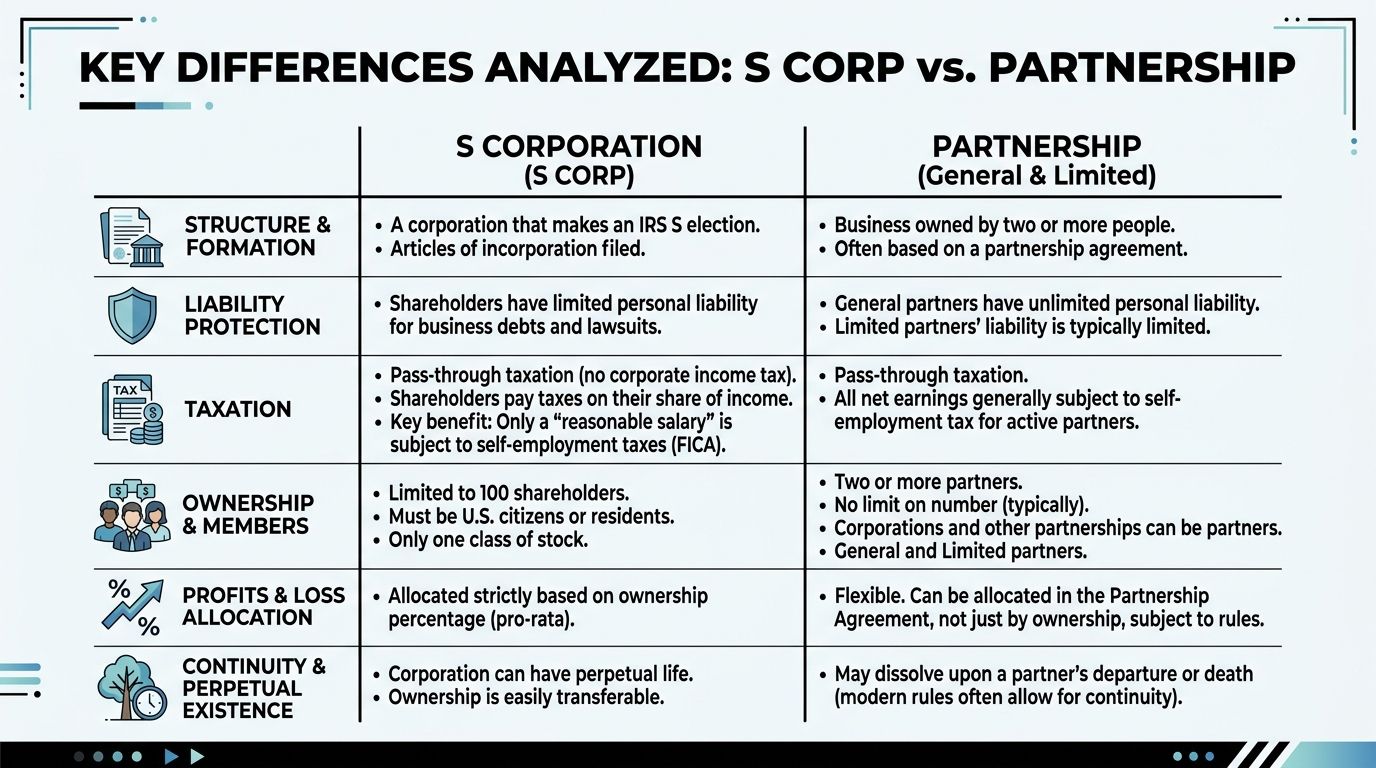
The cleanest way to evaluate llc s corp vs llc partnership is not by labels. It is by pressure points. How are profits taxed? How flexible are distributions? Who can own the business? How do losses work when debt is involved?
Those are the questions that drive the answer.
Tax treatment of profits
This is the issue that starts most conversations.
With partnership taxation, the default rule is straightforward. Business profit passes through to the owners, and that profit is generally exposed to self-employment tax. There is no salary-and-distribution split for active owners in the same way you get under an S corp framework.
With S corp taxation, the owner who works in the business takes wages through payroll. Remaining profit can be distributed without the same self-employment tax treatment.
This difference is why S corp elections often make sense for service businesses with strong margins. Consultants, agency owners, designers, professional practices, and similar businesses often have relatively low capital needs and produce income tied to owner labor. Once profits are high enough, the ability to separate reasonable salary from distributions can materially improve the tax result.
But do not reduce this to “S corp always wins.” It does not. The S corp only wins when the savings exceed the admin burden and the salary is supportable.
Practical takeaway
If your business produces healthy profit above what you would reasonably pay yourself as wages, S corp treatment deserves a serious look. If profits are inconsistent or too low to justify payroll and compliance, the partnership default often remains smarter.
Flexibility of distributions
Partnership taxation dominates in flexibility of distributions.
A partnership-taxed LLC can make special allocations if the operating agreement and economics support them. That means ownership percentage and profit allocation do not always have to match perfectly. In real businesses, that is useful all the time. One owner may bring money, another may bring labor, and a third may get a preferred economic deal for a period of time.
An S corp cannot do that. It requires pro rata treatment tied to ownership.
If the owners want economic flexibility, S corp status is the wrong structure.
This is not a minor drafting issue. It is a structural limit. If you know distributions need to reflect something other than strict ownership percentages, the partnership model is your answer before the conversation even starts.
Common situations where flexibility matters
- Capital-heavy partner and working partner
- Real estate deals with negotiated waterfalls
- Businesses bringing in strategic investors with custom economics
- Family or closely held entities where economics are intentionally uneven
For those setups, the partnership rules are not just convenient. They are essential.
Ownership eligibility
Partnership-taxed LLCs are more accommodating. That matters when ownership is not plain vanilla.
S corps come with strict eligibility rules. They are built for a narrower owner profile. If you expect outside entity owners, non-U.S. owners, or structures that may evolve over time, the S corp rules can become restrictive fast.
The practical problem is not just current eligibility. It is future flexibility. If your business may raise money, change owner mix, or admit owners who do not fit the S corp rules, electing S status can create friction you do not need.
My recommendation
If your ownership group is simple and likely to stay simple, S corp eligibility may not be a problem. If your ownership picture could change, preserve flexibility and stay with partnership taxation unless the tax upside is overwhelming.
Basis for deducting losses
This area gets less attention than it should, especially outside real estate and investment circles.
Under partnership taxation, partner basis can include entity debt. That can be very important when the business uses significant debt. It can support loss deductions in a way that fits the economics of a debt-financed venture.
S corp treatment is usually less generous here. Losses are generally limited to stock basis plus direct loans to the entity. Entity debt does not help in the same way.
This is one of the biggest reasons I rarely recommend S corp elections for debt-financed real estate structures. The owners often care more about basis support and allocation flexibility than payroll tax optimization.
Best example of where this matters
A debt-financed real estate LLC often benefits from partnership treatment because the financing structure is central to the investment model. Trying to force that into S corp taxation for payroll tax savings usually solves the wrong problem.
Administrative complexity
Many comparisons of administrative complexity are too soft.
Partnership taxation is simpler to live with. S corp taxation adds payroll, owner compensation analysis, filing discipline, and a greater chance that a sloppy process turns into a tax issue.
Some owners can handle that well. Others cannot.
There is no prize for electing S status too early. If the owners are disorganized, bookkeeping is delayed, and payroll records will be an afterthought, the compliance burden can erase the planned benefit.
Good tax strategy has to be executable. If you will not maintain it, it is not good strategy.
Which structure fits which business
Use the business model, not the marketing hype.
Partnership usually fits better when
- The business has multiple owners with uneven economics
- Debt basis matters
- Ownership may include entities, trusts, or nontraditional investors
- Profits are modest or inconsistent
- Simplicity is a priority
S corp usually fits better when
- The business is owner-operated
- Owners actively work in the business
- There is consistent profit above a reasonable salary
- Ownership is simple and eligible
- You will comply: Payroll, bookkeeping, filings, and documentation must happen on time.
That is the essential comparison. Not “which one is better,” but “which one fits the facts without creating avoidable problems.”
The Financial Breakdown A Cost-Benefit Analysis
Forget theory for a minute. Run the numbers.
For a business with $200,000 in profit per owner, an S corp structure with a $100,000 salary can produce approximately $12,336 in annual FICA or self-employment tax savings per owner, compared with an LLC taxed as a partnership. That same comparison notes the S corp structure also brings $2,000 to $4,500 in increased annual administrative and payroll costs. The figures come from this 2025 benchmark comparison.
That is the right way to analyze this issue. Look at savings and burden together.
S Corp vs. Partnership Tax Scenario: $200,000 Net Profit
| Metric | LLC Taxed as Partnership | LLC Taxed as S Corp |
|---|---|---|
| Profit per owner | $200,000 | $200,000 |
| Salary to owner | Not applicable in the same way | $100,000 |
| FICA or SE tax result | Higher exposure on full business profit | Lower exposure because part is salary and part is distribution |
| Estimated annual FICA or SE tax savings | None | Approximately $12,336 per owner |
| Added annual admin and payroll costs | Lower | $2,000 to $4,500 |
| Net conclusion | Simpler, but potentially more expensive on payroll taxes | Savings can be meaningful if compliance is handled correctly |
If you want to understand the mechanics behind that tax layer before choosing an entity, review how self-employment tax works.
What the math really says
The S corp side looks attractive because it is attractive. Even after added payroll and admin costs, there can still be a meaningful net benefit when profits are high enough.
Owners make mistakes here. They see the gross tax savings and stop thinking.
They ignore:
- Payroll setup and maintenance
- Additional bookkeeping discipline
- Separate S corp tax return preparation
- Owner wage analysis
- The risk of doing all of it poorly
That is why a small profit business often should not elect S status. If the tax savings are modest and the owner hates process, the administrative drag is not worth it.
The break-even mindset
You do not need a perfect spreadsheet forecast to make a good decision. You need the right mindset.
Ask four questions:
- Are profits consistently high enough to leave room for distributions after a reasonable salary?
- Will the owner run payroll correctly every pay period?
- Can bookkeeping stay current enough to support payroll and year-end reporting?
- Does the savings still look good after adding real compliance cost?
If the answer is yes across the board, S corp treatment often wins for a service business.
If the answer is shaky, stay with partnership taxation until the business is operationally ready.
Tax savings only count if you keep them. Poor compliance can hand them right back.
My recommendation
For a profitable owner-operated business at this income level, the S corp election is often financially justified. But only if the business is organized enough to support payroll and documentation all year, not just at tax time.
If the books are late, owners commingle funds, or payroll feels like a nuisance, the partnership model may produce the better real-world outcome despite the higher tax cost.
Navigating Compliance Risks and State Rules

The biggest mistake owners make in the llc s corp vs llc partnership decision is treating S corp status like a simple tax coupon. It is not. It is a compliance regime.
If you elect S status, you are choosing a more demanding tax structure. That means deadlines matter more, payroll matters more, and documentation matters more.
Reasonable compensation is the pressure point
The IRS does not care that your friend said to take a tiny salary and large distributions. The IRS cares whether the salary is reasonable for the work you do.
That is the central audit issue in most bad S corp setups.
According to UpCounsel’s discussion of LLC partnership vs S corp, IRS audits of S corporations surged 25% year-over-year in 2025, with average audit adjustments exceeding $50,000 and defense costs running $10,000 to $20,000. Those are not minor cleanup numbers. They can wipe out years of expected savings if the salary position is weak.
I push back when owners say, “I just want the S corp for tax savings.” That is incomplete thinking. The question is whether you can defend the salary, not whether you can type a lower number into payroll.
The S corp election is easy to file. The hard part is supporting it under scrutiny.
What proper compliance looks like
Owners often underestimate the ongoing work. A defensible S corp setup usually requires consistent execution in several areas.
- Timely election filing: The tax election has to be filed correctly and on time.
- Regular payroll: Owner wages should move through payroll, not random draws treated like wages after the fact.
- Current bookkeeping: Payroll, distributions, and expenses need clean books behind them.
- Wage support: You should be able to explain why the salary is reasonable based on the owner’s duties and the business facts.
- Entity formalities: Records, tax filings, and governance should be handled with more discipline than many small owners are used to.
Tools help. Payroll systems like IRIS can make recurring payroll easier. QuickBooks can keep books tighter. But software does not fix bad habits. If the owner still treats the business account like a personal wallet, the software is just decoration.
State issues can complicate the picture
Federal tax savings are only part of the story. State treatment can add friction, especially for businesses operating in more than one state or in states with their own review posture around owner compensation.
California owners need to take this seriously. State scrutiny and conformity issues can make a sloppy S corp election harder to manage than owners expect. If you already operate in a high-compliance environment, adding an S corp election should be a considered move, not a casual one.
When partnership taxation may be the safer answer
There are situations where I would rather see an owner pay more self-employment tax than create a fragile S corp structure.
That includes businesses where:
- The owner cannot support a credible salary
- Books are consistently behind
- Cash flow is too erratic for clean payroll
- Owners want flexible distributions
- Audit defense would be a major financial strain
That is not fear-based advice. It is practical advice. Compliance failures are expensive, distracting, and avoidable.
My opinion
A well-run S corp can be excellent. A poorly run S corp is a liability with a tax return attached.
If you are not prepared to act like an owner-employee with real payroll, stay with the partnership structure until you are.
Your Decision Checklist When to Choose Each Structure
Use this as the practical filter.
Choose an LLC taxed as a partnership when
- You need flexible allocations: If owners are not splitting profits strictly by ownership percentage, partnership taxation is usually the better tool.
- Debt matters to the tax outcome: Debt-reliant real estate and similar structures often fit better here.
- Ownership is complex or may change: If you may add owners who do not fit S corp rules, keep flexibility.
- Profits are not consistently high enough: If there is not much room between a fair wage and remaining profit, the S corp benefit may be too small.
- You want lower admin burden: If payroll discipline and formal owner wage support are not realistic right now, do not force it.
Consider an LLC taxed as an S corporation when
- The business is a profitable service operation: The structure often performs best in this context.
- Owners actively work in the business: The salary-and-distribution model only makes sense when compensation can be framed properly.
- There is consistent profit above a reasonable salary: That is where the tax advantage appears.
- Ownership is simple and eligible: Keep the owner profile clean.
- You will comply: Payroll, bookkeeping, filings, and documentation must happen on time.
Red flags that should stop you
Some businesses should not elect S status yet, even if the projected tax savings look attractive.
Watch for these warning signs:
- Books are always late
- Owners mix personal and business spending
- No one wants to run payroll
- The salary number is being chosen only to minimize tax
- The operating agreement depends on flexible economics
Bottom-line recommendation
If you run a healthy owner-operated service business and your profits consistently justify distributions after a defensible salary, the S corp election is often the stronger tax move.
If your business needs flexibility, uses significant debt financing, has multiple owners with uneven economics, or lacks the discipline to maintain payroll and documentation, keep the LLC taxed as a partnership.
Do not make this choice based on hype. Make it based on profit pattern, owner structure, and your ability to maintain compliance without cutting corners.
If you want a real answer for your business, not a generic internet answer, talk with Allied Tax Advisors. Their team helps small business owners evaluate LLC partnership versus S corp treatment, model the tax impact, handle Form 2553 filings, run payroll through IRIS, maintain QuickBooks bookkeeping, and defend compliance decisions before they turn into IRS or state problems.