
The Section 179 vehicle deduction is a massive tax break that lets businesses write off a huge chunk—sometimes the entire cost—of a qualifying vehicle in the same year they buy it. This is a big deal because it provides an immediate tax benefit, instead of having to depreciate the vehicle bit by bit over several years. For small businesses, it’s one of the best tools out there for lowering taxable income and freeing up cash.
How the Section 179 Vehicle Deduction Actually Works
Think of Section 179 as a supercharger for your tax deductions. Normally, when you buy a business asset like a truck, you'd write off its cost over a period of years through a process called depreciation. Section 179 throws that slow-burn approach out the window. It lets you take a massive deduction for the vehicle's purchase price right away, in the year you put it to work for your business.
It’s almost like getting an instant cash rebate on a major business purchase. The whole point is to encourage small and medium-sized businesses to invest in the equipment they need. By letting you immediately slash your taxable income, the government is essentially giving you a discount on that new work van or SUV.
The Basic Idea in a Nutshell
At its core, Section 179 is all about timing. Standard depreciation forces you to spread out your tax savings over the "useful life" of an asset—typically five years for a vehicle. Section 179 lets you pull all of those future years' deductions into the present.
Here’s a simple example: Let’s say you buy a $50,000 work truck. Without Section 179, you might only get a $10,000 depreciation deduction in the first year. But by using Section 179, you could potentially deduct the full $50,000 in that same year, making a much bigger dent in your tax bill right now.
Key Takeaway: Section 179 isn't an extra deduction—it's an accelerated one. You get the tax benefit of your vehicle purchase immediately instead of waiting years to claim the full amount.
The Rules of the Road
To really get the most out of this tax strategy, you have to know the key rules. These are the pillars that determine if your vehicle qualifies and, just as importantly, how much you can actually write off.
- Gross Vehicle Weight Rating (GVWR): This is the single most important factor. Heavier vehicles—those over 6,000 pounds—get much more favorable treatment and often qualify for the full deduction. Lighter passenger vehicles, on the other hand, are stuck with much lower limits.
- Business-Use Percentage: You can’t just buy a car and claim it’s for business. The vehicle must be used more than 50% of the time for legitimate business purposes. And no, your daily commute to the office doesn't count.
- Deduction and Spending Caps: Every year, the IRS sets limits on how much you can deduct under Section 179 and how much you can spend on equipment in total before the deduction starts to shrink.
This tax break really became a game-changer for businesses around 2018. That’s when the overall deduction limit skyrocketed from $500,000 in 2017 to $1,000,000. When combined with 100% bonus depreciation, this allowed many businesses to write off the entire cost of certain assets immediately. You can learn more about the history of Section 179 deduction limits to see just how much things have changed. Getting these core concepts down is your first step to using this powerful tax break effectively.
How to Qualify for the Full Deduction
If you want to get the biggest tax bang for your buck from a Section 179 vehicle deduction, it almost always boils down to one thing: weight. The tax code draws a very clear line in the sand between "heavy" work vehicles and your typical "light" passenger cars, and the rules heavily favor the big guys. Getting a handle on this difference is the first step to a smarter vehicle-buying strategy for your business.
The key metric here is the Gross Vehicle Weight Rating (GVWR). This isn't just what the vehicle weighs; it's the maximum safe operating weight, including the truck itself, passengers, fuel, and any cargo you can haul. Think of it as the total weight the manufacturer certified it to handle.
For tax purposes, the magic number is 6,000 pounds. Vehicles with a GVWR over this threshold open the door to a much larger—and often full—Section 179 deduction.
Finding the Magic Number: Your GVWR
So, how do you know if that truck or van you're eyeing makes the cut? Thankfully, you don't have to break out a scale or pore over technical manuals. Finding the GVWR is surprisingly simple.
Manufacturers are required to put this information on a sticker, which is almost always on the inside of the driver's side door jamb.
- Step 1: Just open the driver's side door.
- Step 2: Look for the little information sticker on the door frame (it's usually black and silver or white and yellow).
- Step 3: Scan the sticker for the letters "GVWR." The number right next to it is the official rating you'll use for your taxes.
That's it. This quick check lets you know instantly if a vehicle qualifies for the better tax treatment before you even sit down to talk numbers.
This infographic breaks down how all the key pieces fit together to determine your final deduction.
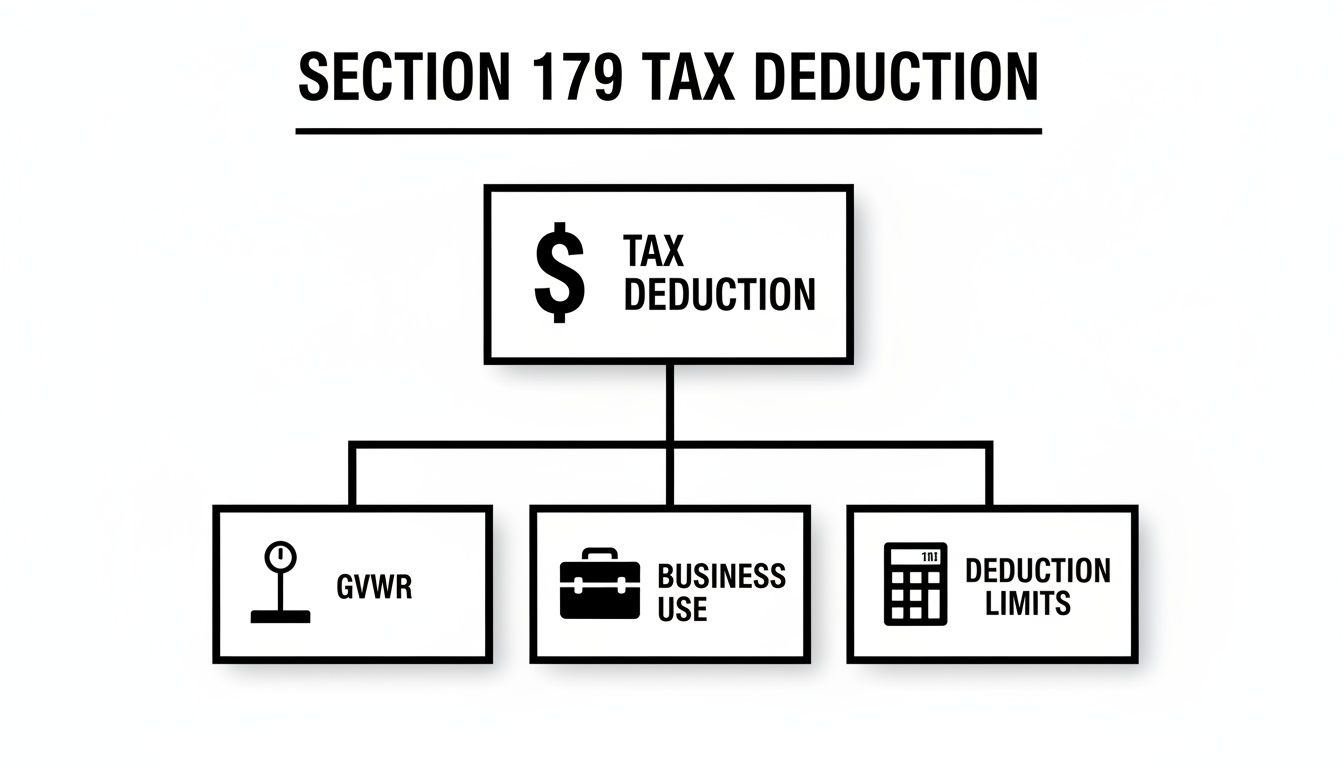
As you can see, the vehicle's GVWR is the foundation. From there, your business use percentage and the specific deduction limits all come into play to shape your final tax savings.
Why Heavy Vehicles Get a Bigger Tax Break
The IRS’s logic is pretty straightforward: heavier, more robust vehicles are less likely to be used as a personal daily driver and more likely to be legitimate workhorses. Because of this, the tax code gives business owners a much stronger incentive to purchase them.
By crossing that 6,000-pound GVWR threshold, you escape the very restrictive "luxury auto" depreciation rules. This moves you into a category where you can potentially write off the vehicle's entire purchase price in the first year, as long as you have enough business income to cover it.
The difference this makes is huge. A standard passenger car might be capped at a first-year deduction of around $12,000 (plus a bit of bonus depreciation). In contrast, a qualifying heavy SUV, truck, or van could be eligible for a much larger deduction—sometimes even the full price tag. You can dive deeper into the specifics in our guide on Section 179 vehicles over 6,000 pounds.
To give you a clearer picture, here’s a breakdown of how the deduction limits typically stack up based on the vehicle type.
Section 179 Vehicle Categories and Deduction Limits
| Vehicle Category | Description | Typical Deduction Limit |
|---|---|---|
| Passenger Vehicles (Cars, Light SUVs) | Under 6,000 lbs GVWR | Heavily restricted; often capped around $12,200 (+ bonus). |
| Heavy SUVs | Over 6,000 lbs GVWR | Subject to a specific cap; $30,500 for 2024. |
| Heavy Trucks, Vans, & "Work" Vehicles | Over 6,000 lbs GVWR (no passenger focus) | Can qualify for the full Section 179 deduction up to the annual limit. |
As the table shows, choosing a vehicle over 6,000 pounds can multiply your potential first-year write-off significantly, especially if it's a truck or van without extensive rear passenger seating.
What Kinds of Vehicles Qualify?
You might be surprised how many common vehicles easily clear the 6,000-pound GVWR hurdle. Think of models like the Chevy Suburban, Ford Expedition, or Ram 2500. It's crucial to remember, though, that even some of these heavy SUVs have their own special cap. For 2024, that limit is $30,500. This rule is aimed at large luxury SUVs and generally doesn't apply to vehicles like cargo vans or heavy-duty pickups that are clearly designed for work.
Here are some of the most common vehicle types that often qualify for the full Section 179 deduction:
- Heavy-Duty Pickup Trucks: Think Ford F-250, Ram 2500, Chevrolet Silverado 2500, and their bigger siblings.
- Large Cargo Vans: Workhorses like the Ford Transit, Ram ProMaster, and Mercedes-Benz Sprinter are classic examples.
- Certain Large, Truck-Based SUVs: Many full-size SUVs built on a true truck chassis meet the weight requirement, though they may be subject to the special $30,500 cap.
At the end of the day, that GVWR sticker on the door jamb is your ultimate source of truth. By focusing your search on vehicles that meet this one simple requirement, you put your business in the driver's seat to maximize this powerful tax deduction.
Understanding the Deduction Limits and Spending Caps
When it comes to using Section 179 for a vehicle, the numbers are what really matter. Every year, the IRS sets two key figures that you need to have on your radar: the overall deduction limit and a cap on how much you can spend on equipment. Think of them as the guardrails that keep your tax strategy on the right road.
First, you have the maximum Section 179 deduction. For 2024, that’s a whopping $1.22 million. This is the absolute most you can write off in a single year across all qualifying business assets, vehicles included.
But here’s the thing: this tax break is really meant for small and mid-sized businesses, not giant corporations. To keep it that way, the IRS put a second number in place—the spending cap, which is officially called the phase-out threshold.
The All-Important Spending Cap
This is the total amount you can spend on equipment in a year before your Section 179 deduction starts to shrink. For 2024, that magic number is $3.05 million. It’s not a hard stop, but it’s where your deduction begins to get smaller.
Let's make this simple. Imagine you have a $1.22 million deduction allowance. Now, picture a line in the sand at $3.05 million for your total equipment spending.
- As long as you spend less than that $3.05 million, you get to keep your full deduction.
- The moment you step over that line, the IRS starts taking away from your deduction allowance.
It's a dollar-for-dollar reduction. For every single dollar you spend over the $3.05 million cap, your maximum deduction is cut by one dollar. If you aren't paying attention, this can eat into your tax savings pretty quickly.
Here’s how the phase-out works in practice: Let's say your business spends $3.2 million on new equipment. You've gone $150,000 over the spending cap. Because of that, your maximum Section 179 deduction gets cut by that same amount, dropping from $1.22 million all the way down to $1.07 million.
This rule really encourages business owners to plan their major purchases carefully. Staying under that threshold is key to getting the biggest possible write-off right away.
Special Rules for Heavy SUVs
Now, while most heavy vehicles (those over 6,000 lbs GVWR) are eligible for the full $1.22 million deduction, there's a special carve-out for certain heavy SUVs. Let's be honest, some of these vehicles can be pretty luxurious, and the IRS knows they often pull double duty for personal use. To prevent misuse, they've put a much lower limit on them.
For the 2024 tax year, the maximum Section 179 deduction for a qualifying heavy SUV is capped at just $30,500.
This specific cap applies to SUVs and crossovers built on a truck chassis with a GVWR over 6,000 pounds. It’s important to know what this rule does not apply to, as these vehicles are typically seen as true workhorses:
- Pickup trucks with a cargo bed of at least six feet.
- Vans that can seat more than nine people behind the driver.
- Cargo vans with no rear passenger seats.
If your vehicle falls into one of those categories, you can often aim for the full Section 179 limit.
Don't underestimate the impact of these rules. Going over the $3.05 million spending cap in 2024 means your $1.22 million deduction drops fast. For instance, spending $3.5 million on equipment would slash your potential deduction down to just $770,000. Considering that Section 179 has helped small businesses shield over $100 billion in income since 2018, getting these details right is crucial. You can find more great insights into how these deductions work from industry experts on CrestCapital.com. Smart planning around these caps will ensure you squeeze every last drop of tax benefit out of your section 179 vehicle purchase.
The Importance of Business Use Percentage

Buying a heavy-duty truck or van is just the first step. The next, and most critical, piece of the puzzle is proving your business use percentage. This is where the rubber really meets the road, and it’s a non-negotiable rule that trips up many business owners.
To even begin to qualify for a Section 179 deduction on a vehicle, you have to use it for legitimate business purposes more than 50% of the time. This isn't a guideline—it's a hard-and-fast threshold.
If you don’t cross that 50% line in the vehicle’s first year of service, the Section 179 deduction is completely off the table. No exceptions.
Defining What Counts as Business Use
So, what does the IRS actually consider "business use"? It's a question that needs a clear answer, because getting it wrong can be costly. The key is that the driving must be directly tied to your trade or business.
Here’s a quick breakdown of what flies and what doesn't:
- Driving to meet a client? Absolutely. That's a classic business trip.
- Hauling equipment to a job site? Yes, that’s a core business activity.
- Making deliveries or picking up supplies? That counts.
- Traveling between different office locations? Also considered business mileage.
On the flip side, some driving is always considered personal, no matter what:
- Your daily commute: The drive from your home to your primary workplace and back is always personal.
- Running personal errands: Stopping for groceries or picking up your kids from school, even in a work truck during the day, doesn't count.
Prorating Your Deduction Based on Actual Use
Once you've cleared the 50% hurdle, the size of your deduction is directly tied to your actual business use percentage. You can't write off 100% of a truck's cost if you only use it for business 80% of the time. The IRS requires you to prorate the deduction.
Let’s see it in action: Say you buy a qualifying work truck for $60,000. You keep meticulous mileage logs and find that your business use for the year was exactly 75%. Your deductible amount for Section 179 isn't the full purchase price; it's $45,000 ($60,000 x 0.75).
This simple math ensures the tax break you get lines up perfectly with how much the vehicle actually worked for your business. For companies juggling multiple vehicles, dialing in these numbers is a key part of smart fleet management best practices.
The Dangerous Section 179 Recapture Rule
Here’s a major "gotcha" to be aware of: the business-use test isn't a one-and-done deal. It continues for the entire life of the vehicle's depreciation schedule, which is typically five years.
If your business use of that section 179 vehicle drops to 50% or less in any of those following years, the IRS can hit you with a painful penalty called recapture.
Essentially, the recapture rule forces you to "give back" a portion of the tax savings you enjoyed. You'll have to add the difference between the Section 179 deduction you took and the standard depreciation you would have taken as extra income on your tax return. This can result in a significant, and unexpected, tax bill.
This is exactly why keeping detailed, real-time mileage logs isn't just a good idea—it's your best defense. It's the only way to prove your business use and protect your deduction. You can find more detail on proper record-keeping in our guide to deducting vehicle expenses.
Combining Section 179 With Bonus Depreciation

Think of Section 179 and Bonus Depreciation as a powerful one-two punch for your business tax strategy. They aren't the same thing, but they work together beautifully, especially when you're buying a vehicle that costs more than the annual Section 179 limit.
The game plan is simple: you apply the Section 179 deduction first. After you've maxed that out (or just taken a partial deduction), Bonus Depreciation kicks in to write off a big chunk of whatever cost is left. This layered approach is your ticket to massively accelerating tax savings in the first year you own the vehicle.
How The One-Two Punch Works
The order you apply these deductions in is absolutely crucial. You always lead with Section 179. It gives you far more control, letting you pick and choose which assets get the deduction, right up to the yearly maximum.
Bonus Depreciation is the perfect follow-up. It's less flexible—it automatically applies to the remaining cost of qualifying assets unless you specifically opt out—but it's still incredibly potent.
For a qualifying vehicle, the sequence looks like this:
- First, figure out your cost basis for the vehicle (what you paid, multiplied by your business-use percentage).
- Next, apply the Section 179 deduction to that amount, up to the annual limit and any vehicle-specific caps.
- Finally, apply Bonus Depreciation to the remaining cost basis.
By strategically combining these two tax breaks, businesses can often write off 100% of a qualifying heavy vehicle's cost in the first year, even if its price tag blows past the official Section 179 cap.
An Example of Combining Deductions
Let's walk through a quick, real-world scenario to see how this plays out. Imagine a construction company buys a new heavy-duty work truck for $80,000. It's used 100% for the business, and since it has a GVWR over 6,000 pounds and a long bed, it isn't hit with the lower SUV caps.
Here’s a step-by-step breakdown showing how a business owner would apply both Section 179 and Bonus Depreciation to maximize the first-year deduction on a qualifying heavy vehicle.
Table: Example Calculation of Section 179 and Bonus Depreciation
| Step | Action | Calculation | Resulting Deduction |
|---|---|---|---|
| 1 | Initial Cost | Cost of the new truck | $80,000 |
| 2 | Apply Section 179 | Deduct the cost up to the annual limit | $80,000 |
| 3 | Remaining Basis | $80,000 (Cost) – $80,000 (Sec. 179) | $0 |
| 4 | Apply Bonus Depreciation | Bonus % applied to remaining basis | $0 |
| Total | First-Year Write-Off | $80,000 (Sec. 179) + $0 (Bonus) | $80,000 |
In this case, Section 179 took care of the whole cost. But what if the business had already used its Section 179 limit on other equipment? That’s when Bonus Depreciation would swoop in to cover the rest. To really dig into the details, check out our complete guide on how bonus depreciation works.
The Phasing Down of Bonus Depreciation
Now for the important part: Bonus Depreciation is slowly disappearing. It used to be 100%, but it dropped to 80% in 2023 and will continue to decrease each year until it’s completely gone. This creates a real sense of urgency if you're planning a major vehicle purchase.
Even with the phase-down, the savings are still significant. For a $75,000 heavy SUV bought in 2025 and used entirely for business, you could potentially take a $30,500 Section 179 deduction (the estimated cap for that year), and then apply Bonus Depreciation to the remaining $44,500. The bottom line is simple: the sooner you act, the bigger the bonus deduction you can claim.
Answering Your Top Questions About the Section 179 Vehicle Deduction
Let's be honest, the tax code can feel dense and confusing. When it comes to something as powerful as the Section 179 vehicle deduction, a few questions pop up again and again. Getting clear, straightforward answers is the key to using this tax break correctly and with confidence.
Think of this as a quick-reference guide for those real-world "what if" scenarios that business owners run into. Let’s clear up the confusion.
Can I Write Off a Used Vehicle with Section 179?
Yes, you absolutely can! This is one of the best features of Section 179. The rules work for both new and used vehicles, as long as the vehicle is “new to you” and your business.
What you can't do is claim the deduction on a car you already owned for personal use and simply decided to start using for business. It needs to be a new purchase for the business. This flexibility is a huge win for small businesses, letting you buy a reliable used truck or van and still get the same powerful, immediate tax write-off. All the other rules—like placing it in service during the tax year and meeting the business-use test—still apply.
What if My Business Didn't Make a Profit This Year?
This is a crucial point. The Section 179 deduction is designed to reduce your taxable income, but it can't be used to create or increase a business loss. Your total deduction is capped by your business's net taxable income for the year.
For example, if your business has $40,000 in net income, you can only claim up to $40,000 in Section 179 deductions. This is true even if you bought a qualifying $80,000 heavy SUV.
Important Takeaway: The unused part of your deduction isn't lost. You can carry it forward to the next tax year to offset future income. This carry-forward can continue indefinitely, so it's vital to work with a tax pro to make sure you use it wisely.
This rule shows just how important these incentives are. In the U.S., where small businesses generate 44% of our economic activity, these vehicle deductions are essential for managing cash flow and funding growth. If you want to dive deeper, you can discover more about these powerful tax provisions to stay ahead of the curve.
What Kind of Records Do I Need to Keep?
When it comes to the IRS, documentation is everything. They will expect you to have meticulous records to prove your Section 179 claim, especially for a vehicle that could easily be used for personal errands.
The single most important document you need is a contemporaneous mileage log. "Contemporaneous" just means you log your trips as they happen, not trying to guess everything at the end of the year.
Your log needs to show the following for every single business trip:
- The date
- Your starting and ending odometer readings
- The total miles driven for the trip
- A clear note explaining the business purpose (e.g., "Client meeting with ABC Corp," or "Supplies pickup at Home Depot")
Using a mileage-tracking app is the easiest way to handle this. It creates a perfect digital record that holds up under scrutiny. On top of the log, make sure you keep the bill of sale, any financing paperwork, and receipts for expenses like gas and repairs.
Do Leased Vehicles Qualify for Section 179?
No, you cannot use Section 179 for a leased vehicle. This is a common mix-up. At its core, Section 179 is a type of accelerated depreciation, and the tax code says you can only depreciate property you actually own.
Because of this, the deduction only applies to vehicles you buy outright or finance with a loan where your business holds the title.
But that doesn't mean leasing is a bad move. There are different tax rules that let you deduct the business portion of your monthly lease payments as a regular business expense. It's not the same as the big, upfront write-off you get with Section 179, but it still provides a steady, valuable tax benefit.
What Else Should I Think About When Buying a Business Vehicle?
Looking beyond tax day is just smart business. A great vehicle purchase strategy always considers the total cost of ownership over the vehicle's life.
When you're budgeting for a new truck or van, you should also factor in ongoing costs. A big one is insurance, so it's a good idea to understand the trends in commercial truck insurance rates.
Factoring in these operational expenses—insurance, fuel, maintenance—from the very beginning gives you a much clearer financial picture. It helps you make a choice that truly benefits your business every single day, not just on your tax return.
At Allied Tax Advisors, we specialize in helping San Diego business owners navigate complex tax rules like Section 179 to maximize savings and ensure full compliance. Our team of CPAs and enrolled agents can guide you through every step, from vehicle selection to proper documentation. Contact us today to optimize your tax strategy at https://alliedtax.com.