
You’re probably looking at a vehicle purchase the way most business owners do. You need room, reliability, and something that fits your operational needs. Maybe you’re a contractor hauling tools, a real estate investor driving between properties, or a business owner who wants one vehicle that can handle client meetings and actual job-site duty.
What often gets missed is that some vehicles over 6000 pounds can also become a major tax planning opportunity, if you handle the rules correctly.
That’s where people get tripped up. They hear “write-off” and think it’s automatic. It isn’t. The tax benefit can be substantial, but the IRS expects you to prove the vehicle qualifies, prove it was placed in service, and prove you used it for business often enough to support the deduction. If any one of those pieces is weak, the deduction can shrink or disappear.
I’ve had plenty of conversations with business owners around San Diego who were focused on the payment, the trim package, and whether the third row folds flat. Then we looked at the GVWR sticker and the business-use pattern, and suddenly the purchase looked very different from a tax standpoint.
Your New Business Vehicle Could Be a Major Tax Asset
A common scenario goes like this. A business owner buys an SUV because it solves a practical problem. They need space for samples, signs, files, equipment, or property visits. They expect fuel, insurance, and maintenance costs. They might even assume they’ll deduct mileage and move on.
Then they learn the vehicle’s weight rating changes the tax conversation.

Some heavier SUVs, trucks, and vans are treated more favorably under the tax rules than lighter passenger vehicles. That’s not a loophole. It’s an intentional part of the tax code that gives businesses a way to recover the cost of qualifying equipment faster, including certain vehicles used in the business.
A purchase can do two jobs
The right vehicle can serve two purposes at once:
- Operational use: It helps you run the business day to day.
- Tax use: It may let you accelerate deductions instead of spreading them over several years.
That second part matters because timing matters in tax planning. A deduction taken earlier can affect cash flow, estimated payments, and how much taxable income you report for the year.
Why owners get confused
Most online guides stop at a long list of qualifying models. That’s helpful, but it skips the questions owners ask:
- What if I use it for both business and family errands?
- What records do I need to keep?
- What happens if I sell it later?
- What if the IRS asks for proof?
A vehicle deduction is easiest to claim when you plan for the paperwork before you buy, not after tax season starts.
That’s the mindset to bring to this strategy. Start with the business purpose. Confirm the vehicle qualifies. Track use as if you’ll need to explain it later. If you do those things, the deduction becomes far more useful and far less stressful.
Understanding the 6000-Pound Rule for Tax Deductions
The first thing to understand is that the rule is about GVWR, not how heavy the vehicle feels and not what it weighs sitting empty in your driveway.
GVWR means the rated capacity, not the vehicle’s own weight
Gross Vehicle Weight Rating (GVWR) is the manufacturer’s maximum loaded weight for the vehicle. This is comparable to the capacity sign inside an elevator. The sign doesn’t tell you what the elevator itself weighs. It tells you how much the elevator can safely carry, including people and cargo.
A vehicle works the same way. GVWR includes the vehicle plus passengers, cargo, and equipment, up to the manufacturer’s rated limit.
That’s why people get surprised. A vehicle can look like a regular family SUV and still have a GVWR above the threshold.

Where to find the number
You don’t need to guess. Check the driver-side door jamb label. That sticker is the practical place to verify whether a vehicle falls into the category commonly discussed as vehicles over 6000 pounds.
You can also confirm through manufacturer specifications, but I always prefer the sticker on the actual vehicle when possible. That keeps you focused on the exact unit being purchased.
Why the threshold matters
For tax purposes, crossing that threshold can move a vehicle out of the more restrictive passenger-auto treatment and into a more favorable depreciation framework.
For 2026, vehicles between 6,001 and 14,000 pounds GVWR face a maximum Section 179 deduction cap of $31,300 for SUVs and crossovers, while vehicles under 6,000 pounds are limited to $12,400, according to National Funding’s explanation of the Section 179 6000 lb vehicle rule.
That difference is why owners pay so much attention to the sticker.
The key misunderstanding to avoid
Don’t confuse these categories:
| Term | What it means | Why it matters |
|---|---|---|
| GVWR | Maximum loaded rating | Determines whether the vehicle may qualify for the heavier-vehicle rules |
| Curb weight | Weight of the vehicle by itself | Not the main tax test for this rule |
| Business use | How much you actually use it for business | Determines how much of the vehicle cost can be considered |
Practical rule: If you don’t verify the GVWR on the actual vehicle, you’re planning around an assumption, not a fact.
That one step prevents a lot of expensive mistakes.
Unlocking Your Deduction Section 179 vs Bonus Depreciation
Once the vehicle qualifies by weight, the next question is how the deduction gets claimed. The answer involves two terms that show up over and over: Section 179 and bonus depreciation.
They’re related, but they aren’t the same tool.
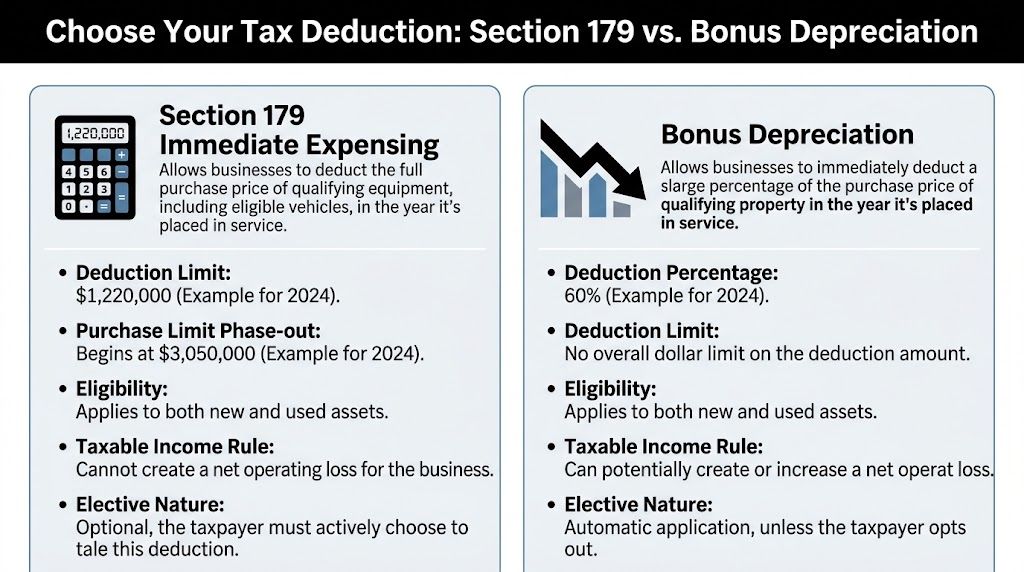
Section 179 is the elected first-year write-off
Section 179 is like choosing to expense a business asset now instead of spreading the deduction over several years. If you’ve ever bought equipment and wanted the tax benefit in the same year it started helping the business, that’s the basic idea.
For heavy SUVs and crossovers in the 6,001 to 14,000 pound GVWR range, the 2026 Section 179 cap is $31,300. The same source also notes that the benefit expanded under more recent law changes, and that bonus depreciation is phasing down to 80% in 2026, as described in Crest Capital’s 2026 list of qualifying vehicles and rule summary.
Section 179 is useful because it gives you control. You elect it. It’s a planning tool, not just a default rule.
Bonus depreciation works differently
Bonus depreciation is the second lever. In plain language, it can apply to the remaining eligible basis after Section 179, depending on the facts and the type of vehicle.
For 2026, the verified figure you can rely on is the 80% bonus depreciation rate from the same Crest Capital summary linked above.
That makes bonus depreciation especially important when the purchase price is well above the Section 179 amount allowed for a heavy SUV.
Side-by-side comparison
| Feature | Section 179 | Bonus depreciation |
|---|---|---|
| How it starts | You elect it | It generally applies unless handled otherwise |
| Why owners like it | More direct planning control | Can accelerate deduction on remaining basis |
| Heavy SUV issue | Subject to the specific SUV cap discussed above | Often used alongside Section 179 for the remainder |
| Best use case | When you want a targeted first-year deduction | When you want additional acceleration beyond Section 179 |
How the two tools work together
Here’s the easy way to think about it.
First, Section 179 is the first scoop. It lets you take a defined amount up front, subject to the rules. Then bonus depreciation may apply to part of what’s left.
That’s why the purchase price alone doesn’t tell you the tax result. The actual first-year deduction depends on:
- The vehicle category
- Its GVWR
- Its business-use percentage
- Whether it was placed in service during the year
- How Section 179 and bonus depreciation interact on the remaining basis
If you want a plain-English walk-through of the second tool by itself, this bonus depreciation guide from Allied Tax Advisors is a useful companion.
Don’t treat Section 179 and bonus depreciation like competing choices in every case. For many vehicle purchases, they work more like stacked layers.
A quick judgment call business owners often need
Owners sometimes ask whether they should focus on the tax deduction first or the business need first. My answer is simple. Buy the vehicle that fits the work. Then optimize the tax treatment around that choice.
A tax write-off doesn’t fix a bad purchase. But when the vehicle already makes sense operationally, the right depreciation strategy can materially improve the after-tax cost.
A Practical Guide to Qualifying Vehicles and Business Use
The market gives you plenty of options. There are over 50 popular SUV, truck, and van models above the threshold, including the Chevrolet Tahoe at 6,800 to 7,500 lbs, Ford Explorer at 6,060 to 6,150 lbs, and Jeep Grand Cherokee L at 6,050 to 6,700 lbs, according to Crest Capital’s qualifying vehicle list. The same planning context notes that bonus depreciation is phasing down to 80% in 2026, which makes timing part of the decision.
The bigger issue, though, usually isn’t finding a qualifying model. It’s proving the use.
Categories owners usually shop first
Instead of memorizing a giant list, think in categories:
- Three-row SUVs: Often attractive for owners who need space but still want something comfortable for client-facing work.
- Full-size pickups: Useful when the vehicle has a real hauling role in the business.
- Cargo vans: Often cleaner from a substantiation standpoint because their business purpose is easier to show.
If you operate trucks in more specialized settings, insurance and use requirements can become part of the planning. For owners trying to understand that side of the equation, this guide to commercial truck insurance in Florida gives practical context on coverage issues that often come up alongside business-vehicle decisions.
The rule that matters most
The vehicle must be used more than 50% for business. That’s the line that opens the door to the accelerated treatment discussed throughout this article.
Business use doesn’t mean “I own a business, so the vehicle counts.” It means you can support that the actual miles or actual use were primarily business-related.
Examples of business use may include travel between properties, supplier visits, client meetings, equipment transport, and trips between work locations. Commuting from home to a regular office is generally where people get sloppy in their thinking, so that area needs careful treatment.
A simple way to track mixed use
For a mixed-use vehicle, use a mileage log that records:
- Date
- Starting point and destination
- Business purpose
- Miles driven
Apps can help because they create records in real time. A notebook can work too, but only if you consistently keep it up to date.
Your memory is not a mileage log. If you wait until tax season to reconstruct trips, the record usually looks weak.
2026 tax treatment by vehicle type examples
| Vehicle Category | Typical GVWR | 2026 Section 179 Limit | Bonus Depreciation Eligible? |
|---|---|---|---|
| SUVs and crossovers over the threshold | 6,001 to 14,000 lbs | $31,300 | Yes |
| Trucks over the threshold | Over 6,000 lbs | Varies by classification | Yes |
| Vans over the threshold | Over 6,000 lbs | Varies by classification | Yes |
The practical lesson is simple. Qualifying by weight gets your foot in the door. Careful business-use documentation is what keeps the deduction standing.
Common Pitfalls and How to Stay Audit-Ready
This strategy gets talked about as if all you need is a heavy SUV and a receipt. That’s the wrong way to look at it.
The IRS pays attention to these deductions. When a vehicle serves both business and personal life, the supporting records matter just as much as the purchase itself.

The audit risk is real
Recent IRS-related data shows a 22% disallowance rate for vehicle deductions over 6,000 lbs, primarily due to inadequate mileage logs. The same discussion notes that California’s FTB denies approximately 15% more of these claims than the IRS because of stricter business-purpose review, according to Bradford Tax Institute’s discussion of vehicles above 6,000 lbs and related compliance issues.
That tells you where the weak spot usually is. It’s not the door sticker. It’s the records.
The mistakes I see most often
Some problems start before the return is filed:
- No contemporaneous mileage log: The owner assumes calendar entries or memory will be enough.
- Overstated business use: Personal errands get lumped into business miles.
- Poor business-purpose descriptions: “Meeting” or “work trip” doesn’t say much if the return is examined.
- Ignoring state differences: Federal treatment and state treatment don’t always line up neatly.
Depreciation recapture catches people off guard
This is the part many articles skip.
If business use later drops below the required threshold, or if you sell the vehicle after claiming accelerated deductions, you may face depreciation recapture. In plain English, that means some of the tax benefit you took earlier can come back into the calculation later.
Think of accelerated depreciation like borrowing time from future deductions. If later facts don’t support the original treatment, the tax code may force a correction.
The deduction isn’t just about the purchase year. You need to think about the vehicle’s whole tax life, including later use and eventual sale.
How to stay ready if the IRS asks questions
The strongest file usually includes:
- The purchase documents
- The GVWR verification
- The placed-in-service date
- A mileage log kept during the year
- Support for the business purpose of major trips
- Records showing how personal use was separated
If you run your books in QuickBooks, keep the vehicle records tied to the same timeline as your business activity. That way the story holds together. For owners who want help with compliance workflows, recordkeeping, and resolution support, Allied Tax Advisors handles tax planning, bookkeeping, payroll through IRIS software, and IRS or state notice response.
The goal isn’t to be perfect. The goal is to be explainable.
Putting It All Together A Step-by-Step Calculation
Let’s make this concrete with a simple fact pattern.
A San Diego real estate investor buys a qualifying heavy SUV in 2026 for business driving between properties, contractor meetings, and supply runs. The purchase price is $70,000. The owner confirms the GVWR on the door jamb, starts using the vehicle in the business during the year, and keeps a detailed mileage log showing 80% business use.
Step one, find the business basis
You don’t start with the full purchase price if the vehicle is mixed use. You start with the business portion.
- Vehicle cost: $70,000
- Business use: 80%
- Business basis: $56,000
That $56,000 is the amount you analyze for depreciation purposes.
Step two, apply the heavy SUV Section 179 cap
For a heavy SUV in the applicable category, the 2026 Section 179 cap is $31,300. Since the business basis is higher than that cap, the owner can potentially take up to that amount under Section 179, assuming the other tax requirements are met.
- Business basis: $56,000
- Section 179 deduction: $31,300
- Remaining basis after Section 179: $24,700
Step three, apply 2026 bonus depreciation to the remainder
The verified planning figure for 2026 bonus depreciation is 80%.
So the owner applies bonus depreciation to the remaining $24,700 business basis after Section 179:
- Remaining basis: $24,700
- 80% bonus depreciation: $19,760
- First-year total deduction: $51,060
That’s why this strategy gets attention. In the right fact pattern, a business owner can move from a normal-looking vehicle purchase to a first-year deduction of over $50,000.
Step four, track what remains
After those first-year deductions, there may still be a remaining amount to recover under regular depreciation rules in later years. That’s one reason the file needs to be clean from day one.
A good calculation worksheet should show:
| Item | Amount |
|---|---|
| Purchase price | $70,000 |
| Business-use percentage | 80% |
| Business basis | $56,000 |
| Section 179 used | $31,300 |
| Bonus depreciation used | $19,760 |
| Total first-year deduction | $51,060 |
If you want help laying out the math for your own purchase, this vehicle depreciation calculation guide helps show how the moving pieces fit together.
The lesson from this example is straightforward. The number that matters isn’t just the sticker price. It’s the qualified business basis, matched to the correct deduction rules and backed by records you can defend.
Driving Your Business Forward with Smart Tax Planning
The tax rules for vehicles over 6000 pounds can be valuable, but they reward discipline more than impulse. The strongest results usually come from owners who handle the purchase like a business decision first and a tax decision second.
A short checklist to keep in mind
- Confirm the GVWR: Check the driver-side door jamb label before you assume anything.
- Use the vehicle primarily for business: Mixed use is allowed, but you need support for the business percentage.
- Keep records as you go: Mileage logs, purchase records, and business-purpose notes matter.
- Think beyond year one: Future use and eventual sale can affect the tax result.
If the vehicle is a truck that sees heavy use, the tax plan and the maintenance plan should work together. A practical resource like this preventive maintenance checklist for trucks can help owners protect the asset they’re also trying to depreciate correctly.
This strategy isn’t about gaming the system. It’s about using a lawful rule the way it was intended. When the vehicle qualifies, the business use is real, and the records are solid, the deduction can support growth instead of creating audit anxiety.
Frequently Asked Questions About Vehicle Deductions
Do used vehicles qualify
Yes, they can. What matters is whether the vehicle qualifies under the applicable rules and is new to your business use. You still need to verify the GVWR, document business use, and keep the same level of records you would keep for a new purchase.
What happens if my business use drops later
That’s where depreciation recapture can come into play. If the facts no longer support the accelerated deduction you claimed earlier, part of that earlier benefit may need to be brought back into income or otherwise adjusted. This is one of the biggest reasons to track use every year, not just in the purchase year.
Are electric vehicles ever included
Some heavy EVs can fall into the same general conversation if their GVWR is above the threshold. The key is still the same. Verify the actual vehicle’s rating and then evaluate the tax treatment based on its category and business use.
Can I claim the full purchase price automatically
No. The deduction depends on the vehicle type, the weight classification, your business-use percentage, and the depreciation rules that apply to the remaining basis after any Section 179 deduction. A qualifying vehicle opens the door. It doesn’t remove the need for proper calculation.
What’s the single most important record to keep
If the vehicle is mixed use, it’s the mileage log. That log is often the difference between a deduction that survives scrutiny and one that gets reduced.
If you're considering a vehicle purchase and want to know how the tax treatment would work before you sign, talk with Allied Tax Advisors. A good review can help you confirm GVWR, sort out mixed-use allocation, calculate the likely first-year deduction, and avoid the recordkeeping mistakes that cause trouble later.