
The core difference between accounting and bookkeeping really comes down to their function. Bookkeeping is the day-to-day recording of financial transactions, while accounting is the high-level process of analyzing that data to give you strategic insights.
I like to use an analogy: the bookkeeper builds the solid financial foundation, and the accountant designs the house that sits on it.
The Core Difference Between Bookkeeping and Accounting
Even though people often use the terms interchangeably, bookkeeping and accounting play two very different—yet deeply connected—roles in a business. You simply can't have one without the other; clean books are the essential raw material for any meaningful accounting work.
Bookkeeping is all about the methodical process of identifying, measuring, and recording every single financial transaction your business makes. It's a transactional, administrative role that focuses on keeping accurate and complete records. This is the absolute bedrock of your financial data's integrity.
Accounting, on the other hand, is where the strategy comes in. It takes the data that the bookkeeper has so carefully organized and uses it to interpret, classify, analyze, and report on the company's financial health. It’s a forward-looking discipline that helps guide big-picture business decisions.
A Hierarchical Relationship
To really get the distinction, it helps to see where each function fits into the bigger picture, often called the cycle of accounting. Bookkeeping is the very first, foundational step in this cycle. Accounting, however, covers the entire process, including those critical final stages of analysis and reporting.
Bookkeeping is the "how"—how transactions are recorded and organized. Accounting is the "why"—why the business is performing a certain way and what it means for the future.
This hierarchy is crucial. An accountant can’t produce meaningful financial statements or offer strategic tax advice without the accurate, up-to-date data a bookkeeper provides. If you want to dive deeper into organizing your finances, you can explore the fundamentals in our article on https://alliedtax.com/bookkeeping-basics-for-small-business/.
Side-by-Side Comparison
Sometimes the easiest way to see the difference between accounting and bookkeeping is to just put their core attributes right next to each other. This really highlights the contrast between the daily, tactical work of a bookkeeper and the broader, strategic focus of an accountant.
| Aspect | Bookkeeping (Transactional) | Accounting (Analytical & Strategic) |
|---|---|---|
| Primary Goal | To accurately record all financial transactions as they occur. | To interpret financial data to inform business strategy and ensure compliance. |
| Time Focus | Present; focuses on documenting daily financial activity. | Past, present, and future; analyzes historical data to forecast future performance. |
| Key Output | Organized general ledgers, reconciled bank accounts, and payroll records. | Financial statements, tax returns, budget analysis, and performance reports. |
| Decision Level | Operational; ensures bills are paid and invoices are sent on time. | Strategic; advises on profitability, cash flow management, and investment opportunities. |
A Detailed Comparison of Core Responsibilities

Definitions are a great start, but to truly understand what is the difference between accounting and bookkeeping, you need to look at what these professionals actually do every day. One role is all about capturing the nitty-gritty details, while the other is about stepping back to see the big picture that those details create.
Let's dig into the specific duties that separate these two crucial financial functions.
The Bookkeeper's Daily Grind
A bookkeeper lives in the here and now of your business's finances. Their primary job is to meticulously track and record every single dollar that comes in or goes out. This isn't just mindless data entry; it's about building a flawless financial foundation, transaction by transaction.
Here's what a bookkeeper is typically focused on:
- Recording Transactions: Diligently logging every sale, purchase, payment, and receipt into the general ledger using software like QuickBooks.
- Managing Invoices: Creating and sending invoices to your customers and keeping a close eye on accounts receivable to make sure you get paid on time.
- Processing Bills: Handling your accounts payable by making sure vendor bills are accurate and paid on schedule.
- Payroll Management: Calculating employee pay, processing the payroll run, and managing withholdings, often with specialized systems like IRIS.
- Bank Reconciliation: Matching the company's books against bank statements each month to catch any errors or discrepancies right away.
The end product of all this work is a clean, organized, and perfectly balanced set of books. This pristine data is the essential raw material that gets handed off for deeper analysis.
The Accountant's Strategic Role
This is where the accountant steps in. They take the perfectly organized data from the bookkeeper and start asking, "What does this all mean?" Their work is interpretive, analytical, and forward-looking. They’re the ones who tell the story behind the numbers.
The relationship is simple: bookkeeping records the financial data, and accounting interprets it to make smart business decisions. In fact, nearly 100% of accounting analysis depends on accurate bookkeeping data. If the initial records are messy, any strategic advice built on them will be flawed.
An accountant's job is to turn raw data into business intelligence. They are your financial strategist.
Core accounting duties usually include:
- Preparing Financial Statements: Generating the big three reports—the income statement, balance sheet, and cash flow statement—that summarize your company's financial health.
- Analyzing Performance: Diving deep into the numbers, tracking key performance indicators (KPIs), and identifying trends, strengths, and weaknesses.
- Tax Preparation and Planning: Managing complex business tax returns and, more importantly, developing year-round strategies to legally minimize your tax burden.
- Auditing and Compliance: Ensuring all financial practices meet legal standards and conducting audits to protect the company from errors and fraud.
- Providing Strategic Advice: Acting as a trusted advisor to leadership on major decisions like budgeting, forecasting, and evaluating investment opportunities.
A bookkeeper ensures you know what you spent last month. An accountant tells you why you overspent and how to adjust your budget to hit future profit targets.
A Real-World Month-End Close Example
Think about how a typical month-end close works. For the last week of the month, the bookkeeper is heads-down, making sure every transaction is posted, every bank account is reconciled, and all payroll is finalized. Once everything is perfect, they deliver a "closed" set of books.
Then, the accountant takes the baton. They use that clean data to generate the financial statements for the month. They’ll compare actual results to the budget, spot an unexpected spike in material costs, and draft a report for the owner explaining the trend. That report gives the owner the insight needed to make smart, timely decisions for the month ahead.
This handoff shows just how symbiotic the two roles are. For business owners looking to get a handle on these processes themselves, our guide to basic accounting for small business is an excellent place to start.
Skills, Education, and Professional Value
The day-to-day work of a bookkeeper and an accountant is quite different, and those differences are a direct result of their training, core skills, and professional qualifications. Both are absolutely essential to a healthy business, but their career paths and the value they bring are distinct. Figuring out which one you need starts with understanding what goes into creating each type of professional.
A bookkeeper's training is all about mastery of the fundamentals. Many start with an associate's degree or a specialized certification program where the focus is on precision, organization, and knowing their software inside and out. They are masters of the financial recording process, developing a sharp eye for detail to ensure every transaction lands in the right category.
Accountants, on the other hand, typically begin with a bachelor's degree in accounting. This isn't just about learning more rules; it's about building the theoretical foundation needed to analyze and interpret the data that bookkeepers compile. They’re trained to see the story behind the numbers.
A Look at Core Competencies
While a good accountant has all the organizational skills of a bookkeeper, their real value comes from a more strategic and analytical skillset. Think of it as a branching path.
Bookkeeper Skills:
- Precision and Accuracy: They live and breathe details. Their work is about preventing errors at the source.
- Organizational Prowess: They can manage and maintain complex ledgers and financial records with discipline.
- Software Proficiency: They are power users of platforms like QuickBooks, navigating them efficiently for daily transaction management.
Accountant Skills:
- Analytical Thinking: They have the ability to slice and dice financial data to find trends, red flags, and opportunities.
- Strategic Problem-Solving: They use financial information to help you tackle business challenges and make smarter decisions about the future.
- Advanced Communication: A great accountant can take a dense financial report and translate it into clear, actionable advice for company leaders.
It boils down to this: a bookkeeper makes sure your financial data is right, while an accountant tells you what that data means for your business.
Professional Credentials and Their Impact
The clearest line between these two professions is the Certified Public Accountant (CPA) license. While a bookkeeper might earn a Certified Bookkeeper (CB) designation, the CPA is a whole different ballgame. It's a demanding, state-licensed credential that gives an accountant a much higher level of authority. If you're looking for this level of expertise, you can learn how to find a good CPA in our guide.
The CPA license is more than just a few letters after a name. It grants the legal authority to handle high-stakes tasks, like representing a client before the IRS or issuing an official audit opinion—responsibilities that are well outside a bookkeeper's scope.
This gap in training and authority is directly reflected in what they earn. According to the U.S. Bureau of Labor Statistics, the median annual wage for bookkeepers is $47,440. In comparison, accountants earn a median of $79,880. That 68.5% difference isn't arbitrary; it shows how much the market values an accountant's ability to interpret data and provide strategic guidance. This data, further analyzed by the University of Cincinnati, highlights the investment it takes to move from recording transactions to providing true financial leadership.
Essential Tools for Financial Management
It’s a common misconception that bookkeepers and accountants use different tools. In reality, they often work within the very same software, but what they do inside that software couldn't be more different. Grasping this is key to understanding the real-world difference between the two roles—it’s less about the toolbox and more about how the tools are used.
A bookkeeper’s world is built on bookkeeping software. This is where the daily financial grind happens. Their main job is to get transactional data recorded cleanly and correctly.
An accountant, on the other hand, sees that data as a starting point. They pull it out of the system and plug it into more powerful software to analyze, forecast, and build strategy.
The Bookkeeper's Digital Ledger
For a bookkeeper, software is all about meticulous recording and organization. They live inside platforms designed to manage a high volume of day-to-day financial traffic.
- Transactional Software: A platform like QuickBooks is the bookkeeper’s home base. They’re in it daily, logging invoices, matching payments to bills, categorizing expenses, and making sure the general ledger is a perfect, organized record of reality.
- Payroll Systems: To manage payroll, they turn to specialized systems like IRIS. These platforms handle the complex math of wages, tax withholdings, and pension contributions, ensuring everyone gets paid correctly and on time, every single time.
The bookkeeper’s entire focus is on feeding these systems with flawless data. Their skill with these tools is what guarantees the business's foundational financial records are solid.
A bookkeeper uses software to build a reliable history of every penny that moves through the business. Their goal is accuracy and organization, creating a clean dataset that an accountant can actually trust and use.
The Accountant's Analytical Toolkit
An accountant might log into the same QuickBooks account, but they treat that data as raw material for a much deeper investigation. They extract information from the bookkeeping system and feed it into a more advanced set of tools built for interpretation and strategic planning.
An accountant's software is designed for analysis, not just data entry. They use a wider array of programs to turn past performance into future intelligence.
An Accountant's Software Stack:
- Advanced Analytics Platforms: These tools go far beyond basic reports. They allow an accountant to run variance analysis, track KPIs against industry benchmarks, and build detailed financial models that can forecast different future scenarios. This is how you find out if your profit margins are shrinking or if a new product line is truly viable.
- Tax Preparation Software: Preparing complex corporate tax returns requires professional-grade tax software. These platforms are constantly updated with the latest tax codes, ensuring the business stays compliant while maximizing every legal deduction and credit available.
- Financial Modeling Tools: Using advanced spreadsheet functions or dedicated modeling software, accountants build projections for cash flow, profitability, and growth. These models are what help a business owner confidently decide whether to make a major investment, hire new staff, or expand into a new market.
So while a bookkeeper and an accountant might both have a QuickBooks login, their missions are worlds apart. The bookkeeper uses it to build a perfect historical record. The accountant extracts that record to interpret the past, assess the present, and help you strategically shape the future. This is the functional heart of the difference between accounting and bookkeeping.
Deciding Who to Hire for Your Business
Understanding the distinction between bookkeeping and accounting is a great start, but the real question is: who does your business actually need on its team? The answer isn't always straightforward and depends entirely on your company's size, complexity, and where you're headed.
Hiring the wrong professional—or worse, asking a bookkeeper to do an accountant's job (or vice versa)—can leave you with costly financial blind spots. This isn't about which role is more important; it's about getting the right expertise at the right time. A brand-new startup has very different financial needs than a mature company facing an audit.
Let’s walk through a few common scenarios to see which financial pro makes the most sense for you.
Scenarios for Hiring a Bookkeeper
You should bring a bookkeeper on board when your main challenge is getting organized. If you're drowning in receipts and can't seem to keep up with who's paid you and which bills are due, a bookkeeper is your first line of defense. They create order out of financial chaos.
Consider hiring a bookkeeper if you're:
- A new sole proprietor or freelancer. At this stage, your priority is simply to get a clean, accurate record of all your income and expenses. A bookkeeper makes sure every transaction is properly categorized, which turns tax time from a nightmare into a simple administrative task.
- Constantly behind on daily financial tasks. Are you late sending invoices, missing bill payments, or staring at bank statements that don't match your records? A bookkeeper takes these time-consuming but vital duties off your plate, freeing you up to focus on growing your business.
- Applying for a business loan. Lenders won't even talk to you without clean financial records. A bookkeeper will get your books in order, presenting a clear and professional history of your business's performance.
This flowchart is a great visual for thinking about financial tools, and it mirrors the decision between a bookkeeper (daily recording) and an accountant (strategic analysis).
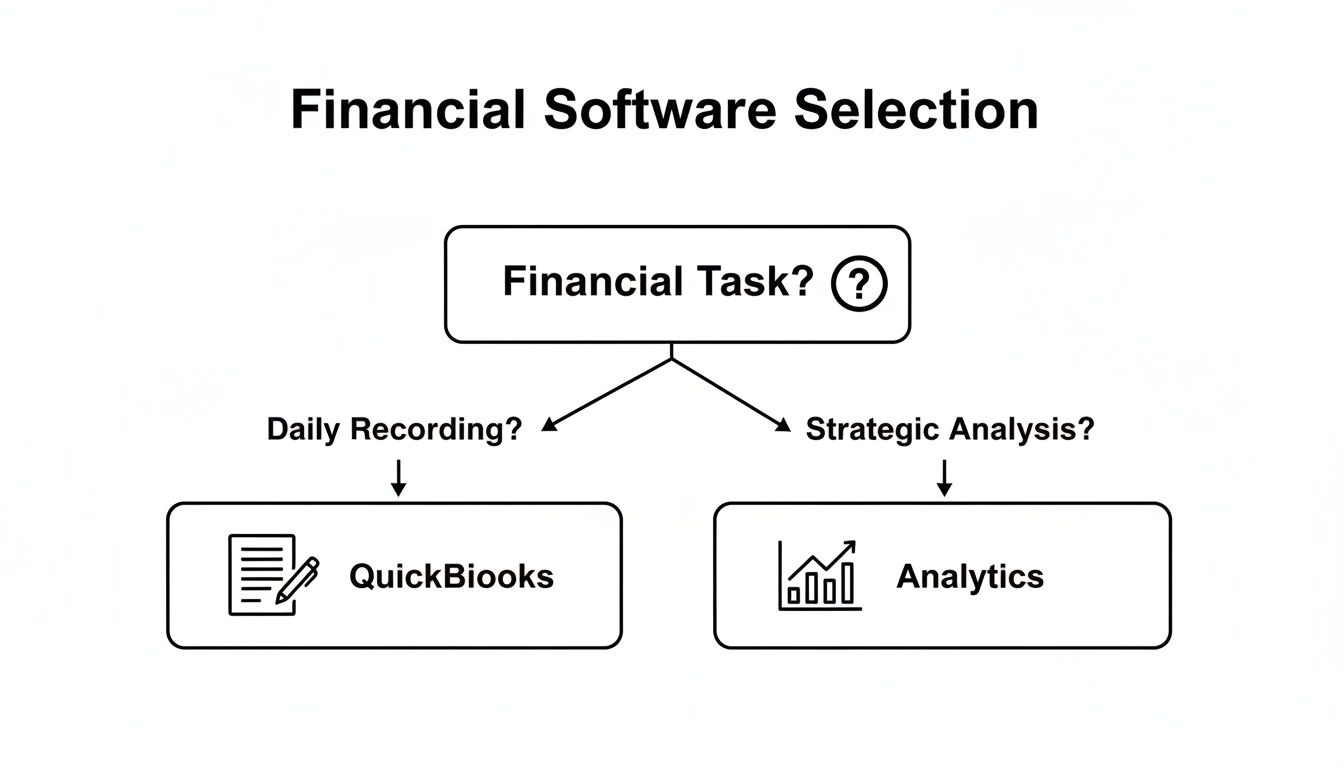
As you can see, tools like QuickBooks are built for the daily, transactional work a bookkeeper handles, while analytics platforms are for the high-level review an accountant performs.
Scenarios for Hiring an Accountant
An accountant becomes non-negotiable once you need to start making sense of your financial data for strategic purposes. They take the clean records from your bookkeeper and translate them into actionable business intelligence. If you're asking "what should we do next?" instead of "what did we spend last month?", it’s time to call an accountant.
Hire an accountant when you find yourself:
- Making major business decisions. Thinking about buying a new facility, expanding into another state, or hiring your first W-2 employees? An accountant can build financial forecasts to model the bottom-line impact of these big moves before you commit.
- Needing proactive tax planning. A good accountant doesn't just file your taxes; they work with you all year to find legal ways to lower your tax burden. This is one of the most direct ways to improve your company’s cash flow and long-term profitability.
- Preparing for an audit or raising capital. Whether you're facing the IRS or pitching to investors, you need an accountant's stamp of approval. They ensure your financial statements are accurate, compliant with accounting standards (like GAAP), and can represent you in an audit.
Your business stage is the single biggest factor here. A startup desperately needs a bookkeeper to build a solid foundation. A growing company needs an accountant to steer the ship. A mature business needs both to keep everything running smoothly while planning for the future.
When You Need Both a Bookkeeper and an Accountant
For most established and growing businesses, the answer isn't choosing one over the other—it's hiring both. Once you have employees, inventory, and substantial revenue, you need both daily financial management and high-level strategic oversight.
In this ideal setup, the bookkeeper handles the day-to-day—processing payroll, reconciling accounts, and managing payables and receivables.
The accountant then takes that perfect, up-to-date data to provide quarterly tax planning, analyze your performance against key metrics (KPIs), and advise on everything from cash flow management to your overall growth strategy. This integrated partnership is the gold standard for robust financial health, perfectly balancing your tactical needs with your strategic goals.
Integrating Bookkeeping and Accounting Services

Knowing the difference between bookkeeping and accounting is a great start. But the real goal is getting them to work together so you have complete control over your finances. Far too many businesses get stuck with a disconnected system where the bookkeeper and accountant barely speak to each other, leading to friction, frustrating delays, and missed opportunities.
At Allied Tax Advisors, we close that gap by providing a single, unified solution. Our approach combines meticulous bookkeeping with high-level accounting strategy, ensuring the data we record today directly fuels the strategic decisions you make tomorrow. It’s about creating one cohesive financial partnership.
Everything we do for our clients is built on a solid financial foundation, and that begins with our dedicated bookkeeping team.
Building the Foundation with Meticulous Bookkeeping
The first thing we do is get your books in perfect order—and keep them that way. We don't just log transactions; we build a system that delivers total financial clarity.
- Dedicated QuickBooks Management: Our experts manage all your daily financial records right inside QuickBooks. This means categorizing every expense, handling accounts payable and receivable, and making sure your general ledger is always accurate.
- Payroll and Reconciliation: We can run your entire payroll process, often using trusted software like IRIS, so your team is paid correctly and on time. We also perform routine bank and credit card reconciliations to make sure your books are a perfect match with your bank statements.
Getting this first step right is non-negotiable. When the bookkeeping is flawless, our accountants have a reliable set of data they can trust. This clean data makes the handoff from recording to analysis seamless and efficient.
From Clean Data to Strategic Tax Planning
With a foundation of pristine books, our CPAs and enrolled agents step in to translate that data into real-world value. They use the information our bookkeepers gather to provide proactive advice aimed at minimizing your tax bill and strengthening your company's financial health.
An integrated service model means your accountant isn't just reviewing old data at year-end. They are tapped into your business's real-time financial pulse, allowing them to provide timely, relevant advice when it matters most.
This forward-looking approach includes:
- Proactive Tax Strategy: We look at your financials all year long to find tax-saving opportunities—not just in the chaotic weeks before a tax deadline. This includes optimizing deductions, planning for capital purchases, and making sure your business structure (like an S Corp or LLC) is actually saving you money.
- Compliance and Advisory: Our team keeps your business compliant with all relevant state and federal tax laws, navigating tricky areas like sales tax management. We become your go-to financial advisors, helping you make smart decisions that support long-term growth.
For instance, we often work with real estate investors. Our bookkeeping team first tracks income and expenses for each individual property. Then, our accountants use that detailed data to maximize deductions like depreciation and create a plan to manage capital gains taxes when a property is eventually sold. It’s a perfect example of how a single firm handling both the detailed recording (bookkeeping) and the big-picture strategy (accounting) can directly boost your bottom line.
Frequently Asked Questions
Even after you've got a handle on the differences between accounting and bookkeeping, you're bound to have some practical questions. Let's walk through some of the most common ones we hear from business owners so you can feel confident about managing your finances.
Can My Bookkeeper File My Business Taxes?
In short, no. This is one of the most important lines to draw. A bookkeeper’s job is to keep your financial records straight, but they don't have the training or legal standing to prepare and file business tax returns.
That responsibility belongs to credentialed professionals like a Certified Public Accountant (CPA) or an Enrolled Agent (EA). They understand the nuances of tax law and are authorized to represent you before the IRS. Asking your bookkeeper to file your taxes would be like asking a nurse to perform surgery—it’s simply not what they’re trained or licensed to do, and it can create serious problems.
At What Business Stage Should I Hire an Accountant?
You should bring an accountant on board the moment your focus shifts from just tracking money to using your financial data to make big decisions. While a bookkeeper is a must-have from day one, an accountant becomes indispensable when your business starts to grow up.
It’s probably time to hire an accountant when you:
- Start seeing significant revenue, say, over $250,000 a year.
- Bring on your first W-2 employees.
- Are thinking about making major investments in equipment or property.
- Need advice on changing your business structure, like becoming an S Corp.
Is It Better to Outsource Both Services to One Firm?
For most businesses, the answer is a definite yes. When one firm manages both your bookkeeping and accounting, you get rid of a lot of friction and make everything much more efficient. Communication is smoother, your data stays consistent, and your accountant always knows what's happening on the ground.
Having a single, unified team ensures that the daily transactional data is perfectly aligned with your long-term tax strategy, preventing costly miscommunications and delays.
For businesses looking to really dial in their financial operations, a great option is to use outsourced finance and accounting services to get this kind of synergy. This integrated approach means you get more timely and proactive advice.
At Allied Tax Advisors, we combine meticulous bookkeeping with expert accounting to provide a seamless financial solution. Let us build a unified strategy for your business today.